
PREMIER League, MARCH 15 2026
Casemiro (53)
Cunha (71)
Šeško (81)
Barkley (64)
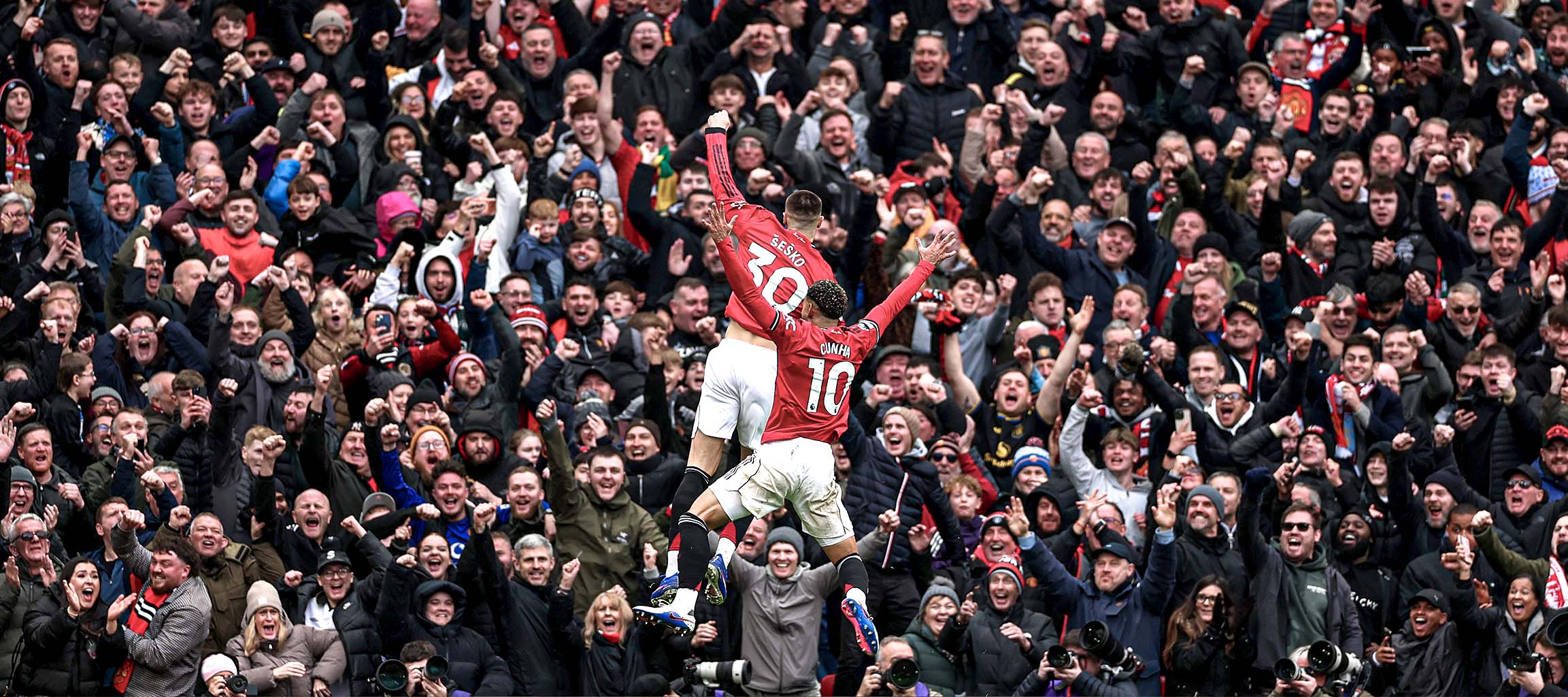
Manchester United struck a blow in the race for Champions League qualification with this win against top-four rivals Aston Villa. The game exploded into life in the second half, with Casemiro heading in a corner to open the scoring on 53 minutes. Villa hit back through Ross Barkley, only for United to continue their impressive run of results under interim head coach Michael Carrick – with summer signings Matheus Cunha and Benjamin Šeško sealing the points. The result extended Carrick’s perfect home record to six wins from six since taking charge. United are now three points ahead of fourth-placed Villa, with Liverpool in fifth now five points behind the resurgent Red Devils.
Below, our UEFA-licensed coaches have picked out the tactical highlights from the game…
How the managers saw it
“I was quite happy at half-time,” said Michael Carrick. “I thought it was just a tight game. I was not expecting it to be an edge-of-your-seat, all-guns-blazing performance. In the second half, we had the players to make the difference. There was only a little spell before they scored where we lost their shape a bit.”
“It was an equal match in the first half,” said Unai Emery. “In the second half we were less dominant against the opponent than the first half, they were dominating more… overall it’s a pity [given] how we were competing, performing and how we lost in some moments the control of the game we had. Through it, they [United] showed their capacity in transition to get the advantage they did.”
 3123515237181081619232645122462771011
15/6
SHOTS / ON TARGET
7/2
52%
POSSESSION
48%
32
ATTACKS INTO AREA
26
1.51
EXPECTED GOALS (XG)
1.13
4-4-2 defensive shapes
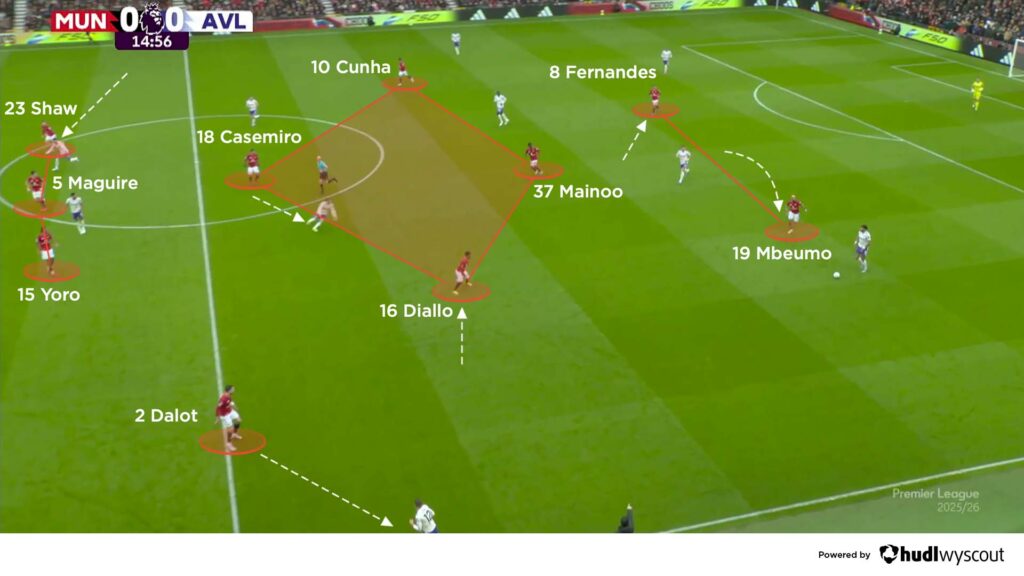
Out of possession, Manchester United initially converted into a 4-4-2, with Bruno Fernandes joining Bryan Mbeumo in the first line. Whenever this front pair locked play wide, United’s midfield adjusted to form a diamond shape, with Casemiro often prioritising the Aston Villa number 10 closest to the ball. Meanwhile, Kobbie Mainoo and an outward-pressing United forward restricted Villa’s access into their double pivots. United mostly forced and pressed the ball on to Tyrone Mings, which meant the right side of Carrick’s team was defensively very important. A narrow Amad Diallo helped to limit Villa’s ability to pass back inside, as Diogo Dalot focused on jumping out wide to the advancing Lucas Digne. United’s other full-back, Luke Shaw, narrowed significantly to support his centre-back teammates in dealing with the two Villa forwards. This gave the home side an overload (below) should Villa play long into that area.
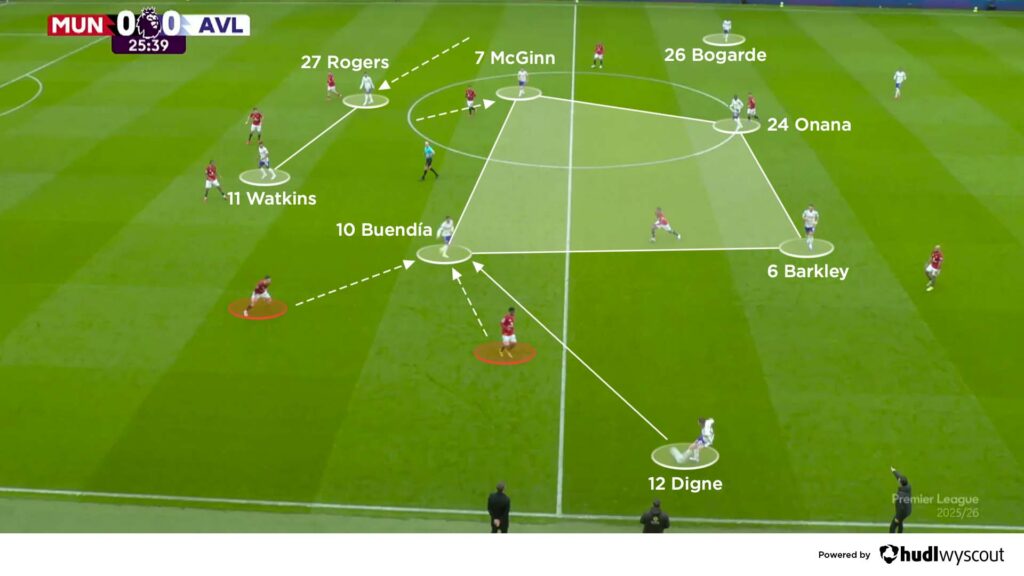
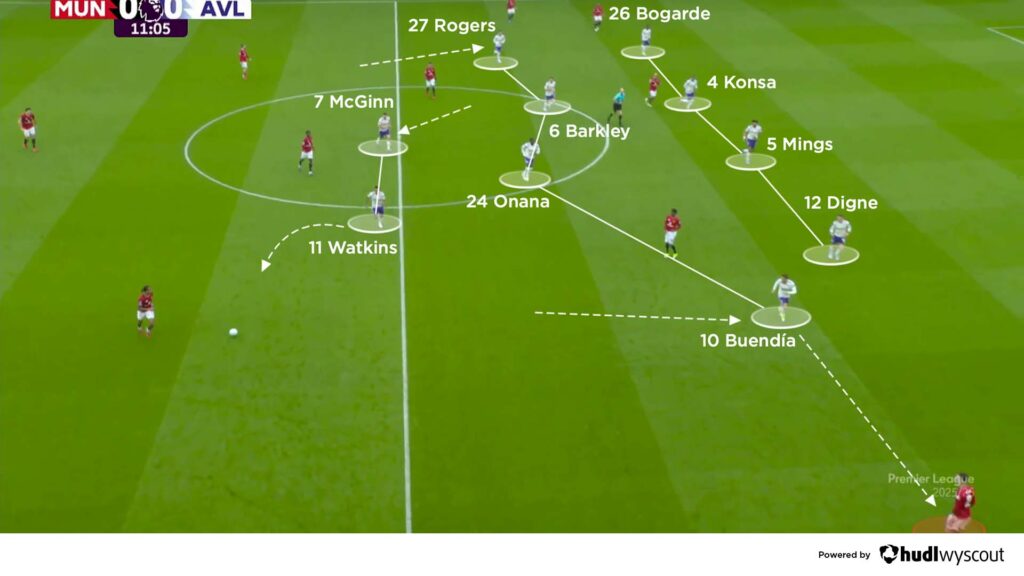
In response, Villa’s main attacking idea was to push Morgan Rogers high around Ollie Watkins and create a midfield box underneath. The double pivot of Barkley and Amadou Onana remained in place, with Emiliano Buendía and John McGinn narrowing to support just ahead. But when Villa tried to play back inside after being repeatedly forced wide, Buendía and McGinn were often pressed in numbers by United as they received (below). Villa also had minimal threat in the wide areas against United’s back line. The visitors’ full-backs were fairly reserved in their attacking, which left Watkins making ineffective channel runs. As a result, the Villa forward’s touches and presence inside United’s penalty area was limited.
Villa also converted into a 4-4-2 block when out of possession, but tended to defend slightly deeper than United. Emery’s team had McGinn defend in the first line with Watkins, while Rogers recovered to a wide-right role in the midfield unit. As with United, Villa looked to lock the ball wide via curved pressing from their front pair, but asked their midfielders to track forward runs all the way. Buendía was especially important in this regard, tracking Dalot in his high attacking positioning. This kept Villa’s back four – and Digne especially – quite narrow (below).
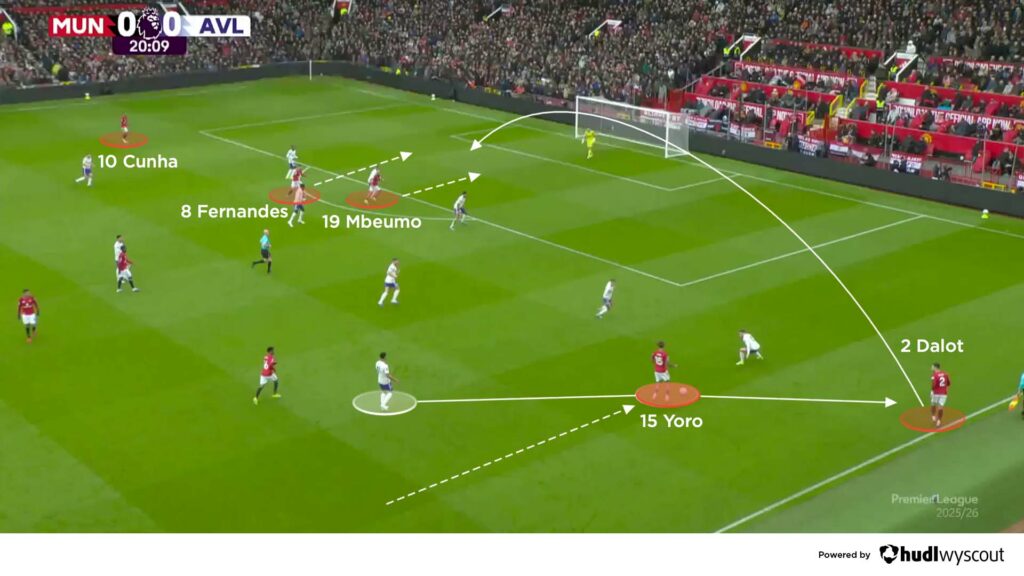
In response to Villa’s 4-4-2, United converted to a back three when they had the ball, pushing Dalot very high. This allowed the widest of the back line – Shaw and Leny Yoro – to step into midfield with the ball and carry it forward. That dragged Watkins or McGinn back, placing them in a less dangerous position for any potential Villa counter-attack. Along with Villa’s deeper defending, this also helped United progress up the pitch and find Cunha and Dalot, to provide dangerous crosses. But United’s front line and others crashing the box (below) were unable to make contact with their deliveries, in a first half of few chances.
Second-half attacking changes
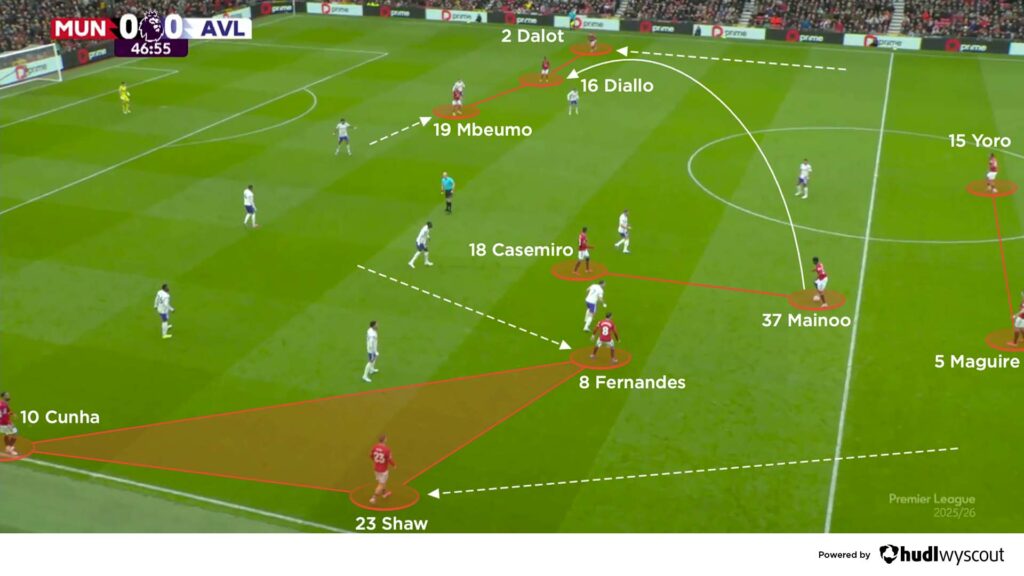
Both sides adapted their attacking play in the second half, with United pushing Shaw higher much earlier. There, he supported Cunha, while the centre-backs stayed as a pair in build-up. At times Bruno Fernandes moved wide left to provide further support, as United’s double pivot linked both sides of the pitch. The home side utilised switches of play more often in the second half, with Mbeumo moving to the right to support Diallo and Dalot, often leaving Villa’s centre-backs with no one to mark, track or cover (below). Fernandes also joined in on the right side after switches of play there, again helping to link both sides of the pitch.
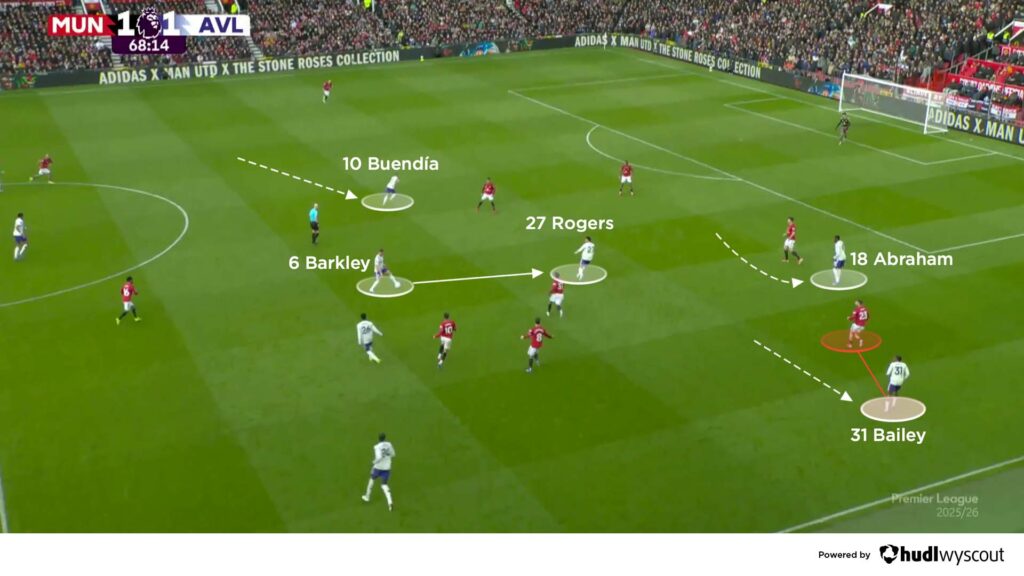
Emery responded by placing Rogers in a central attacking role between the lines. He added Tammy Abraham to the front line in place of Watkins on the hour. The substitute made bending runs around United’s central defenders, freeing space for Rogers to receive, combine and become the dominant source of Villa’s second-half attacks. Buendía narrowed, allowing Digne to overlap from left-back when needed. Emery also brought on Leon Bailey for McGinn. Bailey played wide right and pinned Shaw, giving Rogers more space to operate in (below) as Villa enjoyed their best period of the game.
But United’s quality on the transition put them 2-1 ahead. Carrick then added Šeško as a permanent centre-forward to his side’s attacking structure. Cunha and Dalot continued to create the attacking width, while Shaw got forward as United utilised wide pairings to attack around Villa’s 4-4-2 block. In midfield, United switched to placing Fernandes central for longer, operating between the lines and combining with both wide pairings. Casemiro remained fairly fixed and Mainoo offered opposite to United’s Portuguese captain; the centre-backs remained as a narrow pair, while up top Šeško occupied both of Villa’s centre-backs (below).
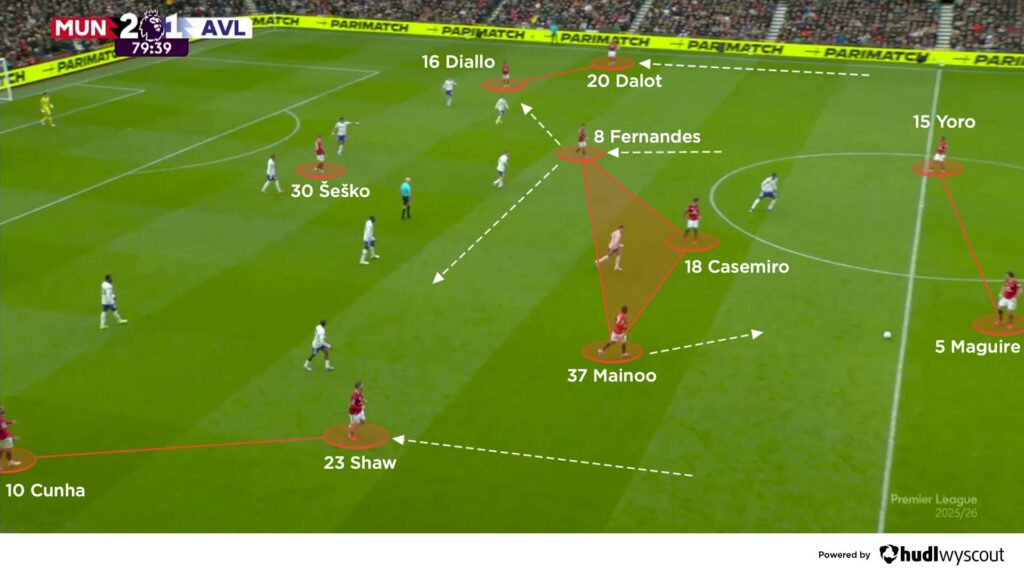
Although Villa had begun to flip the momentum thanks to Emery’s changes, after United punished them on the transition – with Fernandes outstanding in creating chances – Šeško wrapped up the points. It left Villa to reflect on having taken just 12 points from their last 12 Premier League games, leaving them looking over anxiously their shoulders at the top-four chasing pack. United, by contrast, look to have hit form under Carrick at just the right time.
To learn more about football tactics and gain insights from coaches at the top of the game, visit Coaches’ Voice Academy