What is meant by ‘counter-pressing’?
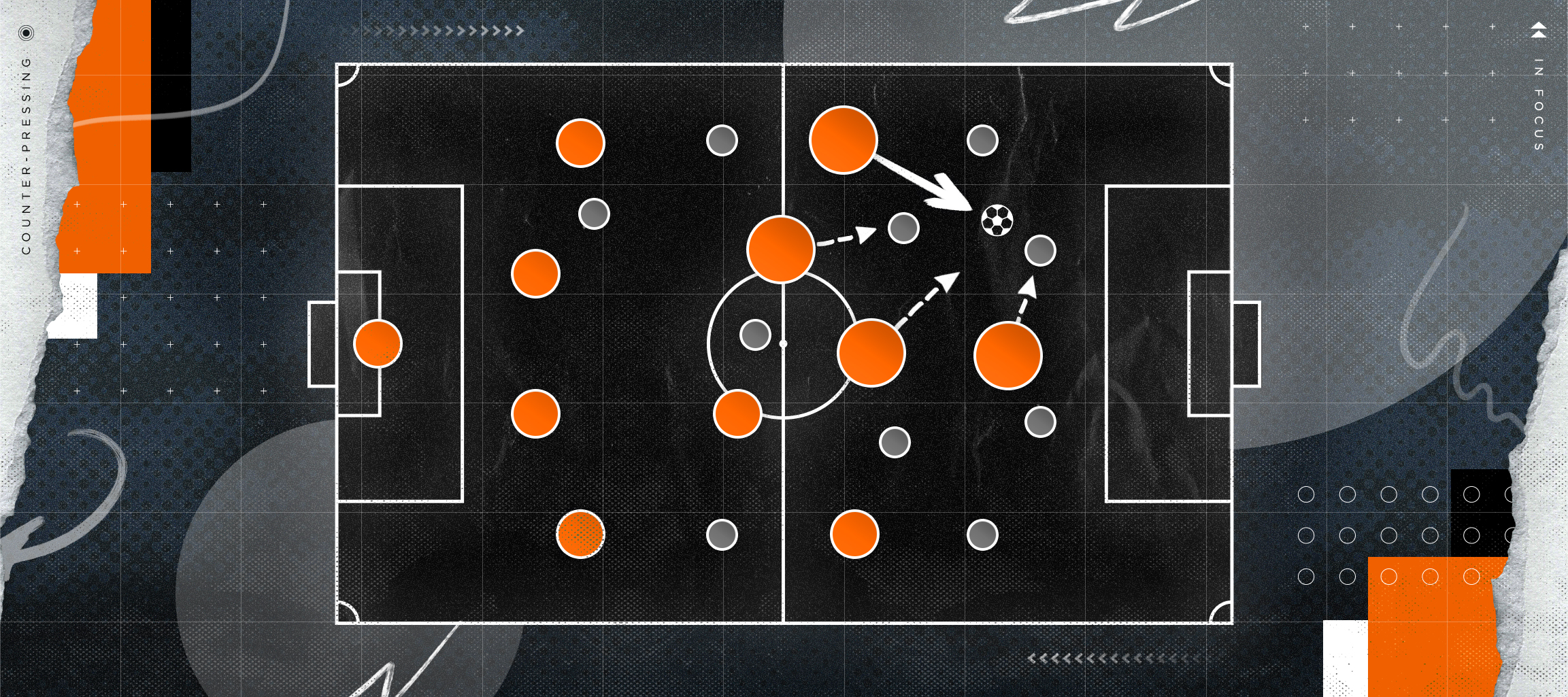
Counter-pressing is a strategy used to disrupt the opposition as soon as possession is lost – the point of defensive transition. It involves aggressively pressing the ball and the opponents near to the ball with several players. The aim is to win possession back as quickly as possible, before the opposition can settle on the ball.
What are the benefits of counter-pressing?
The main benefit of counter-pressing is that it can lead to quick regains high up the pitch. This can then lead to chances, because the team is in possession close to goal and the opposition may have started to transition to their in-possession shape, which could leave gaps in their structure. Teams that counter-press well score lots of their goals following turnovers high up the pitch.
Counter-pressing is also ideal for sides that create chances through sustained spells of possession. If they win the ball back quickly, they will spend little time out of possession and chasing the ball. This means they can control the game.
Successful counter-pressing also stops the opposition launching counter-attacks, as the aggressive pressure can delay forward progress and even force the ball backwards. Even if a counter-pressing team doesn’t regain possession, there is still a good chance they can force the ball out of play or concede a free-kick. These are both effective ways of delaying opposition progress.
Counter-pressing can also help to nullify specific opposing players who may pose a significant threat in certain areas of the pitch, by crowding them out.
Click the links below for two Coaches’ Voice sessions designed to develop a team’s ability in counter-pressing..
What are the key principles of counter-pressing?
The success to any counter-press relies first and foremost on immediacy. The press must be triggered the instant possession is lost, ideally within seconds – this is the window during which the opponent is most disorganised and least able to play out under pressure. If a counter-press is too slow, the opposition gain time and space to secure possession, reorganise into their in-possession shape and, at worst, evade the press and launch a potential counter-attack.
Compactness and proximity are also important. For a counter-press to work, players must already be positioned close together in the moment possession is lost. This is why the shape and spacing of a team in possession is also important; if players are too spread out, they cannot react quickly enough to counter-press effectively as a unit. Good counter-pressing teams tend to play in relatively tight, connected structures that allow them to swarm the ball immediately upon a loss of possession. Compactness between units as well as within units is hugely important.
Working as a collective and with purpose is also crucial to counter-pressing. Players must press intelligently, with clear roles assigned to different individuals depending on the situation. Typically, the nearest player applies direct pressure on the ball-carrier, while teammates cut off the most dangerous passing options. In this way, a good counter-press serves to trap the opposition rather than just harassing them.
In the video below, taken from his keynote session at the Coaches’ Voice Coaching Conference in September 2021, Ralf Rangnick speaks in fascinating depth about the importantance of transitions in football. Using statistics gathered from his time at RB Leipzig, Rangnick stresses the importance of an intense and rapid counter-press to the chances of creating high-quality chances and, ultimately, scoring goals.
When adopting a counter-pressing strategy, what do the players do when in possession?
In general, teams make the pitch as big as possible when in possession by placing players all over the pitch. The aim is to increase the space to play in and the distances that the opposition have to cover when defending.
However, if a team wants to counter-press, that will come into their thinking when they have the ball. The attackers must be close enough to the ball to be ready to press immediately, should possession be turned over. The balance that has to be struck here often dictates both how a team attacks and how quickly they can counter-press.
When adopting a counter-pressing strategy, what do the players do when out of possession?
The success of a team’s counter-pressing often relies on the players’ ability to react quicker than the opposition. Players will aggressively engage the ball-carrier as quickly as possible once a defensive transition has occurred. The aim is to regain possession immediately through tackles, interceptions and individual duels.
Other teammates then swarm around the ball, condensing the space the opposition has to play out, and form a compact structure. These teammates will either man-mark tightly, staying ready to press and engage their direct opponent should they receive a pass, or mark zonally, covering passing lanes between opponents to intercept the ball. A third option is that players will do a combination of these two approaches.
What attributes do players need to be able to counter-press effectively?
Counter-pressing places high physical and technical demands on players. Teams that execute it well typically have individuals who excel across several key areas.
One key physical attribute is an ability to perform consistent high-intensity sprints, as players need to immediately transition from attack to defence the moment possession is lost. This requires covering short distances at maximum speed within just a second or two, which generally needs to be repeated multiple times across a match. Because of this, players also need exceptional recovery speed, and an ability to decelerate, change direction and accelerate again rapidly. All of this places heavy demands on agility and explosiveness.
Technically, players must be highly competent at defending in tight spaces and 1v1 situations, as counter-pressing often involves pressing opponents in congested areas rather than in open play. The ability to time a tackle or an interception accurately is crucial, because mistimed challenges can leave teams exposed to dangerous counter-attacks. Positional awareness and spatial intelligence are also important; players need to instinctively understand where to press and how to cut off passing lanes rather than simply chasing the ball.
Fundamentally, though, counter-pressing is a collective action rather than an individual one. Every player on the team needs a strong understanding of their role within a counter-pressing approach, and the ability to read the game quickly, anticipate where the ball will go, and react before opponents have time to settle.
What are the risks of counter-pressing?
The main issue for teams that counter-press is the space they leave for the opposition to exploit. By committing players forward to counter-press, space is left in behind the back line. If the opposition manages to beat the press, the defence is left vulnerable to opposition counter-attacks, with overloads easier to create.
Successful counter-pressing relies heavily on organisation. If one player doesn’t fulfil their role properly, then the opposition stands a greater chance of beating the press. It also relies on individual players having the tactical intelligence to react quickly – almost instinctively – to a loss of possession. If players don’t have the game intelligence and concentration levels to press consistently, then the strategy can fail.
Due to the physical demands of counter-pressing, it also requires very fit and agile players. If one player cannot maintain the required output, then gaps will appear and the press will fail. Counter-pressing consistently over a prolonged period can lead to fatigued players, both late in games and over the course of a season.
What are alternatives to counter-pressing?
Instead of trying to regain possession immediately, players can delay the opposition by applying pressure without attempting to win the ball back, unless there is an obvious chance to do so. This blocking and screening of any forward play allows teammates to recover back into a more reserved defensive block.
Alternatively, teams can choose not to press at all, and make quick recovery runs back into a mid-block or low block.
What is a good practice to develop players’ ability to counter-press?
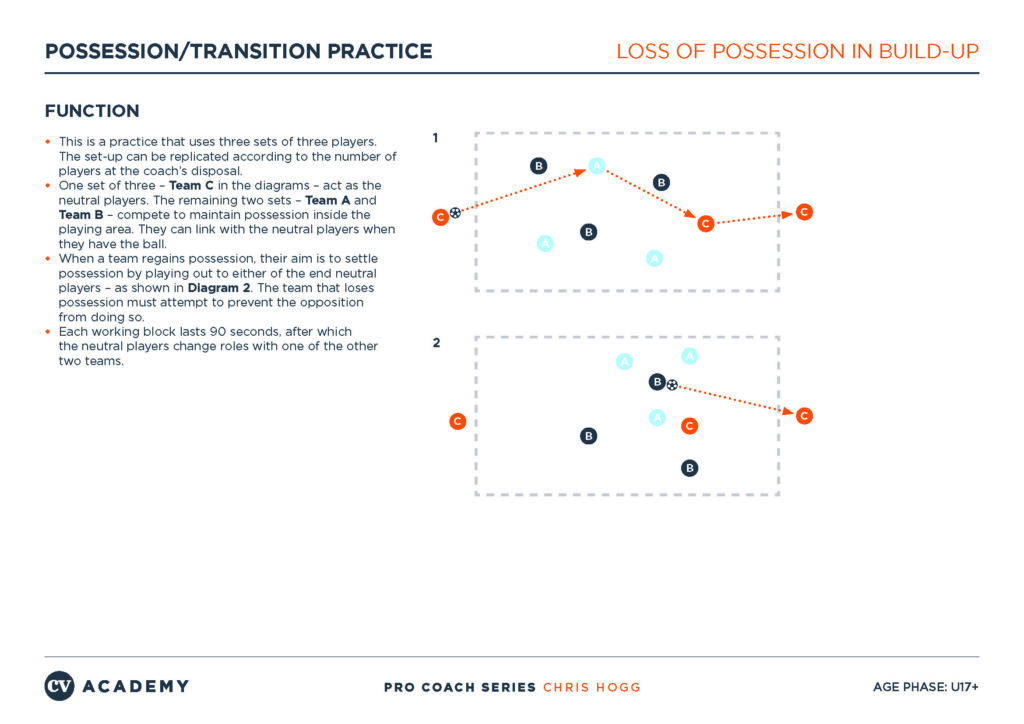
The video below features a possession/transition practice delivered by UEFA Pro Licence holder Chris Hogg when he was coach of the Newcastle United Under-23 team, as part of an exclusive coaching course for Coaches’ Voice. The practice set-up, details of which are included below the video, encourages quick and aggressive reactions to a loss of possession.
What is a good tactical practice to develop players’ ability to counter-press?
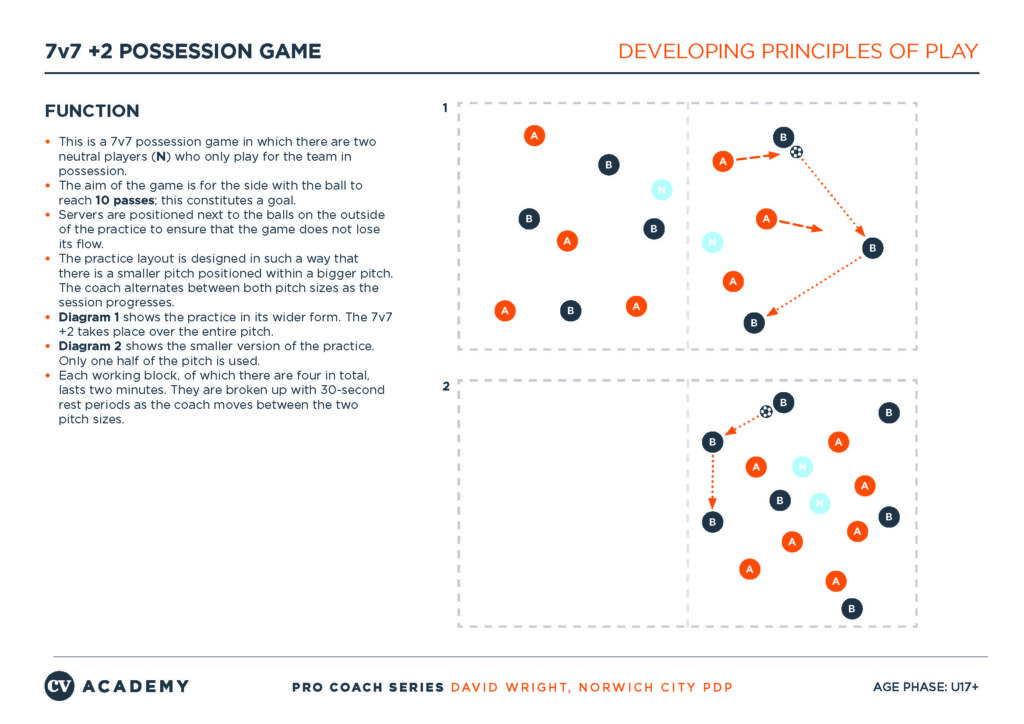
The video below features a possession game delivered by professional development phase coach Alan Neilson, as part of a wider Coaches’ Voice session led by then Norwich City Under-23 head coach David Wright. Details of the practice set-up are included below the video; with each team requiring 10 consecutive passes to earn a point, both are encouraged to counter-press with immediate intensity and intelligence upon a loss of possession.