
EUROPA League FINAL, MAY 20 2026
Tielemans (41)
Buendía (45+3)
Rogers (58)
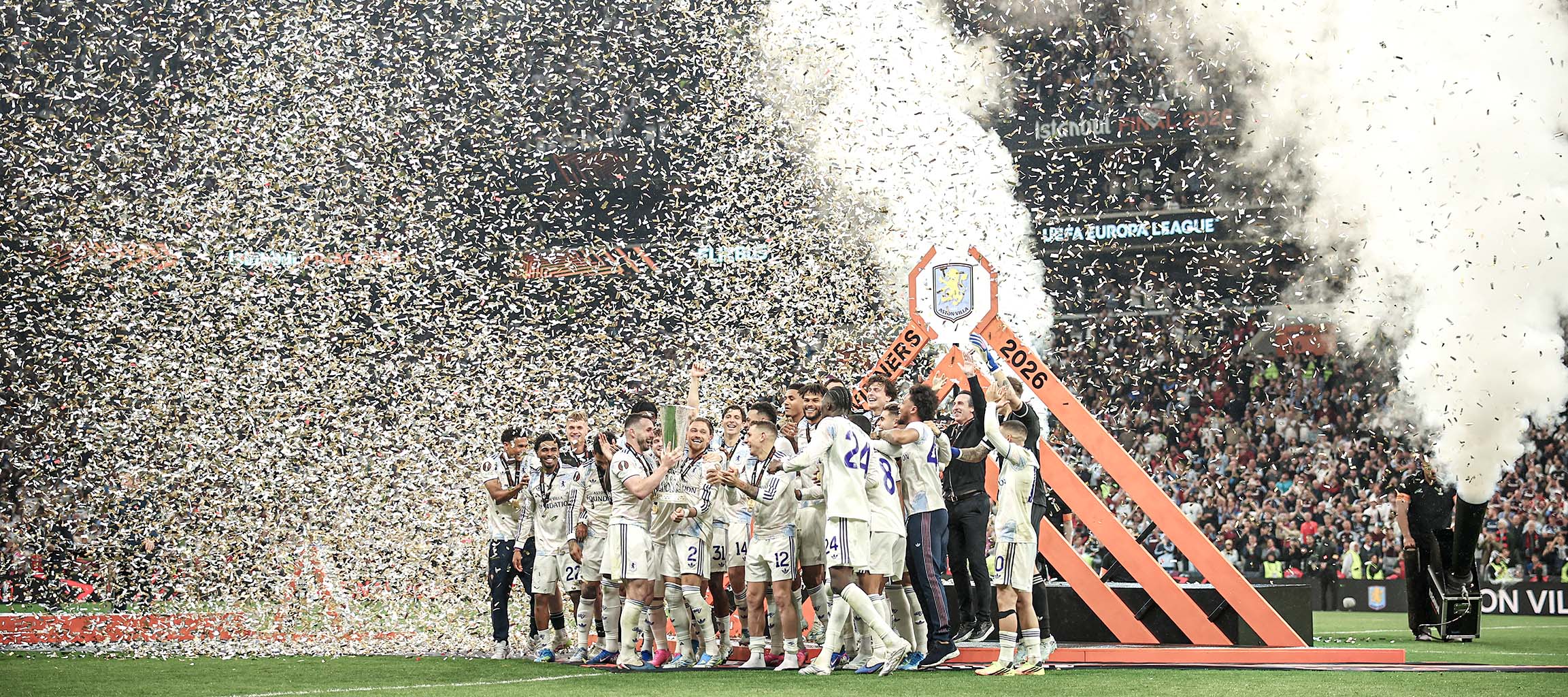
Aston Villa ended their 30-year wait for a major trophy in style with this emphatic Europa League final win against Freiburg. Stunning first-half strikes from Youri Tielemans and Emiliano Buendía put Villa in control going in to the break, before a Morgan Rogers goal just before the hour all but made it game over. It meant that for a record fifth time, Villa manager Unai Emery had led a team to victory in a Europa League final, while securing the Premier League club’s first silverware since the 1996 League Cup.
How the managers saw it
“The first 30 minutes, we were testing the match, both teams, we were trying to set how we were managing the first 30 minutes,” said Emery. “Then progressively we were feeling better, and when we were scoring through the set-pieces, we exploited taking a lot of confidence for the match.”
“For 40 minutes we did well, and then it changed,” said Freiburg head coach Julian Schuster. “For the first goal, Villa worked the set-piece well, for the second it was our error. When you are 2-0 down at the break, you see the real face of a team, and the boys did well.”
Below, our UEFA-licensed coaches have analysed the key tactical points from this Europa League final…
 231214428310277111172832982719443231
16/6
SHOTS / ON TARGET
4/2
47%
POSSESSION
53%
24
ATTACKS INTO AREA
13
1.95
EXPECTED GOALS (XG)
0.55
Villa’s narrowing midfielders
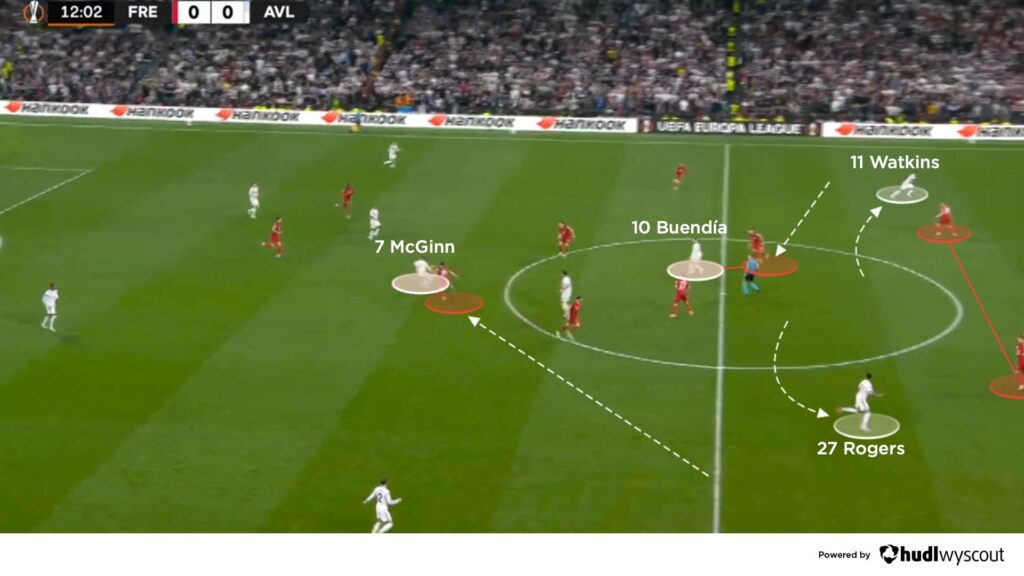
From Aston Villa’s initial 4-2-3-1 shape, wide midfielders John McGinn and Buendía narrowed to receive towards the centre of the pitch. Freiburg’s two full-backs then followed them all the way. Rogers ran away from these movements, initially working underneath, but as the first half progressed he was essentially playing alongside Ollie Watkins, as split strikers (below). From here, Villa played relatively direct forward passes into their front-line pair, who competed against two isolated Freiburg centre-backs, giving Emery’s team momentum and territory.
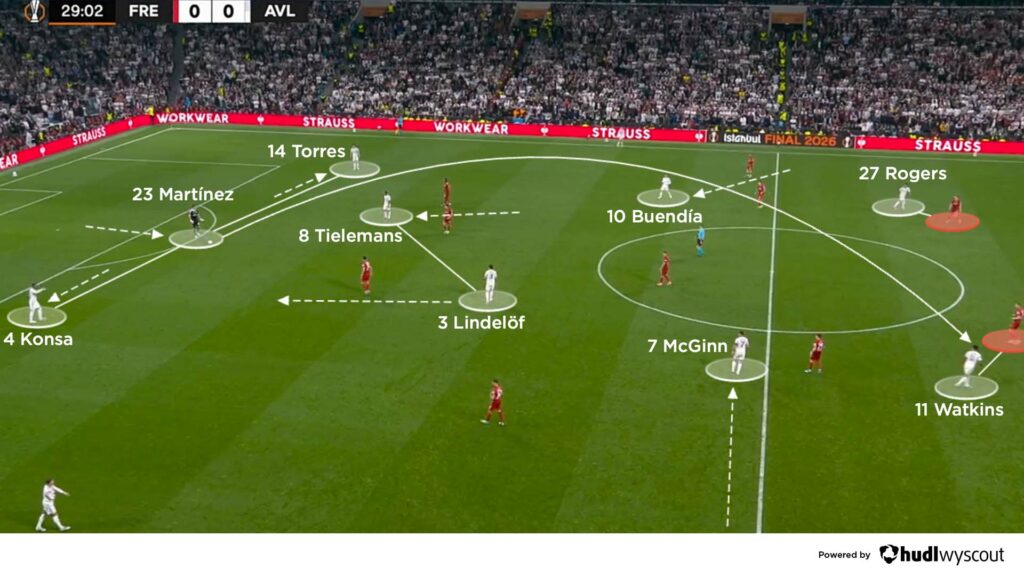
Villa continued to kick long into Watkins and Rogers, supported by the consistently narrow McGinn and Buendía. Whenever they secured the first or second contact, they managed to create dangerous attacking moments. To create more room for their forwards, Villa’s centre-backs split particularly wide, with goalkeeper Emiliano Martínez joining between (below). Villa then had different passing angles from the back line into Watkins and Rogers, plus more room for the double pivot of Tielemans and Victor Lindelöf to drop into. The pivots attracted Freiburg’s midfield, which limited how well the German side could back-press on to the eventual long ball, while also creating space for McGinn and Buendía when they narrowed.
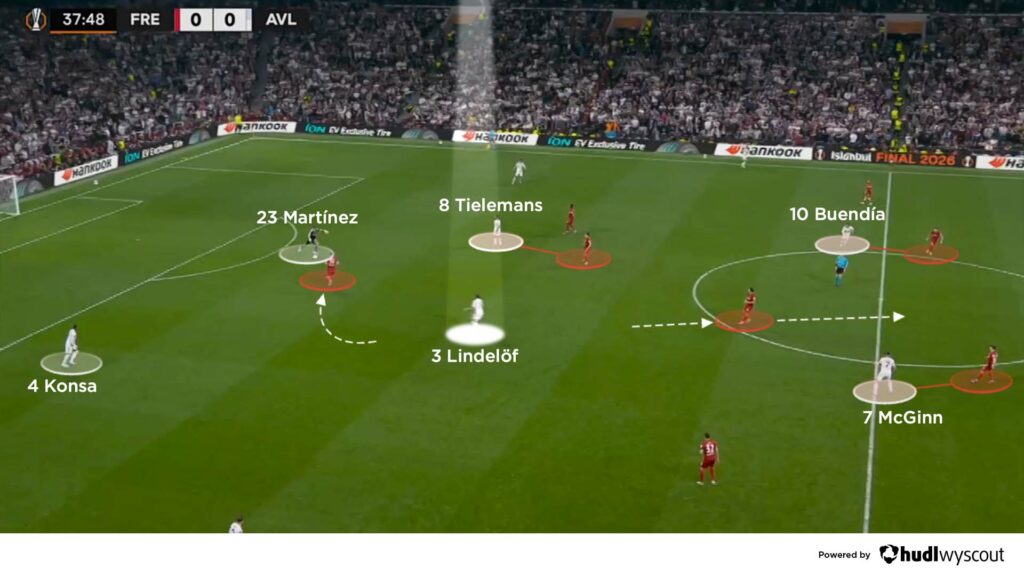
Despite having some success from the long ball, Villa didn’t make enough use of their spare man during the initial phase of their build-up in the first half, especially as Freiburg’s midfield began to drop deeper in anticipation of Martínez’s longer kicking. Forward Igor Matanovic curved his press from left to right, blocking direct access to Villa’s initial spare man, Ezri Konsa. At the same time, Tielemans was often marked very tightly on the opposite side of Villa’s double pivot, making it much less appealing for Martínez to bounce out to Konsa. Lindelöf’s opponent Nicolas Höfler began to position himself much deeper in anticipation of Martínez’s longer kicking, helping to back-press on to McGinn and Buendía, or Villa’s higher forwards. As a result, Villa had more access into a free Lindelöf (below), but Martínez elected to continue playing long.
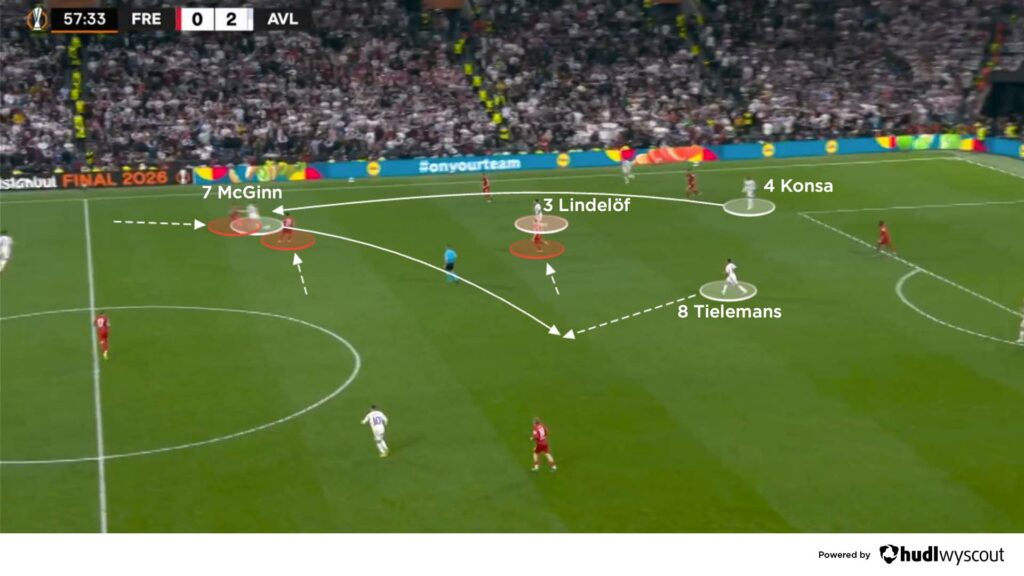
Freiburg continued with the same defensive strategy into the second half, by which time Villa were 2-0 up and making better use of their free midfielder. First, they worked the ball into Konsa more, who could step forward and use his extra time to pick the best forward pass. Freiburg’s central midfield continued to stagger to allow back-pressing on to passes into Buendía or McGinn – with the more advanced player shifting across to the Villa central midfielder closest to the ball. But whenever Villa worked the ball away from pressure and into their furthest free midfielder (Tielemans, below), they progressed forward with control before playing into their front line, as with their superb third goal.
Patient mid-block
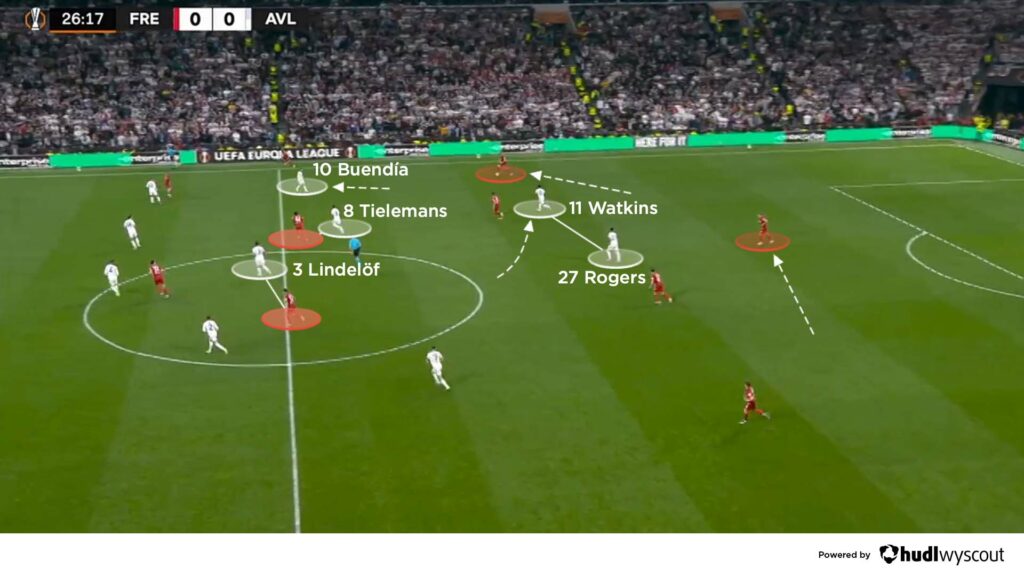
Without the ball, Emery elected for Villa to defend via his favoured 4-4-2 block. When Freiburg’s back line shifted across during their build-up – usually to their right – Villa utilised an effective defensive trap, not least Freiburg’s right side. Villa allowed Freiburg’s centre-backs to move across, then locked the play one way, forcing it along the touchline. Watkins – initially remaining with Rogers to stop almost all access through the middle, limiting play into Freiburg’s deepest central midfielder – pressed outwards. Buendía then tracked any full-back advances, while Lucas Digne remained in the back line, allowing Tielemans and Lindelöf to cover any attacking midfielders between the lines (below).
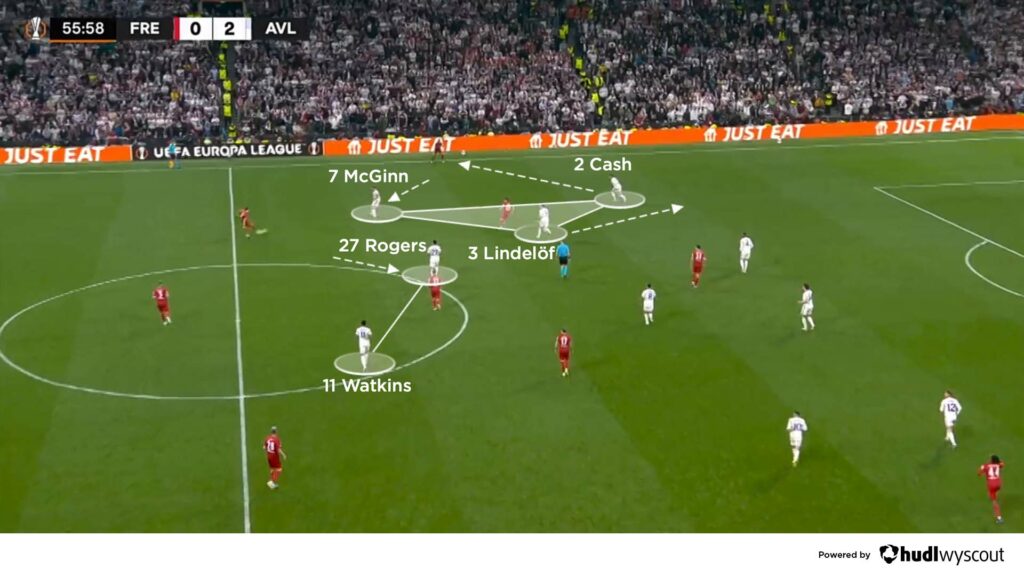
With a comfortable two-goal cushion, Villa continued to frustrate Freiburg into the second half with their mid-block – their wider unit doing well to limit the opposition’s forward play. At the top, Rogers and Watkins remained very disciplined to stay narrow, but also dropped when the ball was on their side, helping to limit attempted reversed passes back into midfield (below). This gave licence to McGinn or Buendía to jump out to apply initial pressure, while still remaining narrow to stop passes coming into Villa’s block. Matty Cash (mostly) and Digne worked on to any dropping wingers, with Villa’s central midfield perfectly placed to cover and track any inside channel runs, ensuring that Villa’s centre-backs remained connected and in place to protect the middle.
The result – coupled with Villa’s outstanding set-piece play and finishes – was as comfortable a victory as Emery could have hoped for in a European final. It also meant a first major European trophy for Villa since they beat Bayern Munich in the 1982 European Cup final. With a return to the Champions League next season already secured via their Premier League performance, attention will soon turn to another crack at the biggest prize of all. But for now, Villa can savour a return to the winner’s circle.
To learn more about football tactics and gain insights from coaches at the top of the game, visit Coaches’ Voice Academy