What is meant by ‘direct play’?
Direct play is an attacking strategy in which a team looks to advance the ball quickly and purposefully towards the opposition’s goal, prioritising speed and penetration over sustained possession or gradual build-up.
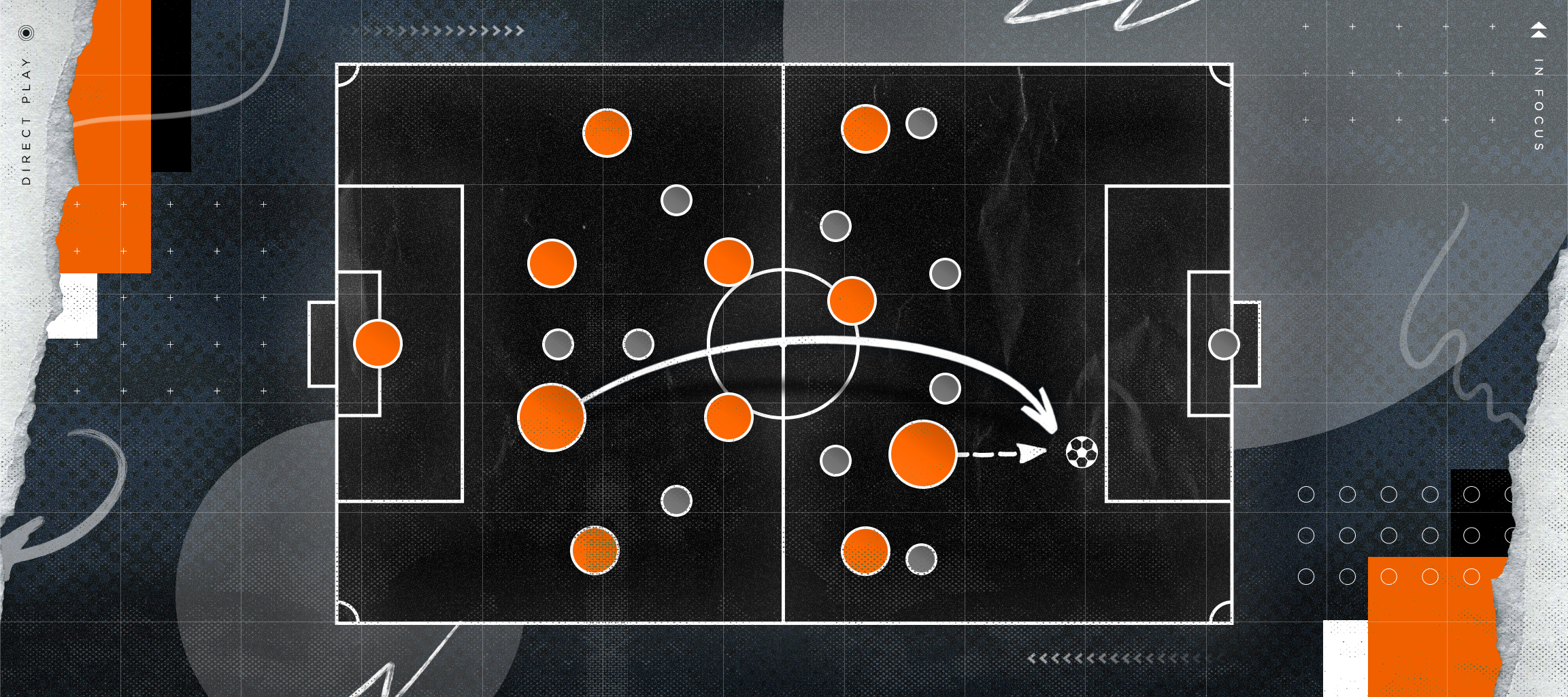
Direct play is not simply about playing long balls. It can involve a short pass to a player who immediately drives forward, a quick combination that breaks a midfield line, or a dribble at a retreating defence. What makes play direct is the speed and purpose with which a team moves towards goal – the desire to get in behind the opposition, or into dangerous areas, at the earliest opportunity.
Why is direct play an important skill to master?
Teams that play directly can be difficult to defend against because the ball reaches dangerous areas of the pitch quickly, giving the opposition less time to organise or adjust their defensive shape. The speed of transition from defence to attack can stretch and disorientate opponents before they have the opportunity to recover their positions.
Direct play is also a practical strategy in specific situations. Against an opponent that presses aggressively or defends with a high line, direct play can bypass the press altogether, using space left in behind rather than trying to play through, or around, pressure. It can be useful in away games, where a team may have less possession. It can also help to simplify a team’s approach when introducing new players to a system or game model, reducing the number of decisions required and helping players understand their roles more quickly.
Click the links below for two Coaches’ Voice sessions designed to develop a team’s direct play.
What are the key principles of direct play?
Speed of transition
The most important principle of direct play is the speed at which a team moves from defence to attack, or from a lower to a higher area of the pitch. As soon as possession is gained – or when a team in possession identifies an opportunity to play forward – the ball should be moved quickly, before the opposition can recover their defensive shape. The longer the ball is retained in non-threatening areas, the more time the opposition has to organise. Players must recognise the moment to play direct and act on it without hesitation.
Moving up as a unit
Playing directly only works if the whole team moves as a unit, keeping appropriate distances from front to back. If the ball is played in behind and a forward gets on to it, but there is 60 or 70 yards between the front and back of the team, that player will struggle alone to create anything. The team’s lines must advance together – as the ball goes forward, teammates must close the distance and provide support. Without this collective movement, direct play risks becoming a series of disconnected long balls that the opposition can mop up.
Forward runs and movement
Without forward movement, direct passes have no target. Direct play relies on teammates making well-timed runs into space to receive forward passes. Attackers and advanced midfielders must commit to runs in behind the defensive line, into the channels, or into the spaces between the lines, while recognising the right moments to do so. Counter-movements – such as a forward peeling away from a defender before attacking the space in behind – are important for creating the angles and timing that make direct passes receivable. Poorly timed runs can lead to offside positions or wasted passes.
Quality of delivery
A direct pass must be delivered with the appropriate weight and accuracy to give the receiving player the best chance of controlling and progressing the attack. Whether the ball is clipped, chipped, driven, or played with the outside of the foot, the quality of execution is what separates effective direct play from simply hitting the ball forward. Equally, when the opportunity to play in behind presents itself, it should be taken.
Controlling the second ball
Because direct play often involves passes into contested areas, the team in possession will not always win the first contact. A key principle, therefore, is being structured to win the second ball – the loose ball that drops after an aerial duel, flick-on or failed clearance. Teams that play directly but fail to control the spaces around those duels can find the game becomes end-to-end and increasingly difficult to manage. A midfield overload – outnumbering the opposition in the central area – can help a team to pick up second balls more consistently, turning the initial direct pass into a genuine platform to attack from, rather than a 50-50 gamble.
In the video below, former Burnley, Everton and Nottingham Forest head coach Sean Dyche uses the Coaches’ Voice tactics board to explain the logic of using direct play when his Burnley team ended a 68-game unbeaten home run by Jürgen Klopp’s Liverpool.
What are the different ways to play directly?
There are several methods by which a team can play directly, each suited to different situations and areas of the pitch.
Pass in behind
This is a pass played over or through the opposition’s defensive line, into the space in behind, for a forward to run on to. It is typically a longer pass, often lofted but sometimes driven along the ground, and requires precise execution and timing. It is most effective against a high defensive line, or when there is significant space between the opposition’s midfield and defensive lines for an attacker to exploit.
Ball to the target forward
Rather than finding space directly, a team can play to the feet, chest or head of a physical target forward who holds the ball up, competes in aerial duels, or flicks the ball on for a supporting runner. A diagonal ball to the target forward – often played from an outside centre-back or defensive midfielder – is a common delivery, with teammates anticipating the knockdown or flick-on and making runs accordingly. This approach can involve a runner arriving from deep, or a second forward exploiting the space created by the target forward’s movement. It is a combination seen at every level of the game and remains effective when the team is connected and supporting runs are well-timed.
Pass between the lines
This is a pass played quickly into the feet of a player positioned between the opposition lines – typically the midfield and defensive lines. Though not as long as a pass in behind, it is a direct form of progression that can create a goalscoring opportunity if the receiver has the quality to receive under pressure, turn quickly and advance. It is particularly effective when the receiver can take the ball on the half-turn, face up and drive at the defence.
Direct switch of play
Playing the ball quickly from one side of the pitch to the other to find a player in space, bypassing the opposition’s press or compact shape, is another form of direct play. This can be executed with a single long pass or a quick combination, and is a direct way to move play into a more advanced or dangerous area of the pitch.
Running with the ball
Players can also execute direct play by carrying the ball at pace into dangerous areas, rather than passing. Once a midfield line has been broken, a player receiving on the half-turn can drive directly at the defence, committing defenders and creating space for others. A dribble can be particularly effective in transition, when the opposition is disorganised and a player can isolate a defender in a 1v1 situation.
In the video below, then Luton Town head coach Rob Edwards uses the Coaches' Voice tactics board to discuss the specific patterns his team used to create and exploit space in behind Sheffield United’s defensive structure in a top-of-the-table Championship game. He explains how a chain reaction of forward passes, co-ordinated striker runs, and well-timed movement from wing-backs and midfielders, can quickly progress the ball into dangerous positions.
What passing and receiving attributes do players need with direct play?
Effective direct play requires specific qualities from both the players delivering passes and those receiving them.
Technical quality on the ball
The fundamental technical skills of passing and receiving are the foundation of direct play. Players delivering direct passes must be capable of executing a variety of passes accurately: clipped, chipped, driven or played with the outside of the foot, ideally from either foot. A direct pass delivered poorly gives the receiving player less chance of creating a goalscoring opportunity. Technical quality in these basics is what allows direct play to be executed with the precision it requires.
Passing range
Beyond general technique, the ability to execute accurate passes over a range of distances is essential. Players initiating direct play must be comfortable with both shorter, incisive ground passes, and longer aerial deliveries, reading the situation to choose the appropriate delivery for each moment.
Pace and timing of runs
Forwards and advanced midfielders who are the primary targets for direct play need the pace to get in behind defences and the timing to remain onside while exploiting space. The ability to read the ball-carrier’s intention and time the run accordingly – including any counter-movements to lose a marker before attacking the space – is critical.
Physical strength and ball retention
Players who receive direct passes under pressure, particularly target forwards, need the physical strength to protect the ball, win aerial duels, and hold up play while teammates advance to support. The ability to bring others into the game – laying off, flicking on or shielding until support arrives – is as important as the initial receiving.
Decision-making speed
Both the passer and receiver must make quick decisions. For the passer, this means identifying the opportunity and executing swiftly. For the receiver, it means reacting immediately once in possession to exploit the situation before the opposition recover. Hesitation at either end of the direct pass reduces its effectiveness.
What are the roles and responsibilities of players within a direct-play strategy?
Goalkeepers, centre-backs and defensive midfielders
Goalkeepers, centre-backs and defensive midfielders are often the initiators of direct play, as they are the players most likely to be in possession when the team looks to transition from defence to attack. Their ability to identify and execute the forward pass quickly is crucial. A goalkeeper or centre-back who can deliver long diagonal passes accurately – to a target forward or wide player, or into space in behind – can launch direct attacks from deep and give the opposition’s high line very little time to adjust. Equally, a defensive midfielder who is comfortable receiving under pressure and playing forward quickly can be the pivotal figure from which direct attacks are launched.
Wide players and full-backs
Wide players are important recipients of direct passes and switches of play. Their pace and positioning make them effective targets in behind opposition full-backs, and their ability to receive and deliver crosses from advanced positions means that direct play through wide areas can create goalscoring opportunities quickly. Full-backs and wing-backs can both initiate and receive direct passes, using overlapping and underlapping runs to exploit the spaces that direct play opens up.
Target forwards
Target forwards are often central to a direct-play strategy, providing a physical presence for long passes into and beyond the opposition’s defensive line. Their ability to compete in the air, hold the ball up under pressure, and lay off or flick on for runners is essential when a team is playing long and direct. A dominant target forward – such as Erling Haaland in the modern game, or Didier Drogba and Alan Shearer in years gone by – can pin back a defensive line, draw opposition players into a contest, and create the second-ball situations that teammates can exploit. Crucially, the target forward’s teammates must read their movements and be ready to react to knockdowns and flick-ons, including making runs into spaces the target forward has opened up.
Number 10s and advanced midfielders
A number 10 can be a particularly important player within direct play. Positioned between the lines, they can receive forward passes in tight spaces, take the ball on the half-turn and drive at the defence, or clear out to drag a covering defender away from a key space for a teammate to exploit. Their movement can provide a target for a direct pass, while their ability to receive and play quickly in congested areas can give an additional option to the long ball into a target forward.
Midfielders and the second ball
Central midfielders play a critical role in making direct play sustainable. When direct passes are played into contested areas, they must be positioned to compete for and win the second ball.
What is a good practice to develop players’ ability to play direct?
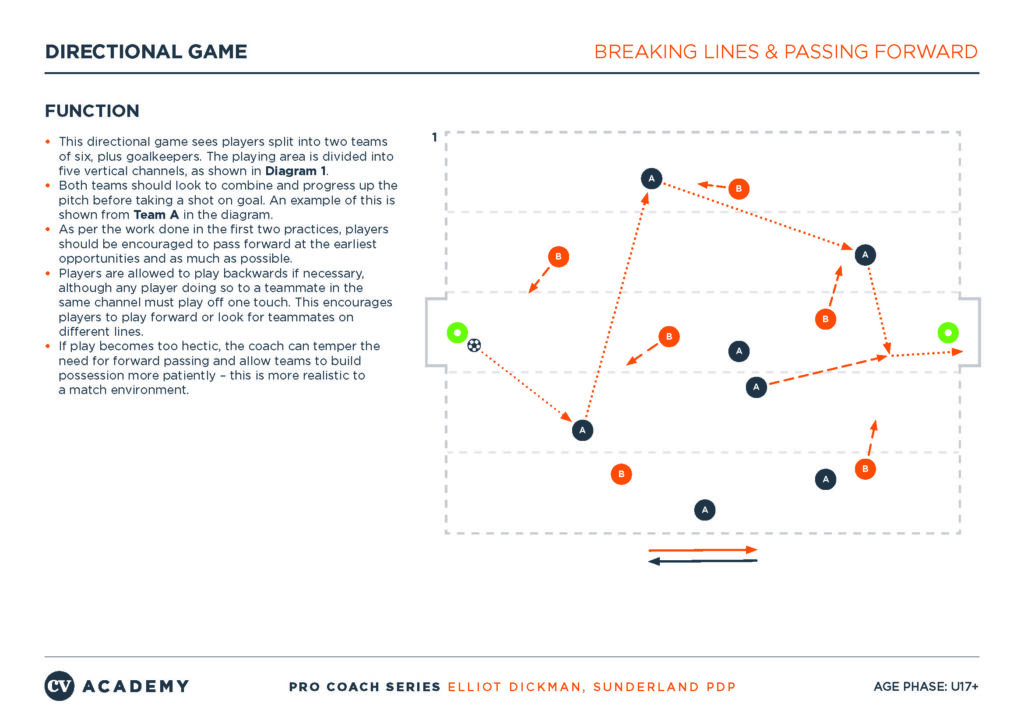
The video below features a directional game delivered by Elliot Dickman, then Sunderland professional development phase coach, as part of an exclusive Coaching Session for Coaches’ Voice. The practice set-up, details of which are included below the video, sees two teams of six plus goalkeepers play on a pitch divided into five vertical channels, with both teams encouraged to pass forward at the earliest opportunity. Backward passes to a teammate in the same channel are restricted to one touch, encouraging players to look for forward options or find teammates in different channels. Players are also coached on supporting movement after passing, attacking 1v1 opportunities, quick combinations in and around the penalty area, and the use of overlaps and underlaps.
What is a good tactical practice to develop players’ ability to play direct?
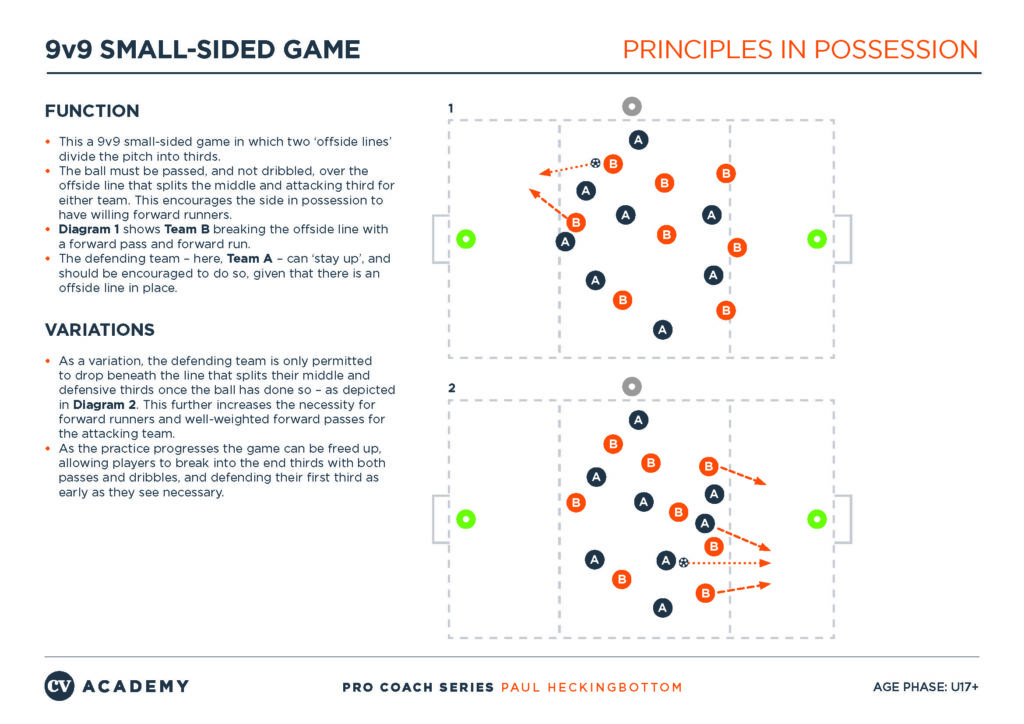
In the video below, experienced EFL head coach Paul Heckingbottom leads a 9v9 game. The pitch is split into thirds, with middle and end thirds split by ‘offside lines’ that are used to encourage forward runs and forward passes when appropriate. Players are coached to take side-on body positions in order to scan and turn to play forward quickly, and to recognise when the tempo can be quickened to break a line.