What is meant by a ‘high press’?
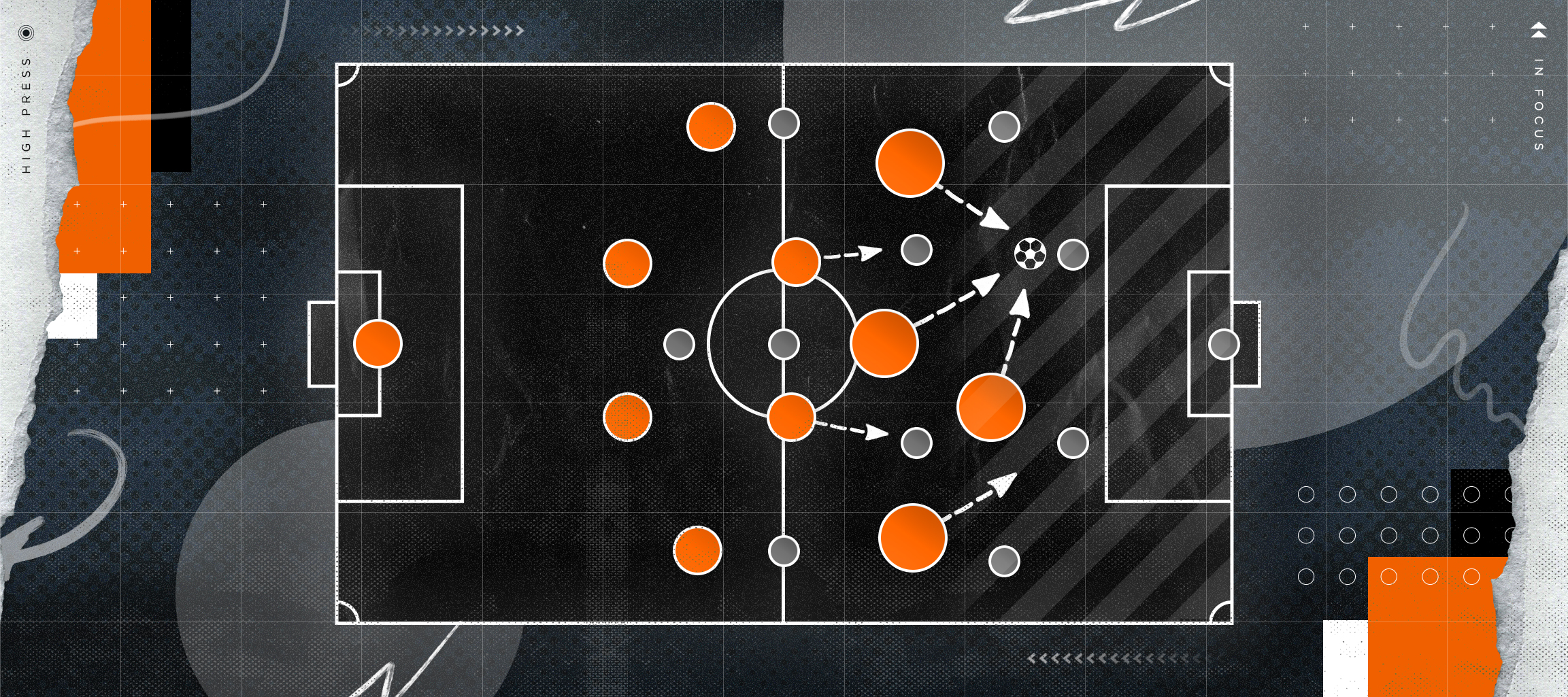
A high press is about applying collective defensive pressure in the opposition’s half, and at its most aggressive in the final third. Rather than withdrawing into a mid or low block and defending closer to their own goal, teams that utilise a high press seek to win the ball back as near to the opposition goal as possible.
What are the benefits of a high press?
The higher the regain, the shorter the distance that the pressing team must travel to create a scoring opportunity. The more often a team wins the ball high up the pitch with players already committed forward, the more chances they should create and the less opportunity the opposition has to recover their defensive shape, leaving gaps to exploit.
Teams can win the ball back quickly with a high press, reducing the time they spend out of possession and chasing the ball, giving them better control of the game.
A successful high press can also stop the opposition launching counter-attacks, even forcing the ball backwards. Even if a high-pressing team doesn’t regain possession, there is still a chance they can force the ball out of play or concede a free-kick, delaying opposition progress.
Session plans
Click the links below for two Coaches’ Voice sessions designed to develop a team’s ability to press high and win back possession in advanced areas.
Key principles
What are the key principles of a high press?
1. Collective commitment
The high press is a team action, not an individual one. When a player moves forward to press, every other player must shift simultaneously, closing passing lanes, cutting off escape routes, and moving to win the second ball if the press has forced the opposition to play without control.
A single forward sprinting towards a centre-back can apply some pressure, but is likely to be an underloaded press, meaning that the opposition have a numerical advantage that should help them to beat the lone presser. For a high press to work, the pressing player must be backed up immediately by teammates who have anticipated where the ball will go when it is forced away from the initial target and have already begun moving to those positions. A high press that is well-executed is a co-ordinated system with specific triggers, shapes and clearly understood individual roles.
In the video below, Ed Brand – who spent 15 years developing players for first-team football at Chelsea, including Marc Guéhi, Mason Mount and Reece James – uses the Coaches’ Voice tactics board to explain a key principle he applies when coaching teams to press high.
2. Intensity and intelligence
In a high press, players must apply pressure on the ball with great intensity, while also restricting passing options through their positioning and pressing angle. If they lose sight of one of these elements, the other will not be anywhere near as effective. If players press without intelligence, the intensity of their work will lose its impact. Equally, there is no amount of intelligence that will cover for players lacking intensity in a high press.
3. Triggers
Players must learn to recognise specific cues – a backward, slow or inaccurate pass, a goalkeeper receiving under pressure, a long square ball across the backline – as triggers to press hard and high together.
4. Locking play to one side
By channelling the opposition toward one side of the pitch and then shifting the team to reinforce that side, the pressing team reduces the ball-carrier’s options. Again, the whole team must move together. When a player locks play wide, every other player shifts to close escape routes while using the touchline as an extra defender, concentrating the pressure until an opportunity to win the ball arrives.
5. Recovery
If a team’s high press is beaten, players must quickly get back into a good defensive shape, becoming compact as quickly as possible and ready to press again from an organised base. Recovering quickly after a failed press can reduce the time and space that the opposition have to create a goalscoring opportunity.
What are the different ways in which a high press can be executed?
Pressing from restarts
The most structured form of a high press typically comes from a goal-kick restart. Goal-kicks have become one of the most important moments for a high press. As short goal-kicks have become more common across the professional game – with outfield players receiving the ball inside the penalty area rather than the goalkeeper launching it long – pressing teams have developed specific shapes to counter them. Rather than sitting off and waiting for play to develop, the highest-pressing sides position players aggressively to block central progression and force the opposition into a mistake, a wide pressing trap, or to play long. For example, a forward cuts the pitch to force play to one side, wide players hold inside positions to keep the central corridor closed, and the whole team is already oriented to press before the first touch is made.
There should be clarity in that every player knows their role and the triggers, requiring significant preparation to execute consistently under pressure. Even if a goal-kick is played long and the press does not directly win the ball, it can force the opposition’s build into something less controlled and more difficult to maintain.
In the video below, former Borussia Dortmund head coach Edin Terzic uses the Coaches’ Voice tactics board to explain how his team pressed high against Paris Saint-Germain in the 2023/24 Champions League semi final, starting with goal-kicks.
Trigger-based press
A trigger-based press responds to specific moments during open play, such as a backward pass, or a slow or inaccurate ball. The team then presses with maximum collective intensity when the moment appears. The key is for teammates to recognise the trigger at the same time and act on it without hesitation.
Positional press
In this approach, the pressing team invites the opposition to play into a specific area by appearing to leave it open, then springs the press when the ball arrives there, with multiple players converging simultaneously. By channelling play towards the trap, the pressing team can outnumber the ball-carrier before they can identify what is happening.
Counter-press
A counter-press is applied in the seconds immediately after losing the ball and will often come high up the pitch. Rather than withdrawing into a deeper shape, a counter-pressing team presses immediately after possession was lost, attempting to win the ball back before the opposition can advance. It is most effective when the pressing team has numbers nearby and reacts with urgency within the first two or three seconds. A successful counter-press can turn a loss of possession into an attacking opportunity. Even when the counter-press does not regain possession, it can force the ball out of play or delay the opposition’s attack, thwarting their momentum and allowing the pressing team to recover their shape.
What are the roles and responsibilities of players within a high press?
Striker
As the most advanced players in a team, strikers often initiate the high press. They will typically approach the ball-carrier at an angle that forces play to one side rather than straight ahead, applying pressure while directing the opposition toward a trap. Their pressing is a trigger to the rest of the team, which means that should they press at the wrong angle or moment, it can allow the opposition to play forward easily. They might occasionally position themselves purposely on the wrong side of an immediate opponent, rather than ball side, playing cat and mouse with opposition defenders and being ready to accelerate and jump on any pass into their opponent.
Midfielders
Midfielders in a high press will often occupy areas that the first press is designed to direct the ball into. When play is locked to one side, the midfielder on that side locks on to their opposite number, while central midfielders would typically look to prevent passes through the centre, and any midfielder on the far side maintains balance. In systems where a team has attacking midfielders (number 10s) behind a striker – such as in a 3-4-2-1 – those players can initiate a high press on goal-kicks and backpasses, as opposed to it coming from the striker.
Wide players and wing-backs
When play is on their side, a wide attacker – for example in the front line of a 4-3-3 – is often the pressing player, releasing to close down quickly. When play is on the opposite side, they will typically move inside to reinforce the defensive block, while being ready to move wider should the opposition successfully switch play.
Wing-backs must be alert to the moment the ball arrives on their side and be capable of covering the distance quickly when a trigger appears to initiate a high press. They should scan to cover any passing lane through which they could be played past easily, and be able to decelerate in order to engage in a 1v1 against the player they are pressing.
Centre-backs
Centre-backs in a high-pressing system defend further up the pitch than in a mid or low block, often holding a high line and dealing with clearances in advanced positions. They must be comfortable defending in space and capable of winning first and second balls when the press forces a long ball. Their ability to shift laterally – defending in wide areas when a long ball bypasses the press – can be tested regularly, and having the conviction to hold a high line is essential. Outside centre-backs in a back three must be capable of defending in wide areas, shifting across to cover the wide area vacated by a wing-back pressing forward.
Goalkeeper
A goalkeeper positioned high enough to act as a sweeper against balls in behind the defensive line reduces the risk that a high press can create. They are also the primary communicator for the high defensive line, alerting defenders in front of them to any threats in behind as the press is applied.
What are the risks of a high press?
The primary risk of pressing high is the space it creates behind the defensive line. A high press requires a high line, and a well-weighted pass over or through the press can send a forward in behind the defence. Managing this risk requires centre-backs comfortable defending in space at pace, midfielders disciplined enough to prevent forward passes from being played through the lines, and a goalkeeper positioned to act as a sweeper. Accepting this risk is part of pressing high; containing it depends on every player understanding both their pressing role and their recovery responsibility if the press is beaten.
A press applied at the wrong moment – such as when the shape is not set, or when triggers have not been recognised collectively – can be worse than not pressing at all. Badly timed pressing leaves gaps that the opposition can exploit.
Finally, there is the question of fatigue. A committed high press is close to impossible to sustain at maximum intensity for 90 (or 100) minutes. The most effective pressing teams manage this by varying the press depending on the game state. They press with maximum commitment when conditions are right and energy levels are high, and temporarily drop into a more conservative shape when tired, protecting a lead in the closing stages, or when the opposition’s quality makes pressing too great a risk. Knowing when not to press is part of knowing how to press.
What is a good technical practice to develop players’ ability to press high?
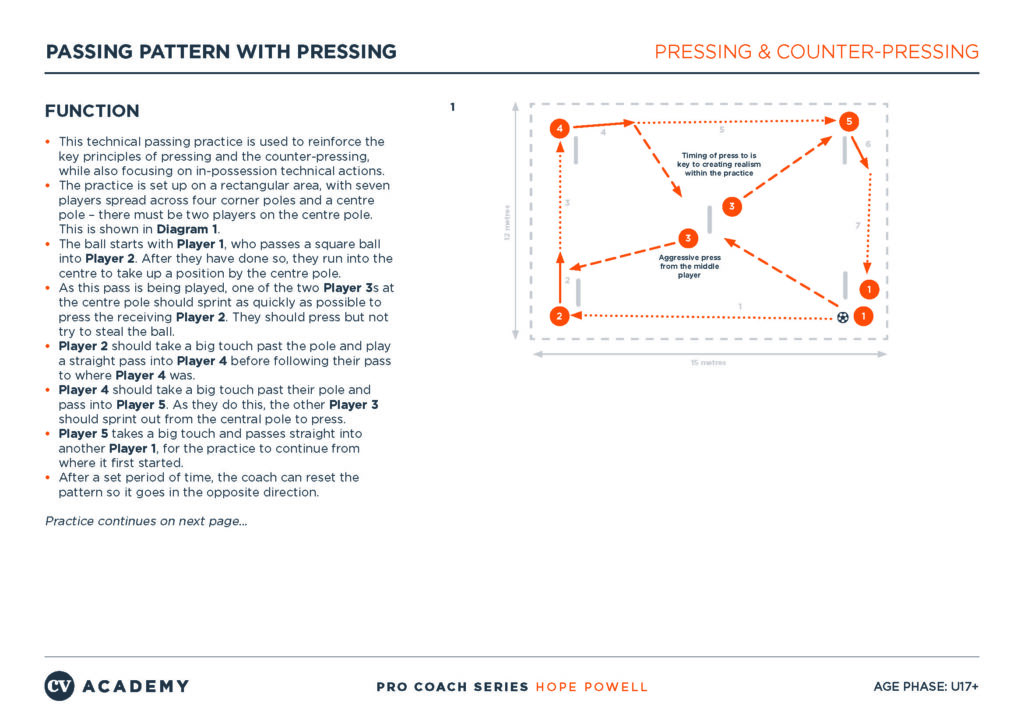
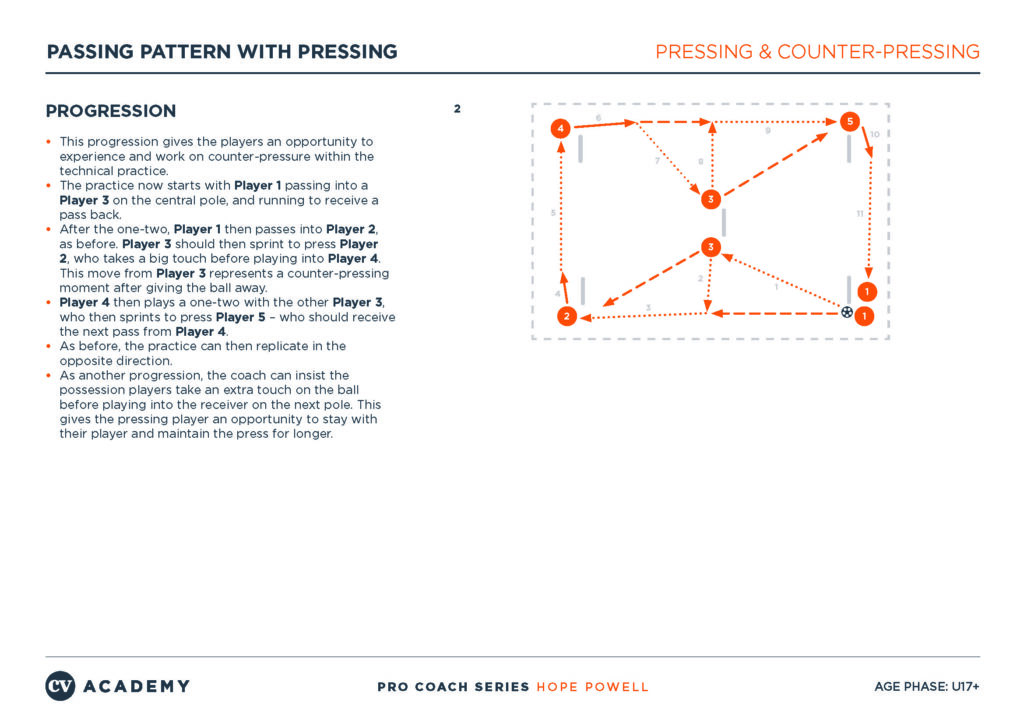
The video below features a passing pattern with pressing, delivered by former England Women coach Hope Powell, then head coach of Brighton Women. Filmed exclusively for Coaches’ Voice, her technical practice isolates a 1v1 pressing action. She demands that pressing runs are performed with purpose, power and pace, and that when a receiver shifts the ball in an attempt to escape the pressure, that pressure is maintained by the pressing player with a secondary pressing action.
What is a good practice to develop players’ ability to press with intensity and intelligence?
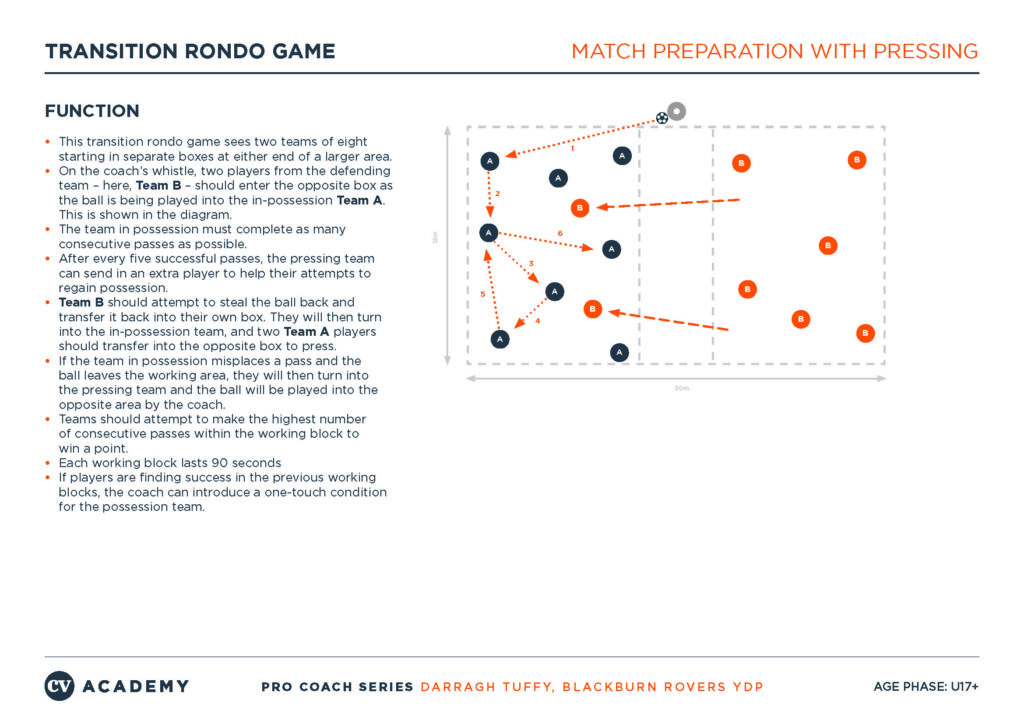
The video below features a transfer rondo game featuring the Blackburn Rovers Under-18 squad, filmed as part of an exclusive session for Coaches’ Voice. Here, the defending team is encouraged to press aggressively in order to regain possession; after they have won and transferred the ball, the coaches stress the importance of recovery runs from the opposition.