



PREMIER League, SEPTEMBER 6 2026
Havertz (25)
Ødegaard (50)
Rogers (2)
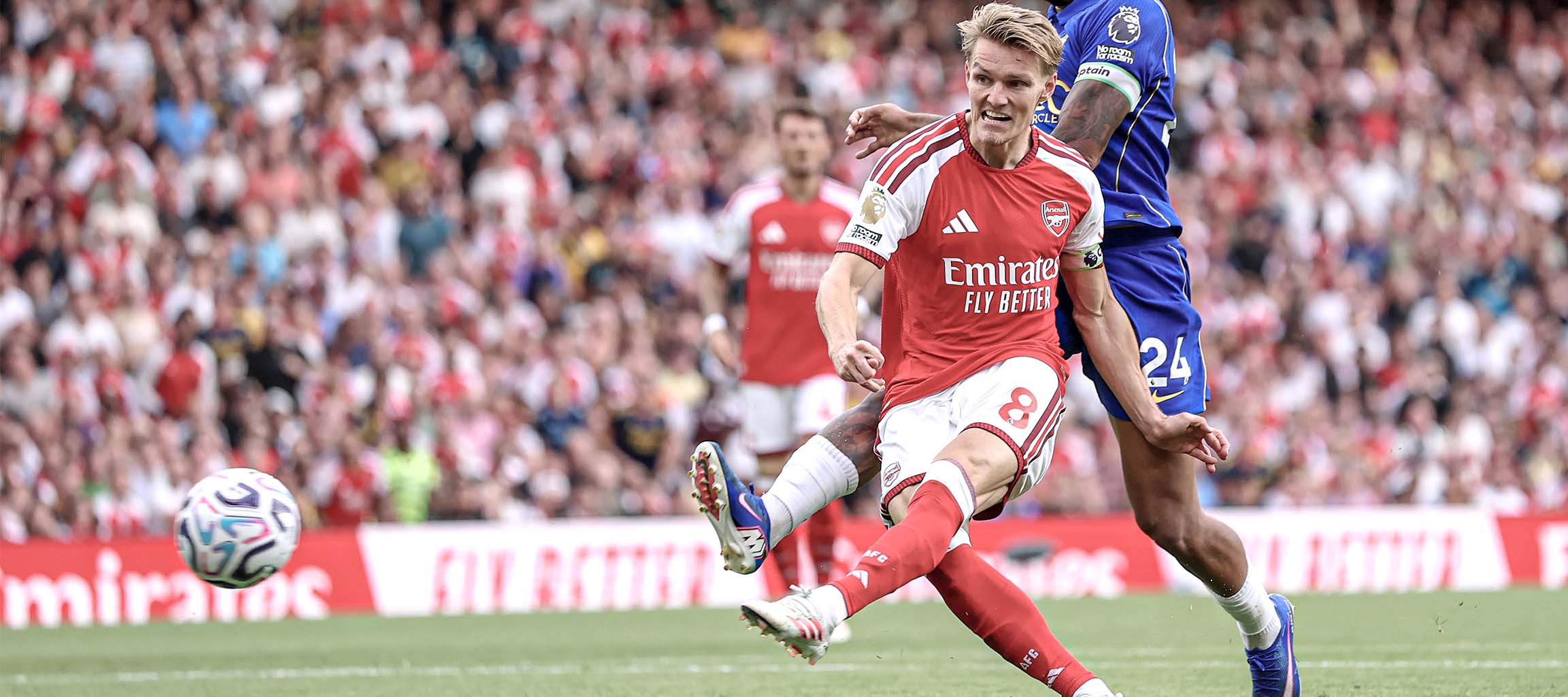
Arsenal came from behind at the Emirates Stadium to win this London derby and make it three wins from three at the start of their Premier League campaign. Xabi Alonso’s Chelsea had stunned the champions by taking the lead after two minutes, thanks to a measured finish from Morgan Rogers. But Mikel Arteta’s Gunners are made of stern stuff. They calmly played their way back into the game, equalising through a Kai Havertz effort, after Riccardo Calafiori had a goal disallowed. Pedro Neto then hit the post for Chelsea just before half-time, but more good play from Arsenal gave Martin Ødegaard the chance to give them a lead they would not relinquish.
How the managers saw it
“It was an incredible game to watch, to coach,” said Arteta. “The level, the quality, the way we competed, the way we attacked, the dynamics and the fluidity. The threat that we generated against that really tough opponent. Those connections between players, that level of threat to occupy different spaces is very unpredictable, something that we are insisting [on] a lot, and today it happened.”
“It was a game with different stages of momentum,” said Alonso. “For sure, the second goal, we could’ve done a little bit better. It’s a part of the game you need to accept because they are a top side and they push you to the limits. They overload a lot on the left side with many players and they got the goal with Ødegaard.”
 1336154494117872913453745242110917
16/9
SHOTS / ON TARGET
13/5
50%
POSSESSION
50%
28
ATTACKS INTO AREA
23
2.57
EXPECTED GOALS (XG)
0.53
A transitional opening
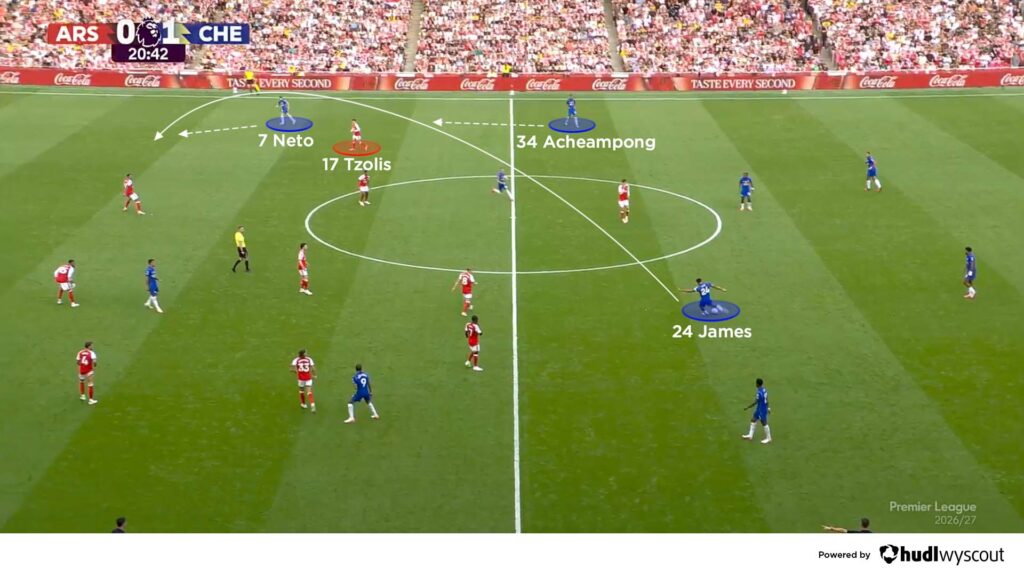
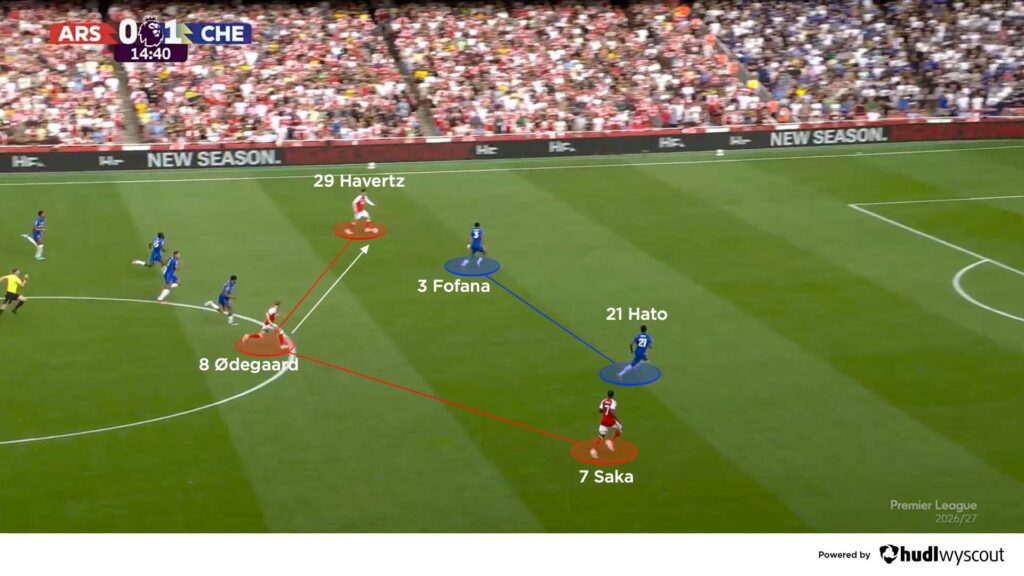
The game began in frantic fashion, with plenty of transition moments for both teams, though neither side was able to establish any real structure in the opening 15 minutes. After taking an early lead, Chelsea were direct with their first-half attacking play, mostly looking to switch possession and find Neto. When Chelsea won possession he was advanced on to the last line on the right-hand side, supported by advancing right centre-back Josh Acheampong. This allowed the visitors to create through quick counter-attacks to exploit the space – particularly behind a recovering Christos Tzolis (below).
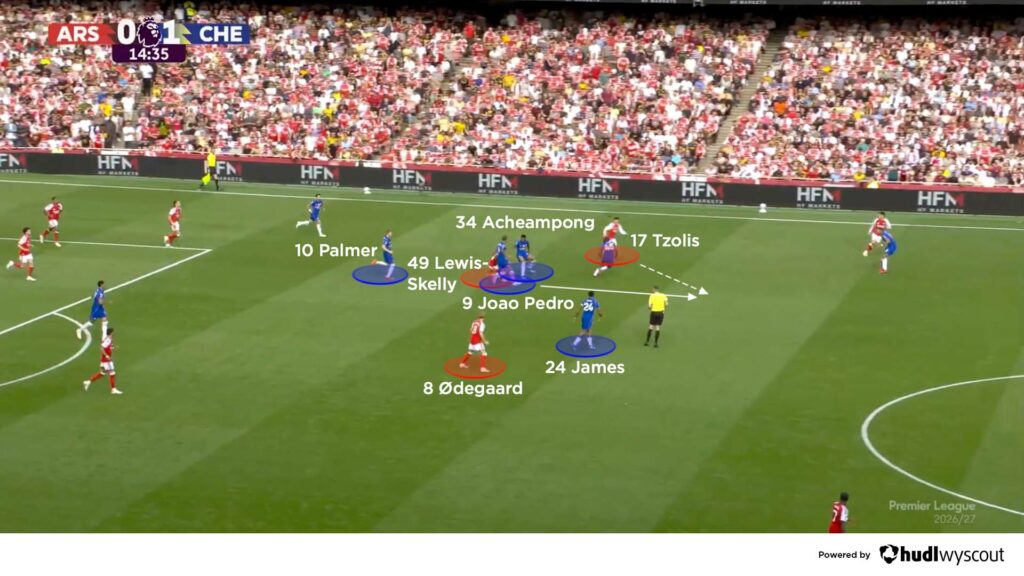
Alonso’s Chelsea were aggressive in their counter-pressing, looking to immediately restrict Arsenal from escaping their defensive third and regain the ball higher up the pitch. In these instances the nearest players looked to press the ball-player, with Acheampong, João Pedro and Cole Palmer applying pressure to Myles Lewis-Skelly (below), while Roméo Lavia and Reece James were attracted to Tzolis and Ødegaard to restrict forward passing options.
While Chelsea’s aggressive approach against the champions was commendable, it did leave them stretched at the back when their counter-press was broken. With Acheampong pushing into a higher position on the right to support attacking play when Neto had possession, Maxence Lacroix was drawn out wider to engage Havertz, leaving big horizontal distances between Chelsea’s defensive line. In the 15th minute Arsenal broke with Tzolis combining cleverly in behind Lavia and James to find Ødegaard, giving a 3v2 against Chelsea’s back line. Wesley Fofana and Jorrel Hato (below) managed to delay the attack while their teammates recovered, as the game began in thrilling fashion thanks to the approaches taken by both teams.
Chelsea’s low block and Arsenal’s adjustments
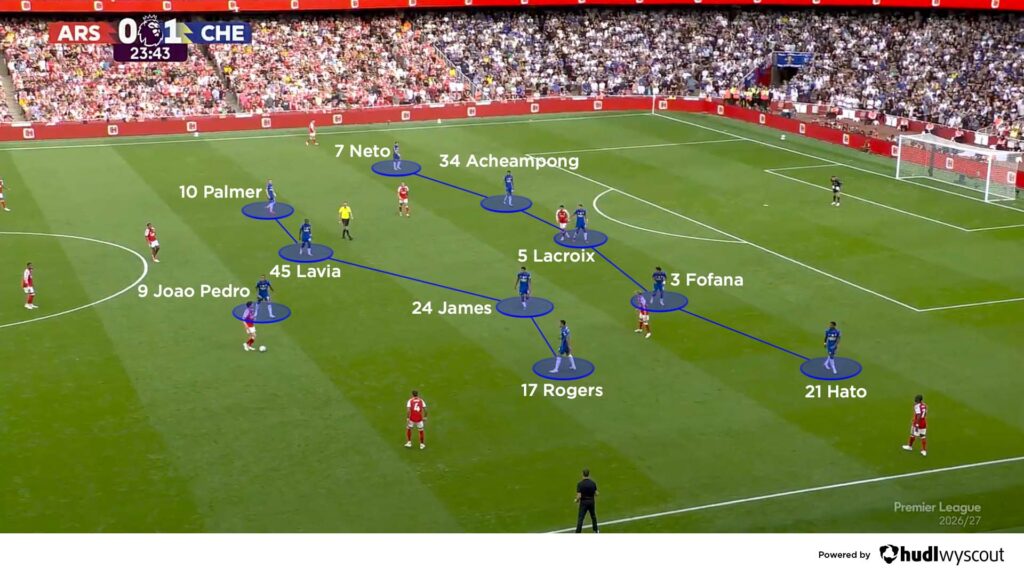
Out of possession, Alonso set Chelsea up in a 5-4-1 low block when forced back to defend their defensive third. The aim was to restrict Arsenal from penetrating through, maximising coverage across their defensive line with a back five defending the full width of the pitch, while retaining a compact midfield to limit the effectiveness of Arsenal’s attacking midfield movements and rotations. João Pedro often screened the central pivot and was ready to release, while Cole Palmer and Morgan Rogers dropped either side of the midfield four, with Lavia and James protecting central areas. Neto dropped from his higher, more advanced position into a right wing-back role on the defensive line, while Hato tucked back in on the left (below). Chelsea’s three central defenders were then ready to be aggressive and engage should Arsenal try to play through central areas.
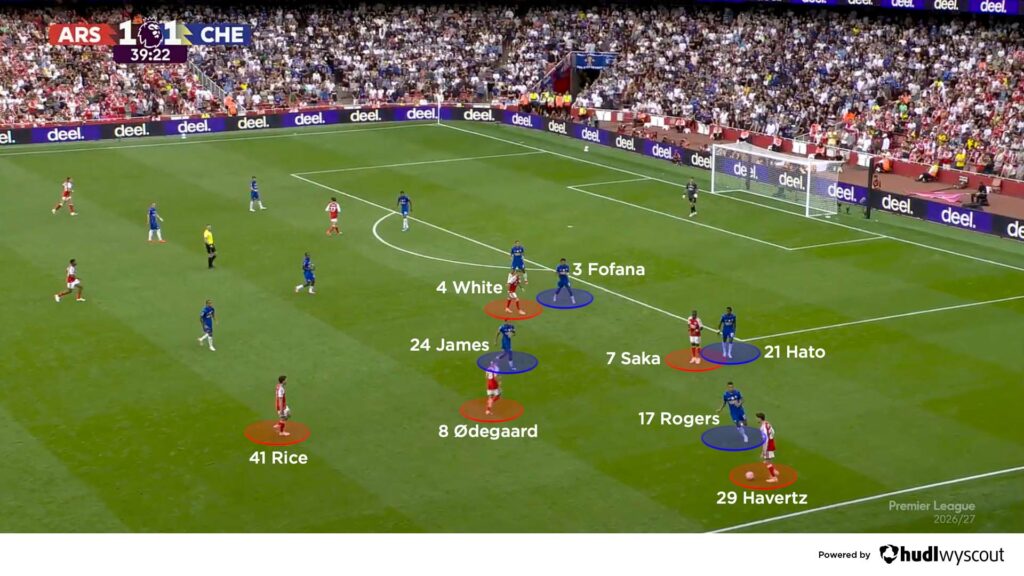
Arsenal were typically fluid in their attacking movements, with lots of wide rotations through Ben White and Bukayo Saka on the right. On the left Tzolis had freedom to drift across, while Calafiori advanced to attack the left half-space. However, one of Arsenal’s clearest adjustments to bypass Chelsea’s defensive block was Havertz drifting out to the right to create overloads against the left side of Chelsea’s defensive structure. With White rotating inside, Havertz drifted right alongside Ødegaard and Saka, as well as Declan Rice, creating a 3v2 against Rogers and Hato on several occasions (below). There, Arsenal combined and created through runs into the half-space to penetrate in behind, while Havertz netted the equaliser having picked the ball up from a wide right position. And when Lavia and Fofana were drawn over to restrict space on the ball-side, Arsenal also had the opportunity to attract Chelsea’s structure to one side before playing back inside or across to the opposite side to exploit space.
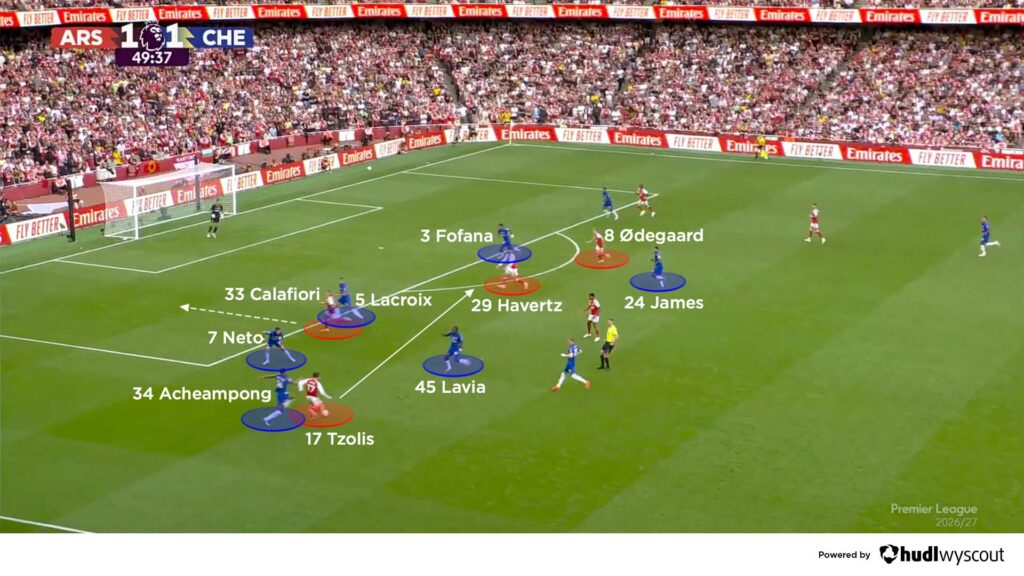
In a somewhat similar fashion, Arsenal took the lead in the second half. As shown below, after circulating possession across to Tzolis on the left – who received and drove inside the pitch while Acheampong engaged – Calafiori made a half-space run. The latter attracted Lacroix and Neto – who had filled in for Acheampong – while Lavia was drawn across as the ball-side midfielder. As a consequence, rather than creating space to overload on the outside of Chelsea’s structure, they created the opportunity to penetrate the space back inside, with big distances created between the midfield pairing of Lavia and James, as well as between central centre-back Lacroix and Fofana on the opposite side. With James unable to recover into a more central position to track the run in behind by Ødegaard, Tzolis played the Arsenal captain in centrally, to receive and put Arsenal ahead.
With Arsenal’s excellent defensive record, it was then always going to be difficult for Chelsea to claw their way back into the game – but the Gunners needed David Raya to save well from Estêvão late on to secure their victory. After nearly seven years under the management of Arteta, the champions have never looked stronger. Chelsea, by contrast, are a work in progress in the early stages of Xabi Alonso’s tenure.
To learn more about football tactics and gain insights from coaches at the top of the game, visit Coaches’ Voice Academy
