
PREMIER League, FEBRUARY 1 2026
Solanke (53, 70)
Cherki (11)
Semenyo (44)
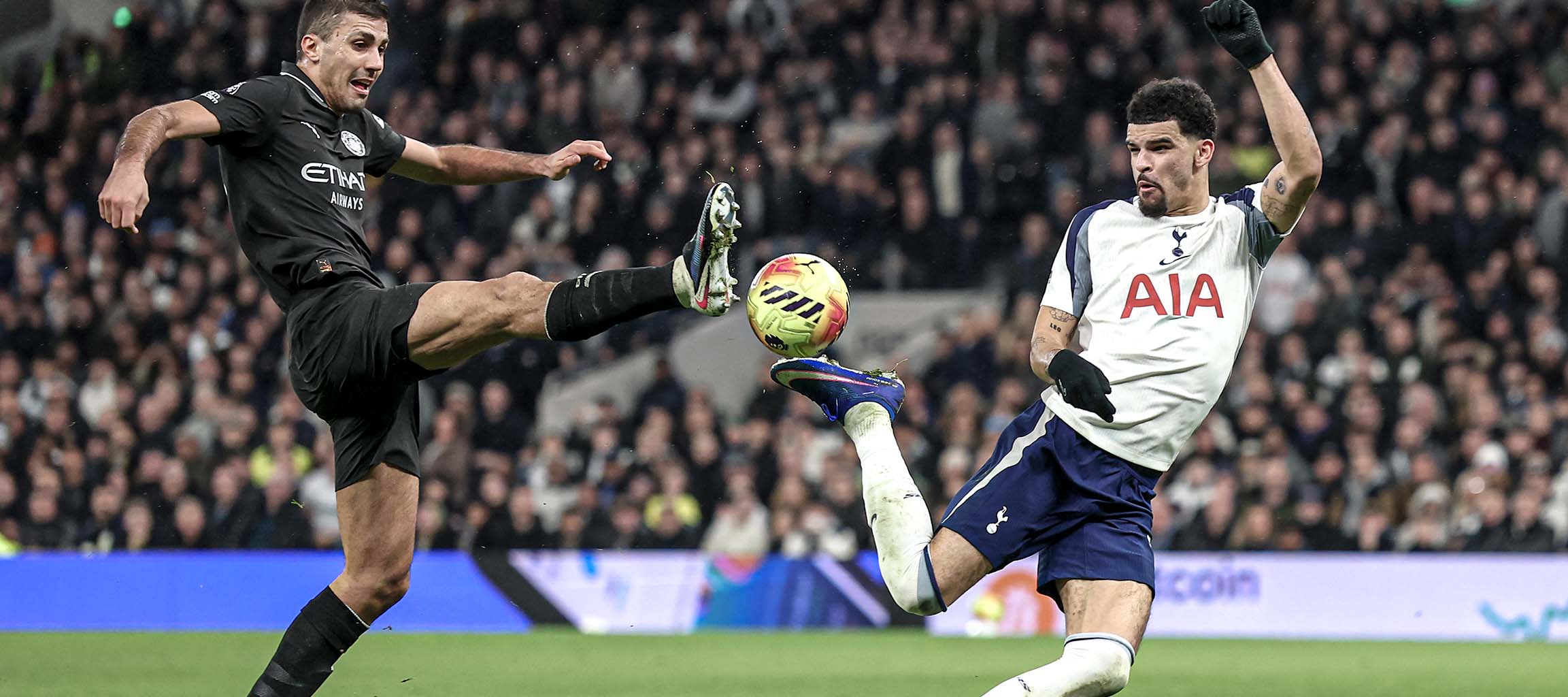
Tottenham Hotspur produced a stirring second-half comeback to claim a point, having trailed Manchester City 2-0 and been booed off at half-time. Dominic Solanke was the hero for the home side, reducing their arrears before scoring a variation on the scorpion kick – a marvellously improvised volley, flicking the ball home with his studs. City had seemed in total control thanks to goals from Rayan Cherki and Antoine Semenyo, but were left to rue not only their failure to win the game, but also the fact it left them six points behind leaders Arsenal with 14 games remaining.
How the managers saw it
“I’m extremely happy that we finally got a point out of a big second half,” said Thomas Frank. “We tried to be front-footed in the first half as well, but we just didn’t land in all the high-pressure situations. We didn’t win them and we were playing against City, who are pretty good at keeping the ball. I think we showed a lot of intention in the first half but just didn’t land on it.”
“After [their first] goal they had the momentum for 15, 20 minutes,” said Pep Guardiola. “What happened in the Premier League today, sometimes you can control it, but the way the game is in England, this happens sometimes. We have to try to finish the actions a little bit better, but the game was well played. We would prefer not to have that transition, but it was an emotional issue for their first goal and after that, the moment is difficult to control in England.”
Below, our UEFA-licensed coaches have analysed the key tactical points from the game…
 13176138221471939252745152110163342209
Silva initiating the press
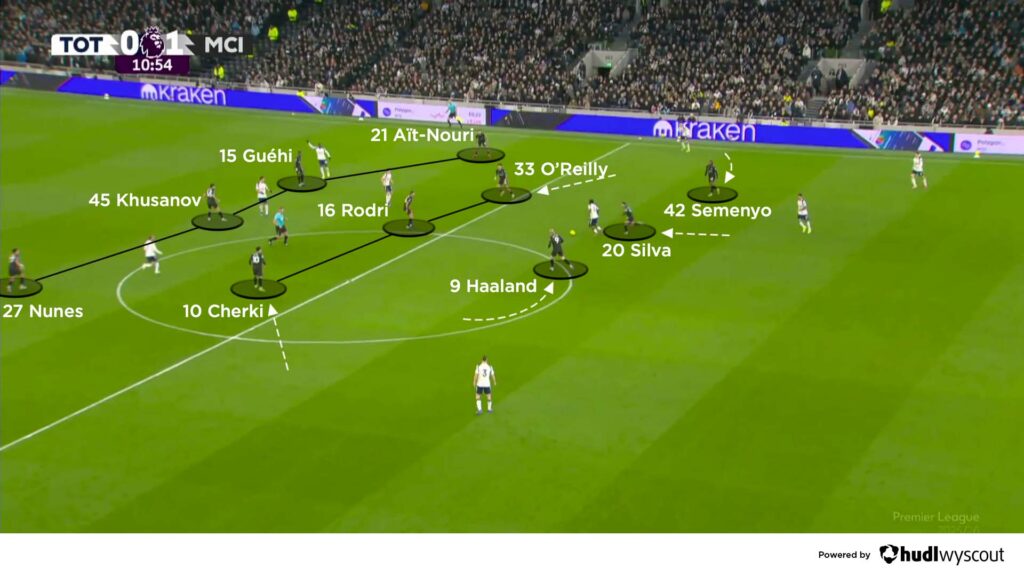
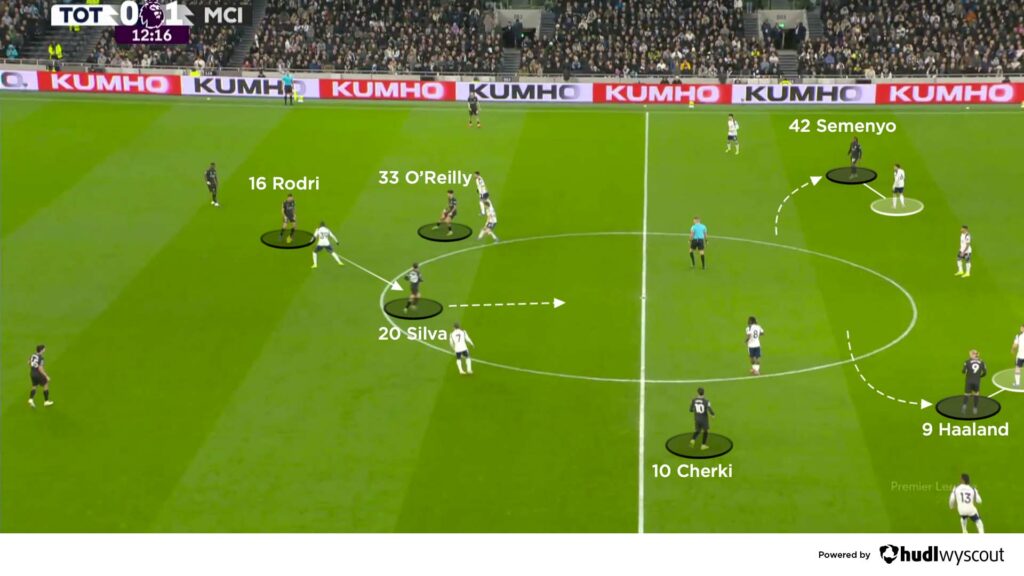
Manchester City defended using a narrow 4-1-3-2 shape, with Bernardo Silva initiating when to jump and press as City switched to a 4-3-3 against Spurs’ build-up. Semenyo and Erling Haaland split wide, trying to force the ball inwards, with Silva jumping centrally to briefly form a front three. Cherki and Nico O’Reilly then dropped and narrowed alongside Rodri to cover central passing options, while Silva tirelessly back-pressed (below). With City’s back four also very narrow and compact, this central trap helped the away side regain and transition to goal. Both first-half goals came after pressing regains inside Tottenham’s half.
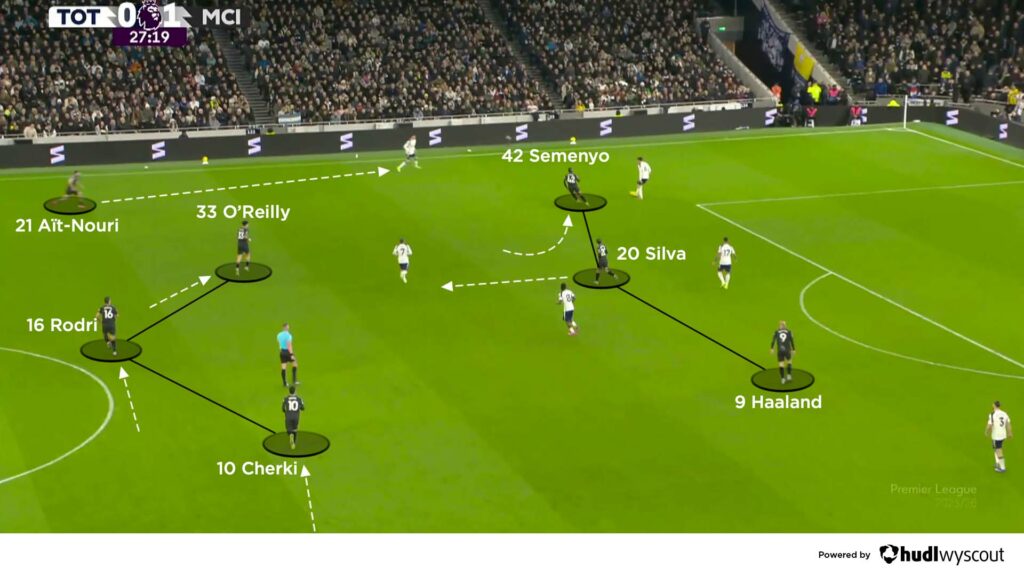
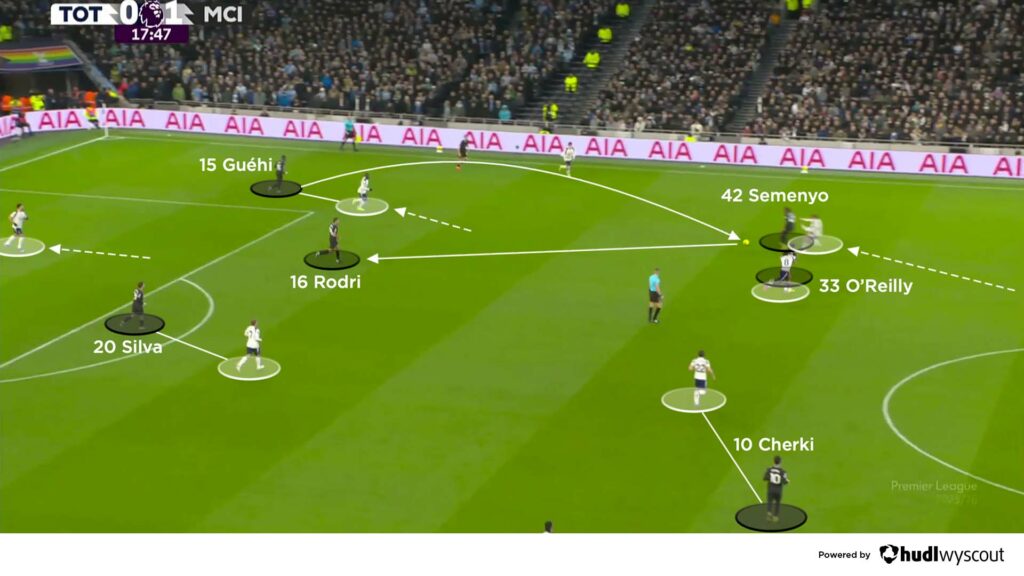
City regained high throughout the first half, in part thanks to the solutions they had when Spurs tried to build around their central trap. Semenyo and Haaland pressed outwards when Spurs played wide, with City’s full-backs Rayan Aït-Nouri and Matheus Nunes required to jump all the way to very deep wing-backs. Silva continued to press back, with the rest of City’s central midfield extremely compact and efficiently moving across to the ball side (below). As a result, City had good defensive numbers, as well as multiple teammates available for attacking transitions.
City’s central numbers
City also attacked centrally with numbers, often via a 4-2-2-2 structure. Rodri and Silva acted as the two pivots, with O’Reilly and Cherki in the inside channels. Up against a disorganised Spurs shape – which fluctuated between a 5-3-2 and a 5-2-3 – City often had a spare man in this area. At times they had multiple spare players, as Spurs struggled to deal with City’s short and fluid passing. Haaland and Semenyo continued to split wider, attacking the outside shoulder of Spurs’ wide centre-backs (below). Semenyo mostly showed short, with Haaland stretching beyond, as both had chances to add to City’s lead.
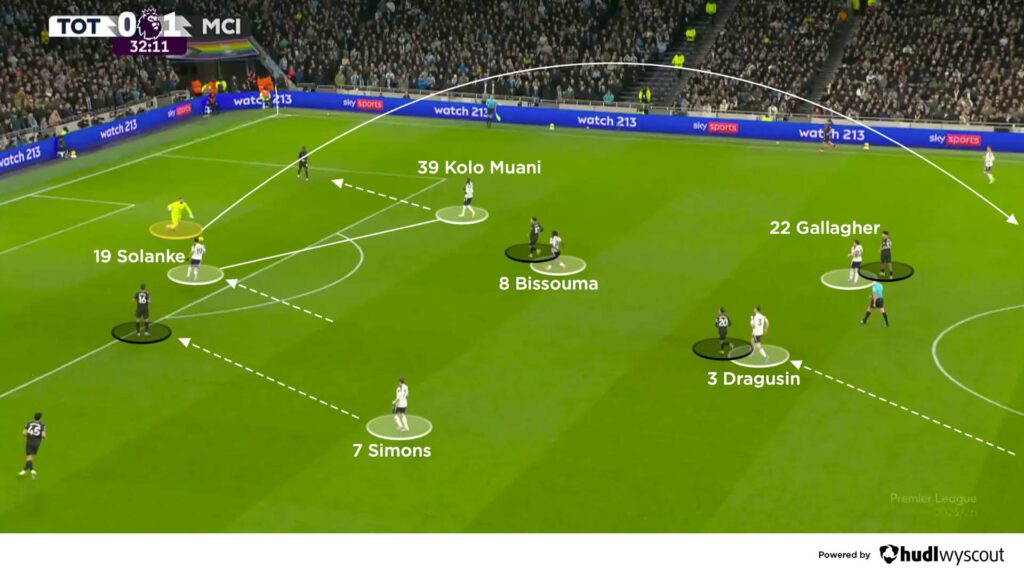
Spurs tried to press higher to disrupt City’s possession, with Solanke and one of Randal Kolo Muani or Xavi Simons pressing City’s goalkeeper and two centre-backs. That left three in midfield for Tottenham, giving City’s midfield a spare player to support their build. Whenever direct access into this free City player wasn’t available, Haaland or Semenyo (below) dropped to bounce the ball back, and City attacked from there. City could also counter-press any loose or sloppy passes efficiently, as their central overload helped them to quickly regain possession.
Spurs’ next response was to commit one of their centre-backs into midfield, creating a 4v4. Solanke continued to press with either Kolo Muani or Simons, while one of Cristian Romero and Radu Dragusin advanced to join Conor Gallagher and Yves Bissouma (below). This left Spurs 2v2 against Haaland and Semenyo when City played direct into their forwards. Although Spurs gained little from this adjustment in terms of attacks or regains, they did limit City’s attacking play and overall rhythm for the remainder of the first half.
Frank changing shape
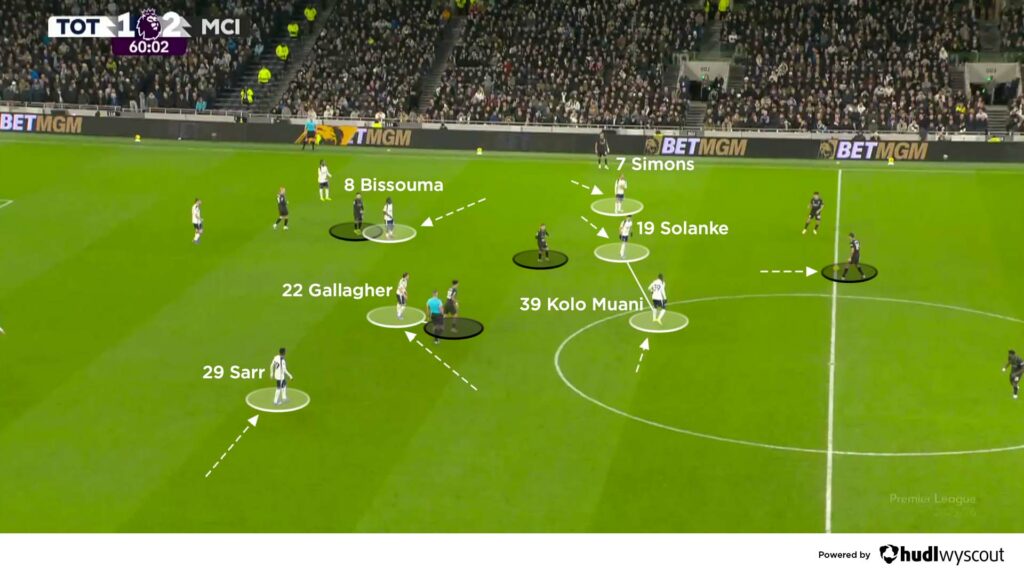
Thomas Frank withdrew Romero at half-time due to illness. He brought on Pape Matar Sarr and changed to a back four, with immediate returns. Without the ball, Tottenham frustrated City initially by deploying a mid-block – City’s two highest central midfielders now marked by Spurs’ double pivot. Solanke and Kolo Muani formed a first-line pair to screen access into Silva, letting Rodri drop back in front of Tottenham’s 4-4-2 block. Wide midfielders Simons and Sarr narrowed (below), ready to press from out to in when needed, with Spurs’ full-backs prepared to jump all the way out into the wide areas as City continued to attack without defined wingers.
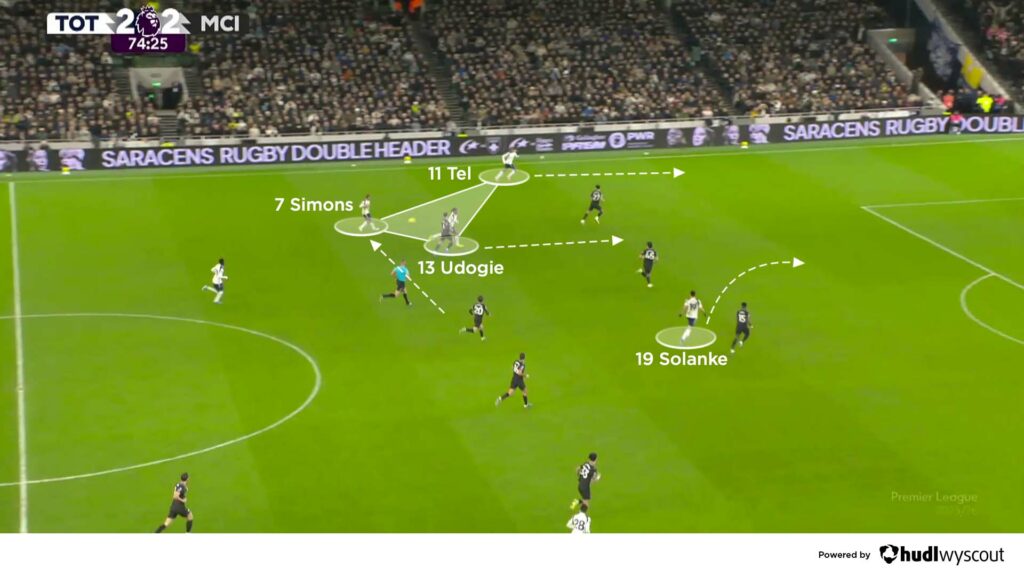
Spurs then attacked via a 4-2-3-1, with Simons moving inside from the left, allowing Destiny Udogie to overlap from left-back. Tottenham put City on the back foot, with more numbers running forward, direct passing and early crosses. Simons was influential from the inside left; his superb through ball found Solanke running beyond for Tottenham’s first goal. Simons became a number 10 in Frank’s 4-2-3-1, but still drifted to the left, with wide rotations from Udogie and Mathys Tel (on for Kolo Muani) creating good moments of attacking play (below). This included Solanke flicking home a Gallagher cross to equalise, as Spurs’ new shape gave them good access to the final third.
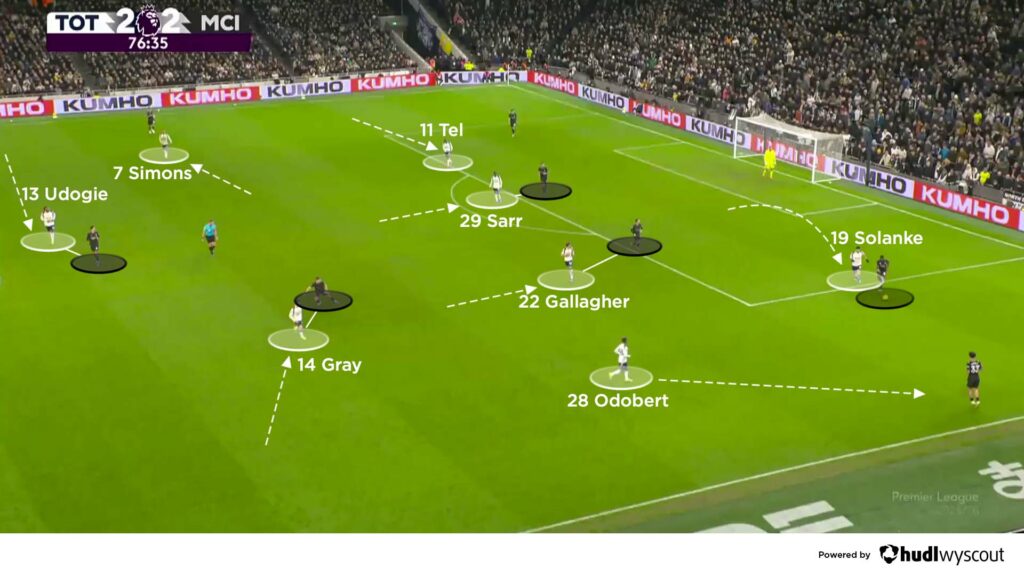
The momentum was with Tottenham and they increased their aggression without the ball, pressing very high and committing fully man-to-man, with both full-backs narrowing to defend City’s two highest central attackers. This left a 2v2 at the back for Tottenham, but with their hard running and duelling higher up, it wasn’t an issue. Solanke pressed out wide and Tel joined him in pressing City’s centre-backs. On Solanke’s pressing side, Wilson Odobert (on for Bissouma) was ready to press the left-back, while Gallagher and Sarr dealt with City’s pivots. Simons – so influential from the left inside channel – tended to cover that side when defending, as Tottenham pushed to complete the turnaround and claim three points.
They couldn’t quite turn their good spell into a decisive third goal, but did enough to claim a point that felt more like a win, whereas City dropped more precious points in the title race. Tottenham’s resolve will be tested again in their next Premier League game, when they visit Michael Carrick’s resurgent Manchester United. City, meanwhile, can clinch a trip to Wembley when they host Newcastle United in the second leg of their EFL Cup semi final on Wednesday, already two goals to the good.
To learn more about football tactics and gain insights from coaches at the top of the game, visit CV Academy