CHAMPIONS League FINAL, MAY 30 2026
Dembélé (65)
PSG win 4-3 on penalties
Havertz (6)
Paris Saint-Germain edged past Arsenal in Budapest to become champions of Europe for the second time and win back-to-back Champions Leagues. The Ligue 1 champions fell behind early to a Kai Havertz finish from an Arsenal counter-attack that had stemmed from an unintentional deflection. The Premier League champions then defended stoutly to limit PSG for the rest of the first half, as the game settled into a pattern of mostly PSG attacks v Arsenal defending. A Cristhian Mosquera foul on Khvicha Kvaratskhelia allowed Ousmane Dembélé to equalise from the spot midway through the second half. And with neither side able to find a winning goal, misses in the shootout from Arsenal’s Eberechi Eze and Gabriel proved decisive.
How the managers saw it
“The match started the best way for them [Arsenal],” said Luis Enrique. “They scored in a lucky action. After that it was pressure for them, because they know how to defend. It was very tough. We are used to attacking in that way with a lot of players behind the ball, but against them they are strong physically. They try to take advantage in any action. Very tough. I think we deserved to draw the match and at the end, we are very happy winning that trophy.”
“I want to congratulate PSG,” said Mikel Arteta. “Luis in particular, because in my opinion they’re the best team in the world. What they are able to do with the ball, with individual actions, I haven’t seen it. It’s not the plan to play in certain areas when you don’t have the ball but they force you to do that, so even more credit to the players.”
Below, our UEFA-licensed coaches have analysed the key tactical points from this Champions League final…
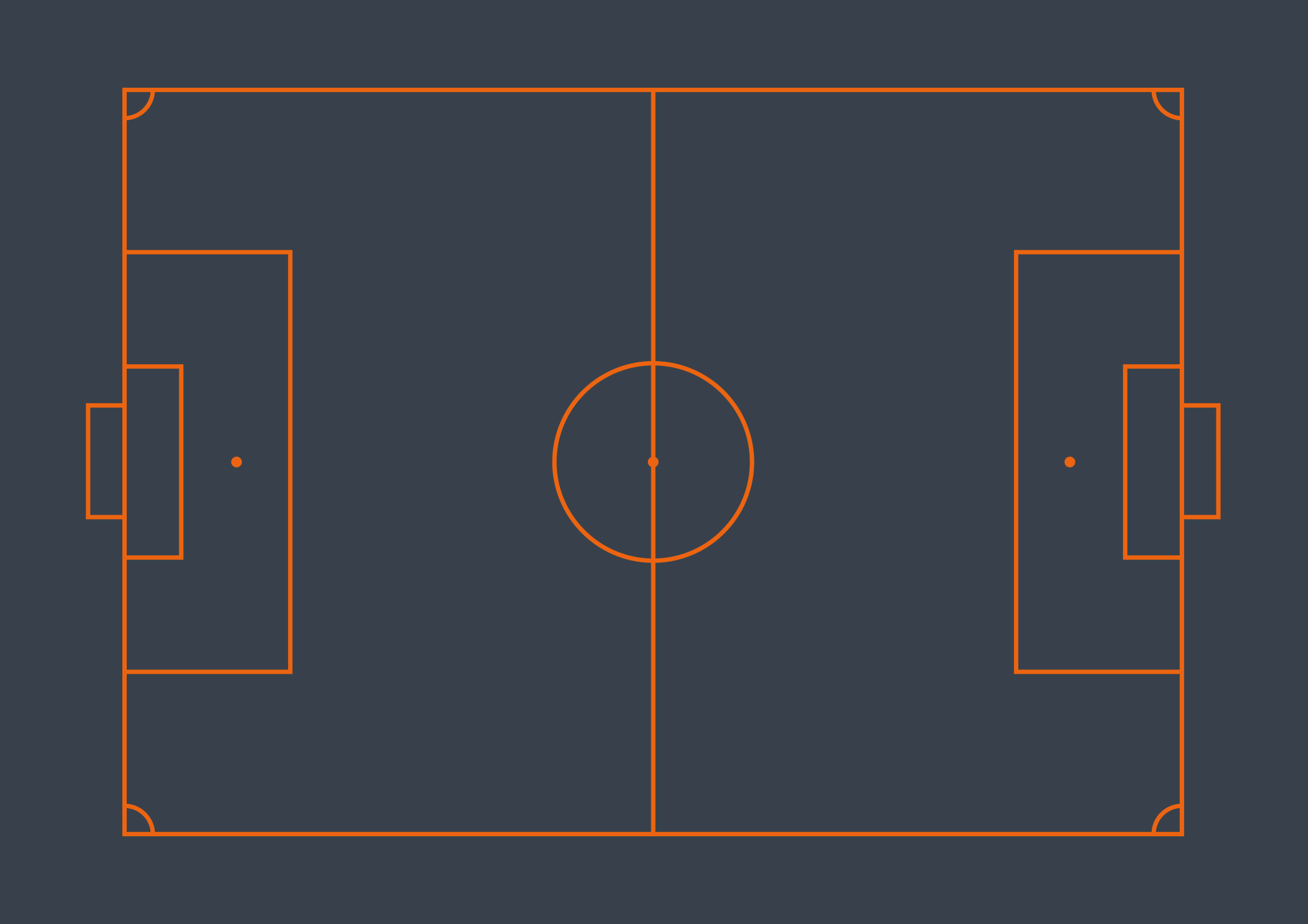 392551521788710714132654149781929
20/4
SHOTS / ON TARGET
7/1
74%
POSSESSION
26%
50
ATTACKS INTO AREA
21
2.21
EXPECTED GOALS (XG)
0.57
PSG rotations
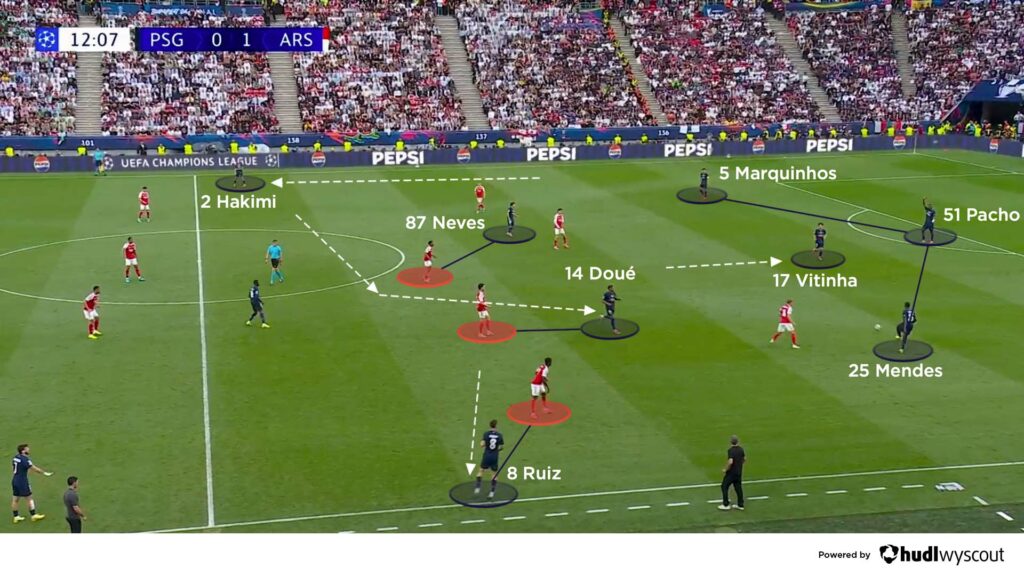
After Havertz’s early opener, PSG dominated the ball. They built with a back three, as Achraf Hakimi advanced very high, very early from right-back. He gave Désiré Doué licence to move inside and join the centre of PSG’s build, along with João Neves, to try to pin Declan Rice and Myles Lewis-Skelly back. With these movements Vitinha could drop freely between or around Arsenal’s first line of Martin Ødegaard and Havertz, supporting as PSG’s single pivot ahead of the remaining three defenders. With Doué repeatedly moving across to PSG’s left early in the match, Fabián Ruiz also widened to this side from midfield. He often dragged Bukayo Saka back, so that Nuno Mendes had time to build until an Arsenal forward was forced to jump out alone, which in turn freed Vitinha (below). From there, he repeatedly helped PSG progress the ball into the Arsenal half.
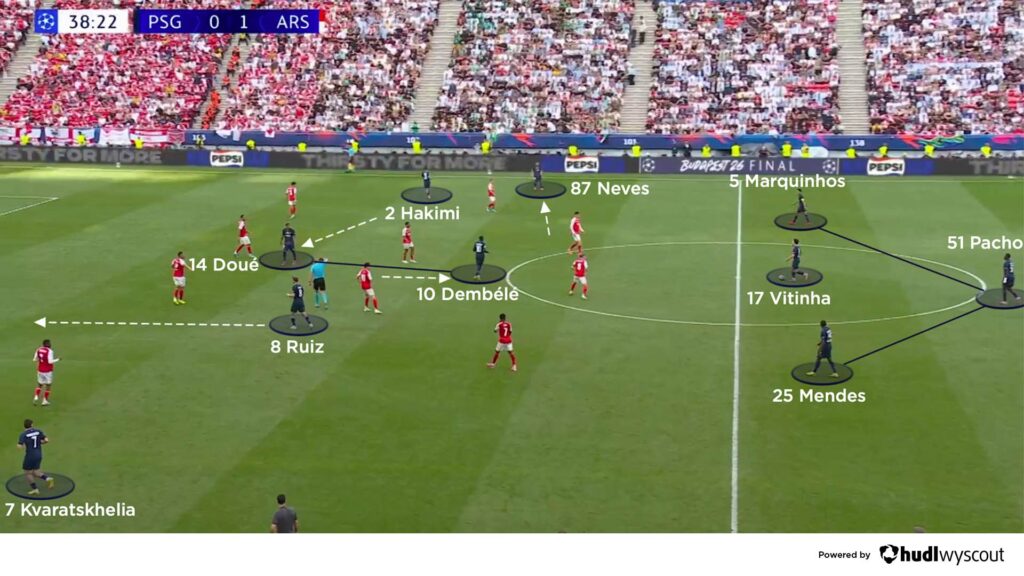
With Arsenal dropping into a deep 4-4-2 block, PSG continued to rotate, but kept their base of three defenders and Vitinha building attacks. This quartet were also positioned to defend what proved to be rare Arsenal counter-attacks. When higher, Ruiz was positioned more centrally to run inside of Mosquera whenever PSG worked the ball wide left to Kvaratskhelia. Doué still came inside, but closer to a dropping Dembélé, with Hakimi holding the width on the right, occasionally supported by Neves (below). Despite PSG’s fluidity around the ball, Arsenal’s central duelling was particularly resolute. The central-midfield unit doubled up and filled into the back line to support the central defending when needed.
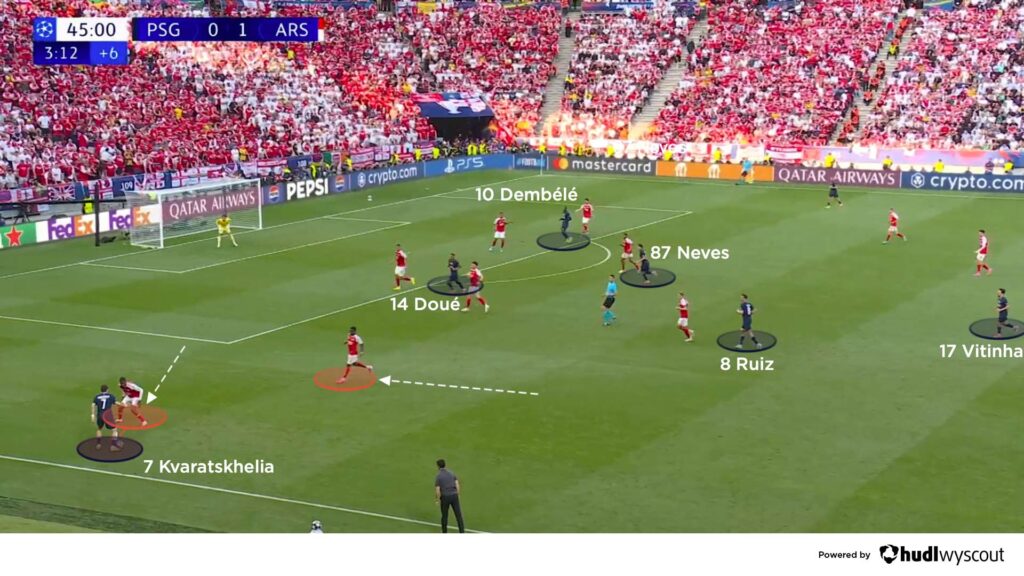
PSG struggled to create dangerous 1v1s in the first half, especially in the wide areas. When deep in Arsenal’s half, they sometimes missed moments to increase the ball speed or play more direct, quicker passes into the feet of their widest attacker – instead combining with short passes into central teammates close by. Saka (below) and Trossard were then able to back-press, as Arsenal doubled up on PSG’s widest attackers, limiting the success of PSG’s wide dribbles and ball-carries. PSG also had minimal overlapping and underlapping threats, preferring to have numbers centrally in the final third, and persisting with a back-three build – no doubt not wanting to leave too many spaces for Arsenal to counter into and make it 2-0. As such, PSG found it challenging to attack around the outside and cross from the byline.
Arsenal’s wide defending
PSG gradually changed their attacking priorities in the second half, which made Arsenal’s wider defending more important. Out of possession, Arsenal’s front two remained central and narrow, limiting how PSG could play through the middle, then funnelling the ball towards their wide teammates to defend. With PSG sometimes attacking without a fixed central forward, centre-backs William Saliba and Gabriel had more licence to widen and defensively support earlier by moving across the pitch. This helped create a plus one in Arsenal’s favour, with a 4v3 towards the byline (below). Wingers Trossard and Saka worked back early to lock play wide; Rice and Lewis-Skelly protected the inside-channel spaces, covering particularly well ahead of their back line.
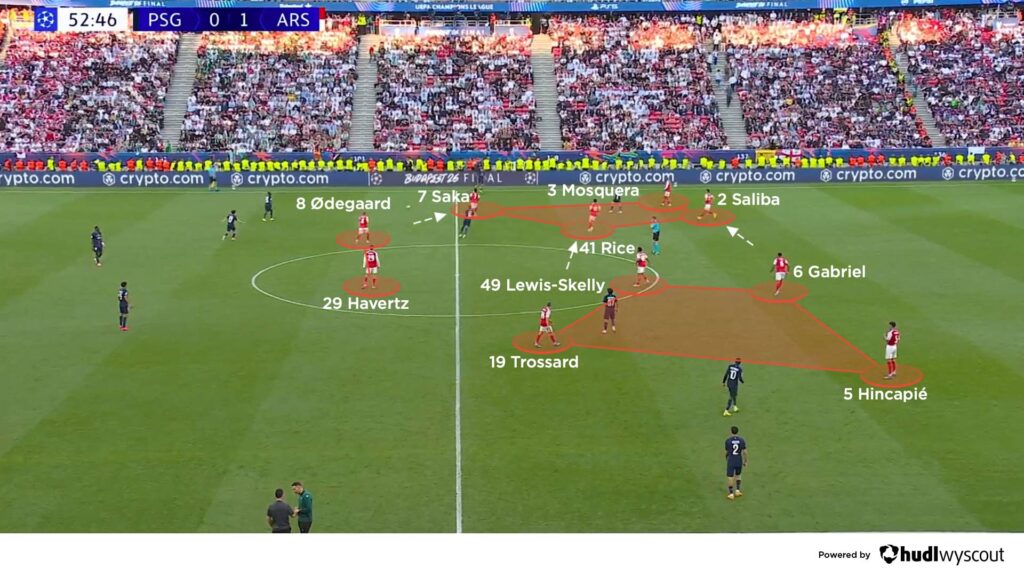
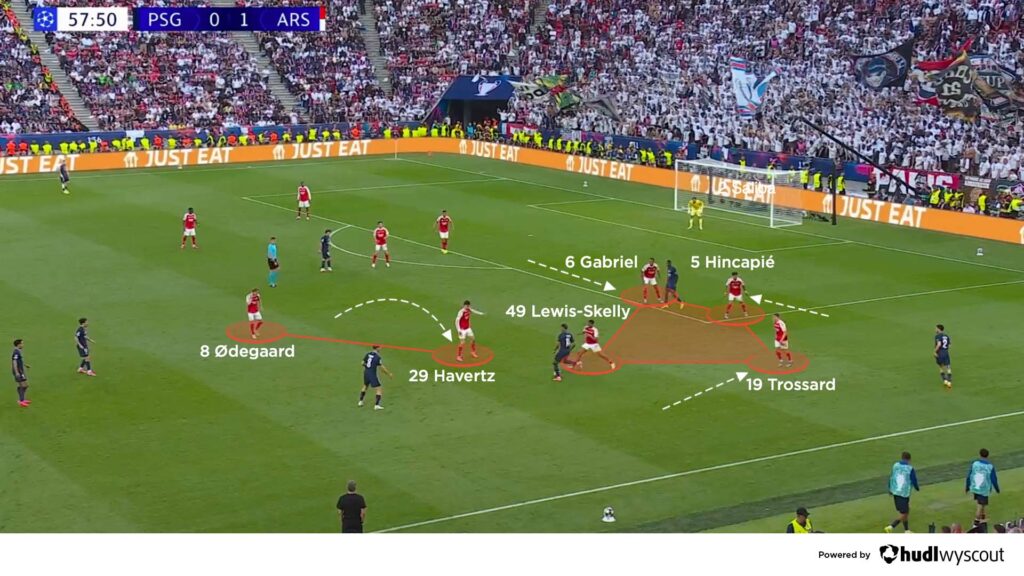
This pattern continued as Arsenal defended deep inside their own half, and was maintained whenever PSG returned to having a central forward around Arsenal’s centre-backs. The deep, recovering position of Arsenal’s wingers allowed full-backs Piero Hincapié and Mosquera to remain narrower for longer, helping protect the inside channels, close to the centre-back on their side. Lewis-Skelly and Rice covered immense ground ahead, with the forwards also working back to curve their individual pressure to force the ball back (below). Arsenal therefore limited how PSG could access the centre after progressing wide, reducing the opposition’s overall attacking output. But although they defended very well overall, defending deep for such a prolonged period against PSG was a very difficult task. Mosquera’s challenge on Kvaratskhelia after a clever give-and-go eventually gave Luis Enrique’s team the chance to equalise.
Luis Enrique tweaks PSG attacks
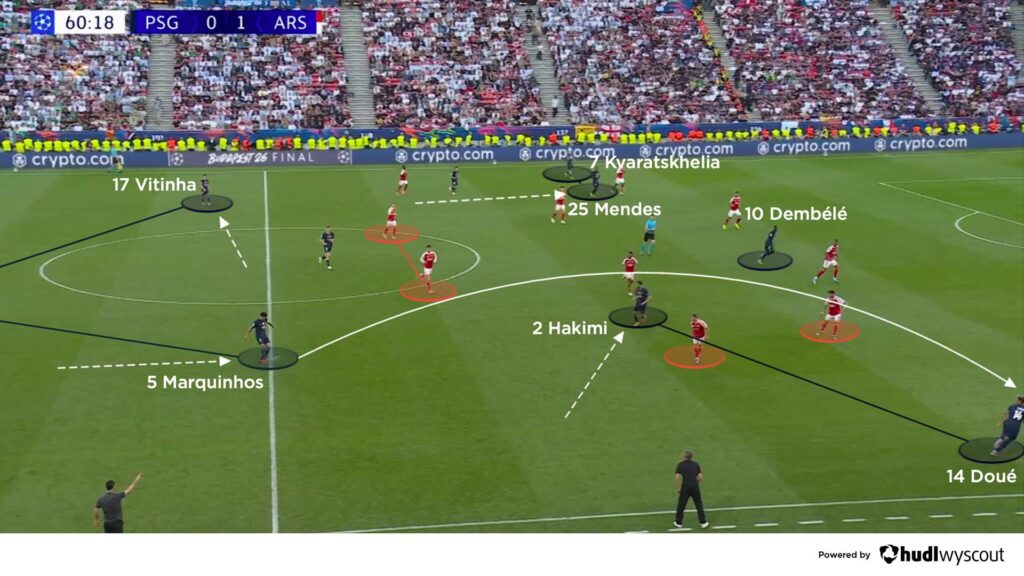
In the second half, PSG did create more dangerous 1v1 moments, especially via the wide areas. Although Doué still occasionally rotated inside in the second half, he was generally wider, helping attack Arsenal’s back line more directly. PSG’s back three quickly fed Doué, stepping in to the side of Arsenal’s front pair to then play forward into the wide attacker. When Hakimi moved inside from PSG’s right, Trossard followed, freeing access to Doué; he was then ready to attack Hincapié with the support of Dembélé as a higher, central forward. Similar moments occurred on PSG’s left, where Kvaratskhelia’s influence grew. But in order to push Mendes forward on this side – similar to Hakimi – one of PSG’s midfield had to drop back in to cover (see Vitinha, below), as they adapted the personnel in their back-line build.
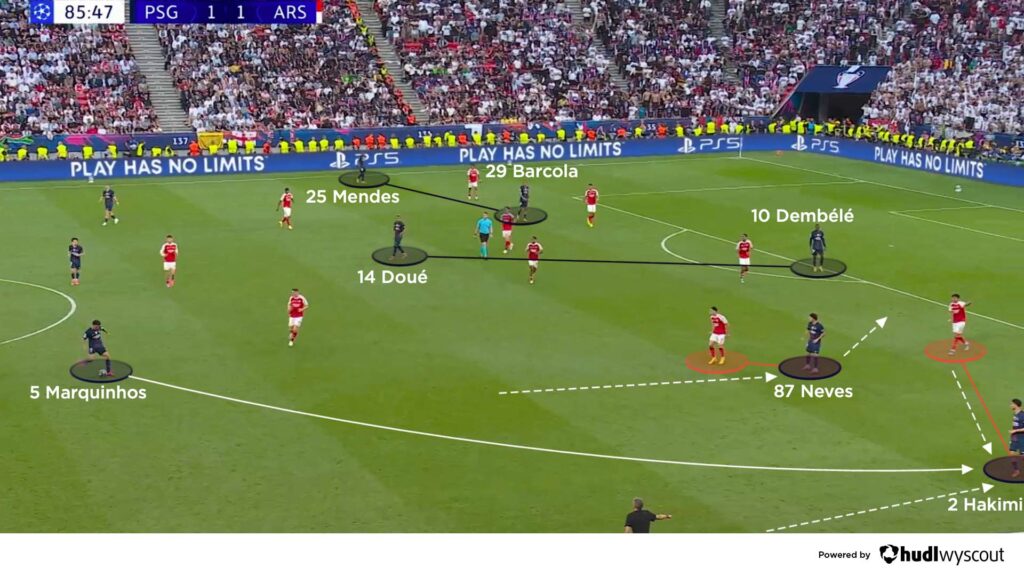
PSG’s wide pairings continued to threaten at 1-1 and into extra-time, with Bradley Barcola (on for Kvaratskhelia) getting in behind on a few occasions. Despite Arteta and Luis Enrique making 11 substitutions between them (six for Arsenal, five for PSG) and players tiring, PSG remained consistent with their use of attacking pairs. Hakimi provided more of the width on his side, with Marquinhos continuing to step in with the ball and feed him. Neves would then operate further across to support inside, making dangerous inside-channel runs as he looked to penetrate whenever Hincapié jumped out. On PSG’s left, Barcola worked with an advanced Mendes, who was covered underneath by a dropping, protective midfielder. Doué then operated centrally to attack between the lines and support Dembélé (below), before he was replaced by Gonçalo Ramos in extra-time.
Nonetheless, for all their attacking endeavour – including Kvaratskhelia hitting the post – PSG were unable to find a winning goal and Arsenal took the final to penalties. In the shootout, David Raya saved from Nuno Mendes moments after Eze had missed the target, giving the Gunners hope it could be their night. But Gabriel’s failure to convert Arsenal’s fifth kick handed the trophy back to the holders.
To learn more about football tactics and gain insights from coaches at the top of the game, visit Coaches’ Voice Academy