
fifa world cup semi FINAL, july 15 2026
Gordon (55)
Fernández (85)
Lautaro Martínez (90+2)
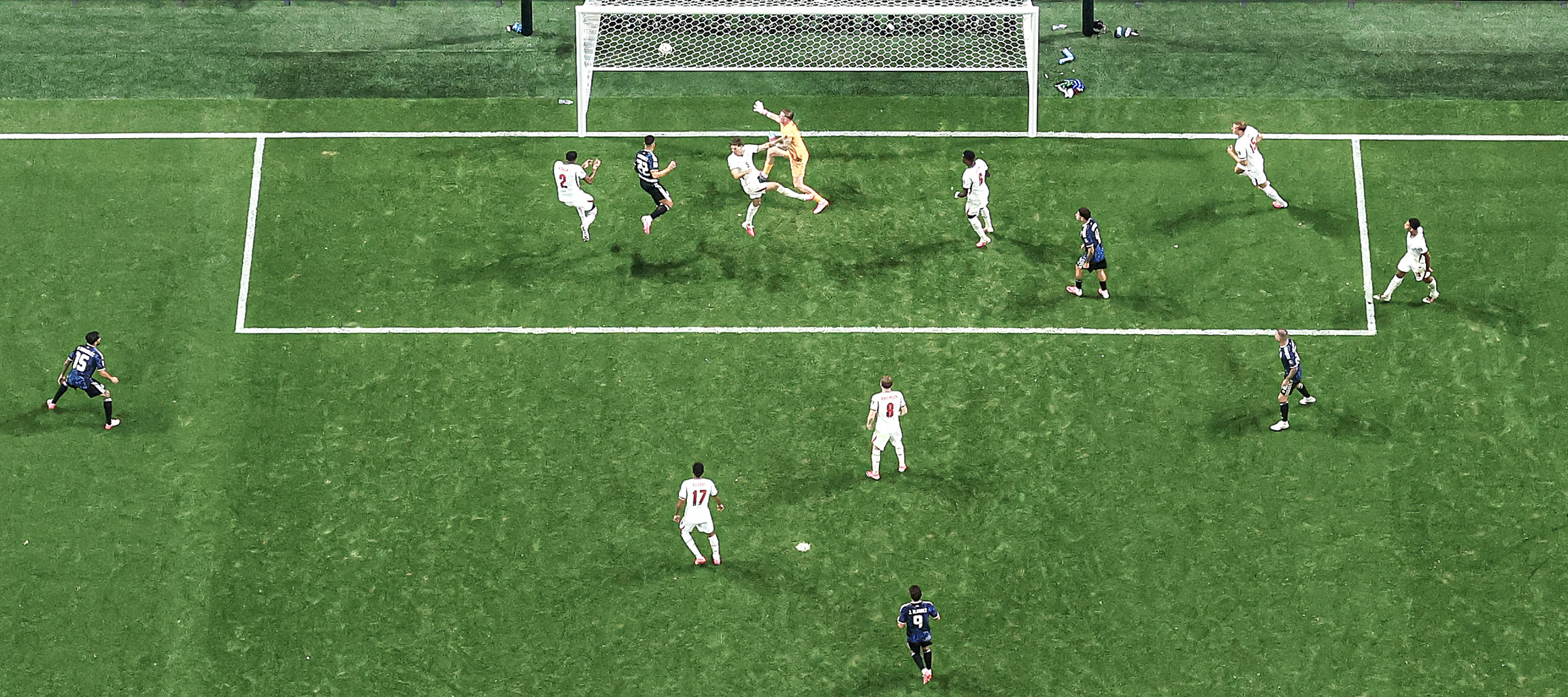
Argentina’s hopes of becoming the first team since Brazil in 1962 to win back-to-back World Cups remain alive after a dramatic but deserved late comeback victory over Thomas Tuchel’s England in the Atlanta Stadium. After a predictably tetchy first half between these two historical rivals, in which quality was on decidedly scant display, England took the lead five minutes short of the hour. Anthony Gordon’s smart finish from a Morgan Rogers cross – England’s first goal of the tournament scored by a player who plied his trade in the Premier League last season – gave Thomas Tuchel and his team hopes of reaching a first World Cup final since, yes, 1966.
With Argentina and Lionel Scaloni forced to attack, however, England retreated – and Tuchel reverted to the defensive back five that had proven effective in earlier rounds. This time, however, it was not. Enzo Fernández’s equaliser on 85 minutes, a crisp strike from the edge of the England box after an intelligently worked short corner, felt inevitable. The winner, two minutes into added time from the head of substitute Lautaro Martínez, broke England’s hearts. Both goals were assisted by Lionel Messi, who at the age of 39 remains the creative rock at the heart of much of Argentina’s attacking play. On Sunday, he has an opportunity to add yet another chapter to his already glorious story.
How the managers saw it
“We decided to go to a back five because the gaps were far too open,” said a disappointed Tuchel. “Argentina played with more risk, played with more rhythm and played with the feeling maybe that they had nothing to lose any more, which freed them up and pulled us back. Because we obviously played suddenly with a feeling that we had a lot to lose. Of course the responsibility is on the coach, and if it doesn’t go well it’s easy to say it was wrong.”
“This team plays best when they are facing adversity,” Argentina head coach Scaloni said. “We had a challenging situation, there was blood in the water and we went for it. We had six or seven chances and the ball wouldn’t go in, but the team fought until the end. After they scored, we really proved ourselves – it shows what football means to us, and it goes beyond tactics.”
Below, our UEFA-licensed coaches have analysed the key tactical points from this World Cup semi final…
 1256524841810179232613635242010179
5/2
SHOTS / ON TARGET
14/7
37%
POSSESSION
63%
18
ATTACKS INTO AREA
35
0.79
EXPECTED GOALS (XG)
1.35
England’s aggressive intentions
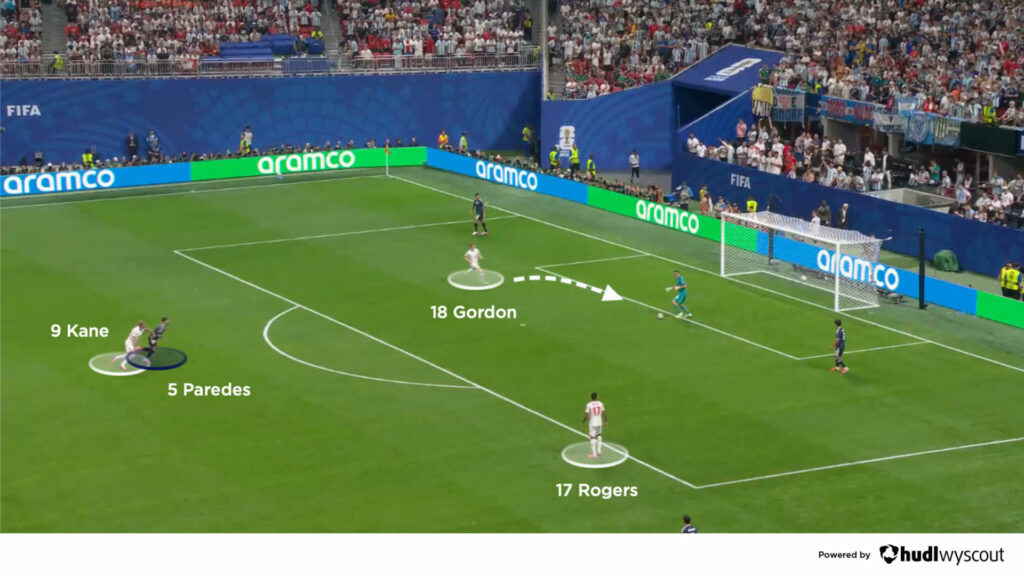
England began their first World Cup meeting against Argentina since the 2002 group stage with an aggressive pressing approach. In an adjustment from their previous matches at this tournament, they set up to press with a 4-diamond-2 structure from dead-ball restarts, and with the same principles when releasing to press in open play.
Harry Kane dropped to mark Leandro Paredes in the Argentina pivot, often front-screening to restrict him from receiving. Wide attackers Morgan Rogers and Anthony Gordon started in narrower positions to press with curved out-to-in runs on to Argentina’s centre-backs, with Gordon often leading the press with his energy and intensity (below). In deeper positions, Jude Bellingham, Declan Rice and Elliot Anderson maintained secure central positions against Argentina’s centrally focused structure in build-up.
.
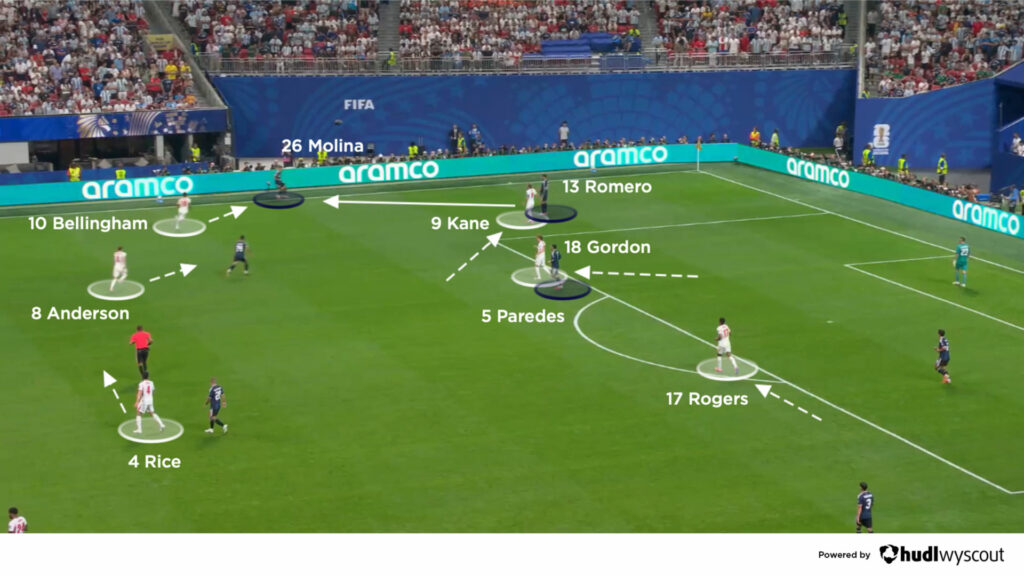
When Argentina were able to provoke England’s press and bounce out to wider areas, Kane released centrally off Paredes in the pivot, to apply pressure on whichever centre-back had the ball. The bypassed wide player – Gordon in the example below – recovered on to the back of Paredes. On the left, Bellingham released in to out from central positions to press Nahuel Molina at right-back – a strategy to keep Djed Spence in a secure defensive position against Lionel Messi. To maintain compactness, Anderson, Rice and Rogers narrowed from the opposite side (below) to maintain balance and prevent Argentina from combining inside to escape and exploit space on the opposite side.
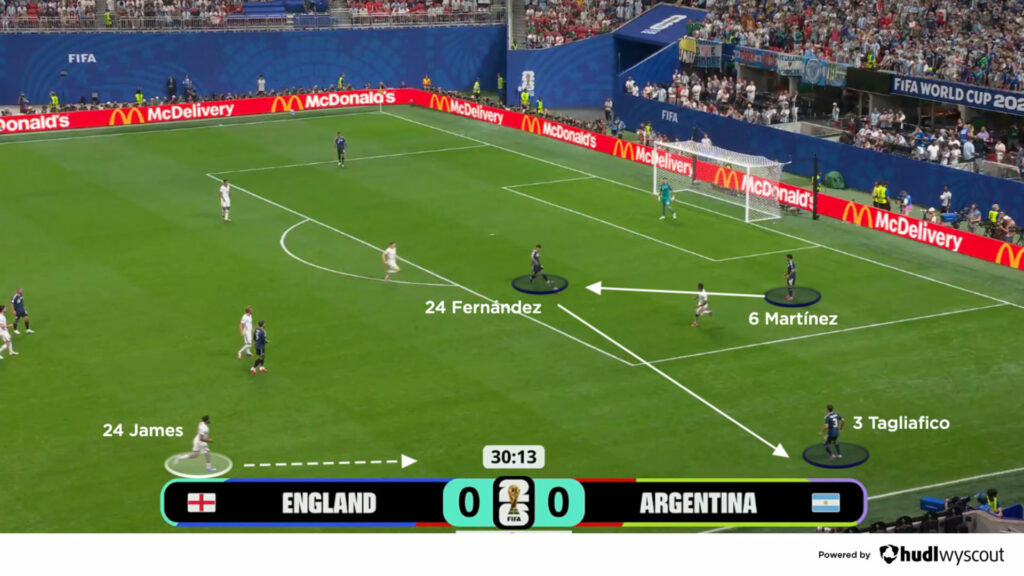
Despite some success in early pressing moments, England experienced some challenges on their right-hand side. Argentina left-back Nicolás Tagliafico adjusted his position to receive in deeper areas, increasing the distance required by Reece James to engage him (below). In these moments, the space and time afforded to a technically proficient Argentina side allowed them to escape quickly using connections in tight areas. They often found Alexis Mac Allister inside, to switch and exploit space on the opposite side, or used Julián Alvarez drifting ball-side on the last line to combine into supporting midfielders.
Threat in behind and breakthrough
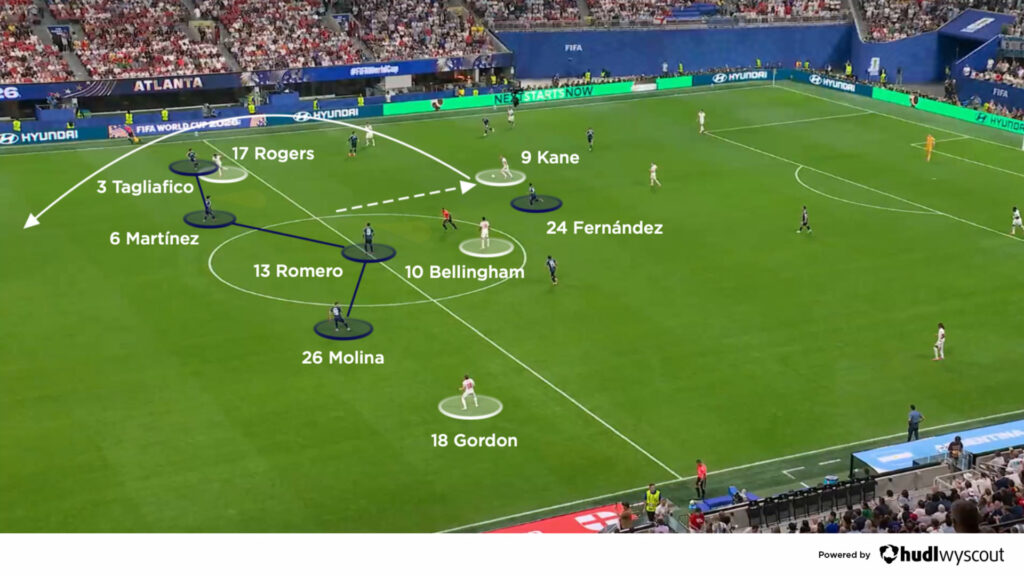
England maintained a consistent threat in behind Argentina’s back line in the first half, and this continued in the early stages of the second. Here, Kane’s ability to drop deep and receive to create was central to England taking the lead. The captain dropped from the top line, with Romero on the front foot in anticipation to engage Bellingham (below); Lisandro Martínez remained deeper but, still conscious of the threat posed by Kane, called for Fernández to shift across to affect him. This allowed Rogers the opportunity to run in between Tagliafico and Martínez with a well-timed run in behind a high defensive line, while Gordon isolated Molina wide on the left.
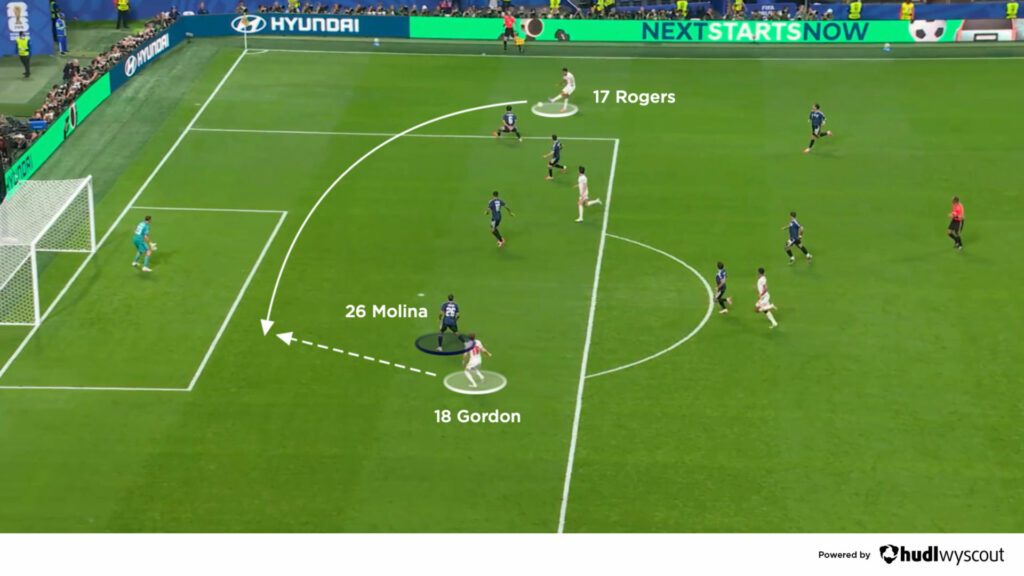
Following Rice’s regain and short pass into Rogers after landing on the second ball, the Aston Villa attacker delivered a perfectly weighted and timed cross into Gordon at the back post. The Barcelona recruit took advantage of Molina’s poor body shape to attack on the blind side (below) and give England a merited lead.
Argentina’s changes
After England’s opener, Argentina began to assert their dominance on the ball; they registered more than 80 per cent possession after the first goal. They had operated from a base 2-2-6 build-up for most of the game, but this became increasingly flexible as England transitioned through 4-4-2, 5-3-2 and 5-4-1 out-of-possession structures.
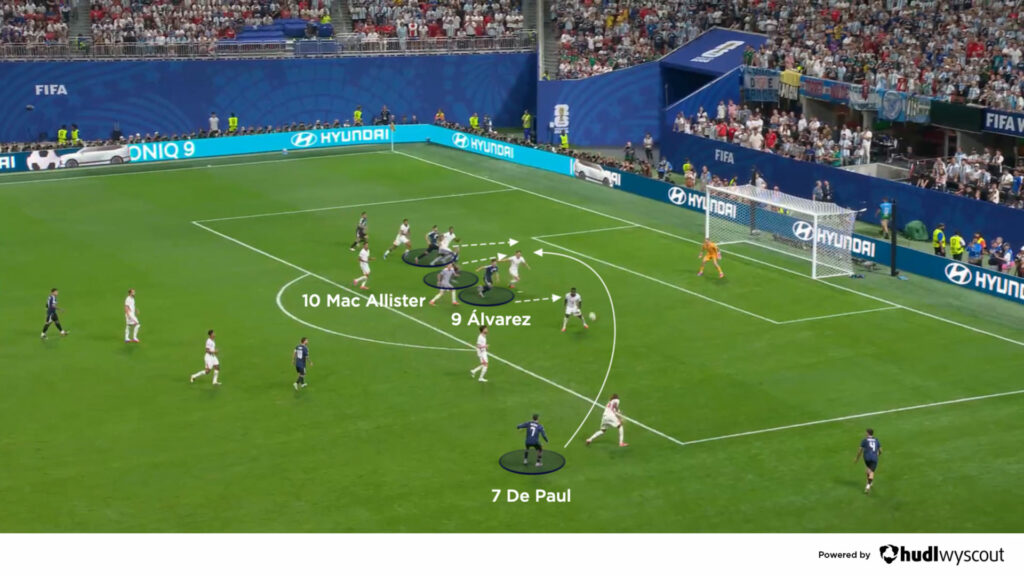
In particular, Argentina’s double pivot of Fernández and the newly introduced Rodrigo De Paul (below) became increasingly fluid to combine around England’s low block. One of these players had the freedom to drift wider, to create a 3-1 structure from which they could progress play outside England’s shape – often towards Messi on the right – and create combination or crossing opportunities from the half-spaces.
.
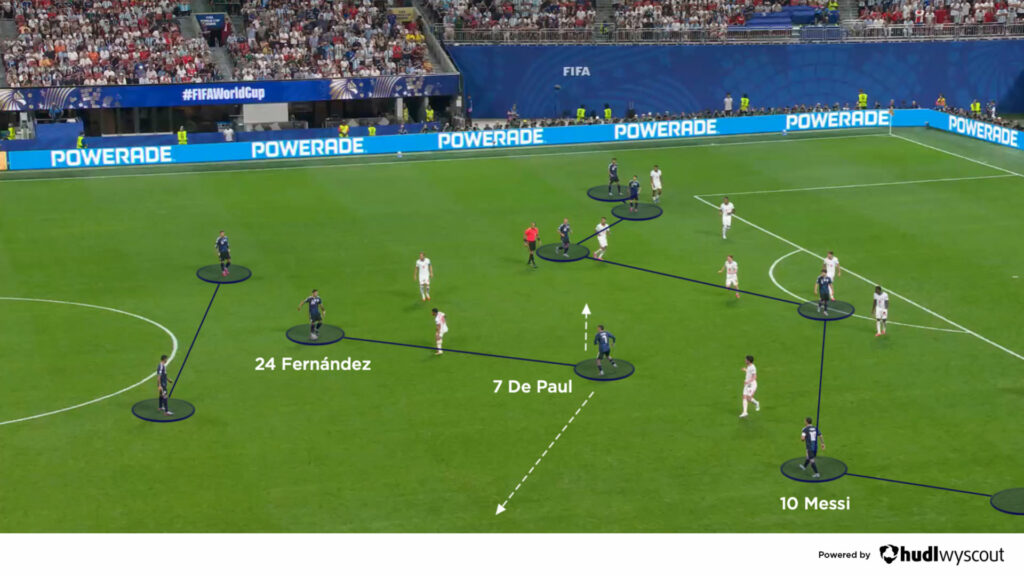
This was evident in the creation of both of Mac Allister’s narrowly missed headed chances, with De Paul delivering from a wider half-space position (below) after progressing and supporting play on the outside of England’s block. The variety of Argentina’s attacking movements, with Mac Allister’s runs from deep alongside Alvarez’s dynamism across defenders, increased the pressure on a tiring England back line. Despite Tuchel’s introduction of defensive reinforcements, England started to shows signs of disconnect between their defensive and midfield units. More and more spaces became available for Argentina to attack, both within and in front of the England block – as was more than apparent when Fernández crashed home a by-then inevitable equaliser.
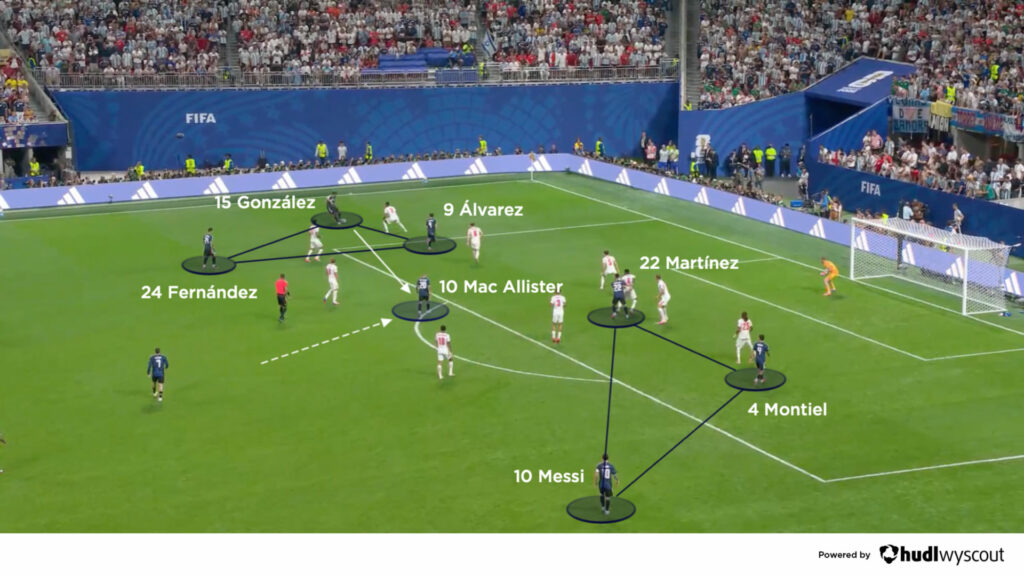
England continued to drop deeper even after the equaliser, which only allowed Scaloni’s side to push more players forward in search of a winner. The Argentina rest defence pushed increasingly high; a minimal and aggressive 2-1 structure behind the ball was made possible by the depth of England’s defensive structure and lack of attacking threat in transition. England’s inability to secure and retain possession afforded Argentina the opportunity for sustained attacking pressure, which eventually proved decisive.
One of Argentina’s double pivot was able to advance higher to support attacking play and wide combinations, as shown with Fernández in the example below. This allowed Mac Allister to rotate into a central position to receive and create between England’s lines – it was from one such move (below) that the Liverpool midfielder struck the post for the second time in the match, which ultimately led to the Messi cross from which Martínez headed home the winner.
For Argentina, the chance to win back-to-back World Cups when they face Spain in New Jersey on Sunday. For England, regret at an opportunity missed.
To learn more about football tactics and gain insights from coaches at the top of the game, visit Coaches’ Voice Academy