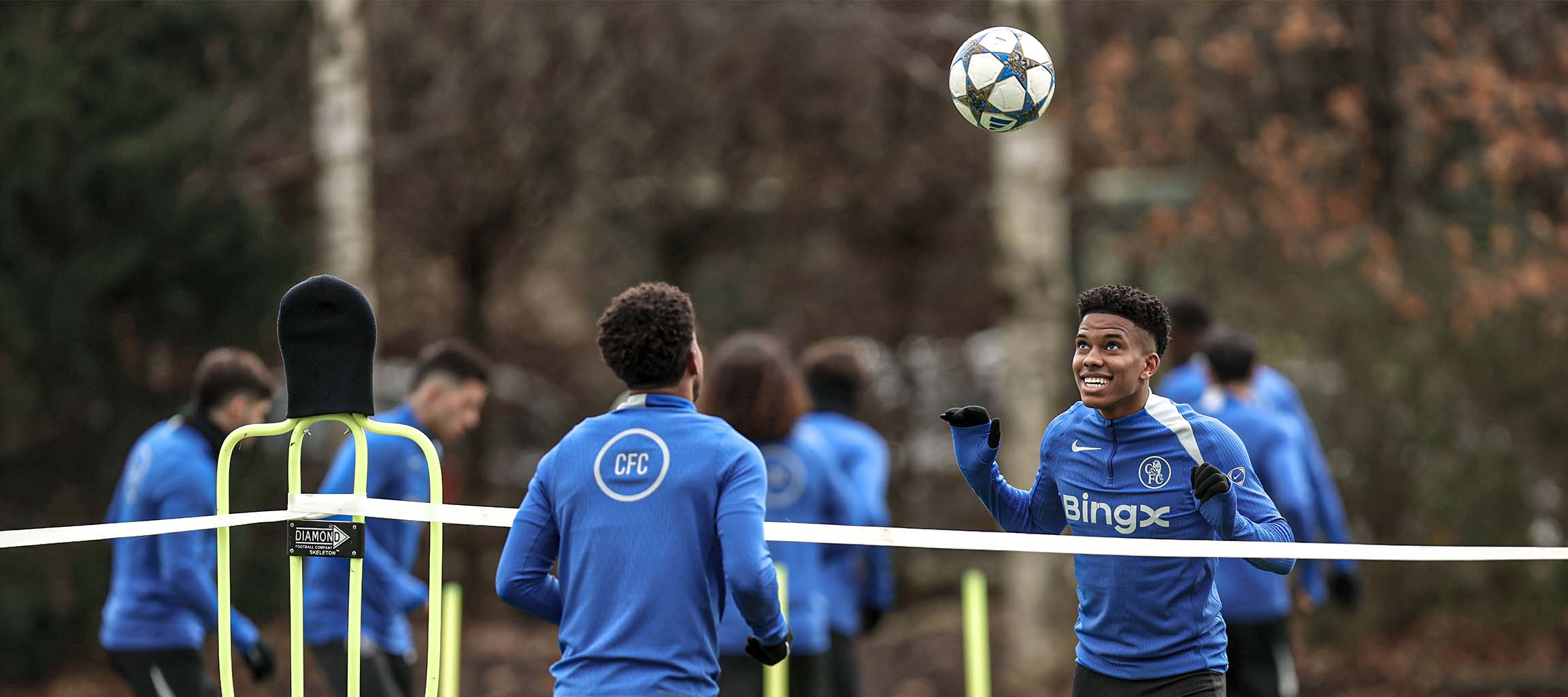

Brazilian wonderkids have been a football staple since Pelé announced himself to the world as a 17-year-old at the 1958 World Cup. The latest talent to emerge from that part of the world is 18-year-old Estêvão, who gave a demonstration of his talent at the 2025 Club World Cup, when he scored for Palmeiras against eventual winners Chelsea. What made his performance all the more eye-catching was that he did it against the club he was about to sign for.
Estêvão made his debut for Palmeiras at the age of 16 in 2023, and won his first Brazil cap in 2024 – after which Chelsea agreed to sign the highly rated attacker in the summer of 2025. He scored his first goal for the Blues with a late winner against Liverpool in the Premier League, before becoming the youngest Chelsea player to score in the Champions League, at 18 years and 181 days old. A month later, his goal in a 3–0 victory over Barcelona meant he became only the third teenager to score in each of his first three Champions League starts, matching the achievement of Kylian Mbappé and Erling Haaland.
Below, our UEFA-licensed coaches have analysed his positional and technical attributes…
Technical analysis
Estêvão is a left-footed attacker who, at time of writing, had mostly played as a right-winger. He has been noted for his dribbling, instinctively wanting to carry the ball forward to attack his direct opponent 1v1, whether in tight spaces or when larger areas open up. He can carry the ball at speed, even when using lots of little touches. The young Brazilian has fantastic timing with his give and go. He releases the ball and pushes off at the same time to immediately begin a forward run, enabling him to receive the ball back and progress.
When receiving, Estêvão will often utilise the sole of his foot to prepare for a dribble. This can entice his opponent forward as he prepares to explode away. He will time his push-off as the opponent is still moving towards him, yet to come to a complete stop, and then burst away with a change of speed.
He has encountered some difficulties when up against particularly physical opponents who are strong in the duel, and use their upper body to block any attempted run around. But in response to aggressive defenders, Estêvão has the ability to shift inside, drop his shoulder, then push off straight away with his next touch. This creates something of a zigzag motion as he dribbles (below), which is useful when he is working his way through congested defending. His drop of the shoulder can create opportunities to shoot, cross or play penetrative passes into the penalty area.
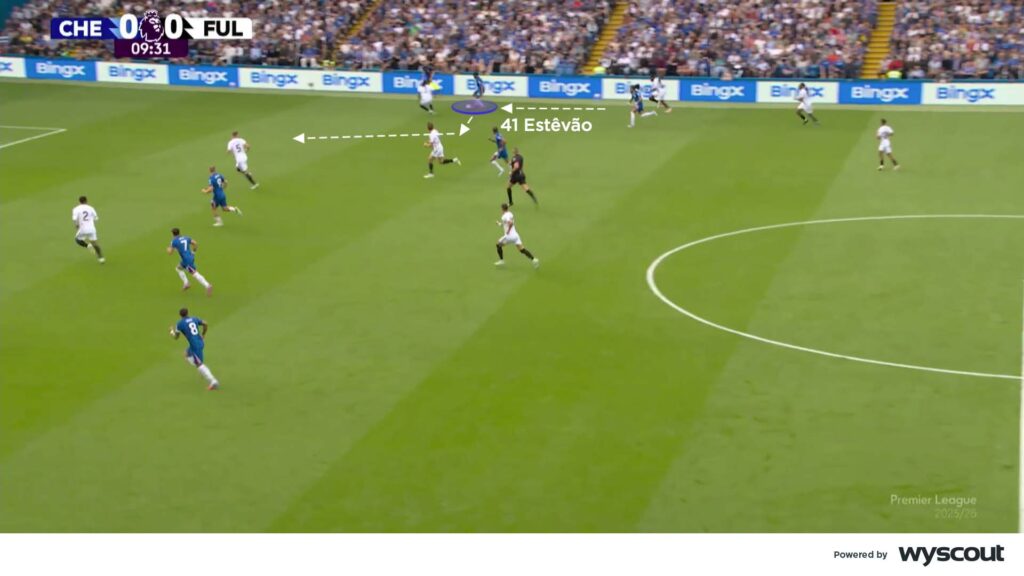
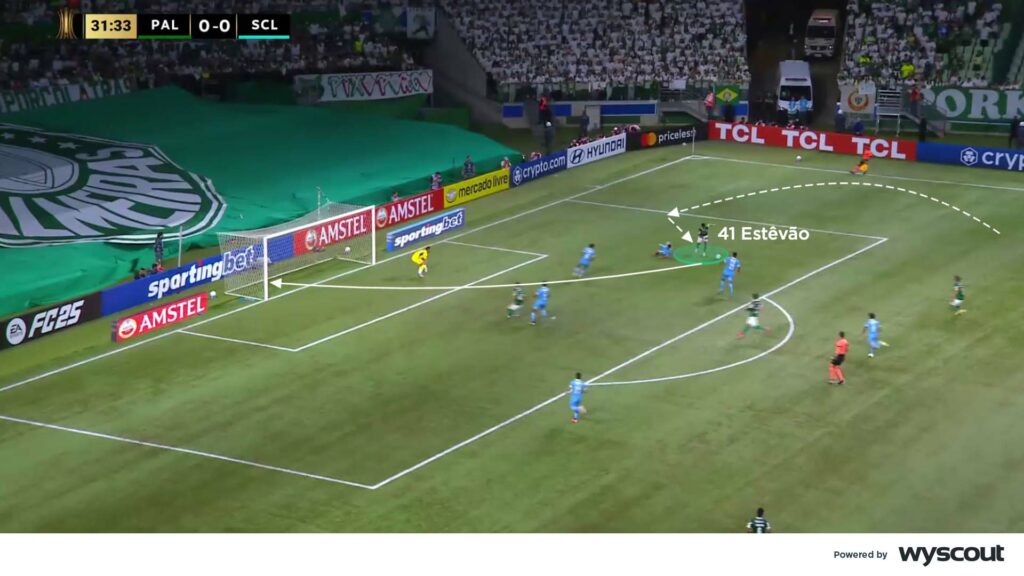
His frequent dribbles mean that he naturally looks to work shots on the angle, bending them back inside the far post. Again, he adds well-timed shoulder drops, feints, fakes and small shifts of the ball – especially from right to left – to create shooting opportunities. He has shown a calmness to these finishes on the angle, even when moving at speed (below).
He has a powerful shot, particularly when he has received centrally and between the lines. Some of his long-range strikes have incredible power, digging the ball out of his feet before unleashing dipping and swerving efforts. Even when the ball is close by – thanks to smaller touches with his dribbling, or because the central space is busy – he can generate significant power.
He sometimes looks to run beyond, typically on the outside shoulder of his full-back opponent when a pass is slipped inside the left-back. From there he may look to open his hips to finish on the angle, but can also use his right foot to power finishes high at the near post. He is slowly adding more runs that take him across his opponent – similar to Bukayo Saka – to receive on the move, but will need more of these to add further variety to his final-third play.
The Brazilian international has shown a willingness to attack the back post, adding goals by running blindside or across his full-back marker – such as when attacking low, driven crosses. He is getting into these positions with increasing regularity, to pounce on rebounds, deflections or saves, adding the kind of reactive goals that are an important source of any winger’s goal tally.
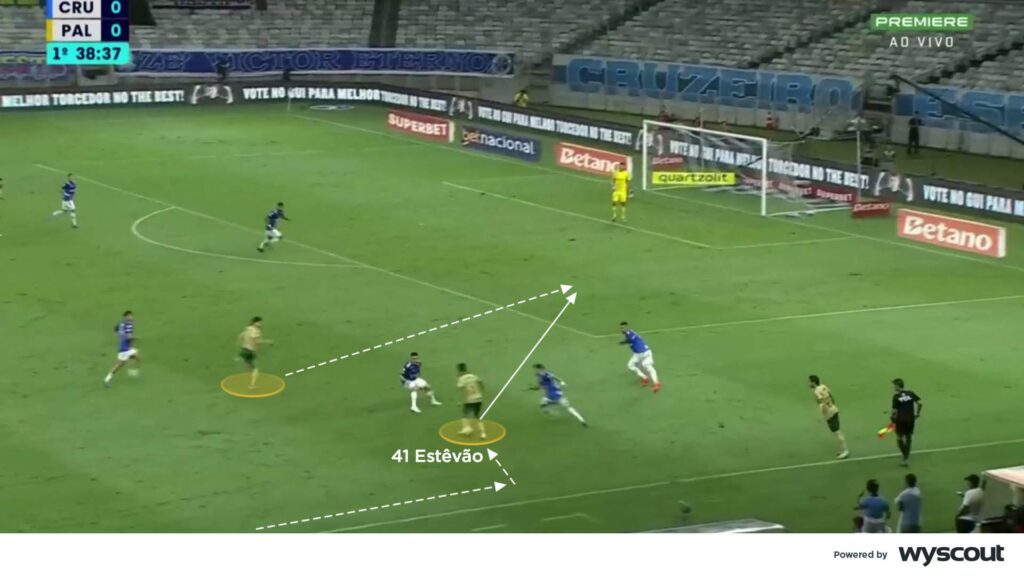
When not impacting the goal directly, Estêvão can support the creation of attacks, penetrating the penalty area frequently. His slipped passes in behind are useful in combining with forward-running teammates; he plays these passes after dropping his shoulder when coming inside (below). Around the box, he has been clever with working the ball into teammates, especially when using disguise on his actions. Although he could be a little smoother with his releases once inside the box, that often comes with the territory in his position. He will most likely improve with age and experience.
His low, driven crosses are powerfully hit across the face of goal and can cause all sorts of problems for defences, while he sometimes uses clever disguise to reverse cut-backs. That sort of variety is allowing him to better attack on the outside when playing on the right. With further work, he should become a winger who can fully attack both ways – this is vital in the modern game.
Right-winger
With Palmeiras, Estêvão mostly operated as a right-winger in a 4-2-3-1 structure, while occasionally playing as a winger or wing-back in a team with a back three. During a particularly fruitful 2024 Brasileiro Série A season with Palmeiras, he returned the most combined goals and assists (22) in the entire division.
He especially benefited from varied and fluid movements from Palmeiras’ opposite side. As he held the width on the right, play across to his side allowed him to receive in bigger spaces, with the opposition drawn across to the left.
From here, he was often left alone to attack 1v1, with right-back Marcos Rocha selective around when to support and when to leave him 1v1 (below). As a result, in 2024 Estêvão recorded the most dribbles of any player in a single Série A campaign since 2021. In doing so he demonstrated his ability to beat his opponent, cut inside, score goals on the angle and penetrate the penalty area. He recorded the third-most shots in Série A in 2024.
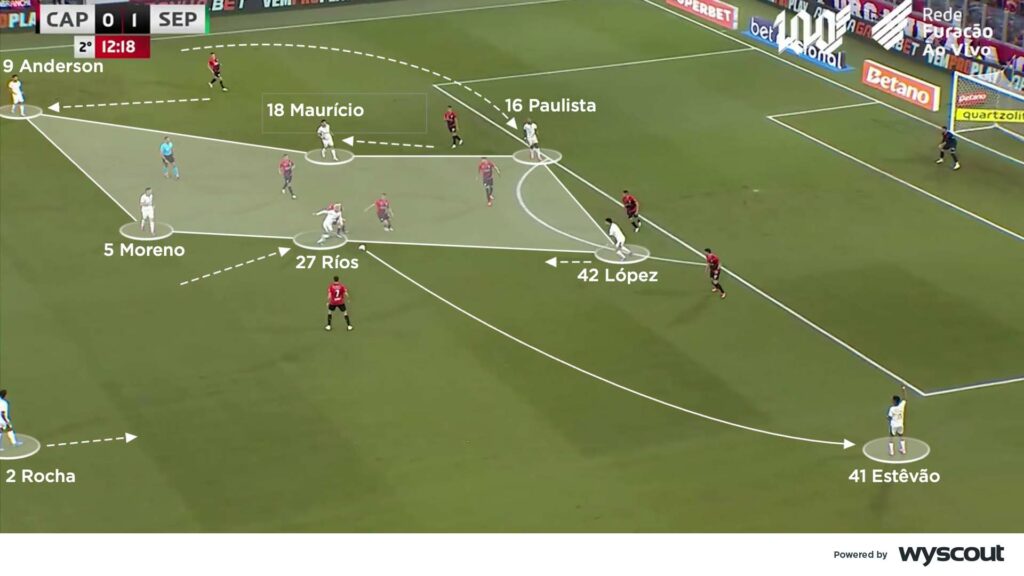
In Palmeiras’ 4-2-3-1, the double pivot often moved across, giving Estêvão a passing option to combine back inside with, including a give and go. With the number 10 – Maurício or Raphael Veiga – often involved in combinations on the left, space inside was also available for Estêvão to aggressively drive inside. The number 10 did make narrowed runs in support, which Estêvão was able to pick out with his penetrative through balls. He also made bending runs himself, across or towards centre-forward José Manuel López, to combine. Indeed, Estêvão ranked joint-third for key passes in Série A in 2024.
With the numbers on Palmeiras’ left making movements to get in and around the box, Estêvão had options for inswinging crosses, as well as driven efforts towards teammates in the middle or at the back post. Cut-back options were available too, with the double pivot, withdrawn attackers, or an advancing left-back lurking on the edge of the box.
Early in his Chelsea career, he continued to attack mostly from the right within an initial 4-2-3-1 shape. But Chelsea have often morphed into a back three under Enzo Maresca’s management, with one of the back line moving into a midfield unit of four. In this adapted shape, Estêvão has held the width on the right, but without the full-back support he had at Palmeiras. He has, however, had earlier options to pass inside, combining backwards with the closest of the double pivot, or higher with the closest of the two number 10s, or a number nine moving across in the case of rotation in the front line (below).
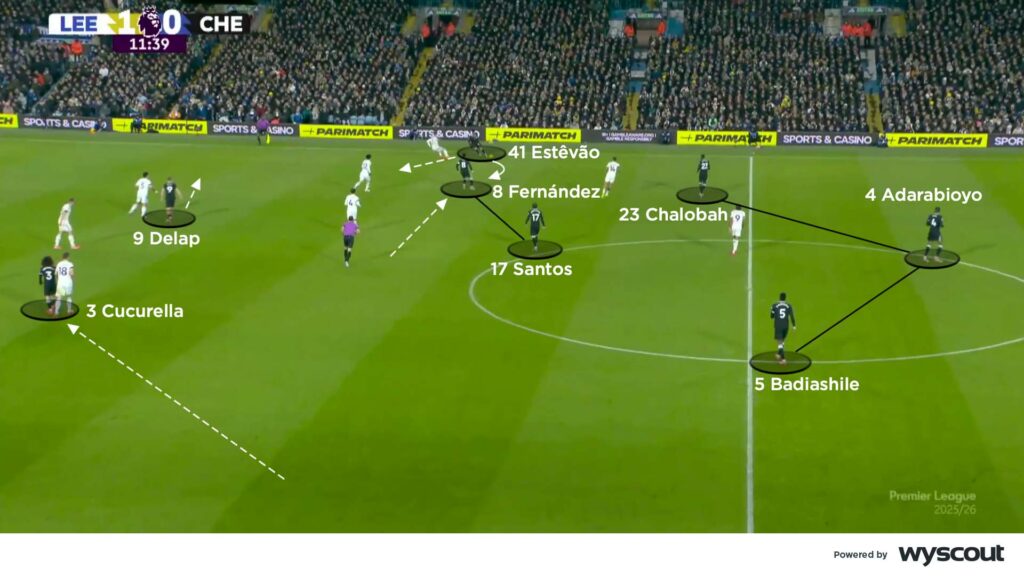
At Chelsea, Estêvão has had more opportunities to work the ball towards teammates looking to penetrate the penalty area. He has also had opportunities for earlier give-and-go combinations, especially if the opposing full-back has jumped out. There have still been plenty of opportunities for him to dribble 1v1 and attack diagonally to goal. And with a centre-forward, two number 10s and opposite winger all looking to attack the box when he progresses forward, he has had options to pick out with his crosses. These have included inswinging deliveries for runners to the back post, especially the opposite 10 and the far winger. But given that Maresca’s attacking unit is a little more structured than the Palmeiras side he played for, he has closer support at Chelsea as he dribbles inside, which means that attacking around, on his right side, could prove to be an increasingly fruitful option for his crossing.
“He is a huge talent,” said Maresca after Chelsea had faced Estêvão at the Club World Cup. “He is going to be an important player for this club.”
To learn more from the professional coaches courtesy of Coaches’ Voice, visit CV Academy