


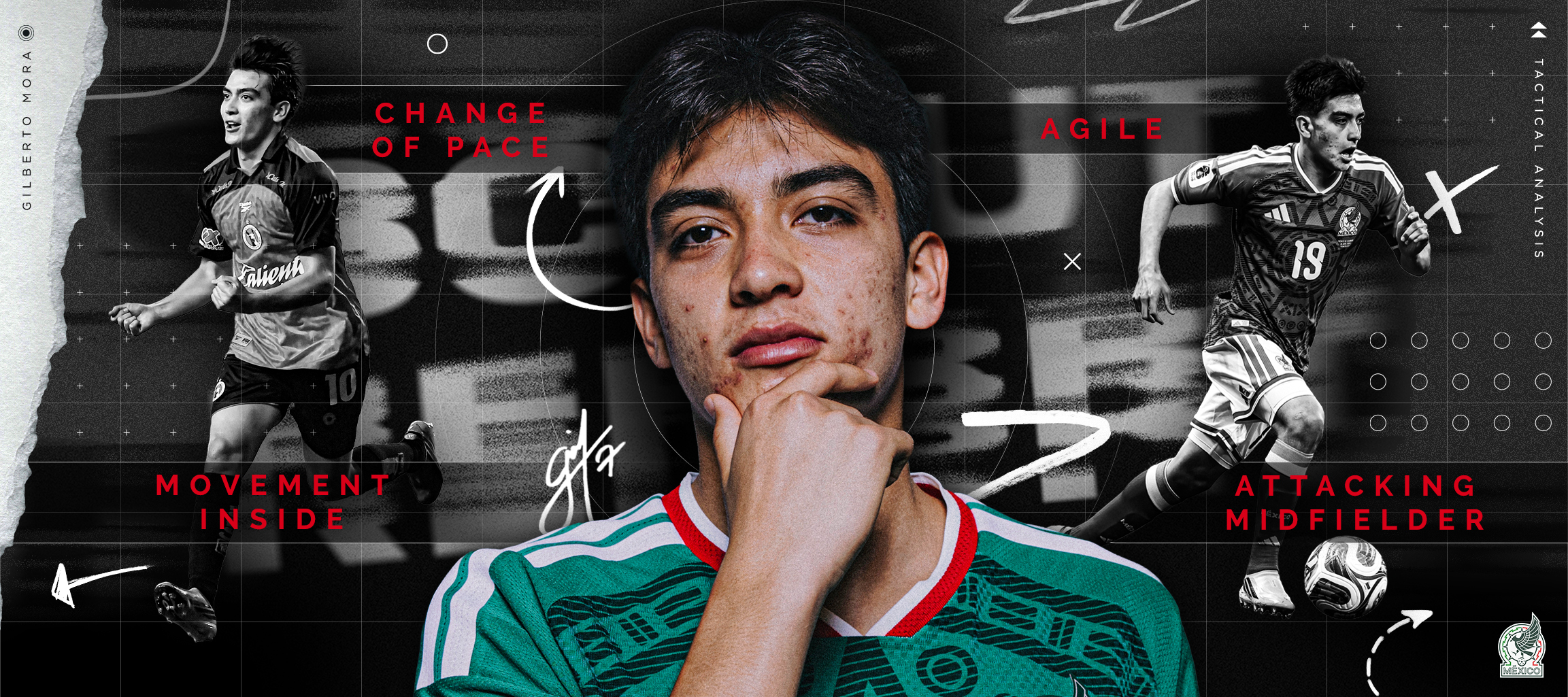

Gilberto Mora
Club Tijuana, 2024-
Talent knows no age, but it certainly knows records in the case of Mexico’s Gilberto Mora. At 17 years and 347 days, he became the Mexican national team’s youngest ever goalscorer, netting against Colombia in September 2026. Despite his tender age, such has been his impact at senior level that clubs including Liverpool, Arsenal and Barcelona have been strongly linked with signing him in the January 2027 transfer window.
A diminutive, nimble attacking midfielder, Mora came through the youth ranks of Mexican side Club Tijuana – otherwise known as Xolos – before making his professional Liga MX debut for the club at only 15 years and 310 days old. In doing so he became Tijuana’s youngest debutant and the Mexican top flight’s youngest player to provide an assist. Just 12 days later he became the league’s youngest ever scorer.
His meteoric rise continued when he played for Mexico at the 2026 World Cup. There he again put his name in the record books, becoming the sixth-youngest player to feature at any World Cup, and the second-youngest to start a knockout match, behind none other than Pelé. Below, our UEFA-licensed coaches have analysed Mora’s technical attributes, positions played to date and style of play, as well as areas for development…
Physical profile and style of play
Slightly built, Gilberto Mora stands 5ft 6in tall, with a physique that aids his eye-catching coordination, agility and ability to change direction.
At Club Tijuana, these characteristics have helped him operate in tight spaces (below), unsettling opponents with changes of pace on the ball. He can slow down to engage a defender, then change direction when his opponent steps in or shifts their body weight. He can also change direction while carrying, or on his first touch, transforming what can look like a tricky reception into an opportunity to progress.
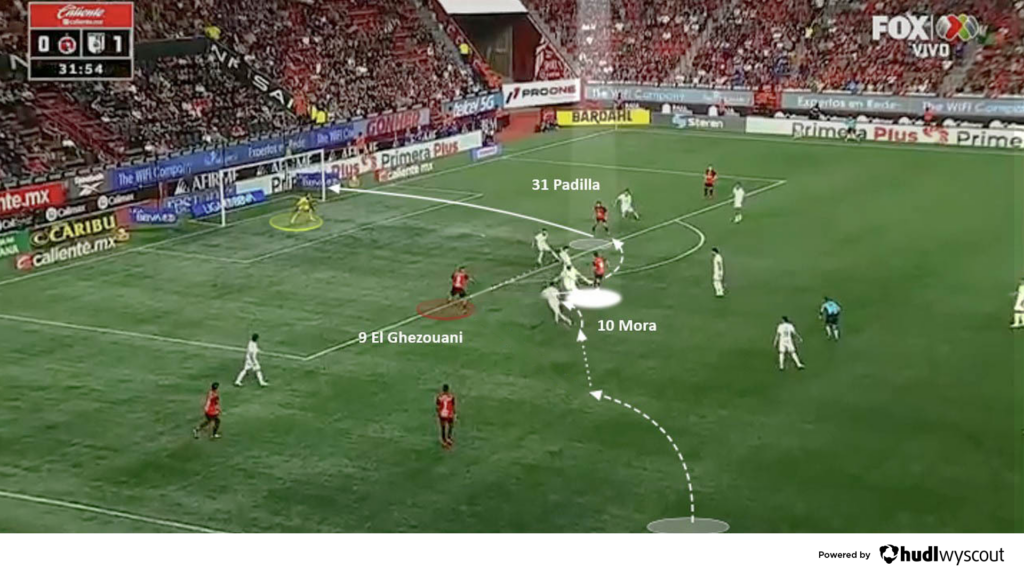
Although he is right-footed, he also carries the ball, links, and finishes with his left foot, making it difficult for opponents who want to influence his next action by showing him to his right. Mora uses his body to position himself between the defender and the ball, using small turns and his arms to keep opponents at bay (below).
His ability to protect the ball is less effective when he faces consecutive challenges. Mora can beat a first defender with a well-directed first touch, but can lose his advantage when faced with a challenge from behind or the arrival of a second opponent. In such scenarios he needs to make the right decision after creating the initial opening – either continue carrying the ball when space is available, or release it before becoming boxed in.
Physical development should allow him to operate more effectively in a 2v1, while improving his pass selection would also help.
Positional profiles
Mora has the characteristics to play as a number 10, receiving behind the opposition midfield line and staying close to areas where chances are created and finished. At Tijuana, he has fulfilled this role from a central position, as well as starting from the left flank (below), where he has operated as a false winger looking to move inside.
His preference for starting from the left allows him to move into central areas and link up with teammates positioned around the edge of the box. When starting wide, Mora can attract a full-back before finding space between the defender and midfielder on his side. If he receives inside he can turn towards goal, and if an opponent tracks him it creates space for a teammate to exploit on the outside. That requires a full-back teammate or another attacker to maintain the width, preventing Mora’s movement inside from compressing the attack into the same channel.
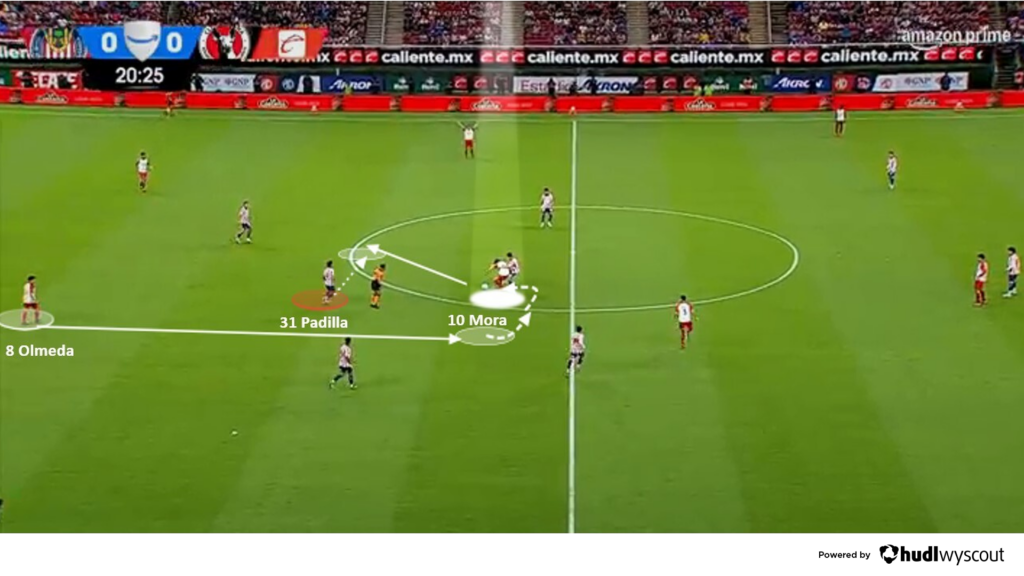
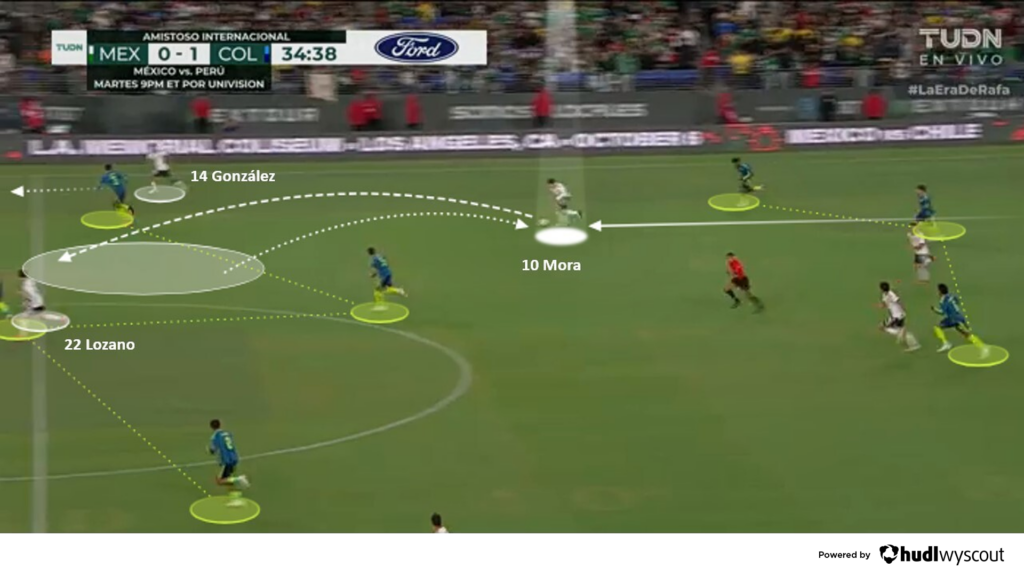
He has the potential to develop into an eight, thanks to his ability to operate at different heights and areas of the pitch. For example, he can drop to offer a passing option to the player in possession and help progress the ball through a turn or lay-off (below). He has the tools to then advance and reappear between the lines, linking build-up play with the attack. In a 4-3-3, that movement could see him get more involved in play, provided he coordinates his movements with the holding midfielder and the other eight.
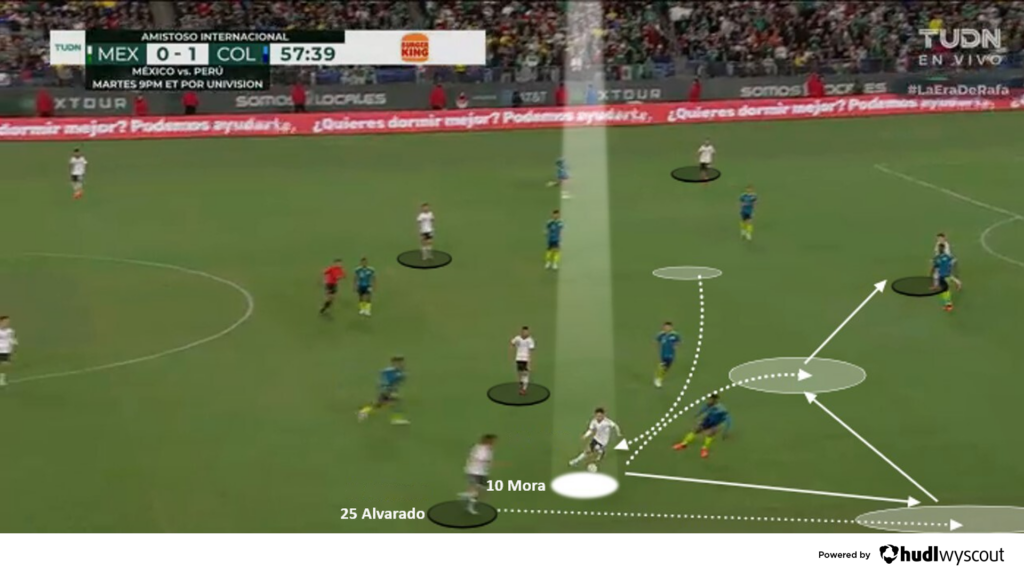
Mora has also played as a supporting, second striker, receiving offloads from the centre-forward and getting into the box. This sort of versatility means he can play various positions, but at his age there is still much to learn about the responsibilities of each role, particularly when he is operating far from goal. Whatever the situation, the key for Mora is to be closely linked to his teammates, complementing his use of space with theirs.
Attacking and combination play
One of Mora’s most frequent attacking movements is carrying the ball diagonally from the left into central areas, approaching the edge of the box and provoking defenders into actions that can free up his teammates. He has been known to slow down in front of his marker, retaining possession while waiting for a passing lane to open up. If a defender steps out, Mora can link with a teammate, but if they stay put he can progress to a shooting position. His ability with his left foot also means that he doesn’t have to shift the ball onto his right to deliver a pass or cross (below).
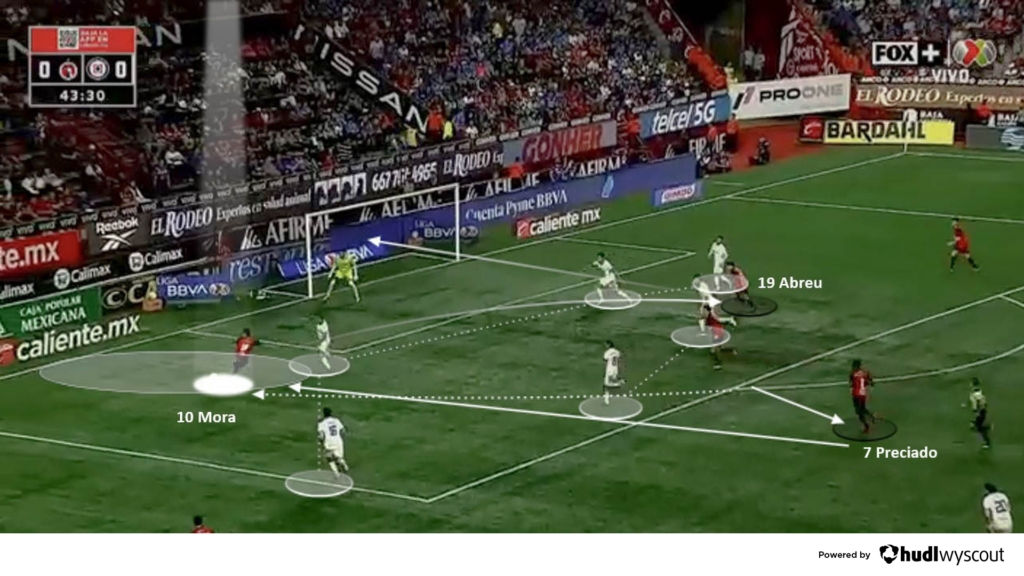
His value to Tijuana’s play has been notable when the striker on his team has fixed the opposition centre-backs, while the wide players threaten other spaces. In this scenario, Mora’s carries have connected with runs that force the opposition to simultaneously defend the ball, the space in behind and runs from other attackers. Mora’s one-twos and combinations have then helped him to beat the press without unnecessarily prolonging his dribble.
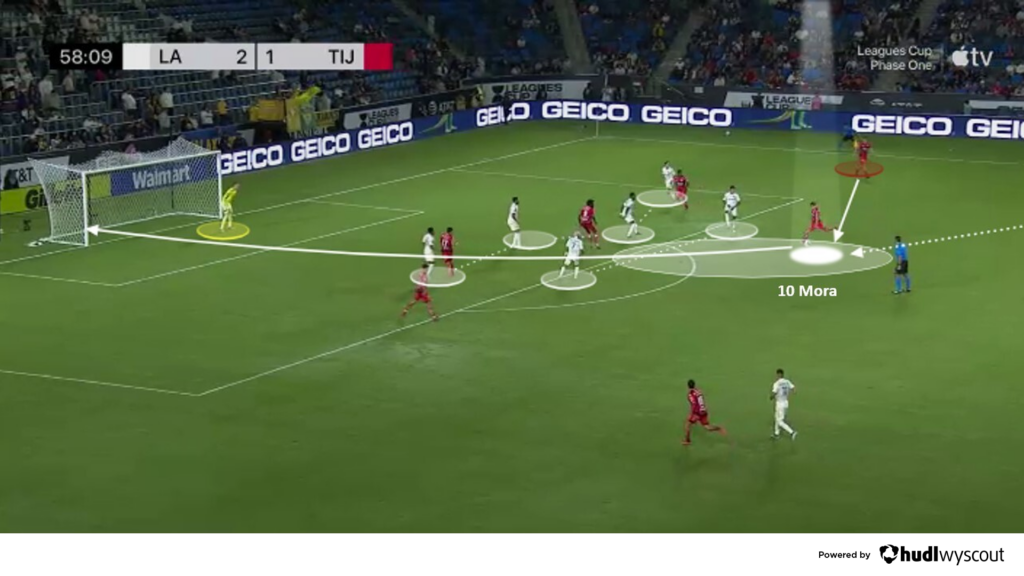
He can play the ball, move into a better position and receive again, or lay off first-time so that a teammate can continue their run. After passing he has tended to look for a supporting angle to join the attack, both creating and finishing chances, including shots from outside the box (below).
Off the ball and out of possession
With his movement, Mora has consistently worked hard to keep passing lanes available and occupy space that has opened up when Tijuana have progressed an attack. This has included moving closer to the player in possession in order to combine, moving wide to change his receiving angle, or advancing after a lay-off. His adjustments have been particularly useful when Tijuana have faced a press that blocked direct passing into their forwards. By providing a passing option, Mora has linked play and provided an alternative route to progress through the middle.
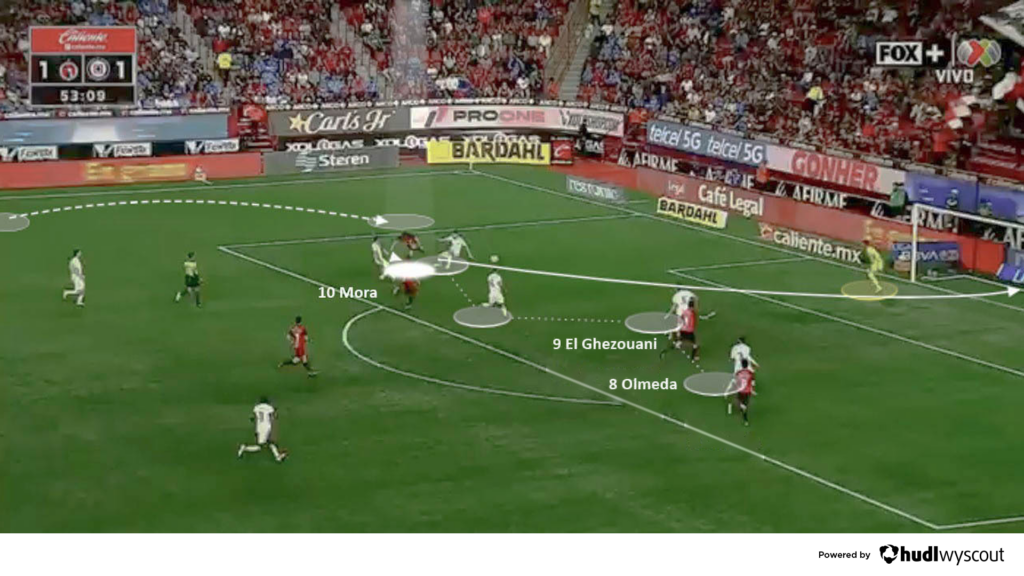
His reading of the game has also made him more effective when arriving in the box. When his striker occupies the centre-backs, Mora can arrive from the second line (below) – as the move progresses down one flank, he can support by moving to the opposite side and looking for a shooting position. His aim is to arrive when the defence is drawn towards the ball, taking advantage of defenders shifting their attention, and avoiding being picked up too early inside the box.
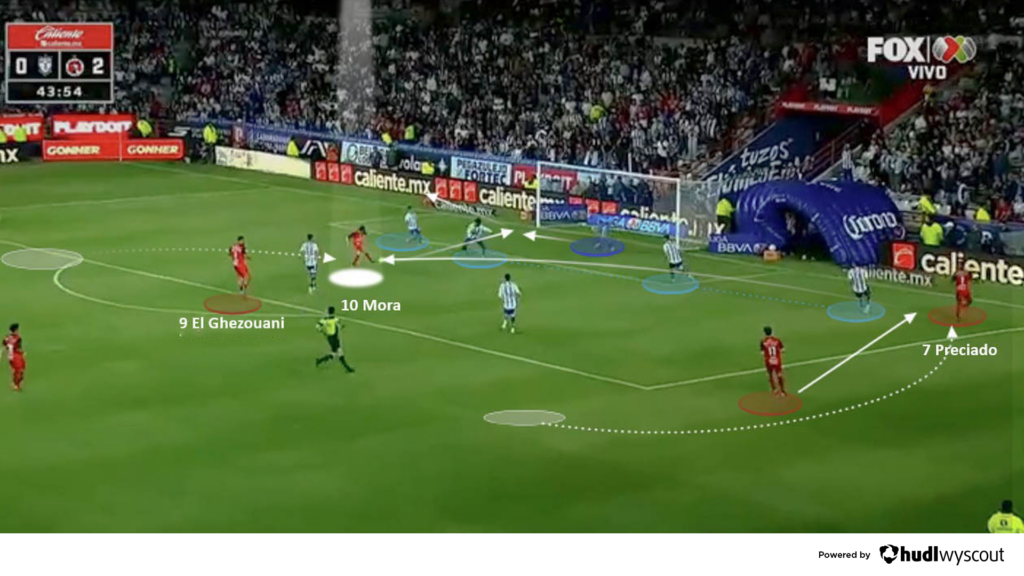
In defensive transitions, he has shown a willingness to react after losing possession by immediately trying to win the ball back (below). This response is particularly useful near the opposition box, where an immediate regain can create a chance close to goal before the opposition can reorganise their defensive block.
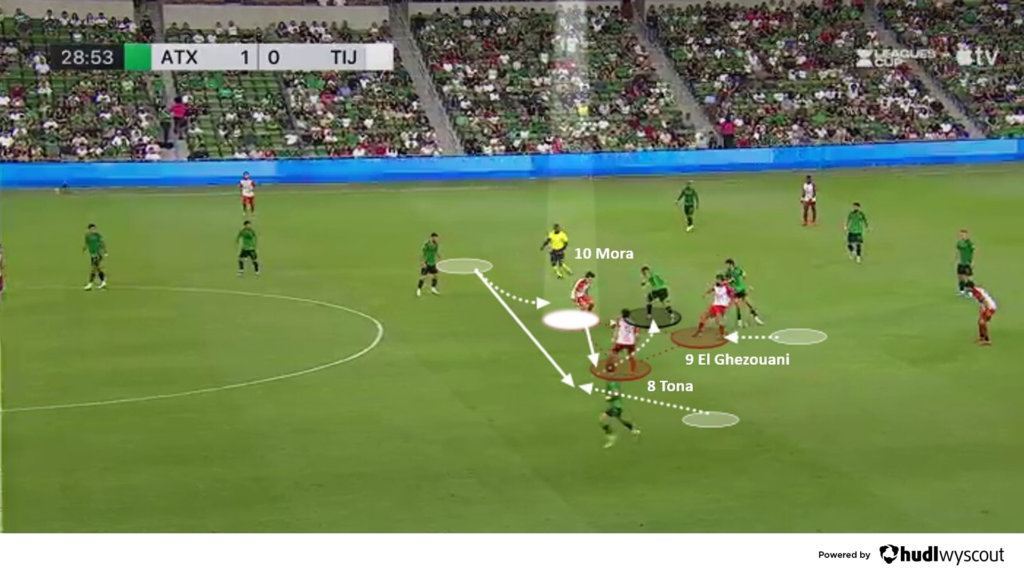
Mora has room to improve with his out-of-possession contribution by harnessing his enthusiasm as part of a collective press. As a number 10, he can move towards the centre-back while blocking a passing lane into the holding midfielder. As an eight, he must recognise when to step out and when to protect the space he would leave behind. And the direction of his pressing run matters as much as its intensity, because of how it can influence the direction of the opposition build-up. He must also learn to adjust how far he drops back, particularly when he is coming from an advanced position following an attack. Developing such discipline will allow him to retain his attacking freedom within a structure that helps his team to defend after losing possession.
His role with Mexico
Under Javier Aguirre, Mora provided a link between Mexico’s midfield and forwards, offering support between the lines, mobility and precision in tight spaces. He was trusted enough to start the quarter final, semi final and final of the 2025 CONCACAF Gold Cup, and has been valuable to Mexico as a substitute, not least coming on in the 66th minute of the 2026 World Cup game against South Africa.
As a substitute he can reshape an attack that needs support in central areas, or greater speed in its combination play. His ability to turn can force the opposition to track a new receiver behind their midfield line, while his one-twos can help Mexico get closer to the box. To make the most of these qualities, he needs teammates who continue those moves, including a striker to lay the ball off, players who threaten in behind, and others who provide cover for his movements. When he has that structure in place, his introduction can transform the dynamics of the attack.
In the early stages of Rafael Márquez’s tenure as Mexico manager, there are signs that Mora may play a greater role in build-up play without losing the threat he poses in the final third. If he plays as a number eight he can move closer to receive the ball, draw pressure and link further forward (below), whereas playing as a number 10 he can concentrate his influence around the striker. In Márquez’s first game in charge, against Colombia, Mora started and scored the equaliser with an individual move that combined control, a feint and a finish.
It was another glimpse of his prodigious talent, and there is no doubt that Mora is an exciting prospect. If he keeps up his rate of progress it will be just a matter of time until he moves to one of Europe’s richest clubs. Watch this space.
To learn more about football tactics and gain insights from coaches at the top of the game, visit Coaches’ Voice Academy
