What is meant by ‘creating overloads’?
Creating an overload means gaining a numerical advantage over the opposition in terms of players in a specific area of the pitch – for example a 3v2 or 4v3 in midfield. Overloads can be established either when a team has the ball or does not have the ball. When a team has the ball, creating an overload can help them progress play to create opportunities to score. When a team is defending, overloading the opposition can help to restrict space, win the ball back and protect the goal. Here, we are focused on the theme of creating overloads in possession.
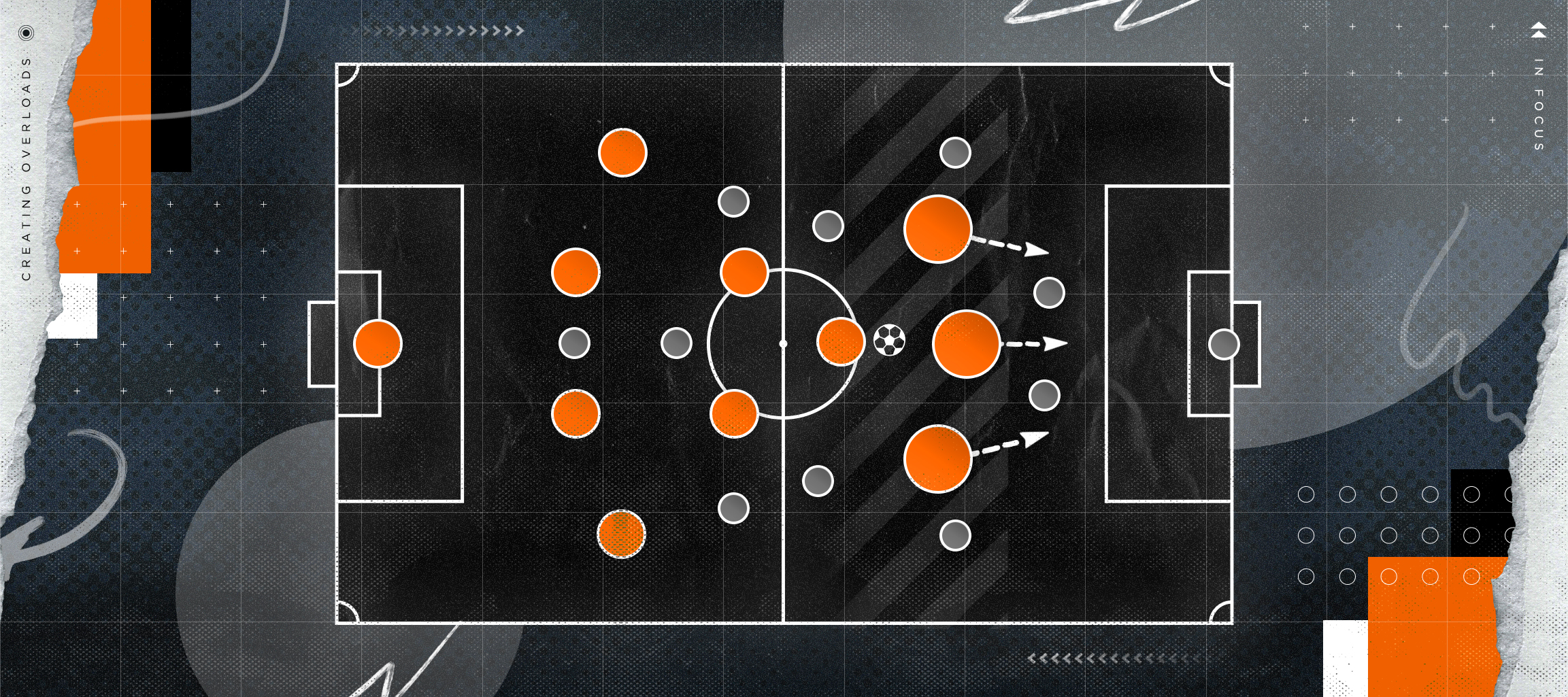
How that extra player is achieved varies with the formation, the area of the pitch, and the movement of the opposition. For example, if the opposition have three players in central midfield, two pivot players plus two players higher up the pitch can form a midfield box for the attacking team, creating a 4v3 in that area. On the flanks, a triangle of three can overload two opposition players.
Why is creating overloads important?
Numerical superiority can help to create advantageous attacking situations, through unmarked players and space that can be exploited. An overload can provide options to find a pass that breaks a line, or it could prevent a defender from tracking a run because they are occupied covering another player. Creating overloads can separate teams that create chances consistently from those that rely on moments of individual quality to unlock organised defences.
Click the links below for two Coaches' Voice sessions designed to develop a team’s ability to create and exploit overloads.
What are the key principles of creating overloads?
Numerical supremacy and recognising how to achieve it
There is no overload without having at least one more player than the opposition in a particular area. Recognising good opportunities to create an overload can happen in real time as a passage of play develops, or through communication between players, and between players and coaches, as the picture in a particular area of the pitch becomes clearer as a game progresses.
Intelligent movement
Movement within and around the shape of an overload is what makes it genuinely threatening. For example, a full-back can invert – that is, move inside the pitch – to create a 4v3 central overload in a box shape. Here, two midfield pivots – temporarily including the inverted full-back – anchor the base of the box, and two higher players complete the top. The top and bottom of the box should be staggered – one nearer the ball, one further away – rather than being on the same horizontal line, so that the opposition cannot press both options with a single movement.
Rotations
Having attacking players interchange positions can help create the overload as well as confuse defensive marking. A wide attacker coming inside, for example, can force an opposition full-back into a difficult decision: follow the attacker centrally and leave space in behind that could be exploited, or hold and potentially allow them to receive as a free player in an overload?
Change of speed
Overloads can be created patiently and exploited quickly, with a deliberate distinction between those two phases. A team may build a move with composure and clean possession, waiting patiently for space or a gap to appear in the opposition block – for example, if an opposition player jumps out to press, or the press shifts to one side. At this moment, if the in-possession team identifies an opportunity to exploit an overload, they should be decisive and accelerate their play to exploit it before the defending team recovers.
Playing against the flow
As the ball moves laterally, a defending team will shift in the same direction, which leaves space on the opposite side of the pitch. Moving the ball quickly against that flow, switching to the side that the defending team has left exposed, can be an effective way to create and exploit an overload. The switch needs to be fast, to avoid giving the opposition time to recover before the advantage can be exploited.
In the video below, Pep Lijnders, then assistant head coach at Liverpool, uses the Coaches’ Voice tactics board to explain how Liverpool created overloads against Barcelona in the 2018/19 Champions League semi final – a game Liverpool won 4-0 to overturn a 3-0 first-leg deficit.
What are some ways that teams can create an overload?
Goalkeeper in build-up
A goalkeeper can join in build-up play, effectively playing as an outfield player to help overload the opposition’s first line of pressure.
Centre-back stepping in
When the opposition matches an in-possession team’s numbers in midfield, a centre-back carrying the ball forward into the central zone can create the overload. An outside centre-back in a back three, for example, can step forward with conviction, drawing an opponent towards them to then play to a pivot or a more advanced player behind the pressure. The centre-back’s movement can change a 3v3 or 4v4 into a 4v3 or 5v4.
Box midfield
A central box can create an overload in the middle third against three opposition midfielders. The top of the box – the two nearer the opposition goal – is the most dangerous area to connect to, and the end point that the central overload is designed to reach.
Midfield diamond
The midfield unit can also create a diamond shape, with a single pivot at the base, two number eights on the outside of the midfield four, and a number 10 at the tip of the diamond, against a three-player midfield.
Wide players narrow
As well as a full-back inverting, a wide player or two wide players can move inside to create a central overload. For example, in a 3-4-3, one of the wing-backs can vacate the flank temporarily, narrowing to join the two central midfielders and a number 10 to form the central box, completing the top of the shape from a wide starting position.
Dropping number nine
A centre-forward can help create an overload by dropping off the attacking line into the central zone at the right moment. By dropping they can drag a central defender out of position, opening space in behind for an opposite movement. Or, if the defender stays, the nine can help create an overload in a deeper area.
Midfielders arriving from deep
Midfielders joining attacks from deeper positions can create an overload at a critical moment in the final third. Bodies arriving from midfield can finish attacks, such as arriving in the penalty area to overload a defence and finish a cross. Or they may create space for a teammate by making a run that is tracked by a defender who vacates crucial space in the box.
In the video below, former Chelsea assistant coach Steve Holland uses the Coaches’ Voice tactics board to explain how, in their 2016/17 title-winning season, Antonio Conte’s Chelsea created a 5v4 overload against teams defending with a back four.
What are the roles and responsibilities of different positions when creating overloads?
Goalkeepers
Including the goalkeeper in build-up play effectively guarantees an overload when building from the back. This is because, with the in-possession goalkeeper’s opposite number at the other end of the pitch, there is temporarily an 11v10 situation, while teams typically have more of their own players closer to their own goal than the opposition, ensuring numerical superiority in this area.
Centre-backs
Centre-backs can often initiate overloads when building from the back with the goalkeeper, or by stepping forward to create a central overload in midfield. With the former, two centre-backs may split either side of the goalkeeper, creating a 3v2 against two attackers, or a 4v3 with the help of a full-back or pivot. With a midfield overload, they may play the first pass into the shape, decide when to carry the ball forward to create an additional player, and step in when the opposition has matched up centrally to tip the balance back in their team’s favour.
Pivots (number sixes)
In a central overload, pivots are the foundation of a box shape. They must stay inside the pitch and be available to the ball-carrier, working to provide immediate options to keep build-up clean. With a double pivot, their offset positioning – never on the same horizontal line for long – is a detail that can make a midfield overload work when under defensive pressure. The near pivot often provides a link between the back line and the higher players; the far pivot can provide a second line of connection to move the ball through the central zone quickly.
Advanced midfielders and wide players
Whether operating as an eight in a midfield structure, as a wide attacker, or as a number 10, advanced midfielders and wingers who can move intelligently at the right moment – such as inside from wide, or forward from deep – can be key in creating and exploiting an overload. For example, a central midfielder arriving in the penalty area from a deeper starting position, or a full-back overlapping in a wide overload.
Number nine
A centre-forward can drop off the defensive line to create an overload, with good timing. Too early and they can be tracked and the space in behind is gone before a pass can be played to a runner. Too late, and the window of opportunity will be closed.
What attributes do players need to create and exploit overloads?
Awareness and recognition
Players need to read the situation as quickly as possible, being aware of what players around them are doing, as well as where the ball is.
Positional discipline and clever movement
Creating and exploiting an overload requires players within the shape to understand their role and occupy the right areas, whether that means holding a position, or rotating.
Technical quality in tight spaces
Central and wide areas, where overloads are created, are typically congested. The technical quality of passing and receiving must therefore be consistently high under pressure.
Decisiveness
A transition from patient build-up to fast attack requires recognising the moment a gap appears and acting to exploit it without hesitation. Good timing and weight on the pass should be matched by a player who progresses play forward quickly if it is on, while teammates around them must anticipate a change in tempo and begin their movement before the ball is played.
Patience and composure in the build-up
Composure in possession and a willingness to recycle the ball can be just as vital a component of creating overloads as acting decisively. Players should wait until the right moment to create and exploit an overload, which means avoiding making premature forward passes, holding the ball too long, or getting impatient and moving in a way that disrupts shape and prevents an overload.
Is there a risk to creating overloads?
The primary risk is that concentrating players in one area leaves space somewhere else, when both teams have their full complement of players on the pitch. For example, wide players coming narrow will vacate the flanks. If the ball is lost and cannot be regained immediately, those wide areas become available for a quick counter-attack.
What is a good practice to develop players’ ability to create central overloads?
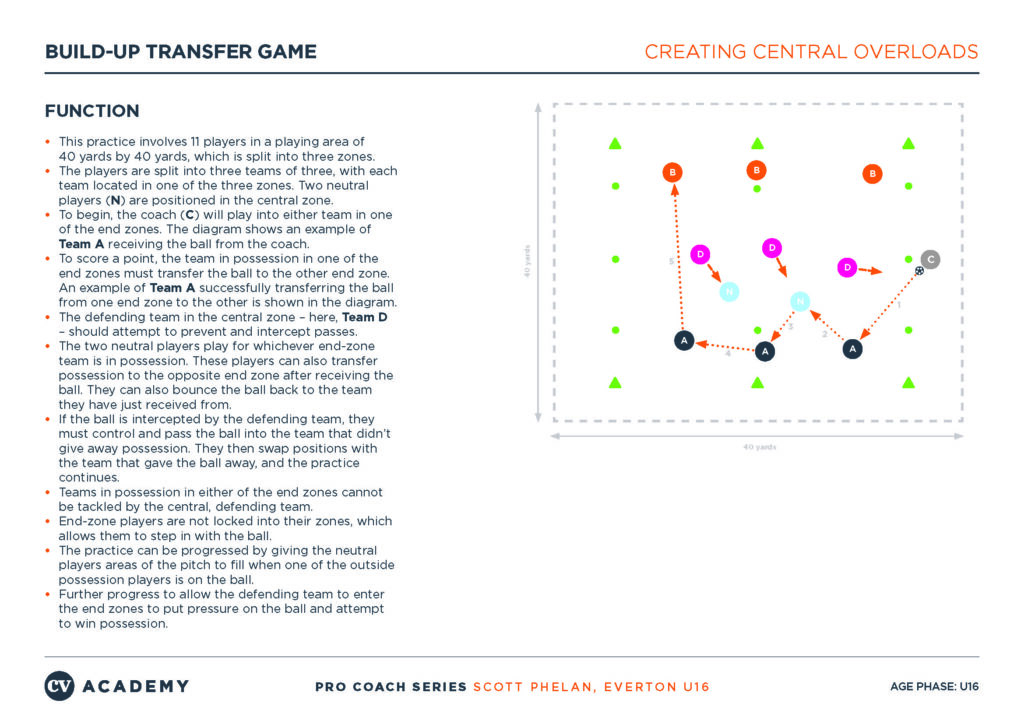
The video below features a central overload possession game delivered by Scott Phelan, then lead Under-16 coach at Everton, as part of an exclusive Coaching Session for Coaches’ Voice. The practice set-up, details of which are included below the video, uses two teams plus two neutral pivot players permanently stationed in the central zone, who play for whichever team is in possession. The team in possession scores by completing a pass from one end zone, through the central zone, into the opposite end zone. Players are coached on details of playing with a central midfield box to create overloads and progress the ball through the thirds.
What is a good tactical practice to develop players’ ability to create wide overloads?
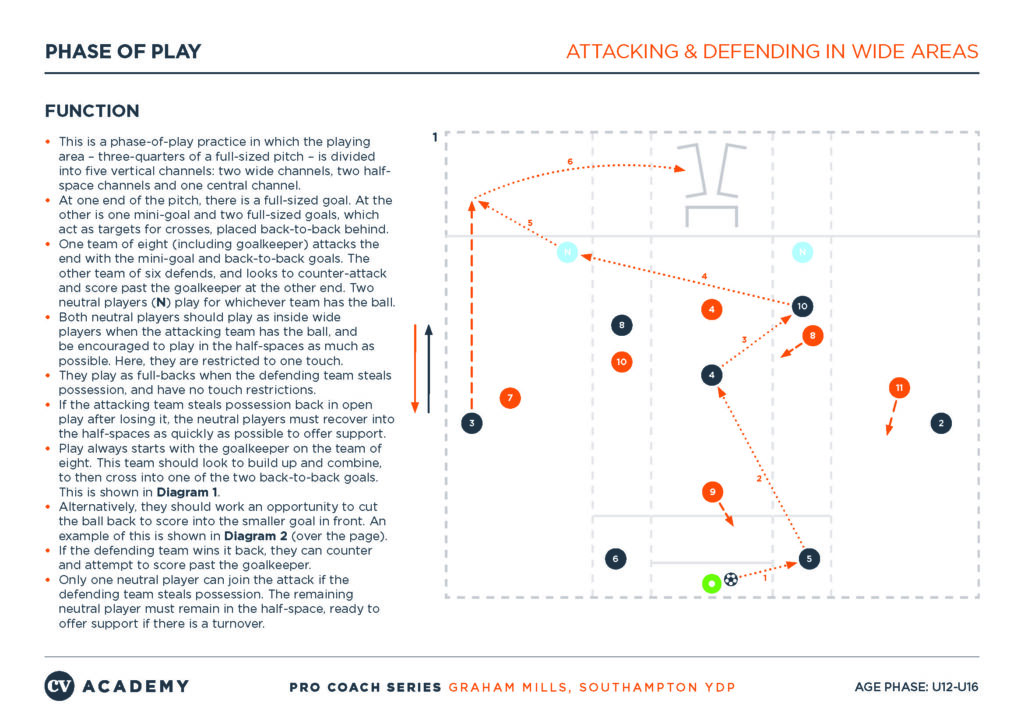
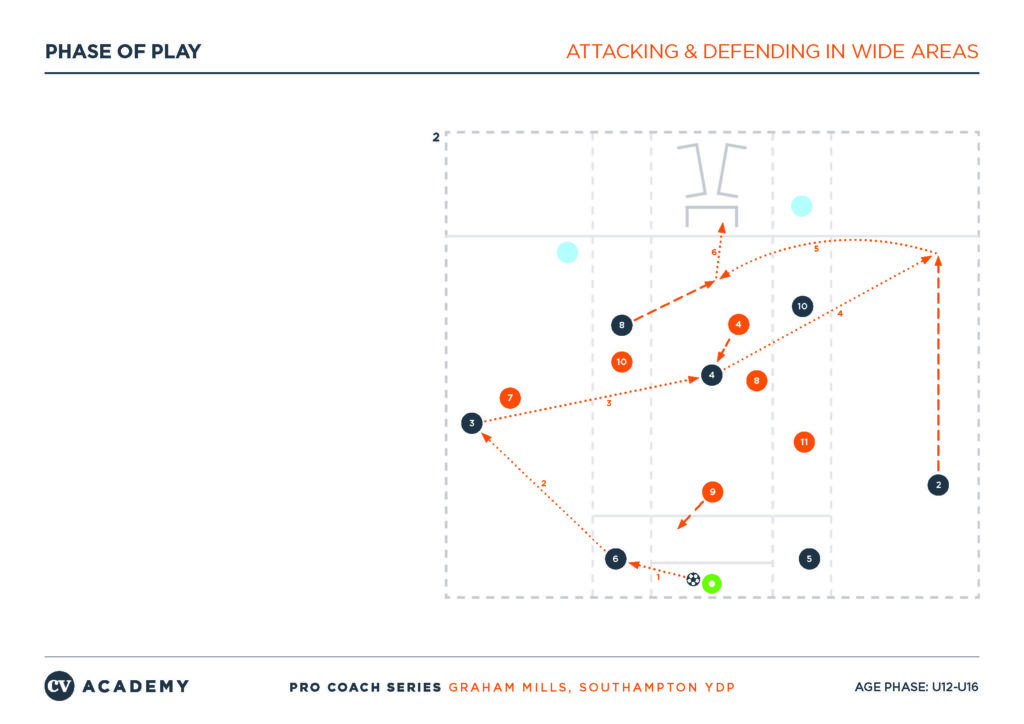
The video below features a phase-of-play practice led by Graham Mills, then Southampton youth development phase coach, with a group of Southampton Under-15 players. The practice encourages the use of players in the half-spaces to create wide overloads and crossing opportunities. It takes place on three-quarters of a full-sized pitch, which is divided into five vertical channels. There is a full-sized goal at one end, while two goals are placed back-to-back behind a smaller goal at the top of the playing area.
The team building up from the bottom goal must combine and create opportunities to either cross the ball into one of the two goals that are back to back, or cut the ball back for one of the central players to score in the goal in front. The other team must look to steal possession, counter-attack and score past the goalkeeper.