What is meant by ‘defending in a low block’?
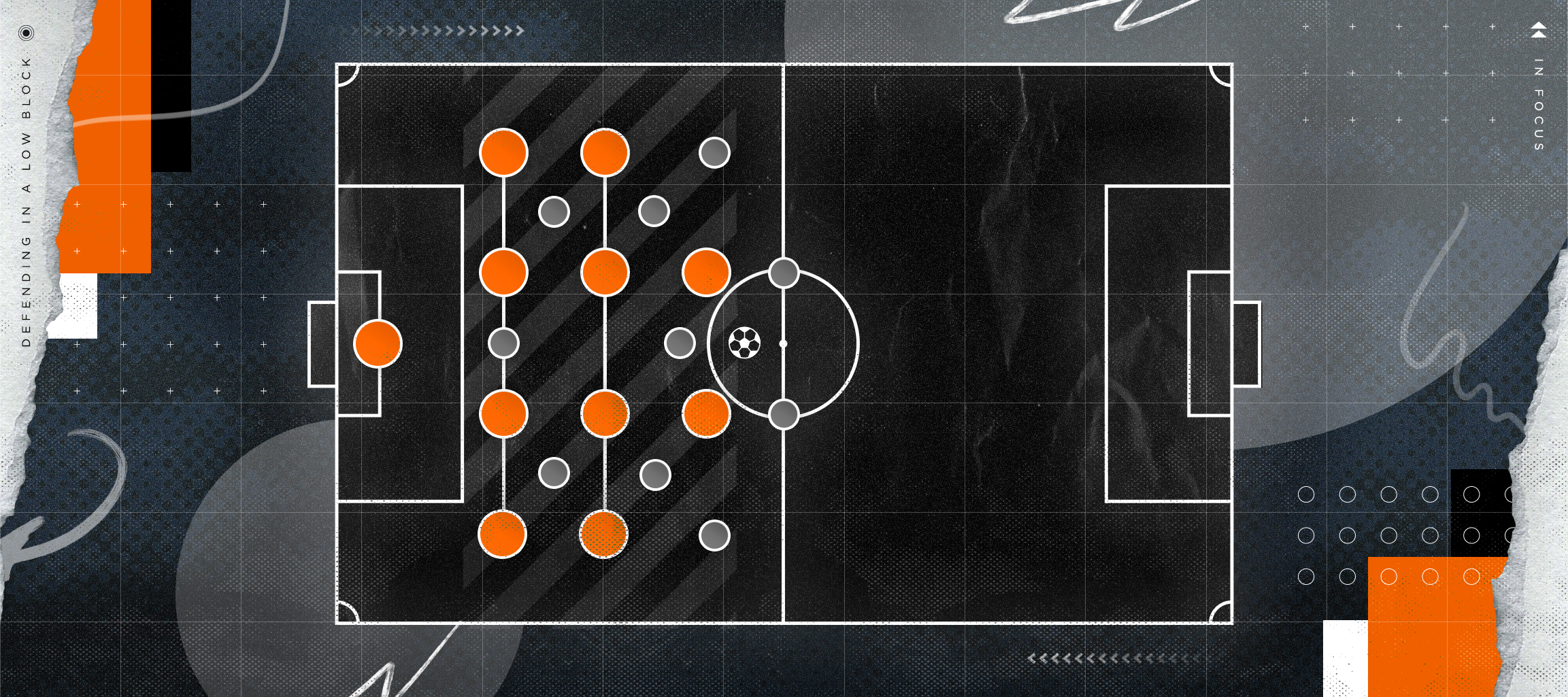
Defending in a low block is an out-of-possession strategy where the defending team have most, if not all, of their players positioned deep in their defensive third. The idea is to restrict the space and time that the opposition have to attack in key positions close to goal, where the chances of scoring increases. The back line in a low block is positioned deep to limit the space in behind for the opposition to exploit. Just ahead of the defence, the midfield and attacking units look to keep the distances between each unit to a minimum, making it difficult for the opposition to break defensive lines, particularly centrally.
What are the benefits of playing with a low block?
When executed effectively, a low block should make it more difficult for the opposition to score goals, by reducing the time and space they have to create goalscoring opportunities.
For example, because a low block places defenders so close to their own goal, the space behind the defensive back line and their goalkeeper is reduced to the point that it is extremely difficult for the opposition to get in behind by playing over the top. An organised, disciplined low block is compact, which means that playing through is also difficult for the opposition. As a result, the opposition will often have to try to play around a low block and put crosses into the penalty area, where a low block will have sufficient numbers in position to compete for first and second balls.
Additionally, a low block can provide players with an opportunity to rest and regroup, while a high press requires more energy and a higher physical output.
It can be a good strategy when a team has a scoreline to protect, or when facing opposition who are likely to dominate possession and/or cause significant problems with even a small amount of time and space to attack in the final third.
Click the links below for two Coaches’ Voice sessions designed to develop a team’s ability to defend in a low block...
Session 1: Defending in a low block 1
Session 2: Defending in a low block 2
What are the key principles of playing in a low block?
The main priority of the low block is to protect and defend the goal, crowding the space in front of goal.
In the video below, former Burnley, Everton and Nottingham Forest manager Sean Dyche explains the concept of “The V” – the space in front of goal – and protecting it in a low block.
Although most low blocks are initially made up of three lines or units – defence, midfield and attack – players are encouraged to drop back and cover for any teammates who get pulled out of position and leave gaps in the defensive structure.
In the video below, Strasbourg head coach Gary O’Neil explains how – when he was managing Wolverhampton Wanderers against Chelsea – his back four and outside midfielders worked together to ensure their low-block defensive structure dealt with overlapping movements designed to disrupt their organisation.
It is essential that individual players remain disciplined in a low block. Keeping distances between players within each line – and between each defensive unit – to a minimum is crucial to the success of a low block. Any player who moves out of their slot to try to win the ball or track the movement of an opposing player, must not compromise the team’s compactness. Communication and an understanding between defenders of how to press and cover the opposition is essential to ensure key space and gaps that the opposition can exploit do not open up.
As a significant amount of a team’s work in a low block comes close to or in the penalty area, players must maintain their positions for long periods. Defenders are constantly tested under prolonged periods of pressure, both to stay compact and make individual defensive actions to clear the ball, block shots and challenge for crosses. It is their job to make it as difficult as possible for the opposition to get a clear sight of goal.
What is a good technical practice to develop players’ ability to defend in a low block?
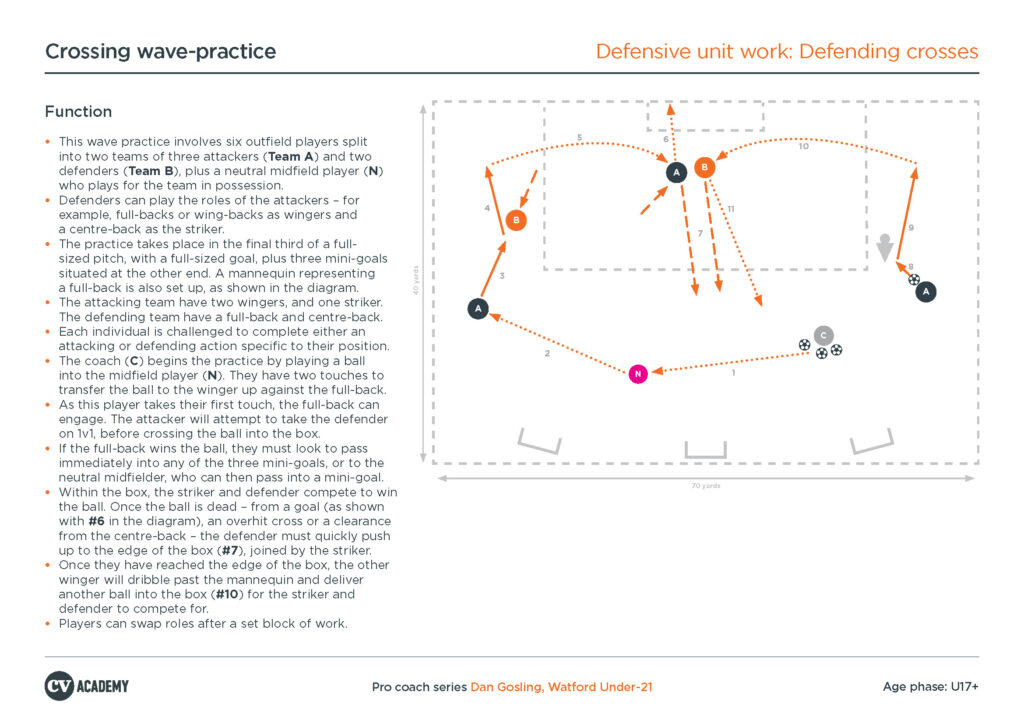
The video below features an individual development and unit practice that is focused on defending crosses, led by then Watford Under-21 assistant coach Dan Gosling. This includes attempting to prevent crosses at source, as well as defending different types of cross in the penalty area. Gosling coaches correct defensive body position, the importance of contact with attackers, and detail on clearances.
What is a good tactical practice to develop players’ ability to defend in a low block?
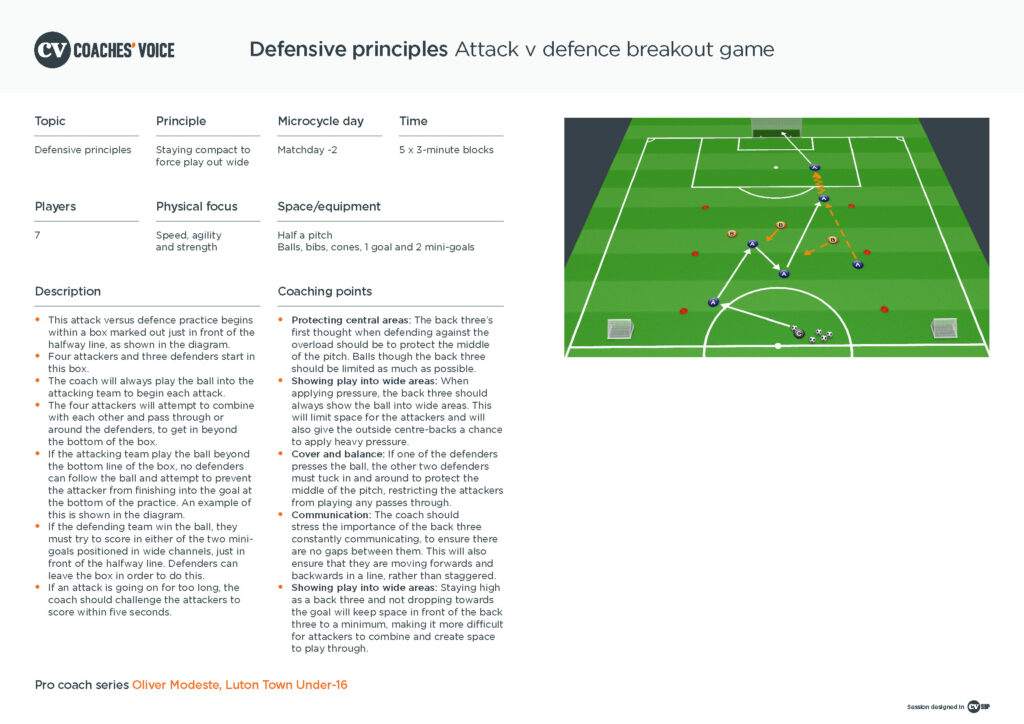
The video below features an attack-v-defence breakout practice, led by Luton Town Under-15 head coach and Under-16 assistant coach Oliver Modeste, which focuses specifically on a back three and their ability to stay narrow and compact and force opposition attacks into wide areas. Modeste coaches the players to communicate within, cover and balance their defensive line, to prevent gaps and the opposition playing through.