
Keith Andrews
Brentford, 2025-
Brentford’s Keith Andrews has made an impressive start to life as a head coach in his first season in the role. Succeeding Thomas Frank – who spent seven years with the Bees as they established themselves as a Premier League club – appeared to be a daunting prospect. But having spent the previous campaign as Brentford’s set-piece coach, Andrews had a handle on how things worked previously, while being known to the players he would subsequently lead. Nonetheless, few outsiders predicted he would have Brentford seventh in the Premier League and eyeing European qualification for the first time, as spring approached.
Born in Dublin in 1980, the Irishman played more than 400 games across all four divisions of English professional football, and won 35 caps for the Republic of Ireland. Following the end of his playing career, he became assistant manager at MK Dons, then assistant with the Republic of Ireland’s Under-21 and senior national teams, before joining Chris Wilder’s staff at Sheffield United. Next came his role as Brentford set-piece coach, before promotion to head coach in the summer of 2025. A win against Aston Villa in his second Premier League game in charge got Brentford up and running. Some notable results followed: wins over Manchester United and Liverpool, league doubles against Villa and Newcastle United, and late comebacks to take points off Arsenal and Chelsea.
Below, our UEFA-licensed coaches have analysed the tactics that Brentford have employed in Keith Andrews’ first season as head coach.
Dropping pivots
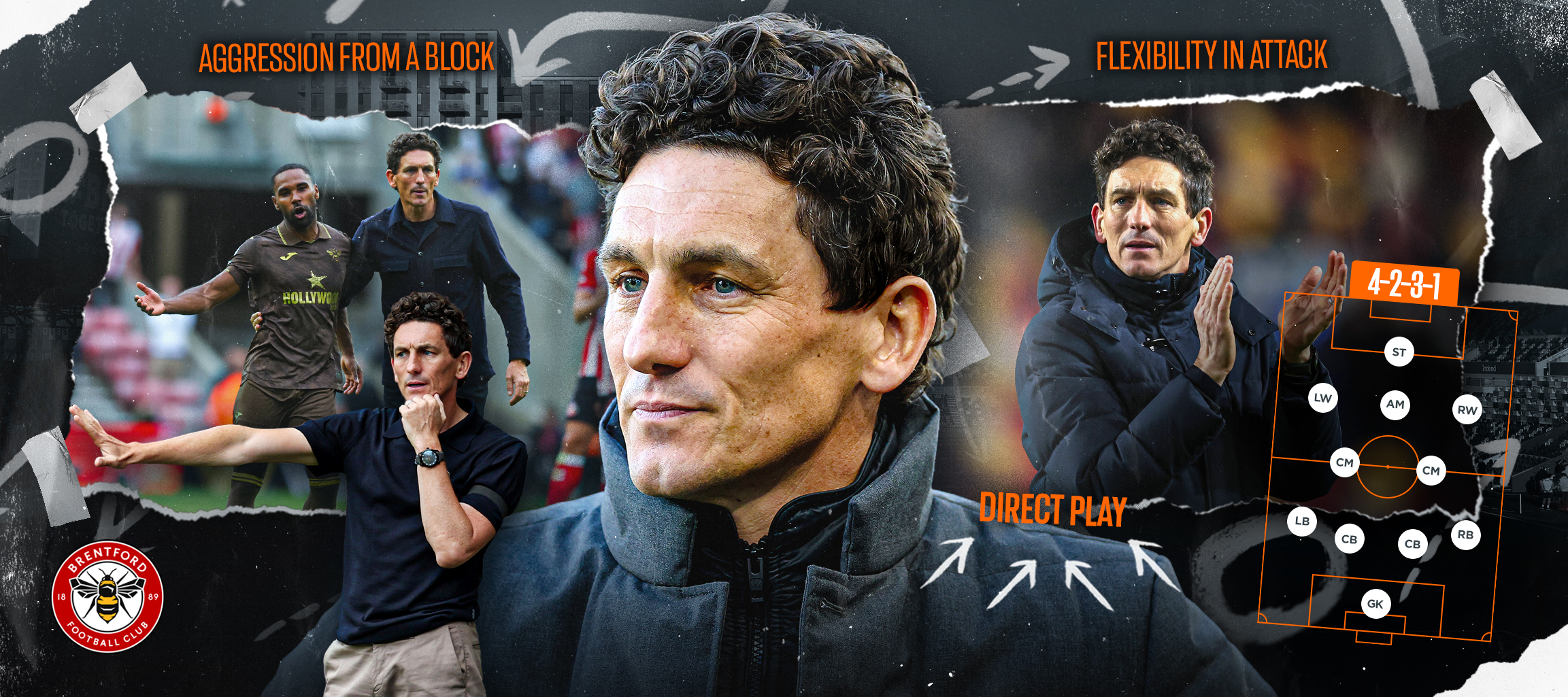
Brentford under Keith Andrews have mostly utilised a 4-2-3-1 structure The Irishman has demonstrated flexibility in his side’s attacking play, building with shorter passes but also playing longer and more direct at times.
When connecting through a sustained build, his central midfielders have often readjusted into new spaces, allowing teammates ahead to eventually rotate. On some occasions this has meant one of the double pivots dropping to one side of the back line, to work alongside the two centre-backs. This allows the full-back on that side to push forward earlier (below) – particularly on Brentford’s right, where Michael Kayode has got forward to provide crosses.
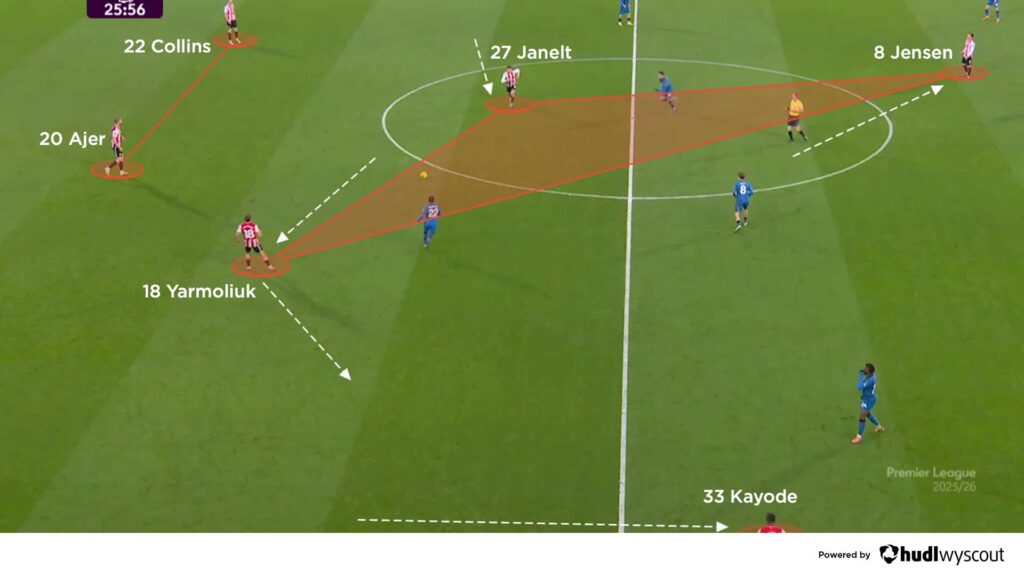
Moving into wider spaces also means that Andrews’ midfielders receive away from busy central areas. There they often have more time to make a decision on the ball, including to play longer passes if available. Moving to the side also keeps the centre-backs through the middle of the pitch, where they are well placed to defend counter-attacks.
From here, the other central midfielder moves across to fill the centre, briefly becoming a single pivot. The number 10 maintains their positioning between the lines, where they look to receive penetrative passes – especially if the opposing midfield man-mark and follow the dropping pivots. Brentford can then stretch the opposition midfield in a key part of the pitch, while creating space for the front line to drop in to receive, and/or pull the opposition defensive unit out of shape.
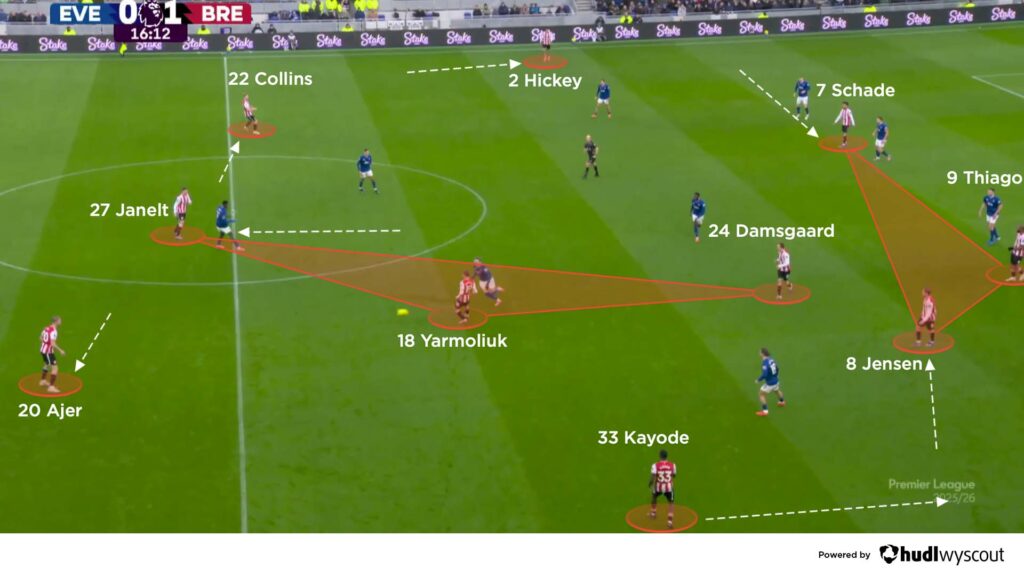
Alternatively, the midfielder dropping into the back line can split Brentford’s centre-backs, pushing them into slightly wider positions (below). This works in tandem with both full-backs pushing forward at the same time, with the wide attackers ahead of them narrowing earlier, close to Brentford’s single centre-forward, Igor Thiago. These are movements that Brentford have typically deployed against a mid-block, but have also used when building from deep.
Playing into the front line
Regardless of whether the pivots drop between or alongside Brentford’s centre-backs, Andrews’ team has frequently played forward with through balls and longer passes, often looking to hit the front line as efficiently as possible. After 27 games under Andrews, Brentford ranked third for most through balls, and first for most long passes in the Premier League in the 2025/26 season. This was helped by how often the front three were narrow, with Thiago supported by the likes of Kevin Schade and Dango Ouattara moving inside early. Keane Lewis-Potter has been utilised as more of a traditional winger, holding the width, but has still come inside to support when needed.
Brentford’s play through and over has often worked in tandem with opposite movements. One of the narrow front line drops, either to receive and turn to face goal, or to drag their direct marker out of the back line, to create gaps and space to exploit. A teammate then makes an opposite movement, which is most effective when exploiting the space created by a defender who is tightly marking (below). All of Brentford’s front line have shown the capability to run on to receive through balls, but also to drop short to receive and drag markers out. This gives the opposition fewer triggers or patterns to readily recognise.
A dropping pivot also helps with these longer passes. They can move away from midfield pressure to receive, creating more time on the ball to pick out what are more difficult passes due to the distance. They pull opposing midfielders with them, creating more space between the lines for the front line to receive and allow for challenging passes or poor touches. The full-backs then provide the width, but can also receive longer passes via switches, or move inside to support any longer central pass into the forwards.
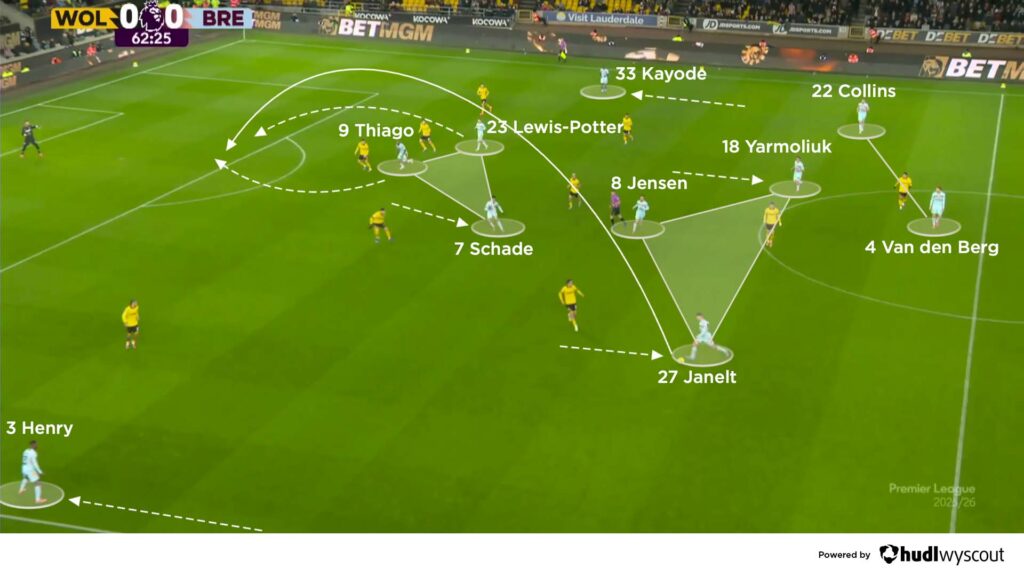
Narrowing, running wingers also help Brentford play longer from deep, with goalkeeper Caoimhin Kelleher and centre-back Nathan Collins adept at playing such passes with consistent accuracy – often when play through the middle of the pitch is blocked. From here, the winger running in helps challenge and support flick-ons, aerial duels, and first and second contacts, with Brentford going from back to front with purpose and aggression (below). Andrews’ midfield have been alert to support around the ball for knockdowns, lost duels by the front line, or loose balls. They rank second for interceptions after 27 games of the 2025/26 season.
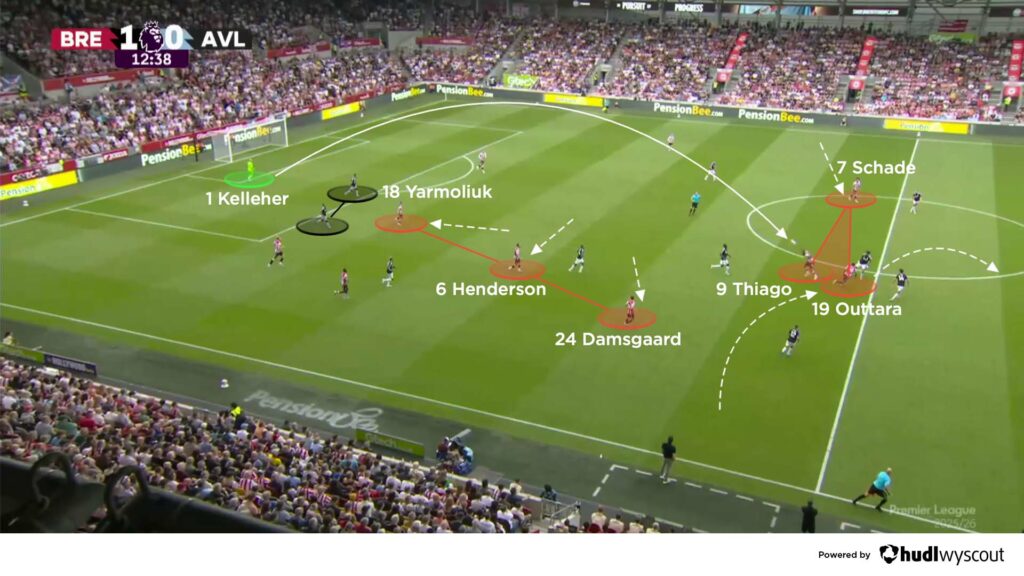
Key coaching points for playing into a front line
• Ball speed, height, weight, spin direction and flight of pass are passing details that must be appropriate and accurate.
• The timing of movement must also be appropriate to the pass – not too fast that it leads to miscontrol of the ball, but not too slow that the opposition intercept or regain.
• Support and runs to the receiver must ensure they aren’t underloaded for too long, such as a single centre-forward up against two centre-backs.
• Teammates supporting underneath will allow the receiver to lay the ball off or set it back.
• Support around the receiver can help them to move the ball across, or switch play to a wide area.
• Teammates supporting ahead or in behind will help stretch the opposition’s back line and allow the receiver to pin, spin, roll or turn to play forward.
Brentford are equally strong on the transition. They attack well from middle-third regains, but also after deep defending, and can counter-attack from well within their own half. Again, passes into and on to are very effective, with opposite movements from the narrow front line working chances on goal.
Andrews’ wingers narrowing early to support around the single number nine has given Brentford good options for combinations, with the central forward having the option to pass either way. As such, Brentford have had flexibility and unpredictability in attack. Delayed runs from their full-backs have created attacking width when needed, but they haven’t crossed for the sake of it. Brentford had delivered the fifth fewest crosses in the league after 27 games. When they do cross, they often look to do so from inside the box, or otherwise to circulate the ball into a better position to advance from.
Aggression from a block
Without the ball, Andrews’ side has usually performed a high press from dead-ball situations, especially goal-kicks, as well as throw-ins or free-kicks deep in the opposing half. They don’t continuously press high during sustained periods of opposition possession. Indeed, they only jump as a team on certain triggers such as misplaced passes, poor touches or significant overloads around the ball, particularly during transitional moments.
Andrews’ Brentford have shown defensive aggression from a slightly more withdrawn block, typically with a midfielder jumping forward to support single centre-forward Thiago, applying pressure on both opposing centre-backs (below). From here, the remaining central midfielders jump to duel and aggressively hunt for the ball. The wingers track any full-back advances, tucking in and positioning slightly deeper to cover the inside channels and thus the outside shoulders of any aggressive midfield advances.
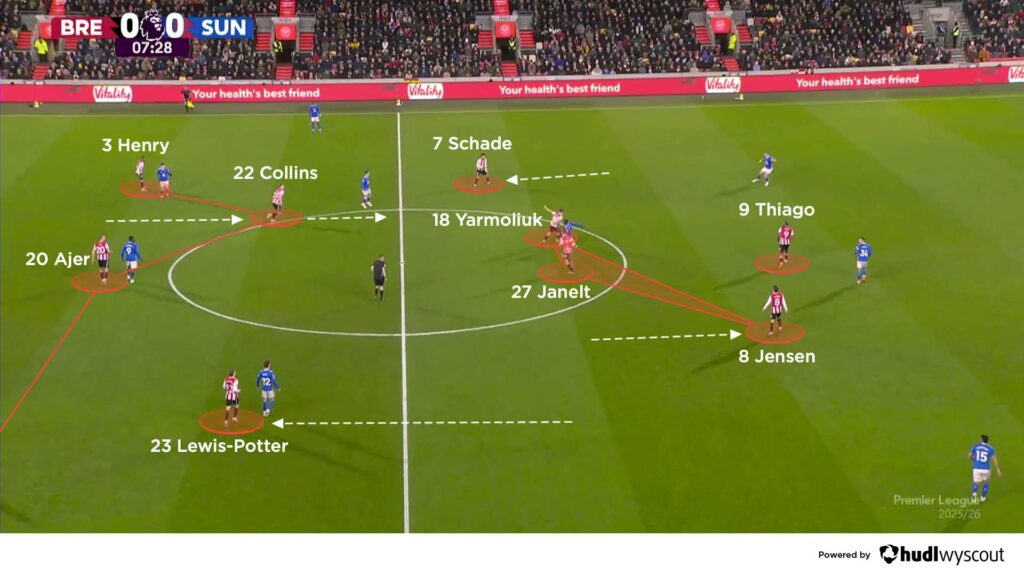
Centre-back Collins has also been also aggressive in his positioning, ready to engage well into midfield. His ability to time his jump often provides necessary extra support, without being too distant from the rest of the back line. This dual role – sometimes known as half and half – enabled Collins to record the sixth most interceptions in the Premier League after 27 matches. Brentford, as a team, ranked second overall.
Andrews has also utilised his centre-forward to lock play one way, supported by a narrowing winger from the far side. This works to force the ball wide and keep the opponents’ attack down one side of the pitch, allowing the likes of Collins to remain within the back line. Brentford have used Thiago as a sole presser, using a 4-1-4-1 block to cover and protect the ball. Here, they wait until the opposition brings the ball to them before engaging, without the need to bump up a centre-back.
There have also been moments when Andrews’ side have defended with a back five. This has been seen when the centre-backs are narrow and close together, with the full-backs defending quite wide, usually against wingers hugging the touchline. From here, any opposition runs have been tracked, which has meant a Brentford midfielder, or occasionally winger, working back to defend between the centre-back and full-back.
Andrews has also used a set back five in some games, with the front line forcing the ball around, ready to lock the play on one side of the pitch (below). From here, the rest of the central unit moves across to limit how the opposition can switch the play via their midfield. The idea has been to force the opposition into longer passes across, where Brentford’s far wing-back can then engage, or make them go all the way back to the centre-backs. At that point, Brentford can reset centrally and force the ball around again.
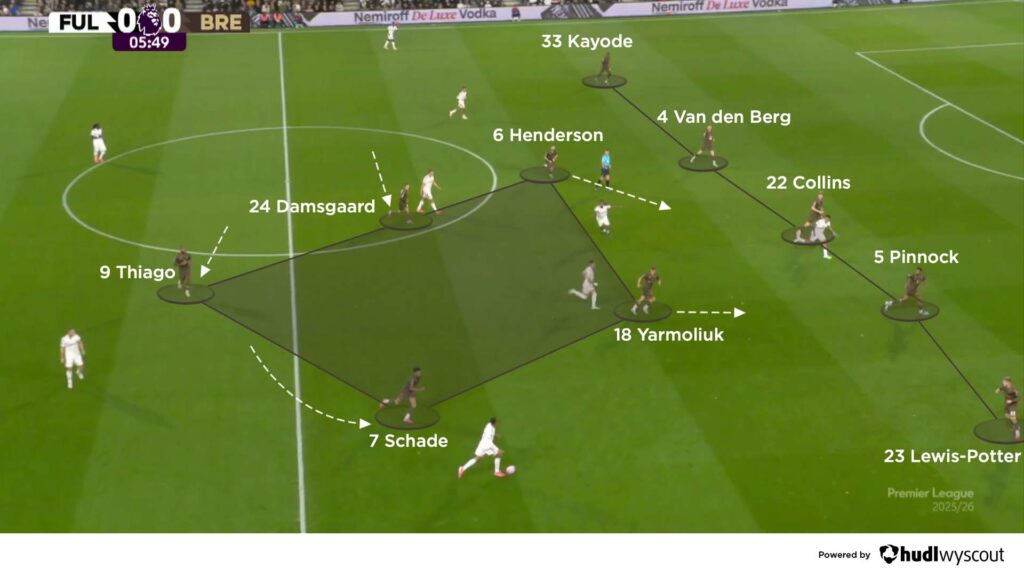
With three centre-backs in place, one has had licence to jump into midfield to support any higher defending, as Collins has done in a back four. When one of the central midfielders has jumped out wide to help the wing-back lock play, a centre-back has been able to push into midfield to briefly re-establish defensive numbers.
It has all added up to an impressive start to life as a head coach for Andrews, as Brentford have enjoyed a string of good results in the 2025/26 season. More tests lie ahead for both team and coach; it will be fascinating to see how the Irishman adapts his game plans.
To learn more about football tactics and gain insights from coaches at the top of the game, visit Coaches’ Voice Academy