Khvicha Kvaratskhelia
Paris Saint-Germain, 2025-
Khvicha Kvaratskhelia had a stunning start to life as a Paris Saint-Germain player. Within a few months of signing from Napoli for £59m in January 2025, he had won a treble of Champions League, Ligue 1 and French Cup. He had already claimed two Serie A titles during two and a half years in Naples. Little wonder the Tbilisi-born attacker was being hailed as Georgia’s greatest ever footballer.
Below our UEFA-licensed coaches have analysed the play that has made Kvaratskhelia one of world football’s most exciting players…
Technical analysis
Khvicha Kvaratskhelia is a right-footed winger who mostly attacks from the left side of the pitch. He possesses a wonderful ability to dribble, drive and carry the ball up the pitch. In his first season with Napoli he registered the second-most dribbles in Serie A, only five behind Rafael Leão. He duly ranked first for this statistic the following season.
Since joining PSG, Kvaratskhelia has continued to be a threat with his dribbling, and he is particularly strong from a static start. His body shape doesn’t always give the impression he is going to drive with the ball, or that he is even ready to do so. The result is that he can draw his opponent close before exploding away. When space opens up, he can burst around and beyond, looking to dominate his direct opponent 1v1.
At 6ft he is probably taller than the average ball-carrying winger; he uses his upper-body strength well when carrying over larger distances. When opponents attempt to match his knock and run, he can lean or step across them to maintain possession. Sometimes he will power across the line of a recovering opponent, making it much harder for them to tackle or stop him.
Kvaratskhelia excels when dribbling in tighter spaces, usually in the final third. He looks to drive inwards on the angle from wide left, keeping the ball as close as possible (below). When progressing inwards he tends to take lots of little touches, which allow him to react quickly to any attempted tackles or duels. His ability to drop his shoulder and push the ball slightly to his right, then bring the ball inwards on the next touch, helps him to avoid opponents once he’s locked them in a 1v1. This technique has also helped him to create good shooting, passing and crossing opportunities.
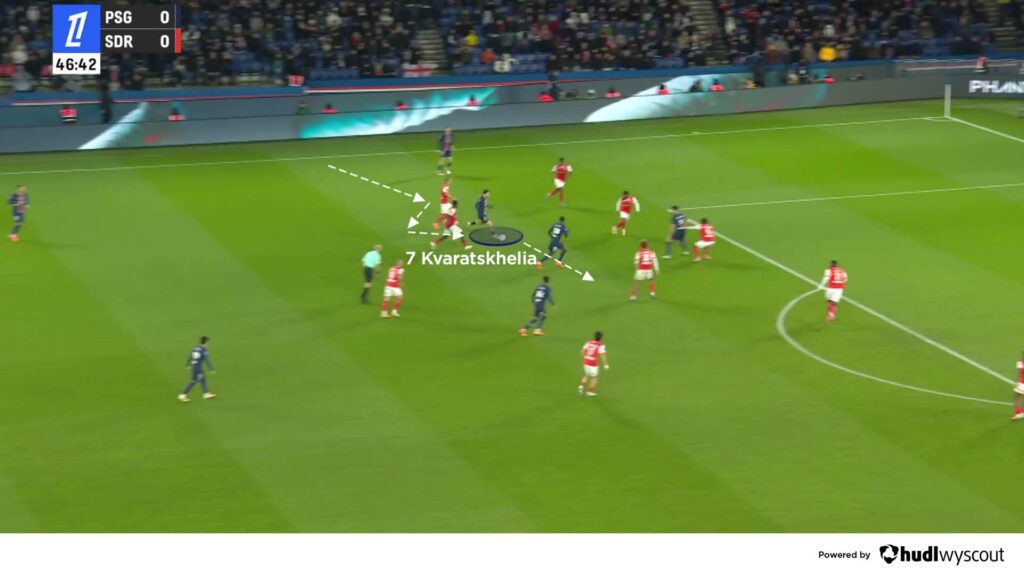
Kvaratskhelia can chop back to his left side when necessary, often with wonderful disguise as he fakes an action to his right, before quickly but calmly turning the ball back the other way across his body. Most wingers use the inside of the foot to cut the ball back, and Kvaratskhelia is no exception. But he will also use his sole to do so, rolling or dragging the ball back across his body. With this technique, he can work shooting, passing and crossing opportunities on his left.
At Napoli and PSG he has contributed goals and assists from various positions. He can run in behind well, and attacks the back post with purpose. He can also support from a narrowed position between the lines to create and finish.
Much of his best play on goal has come from dribbling and 1v1 attacking. When moving inside with the ball he has a strong repertoire of finishes. He can powerfully bend balls into the far corner (below), but also drives shots across goal, often after coming inside from wide left. His shift-and-shoot technique is similar to the shifting action he employs when dribbling, replacing the touch-back inwards with a shot. This is useful when he gets past an opponent, but he has also scored goals when shooting with a defender in front of him.
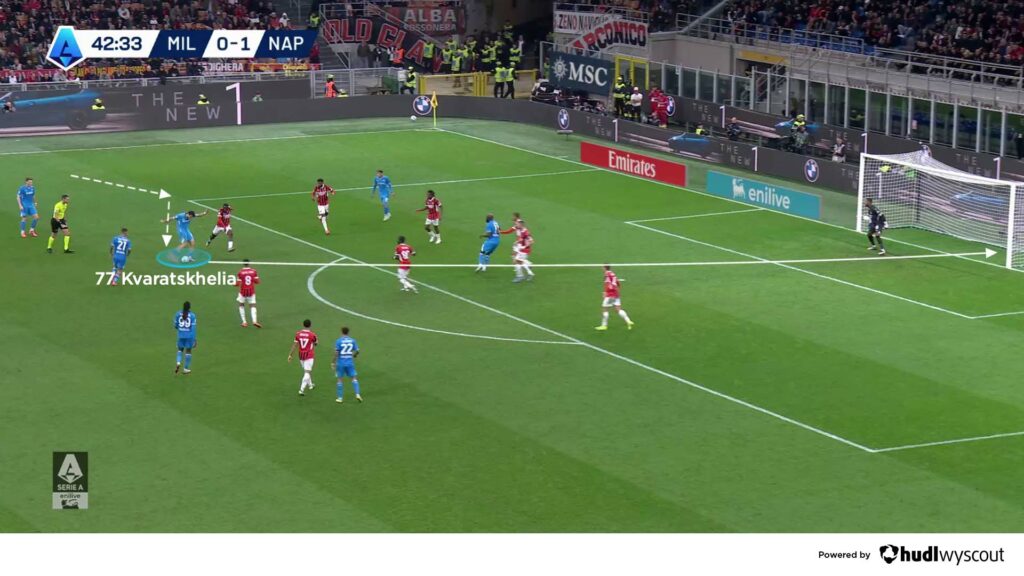
His left-foot strikes are usually more about pure power, with low, driven efforts across goal, or up high towards the near post. The same goes with his crosses and cut-backs. He focuses more on power on his left foot, which is handy for taking advantage of space he has created by chopping back.
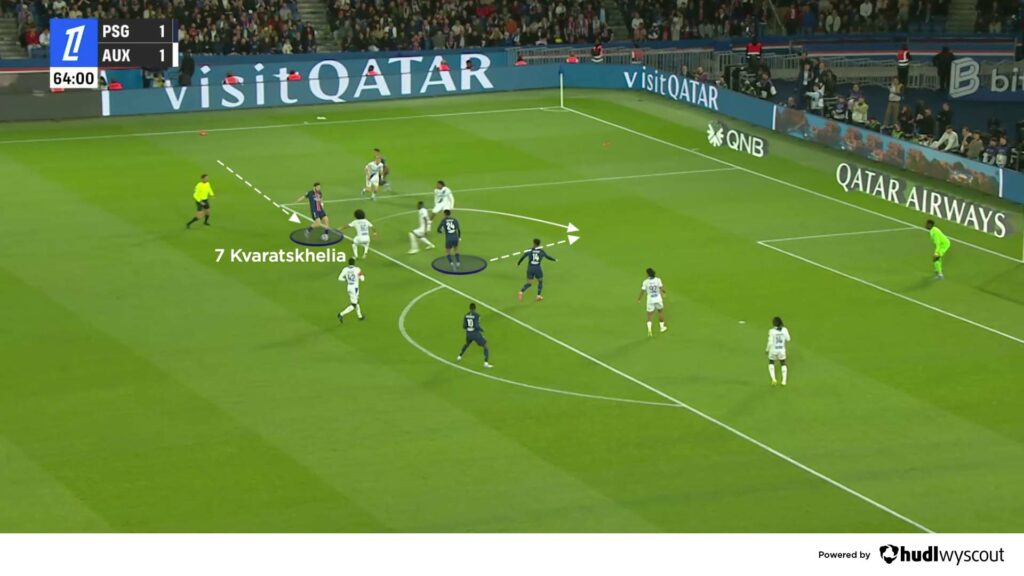
His close touches when dribbling allow for front-foot releases into teammates. Deft passes in behind, or incisive through balls, create chances for them to score – especially if his dribbling has drawn a defender out towards the ball, deep in the final third. Opponents have found it difficult to react to this as they can’t easily predict when he will release the ball. He shows fantastic timing to match the release of his passes with teammates’ runs (below) .
Left-winger
Since joining PSG, Kvaratskhelia has mostly attacked from the left, working within Luis Enrique’s 4-3-3 structure. As PSG have often dominated the ball in his time at the club, his attacking has usually come against organised mid or low blocks. Against this, PSG have typically had significant rotations from their right side, whereas Kvaratskhelia has tended to be much more fixed from the left (below).
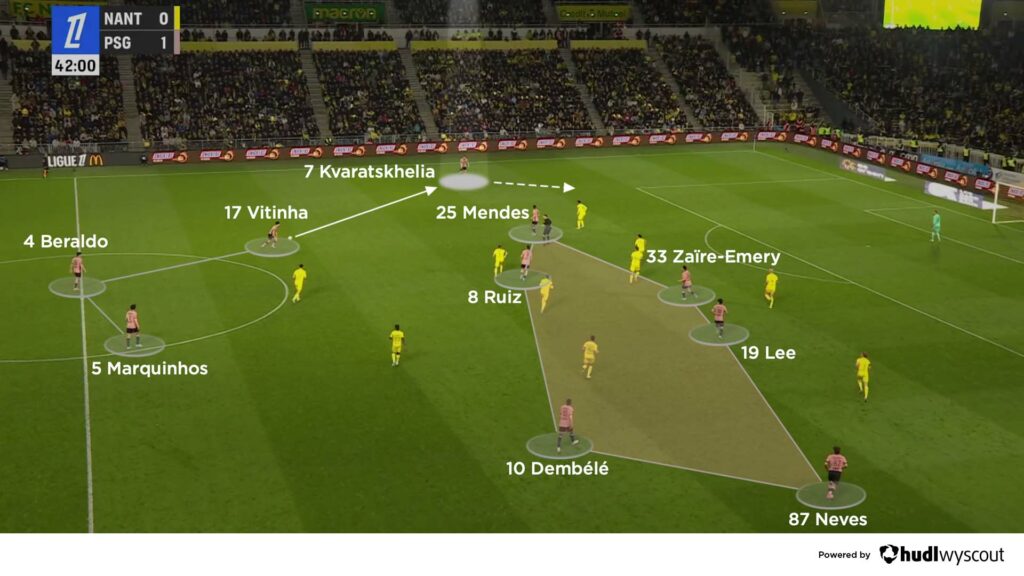
The varied, unpredictable movements and rotations from PSG’s right has often pulled opponents across the pitch, as they attempt to track but remain compact around the ball. From here, PSG’s quick passes or switches of play have found Kvaratskhelia isolated on the left, ready to progress forward, usually in 1v1 situations.
When moving inside after receiving, he has been able to shoot on the angle, as he did at Napoli. But with so many central options at PSG, he has also taken opportunities to combine back inside, to work shots after receiving the ball back. He also has plenty of teammates available for crosses; these can be inswinging, after cutting inside, or delivered across goal after chopping back on to his left and driving towards the byline. With PSG having consistent numbers on their right side, Kvaratskhelia usually has plenty of teammates to aim for. This can be runners from midfield or the right-winger moving inwards, although right-back Achraf Hakimi has on occasion been the main goal-scoring threat. This gives an indication of the level of PSG’s right-side rotations.
During transitional moments, Kvaratskhelia has provided a key threat for PSG from the left, joining teammates including Ousmane Dembélé, Désiré Doué and Bradley Barcola in surging forward. Like these teammates, Kvaratskhelia has carried the ball large distances on the break, but also slid passes in for runners beyond. PSG are consistently able to exploit spaces in behind a retreating back line thanks to the pace of their attackers.
Drifting central
Kvaratskhelia has occasionally rotated inwards from the left, as well on the rare occasions he has started from the right. So far under Luis Enrique, Dembélé has been PSG’s main central forward, often dropping deep to help overload midfield during sustained spells of attacking possession. But there have been moments when Kvaratskhelia has moved inside to either join Dembélé around the centre-backs, or replace him when the French attacker has moved away from the back line.
When PSG have simultaneously pushed both full-backs high and wide, one of the midfielders has dropped alongside the centre-backs to build as a three. From here, the number eights have linked defence to attack. In these moments, Kvaratskhelia has joined the front line between the lines (below), aiming to work close combinations and create with deft through balls.
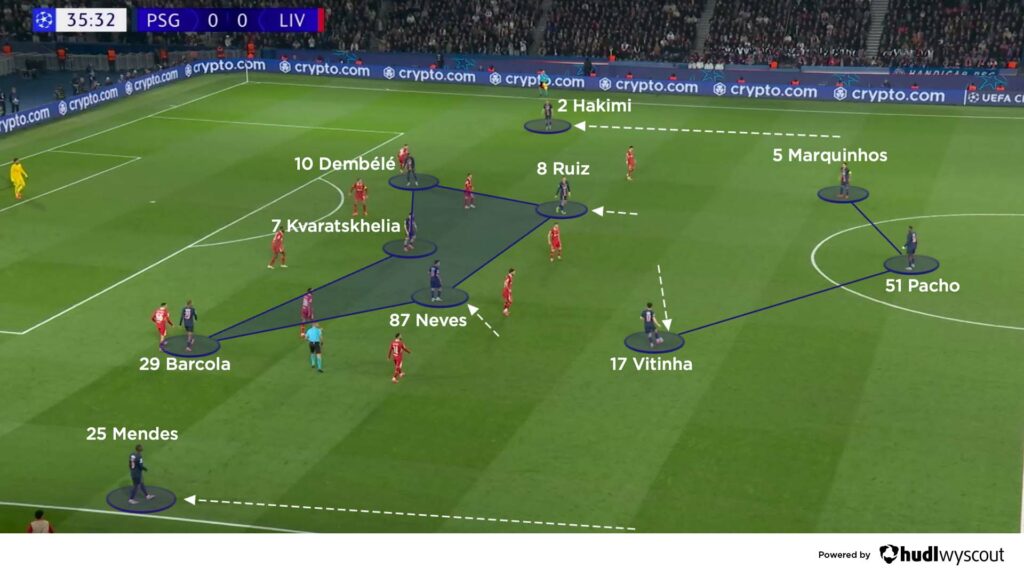
This is a role Kvaratskhelia could adopt more often in future, with PSG left-back Nuno Mendes more than comfortable in providing attacking width. Dembélé also has significant experience playing wide, which can aid rotation with Kvaratskhelia. By contrast, their teammate Gonçalo Ramos is a more of an out-and-out centre-forward, meaning that, although Kvaratskhelia can still link inside with him, he would tend to stay wider for longer.
Wherever he plays in the front line, though, Kvaratskhelia has the ability to be a threat. PSG and Georgia look set to benefit from his skilful attacking play for years to come.
To learn more from the professional coaches courtesy of Coaches’ Voice, visit CV Academy