



PREMIER League, NOVEMBER 1 2026
Havertz (16)
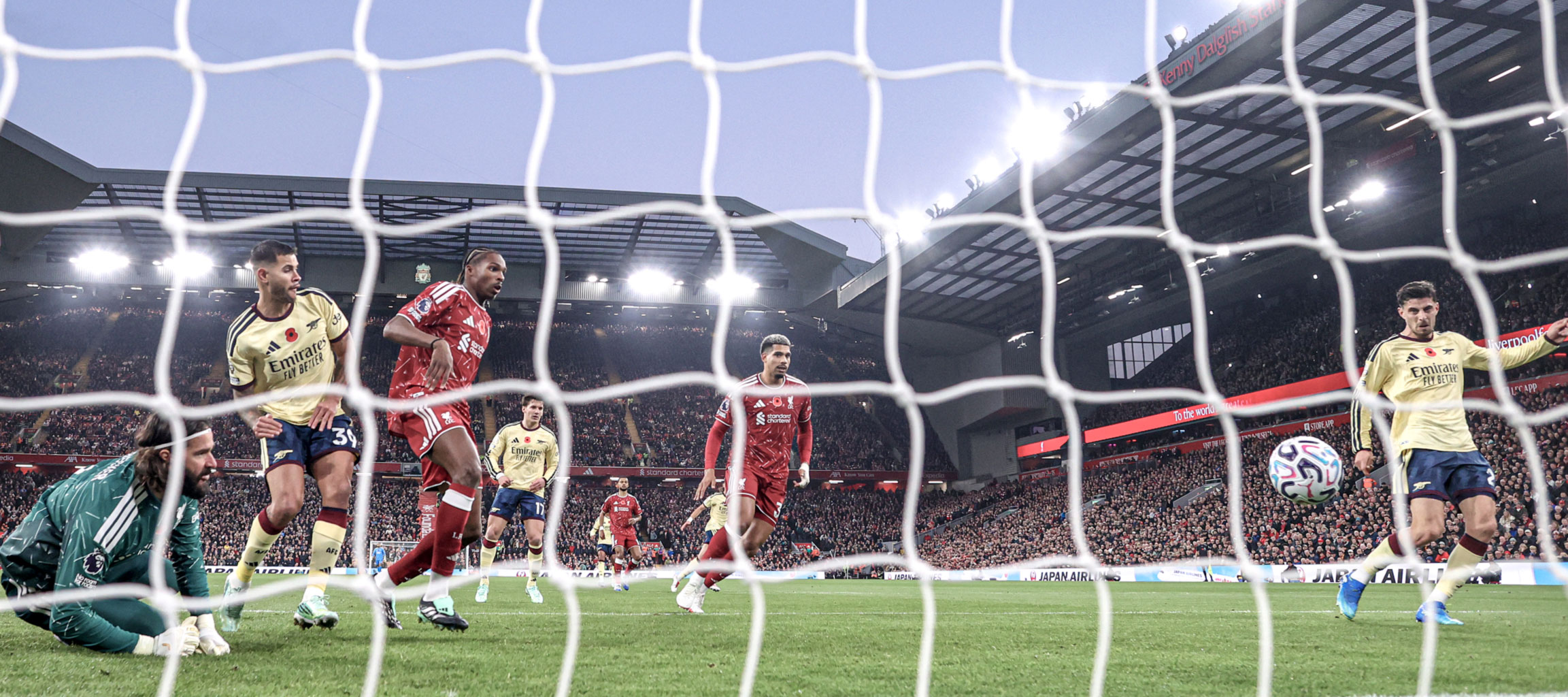
Defending champions Arsenal returned to the top of the Premier League table with this first league win at Anfield since 2012. German forward Lukas Podolski was on the scoresheet for the Gunners in that 2-0 victory, and it was his compatriot Kai Havertz who netted the winner this time round. Havertz stroked a Declan Rice cross home at the far post as early as the 16th minute, after wayward distribution from Alisson had invited pressure Andoni Iraola’s men failed to then deal with.
Liverpool showed improved intensity and quality after falling behind, but struggled to create enough to genuinely worry an organised and combative Arsenal defence. Jurriën Timber might have been penalised for a tug on the shirt of Alexander Isak later in the first half, while Alexis Mac Allister’s header should have hit the target when connecting with a Milos Kerkez cross.
As it was, Mikel Arteta’s team resisted all the hosts had to throw at them in a largely disappointing second half. An important three points helped the visitors go clear of Manchester City in second, and leave Liverpool in fifth.
How the managers saw it
“It feels better as a manager [to win at Anfield], because it has been such a long time without this feeling,” said Arteta after the game. “I am extremely proud, especially given the conditions we arrived to the game.
“The defeat against Fleetwood looks like the end of the world, but then you have to pick yourself up. That is the beautiful part of this game. Four days later you have to come to Anfield, and play against this manager, this team who are in a good moment, and so I am so proud of what my team has done.”
Iraola was less than impressed with the officiating: “The Isak one is a clear penalty. He is going to head the ball in front of the goal and they grab him where everyone sees the shirt. The ball just goes in front of Alex and I don’t see the reason why [it isn’t given].
“I think Alex is honest. He tries to go for the ball, everyone can see live straight away there is a clear, clear pull.”
 16453342102971891121563341392081729
16/2
SHOTS / ON TARGET
10/3
59.4%
POSSESSION
40.6%
59
ATTACKS INTO AREA
20
1.89
EXPECTED GOALS (XG)
0.64
Arsenal’s early dominance
Liverpool started the game with the intention of being on the front foot. They set up to jump into an aggressive man-to-man press, with Florian Wirtz joining Isak on the front line after releasing off the front of Bruno Guimarães, while Trey Nyoni and Mac Allister were aggressive to push on to Arsenal’s double pivot of Declan Rice and Bruno Guimarães.
Despite this, Arsenal were able to play through by finding space on the blind side of Mac Allister, with Martin Ødegaard in particular making intelligent lateral movements behind the Argentinian as he jumped to engage Guimarães (below). In these situations, Mac Allister’s delayed jump to press prevented Jérémy Jacquet or Virgil van Dijk from stepping up to make up the sufficient distance to Ødegaard to apply pressure.
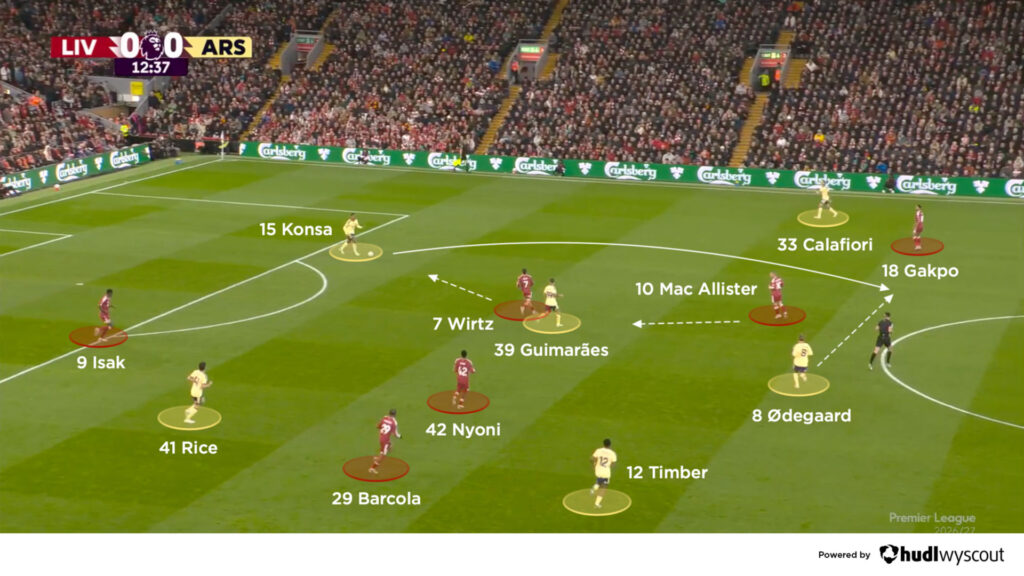
As a result, Arsenal were able not only to dominate possession in the build and middle thirds, but also to accelerate into wide areas, where they often found Christos Tzolis (below) to attack and combine with Havertz to try and create dangerous attacking moments. This consistent pressure ultimately culminated in the opening goal, after a successful high regain from a poorly executed Liverpool attempt to play out from the back. Rice overlapped on the right before delivering a delicately weighted cross across the front of goal for Havertz to tap home.
Liverpool’s bold response
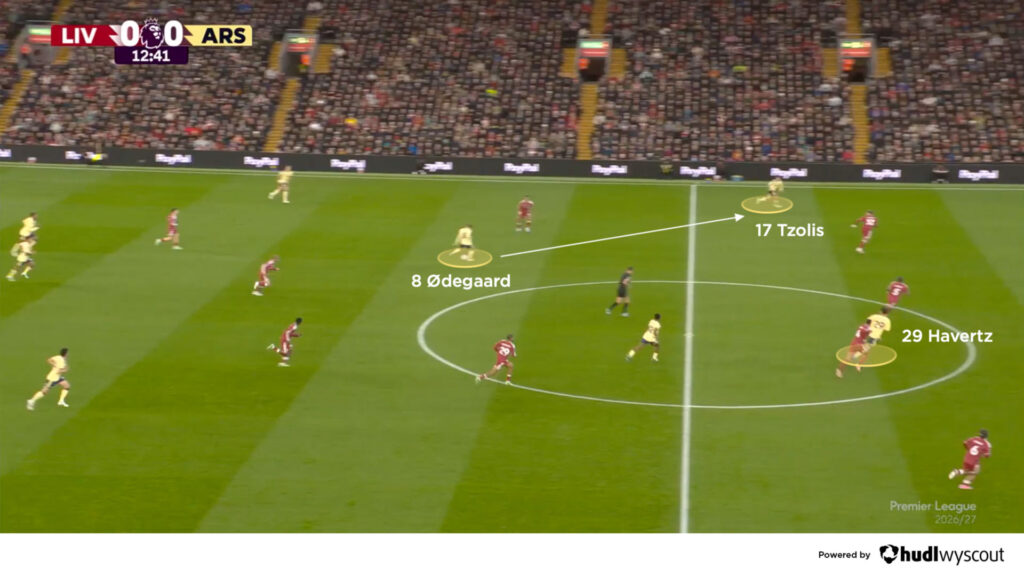
Liverpool’s attempts to respond immediately caused the game to become increasingly transitional, with neither team managing to find enough in-possession balance to prevent transitions against them. As the first half continued, this began to favour Liverpool’s more direct and transitional style, with Bradley Barcola in particular often managing to exploit the space behind the advancing Jurriën Timber after regains in deep areas (below). In these moments, Wirtz would often initially take up a more central position before drifting left to combine, support and create overloads. Rice was often able to delay these counter-attacks and drop in to cover the space vacated by Timber, but Arsenal’s rest-defence structure was largely unable to move high enough up the pitch to restrict Liverpool’s progression with immediate counter-pressure and prevent these counter-attacks.
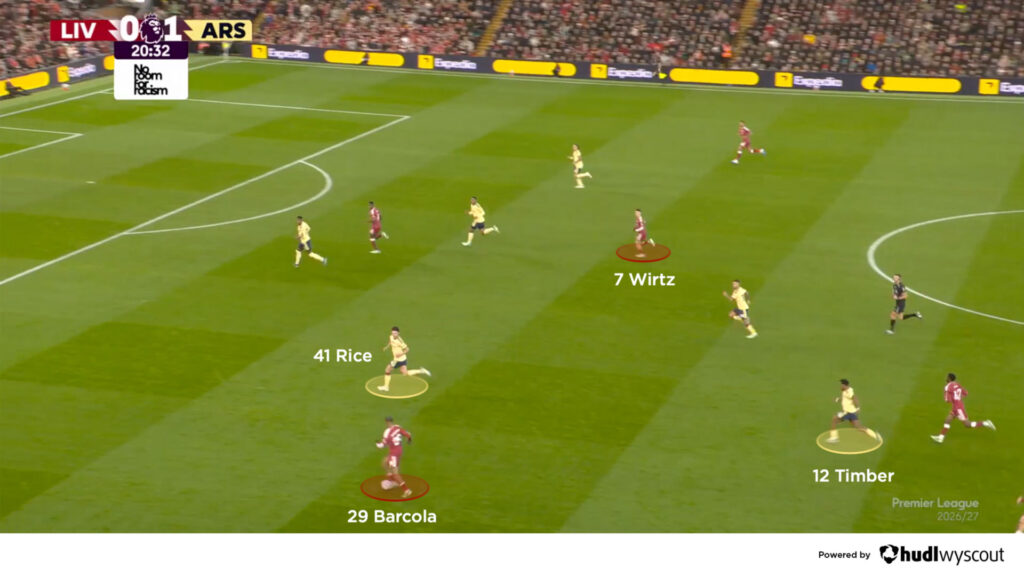
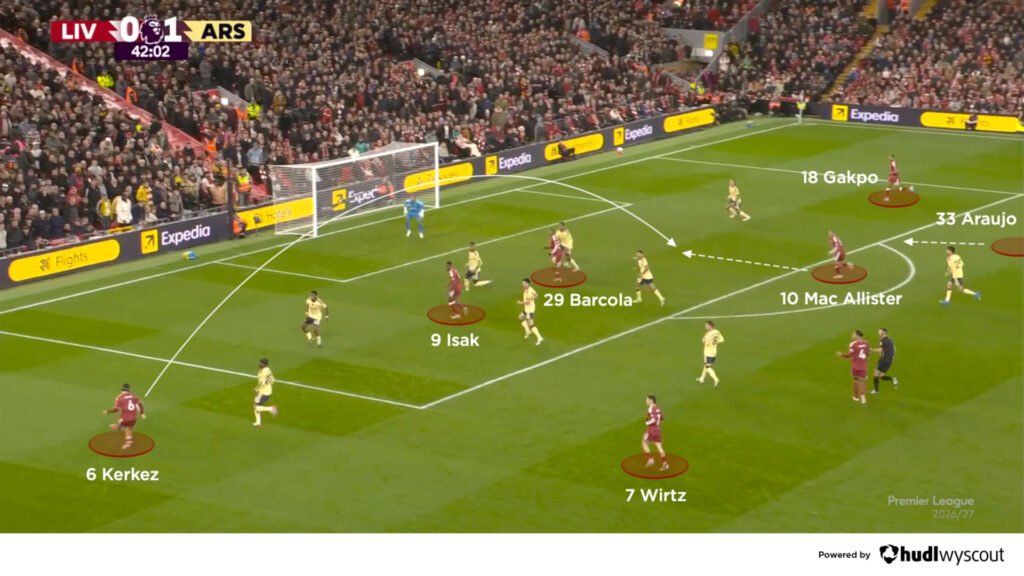
As the hosts built momentum, they were able to sustain attacks in the attacking third. They registered 28 touches in the opposition box in the first half alone, primarily through crosses and putting the Gunners’ back line under a significant amount of pressure. The vast majority of these crosses came from the left, where Barcola attacked 1v1 or in combinations with Wirtz. Kerkez also provided an option by arriving late on the overlap to support, as in the example below.
As a result, there were numerous moments where Liverpool were able to deliver dangerous crosses into the box, with Mac Allister often arriving late to attack the box. The opposite winger and full-back (Cody Gakpo and Ronald Araújo in the example below) would also regularly make the box, ensuring Liverpool crowded the area with high numbers to attack these crosses. During this phase of the game, Arsenal found it difficult to escape. Liverpool were extremely aggressive in the counter-press whenever Arsenal regained possession, leaving them with a limited outlet. When they did try to escape and play forward, Havertz struggled to secure the ball on the last line.
Resilient Arsenal
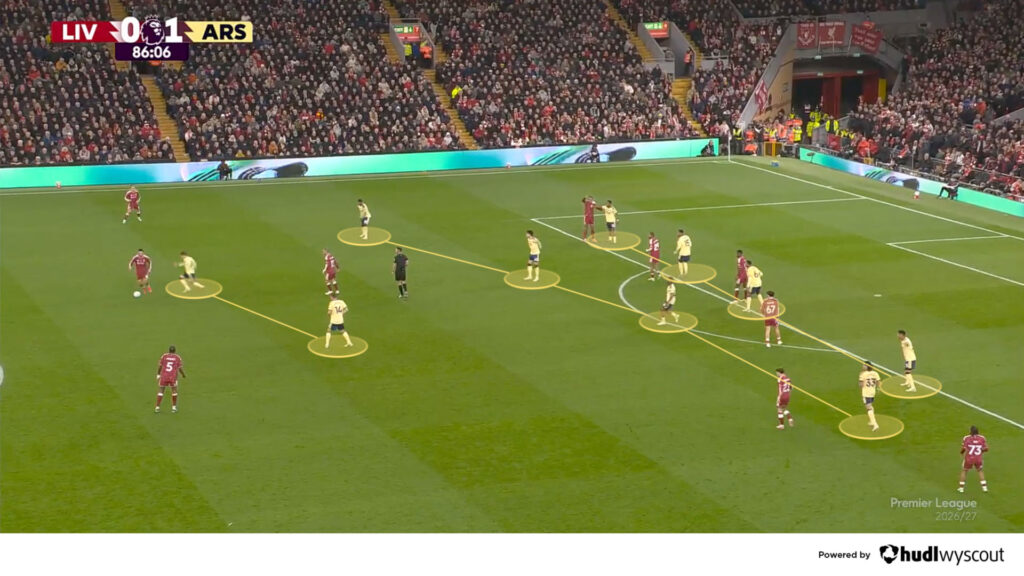
As the game progressed, Arsenal increasingly found themselves in their 4-4-2 defensive structure when defending the box (below). Liverpool pushed more players forward, often committing six players up against the last line. As a result, Arteta made a number of adjustments; Piero Hincapié was introduced to double up with Riccardo Calafiori on Arsenal's left, while on the right Noni Madueke supported Timber to restrict and prevent crosses. In contrast with the first half, Arsenal were more successful in escaping Liverpool’s counter-press in these stages. They gained much-needed territory away from their defensive third and slowed the game down to disrupt Liverpool’s attacking momentum.
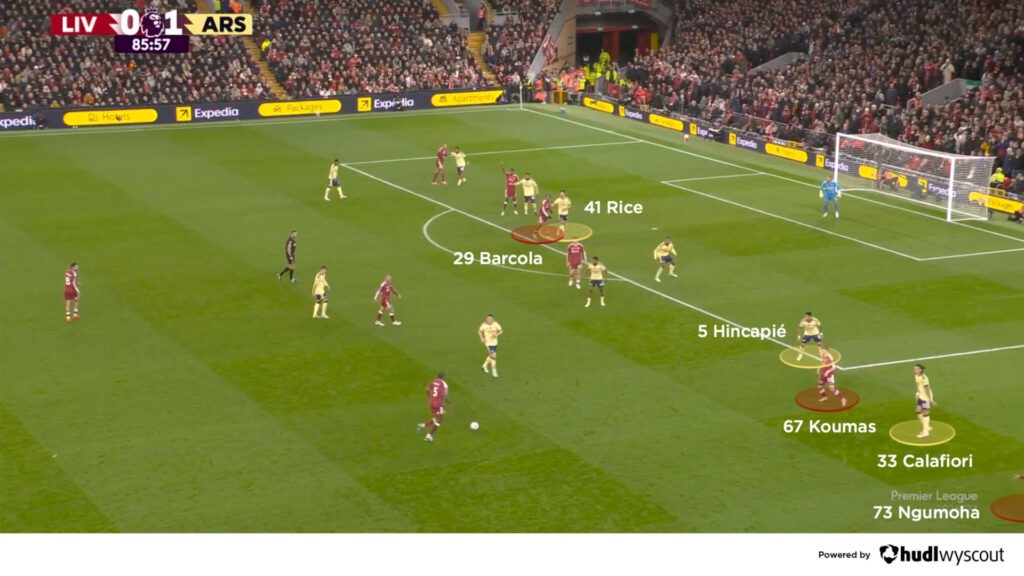
When defending extremely deep, Arsenal would often find themselves with six players on their back line, as the wingers dropped in to defend wide areas and help restrict crossing opportunities. In the example below, Hincapié and Calafiori work to defend against the fresh legs of Liverpool replacements Rio Ngumoha and Lewis Koumas – the latter of which drifted from central positions in a fluid Liverpool front line. In addition to this, Rice and substitute Myles Lewis-Skelly would often drop between their central defenders to provide more coverage across the defensive line and be in position to attack crosses into the box, defend any second balls and make increasingly important clearances.
Sadly for a raucous Anfield crowd, the visitors displayed enough of their trademark resilience to see the game out with a precious clean sheet and earn a morale-improving three points.
To learn more about football tactics and gain insights from coaches at the top of the game, visit Coaches’ Voice Academy
