



PREMIER League, SEPTEMBER 13 2026
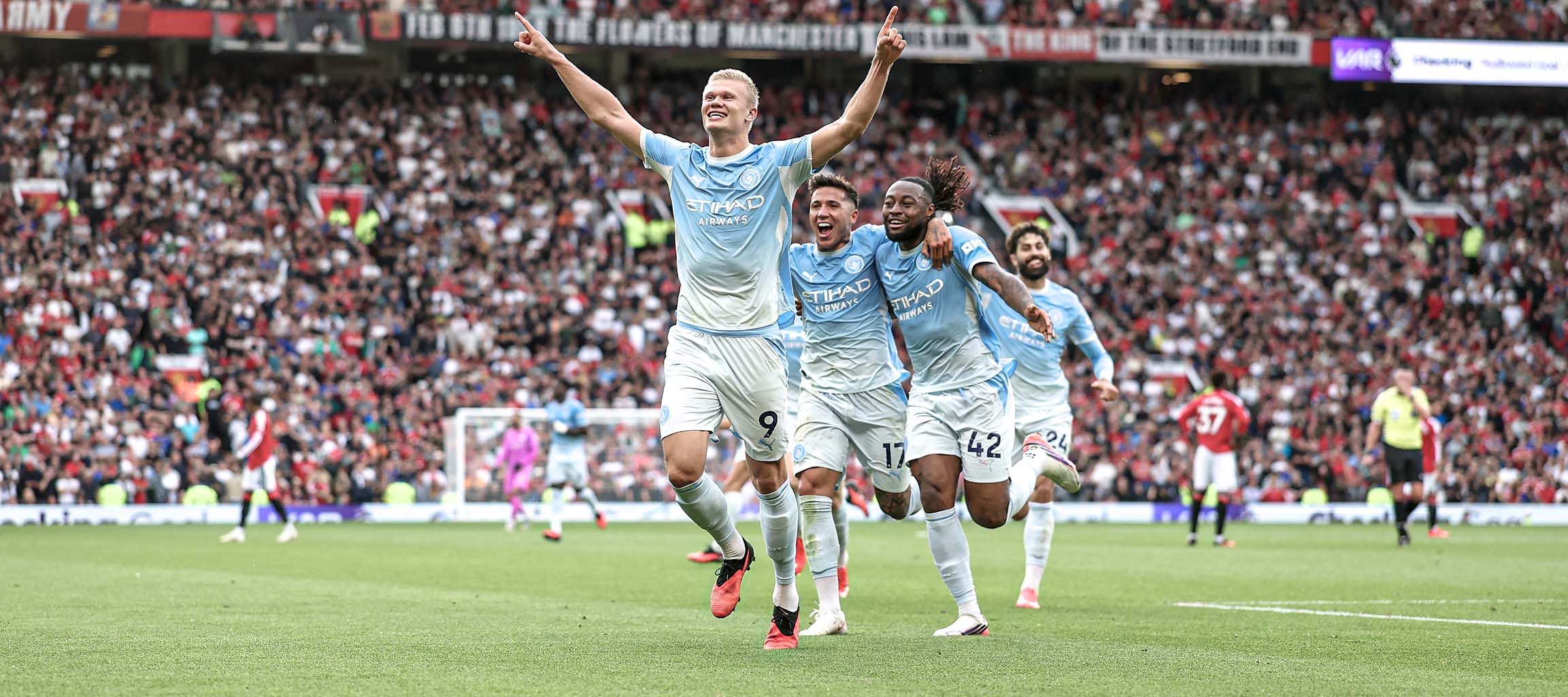
Haaland (52)
Manchester City overcame a 23rd-minute Phil Foden red card to claim three points at the home of their local rivals, and give a major boost to the start of the Enzo Maresca era. When Foden was dismissed for kicking out at Bruno Fernandes after the United captain had kicked him, the odds looked stacked against City. But Maresca’s team seemed to improve after being reduced to 10 men, and were able to rely on the finishing of Erling Haaland to claim victory – albeit with a controversial winner. The Premier League’s refereeing body, Pro Ref, subsequently admitted there had been an “error of judgement” by the video assistant referee in awarding the goal, much to United’s dismay. Not that it mattered to City and their new head coach, who celebrated wildly with the visiting support at the full-time whistle.
How the managers saw it
“I thought we came out after half-time and built momentum, hit the post and the game was building the way we wanted it to at that point,” said Michael Carrick. “Then the goal obviously has a big impact. We could have finished the game better, we could have been a little bit more creative.”
“We had a plan 11v11 that, after the red card, completely changed,” said Maresca. “The game with 10 men became more difficult for us but also for them, because they are a team that loves to play in transition. They love space in behind, but with 10 players we just dropped waiting for them and we didn’t concede any transitions or concede any space behind.”
 113652371898191012763245174710429
City’s press
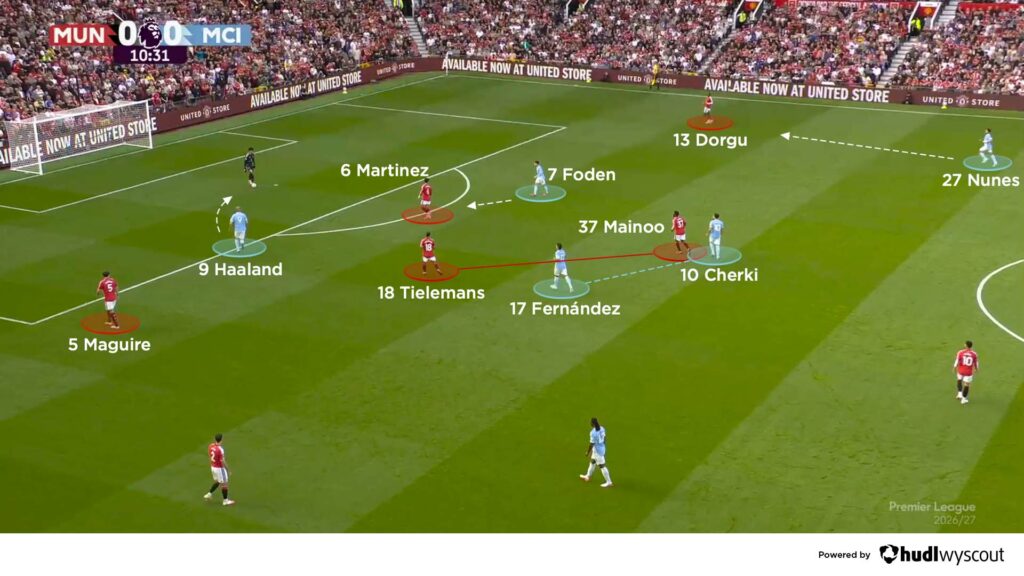
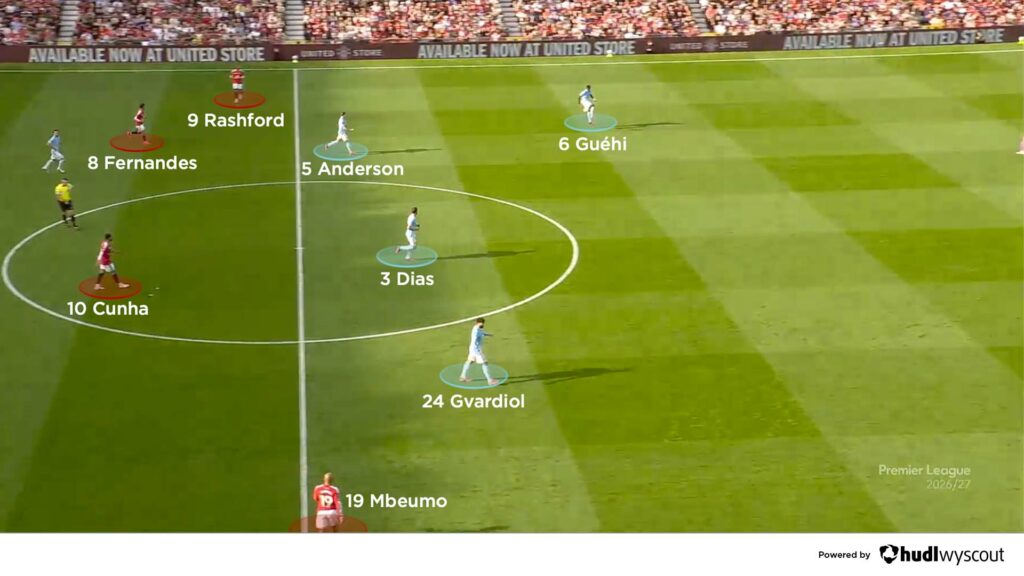
Manchester City started the game on the front foot, jumping into an aggressive player-oriented press to restrict Manchester United’s ability to play out from the back and progress. As shown below, Foden pressed out-to-in from the right, on to Lisandro Martínez, while Haaland pressed out-to-in on to Harry Maguire, continuing his press on to goalkeeper Senne Lammens and keeping Maguire in his cover shadow when required. As United built in a 4-box-2 structure – with Marcus Rashford and Bryan Mbeumo holding wide positions on the last line – City’s Enzo Fernández and Rayan Cherki engaged the deep double pivot of Kobbie Mainoo and Youri Tielemans, Elliot Anderson occupied Bruno Fernandes, while Rúben Dias positioned himself to engage Matheus Cunha. To accommodate Foden’s adjusted position, Matheus Nunes was aggressive in jumping on to left-back Patrick Dorgu, which in turn forced Marc Guéhi to slide across and cover Rashford on City’s right.
As a result, United were often unable to progress in build-up situations, and when they did look to play through they were immediately pressured centrally by City. Lammens was frequently forced to play longer into duels on City’s back line, where the visitors were dominant, often regaining possession – as in the example below, where Guéhi took simple control of a long ball from Lammens.
United’s structure to create
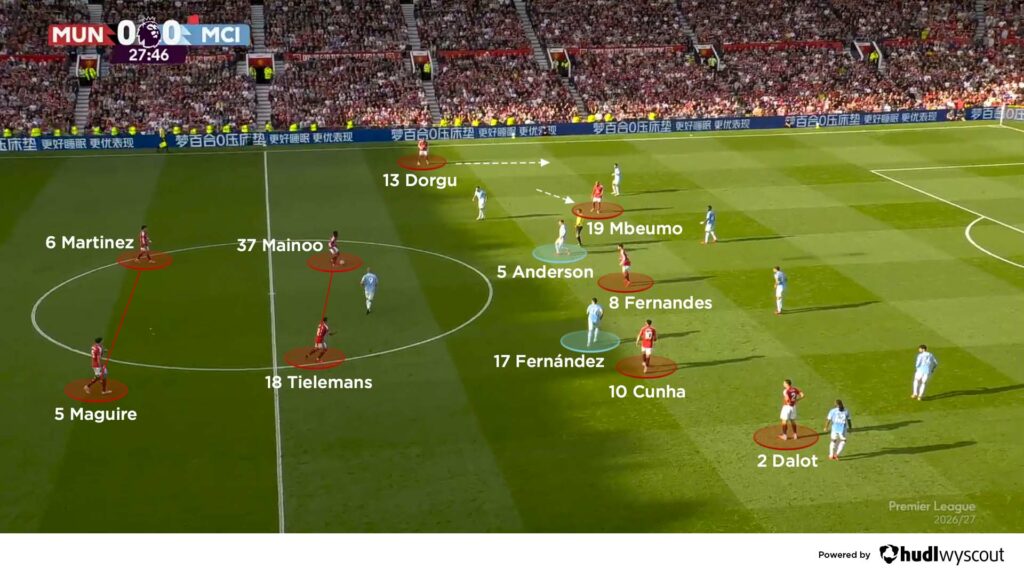
Following Foden’s red card, United looked to move into a 2-2-6 structure in possession when possible, to create against City’s 4-4-1 block, but moved into a 2-3-5 at times, with either Diogo Dalot or Dorgu balancing off when possession was on the opposite side. Maguire and Martínez formed the base of the 2-2 build-up structure, with Mainoo and Tielemans in front. In this structure, United operated without a fixed striker, opting to play mostly through Cunha and Fernandes, who took up attacking midfield positions off the back of City’s midfield. As shown below, United had moments where they were able to overload City centrally, which was even more evident whenever Mbeumo (below) or Rashford moved further infield when Dalot or Dorgu advanced.
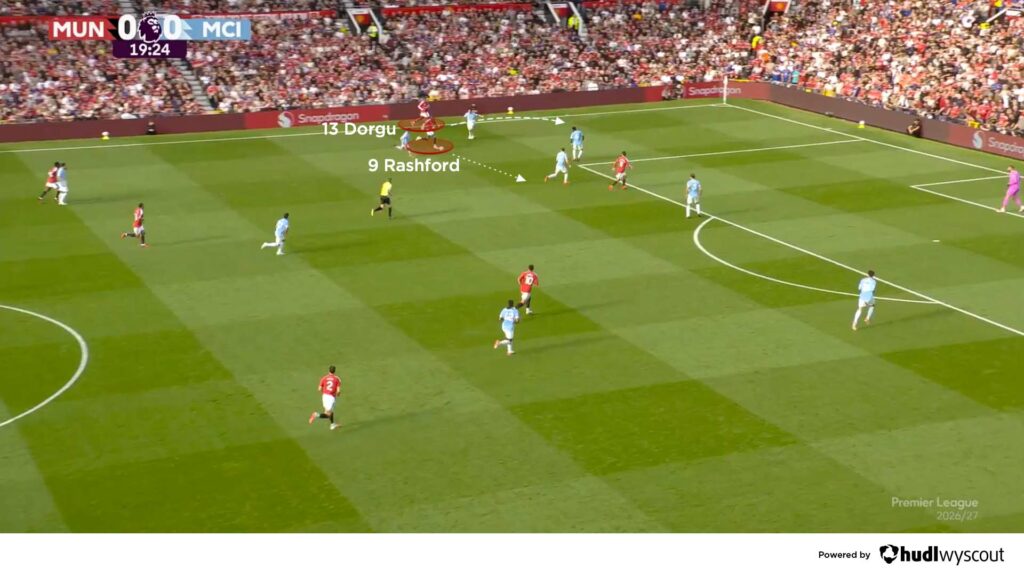
A secondary outcome of this approach was that Rashford had a great deal of space on the left to attack Nunes in 1v1 situations, and to create temporary 2v1s when Dorgu advanced from left-back. As a result of United’s central-focused approach, Fernández and Anderson narrowed, occupied centrally by Bruno Fernandes and Cunha, which gave Rashford space to then drive inside and attack. He utilised his dynamism to quickly change speed and attack the space inside City’s structure, often looking to cut on to his right foot to shoot (below, shown doing this even before City were reduced to 10). The England attacker carried most of United’s attacking threat in the first half.
Maresca’s second-half adjustments
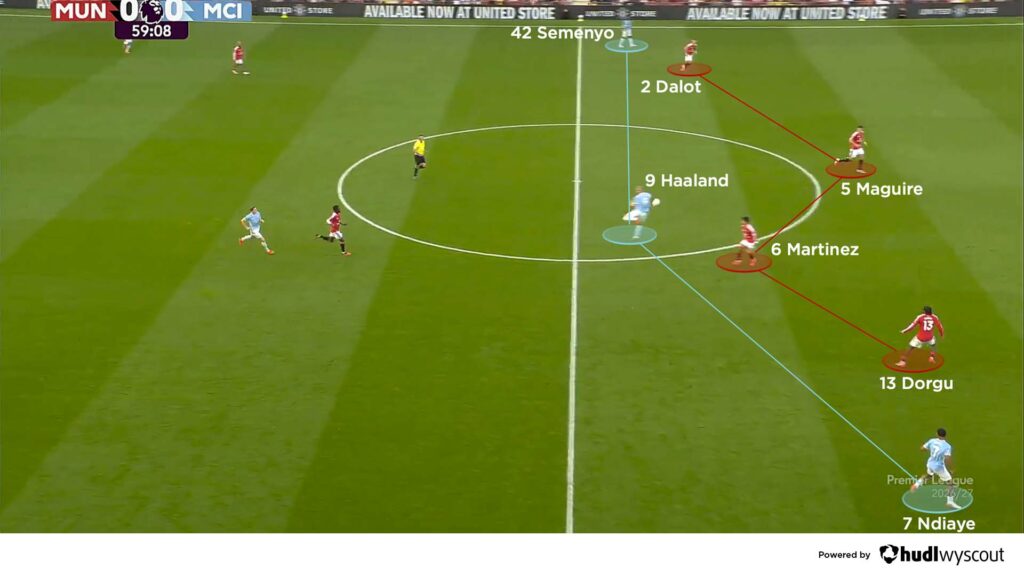
Maresca reshaped City in both personnel and approach for the second half, with Iliman Ndiaye replacing Cherki. United’s one-man advantage invited them to press in a slightly more aggressive manner than in the first half, and so City became far more direct and vertical. They now looked to exploit the bigger spaces in behind the press on their last line – either into Haaland, or by switching to find Ndiaye on the right or Antoine Semenyo on the left. As shown below, City had dynamic and explosive players at the top end of the pitch, who were exceptional in exploiting the bigger spaces and attacking 1v1 to maximise attacking opportunities. It was off the back of this approach that Ndiaye landed on a second ball following a direct pass from Gianluigi Donarrumma, to begin the move that led to City’s controversial goal.
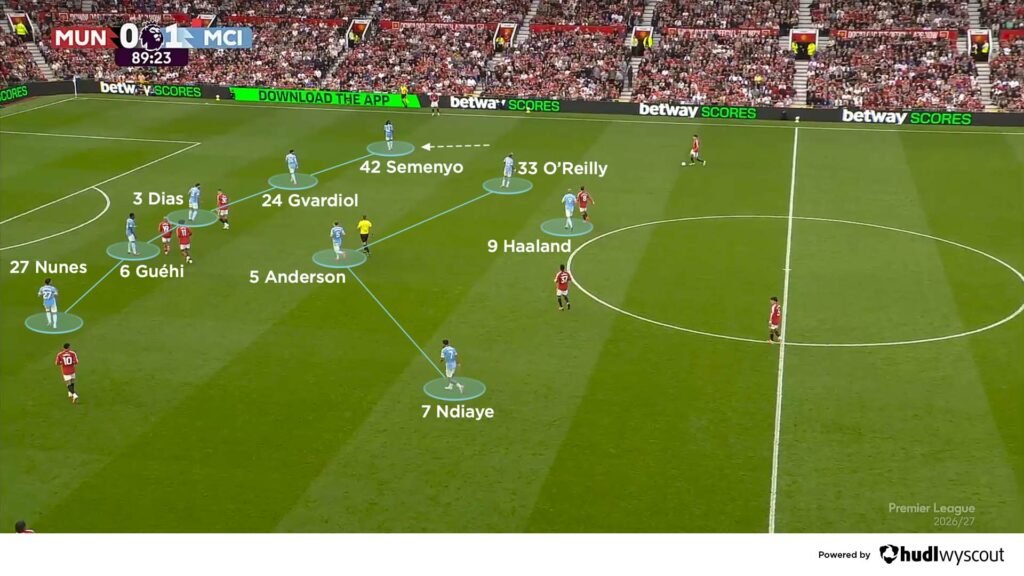
Out of possession, Maresca’s side were far more cautious in the second half. They became narrower and more compact; rather than stepping out to engage and press, they were patient in restricting United’s ability to play through. City’s deeper block also gave them more opportunities in transition, exploiting the space in behind as United committed players forward, which became more evident following the opening goal. As the game progressed and the away side looked to see the game out, their 4-4-1 often became a 5-3-1 (below). One of City’s wide players matched the height of an advancing United full-back, limiting the influence of United pushing five or six players on to City’s back line.
Still, City required Donnarumma to make a smart save in added time to deny Bryan Mbeumo an equaliser, after Carrick’s team had hit the post either side of half-time. The result was not only painful for United coming in a derby and against 10 men, but left them with just four points from their opening four Premier League games of the season. City, by contrast, are the only team other than Arsenal to take maximum points so far.
To learn more about football tactics and gain insights from coaches at the top of the game, visit Coaches’ Voice Academy
