


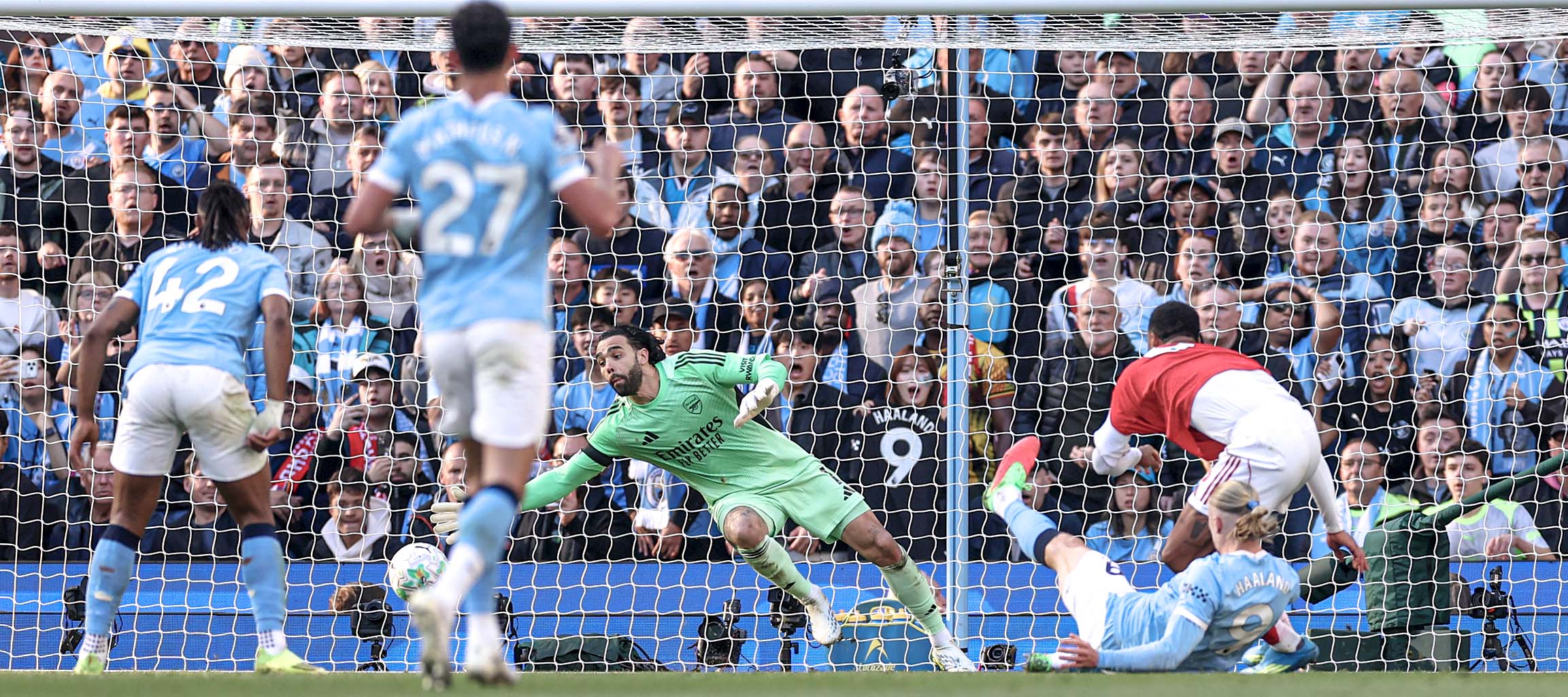

PREMIER League, APRIL 19 2026
Cherki (16)
Haaland (65)
Havertz (18)
In this showdown between the Premier League title contenders, it was Manchester City who got the job done on a day when the result was all important. Rayan Cherki opened the scoring for City with a dribble and finish that is a contender for goal of the season, only for Gianluigi Donnarumma to produce a contender for biggest calamity moments later, Kai Havertz pouncing on the Italian’s dithering to quickly level for Arsenal. Both teams had chances to add to their tally in the second half, with Donnarumma partly redeeming himself by helping to keep Arsenal at bay. Only Erling Haaland was able to find the back of the net in the second period, as the league’s top scorer gave City the chance to go top of the league if they win at Burnley on Wednesday night.
How the managers saw it
“It’s the best two teams in England and I think it was a good advert for football in England,” said Pep Guardiola. “[Arsenal] don’t allow you to go through the process, they’re so aggressive. They are good in the duels and one of the most competitive teams I ever faced in my career in terms of duels and one against one; long balls with Havertz and [Declan] Rice, second balls – fantastic… they are so competitive and aggressive in all departments. We had momentum, they had momentum, we had chances, they had chances. At the end in these type of games, it is little margins.”
“Very upset with the result,” said Mikel Arteta. “We came here to win the game. I think the message was clear from three days before. We prepared to do that, to play the game to the areas that we believe we could win it. We certainly done that. Even though we started the game with a goal down and psychologically we had to play with that, we’ve done it. So it proves that we are there, but the reality is in the two boxes today was a difference and that’s what decided the game.”
Below, our UEFA-licensed coaches have analysed the key tactical points from the game.
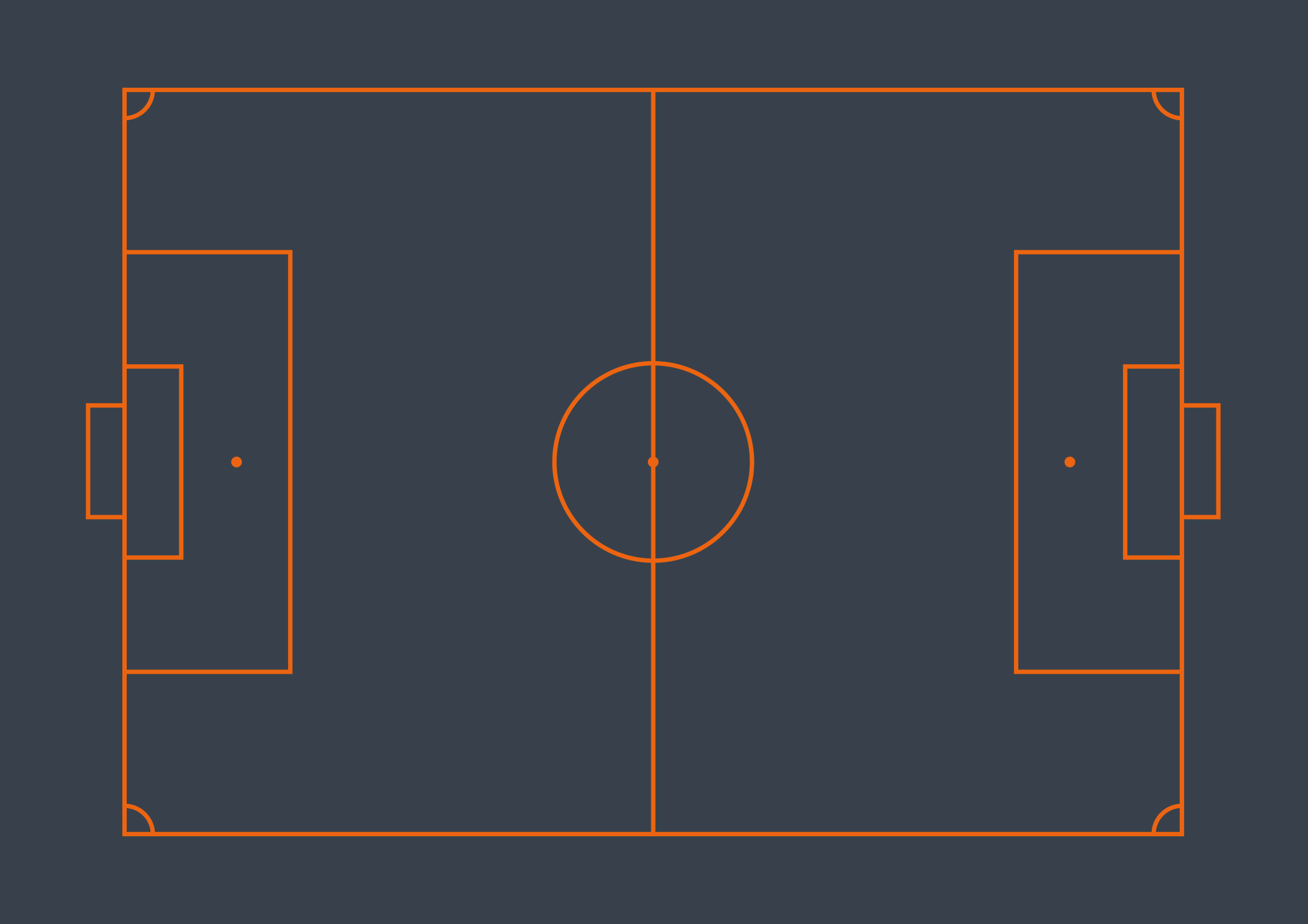 2533154527112016429101326536841292010
14/4
SHOTS / ON TARGET
8/3
61%
POSSESSION
39%
28
ATTACKS INTO AREA
18
2.34
EXPECTED GOALS (XG)
2.04
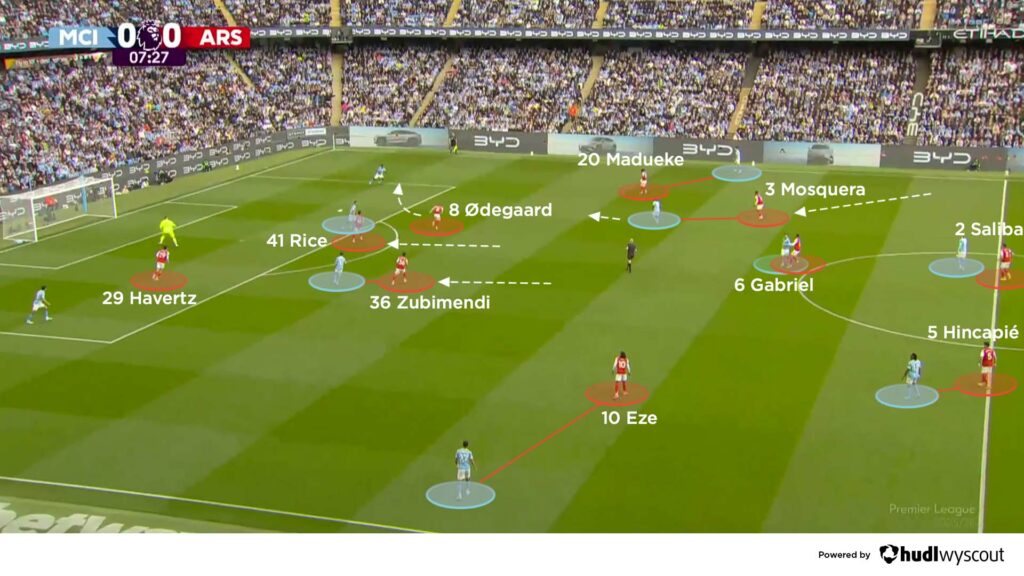
Arsenal’s high press
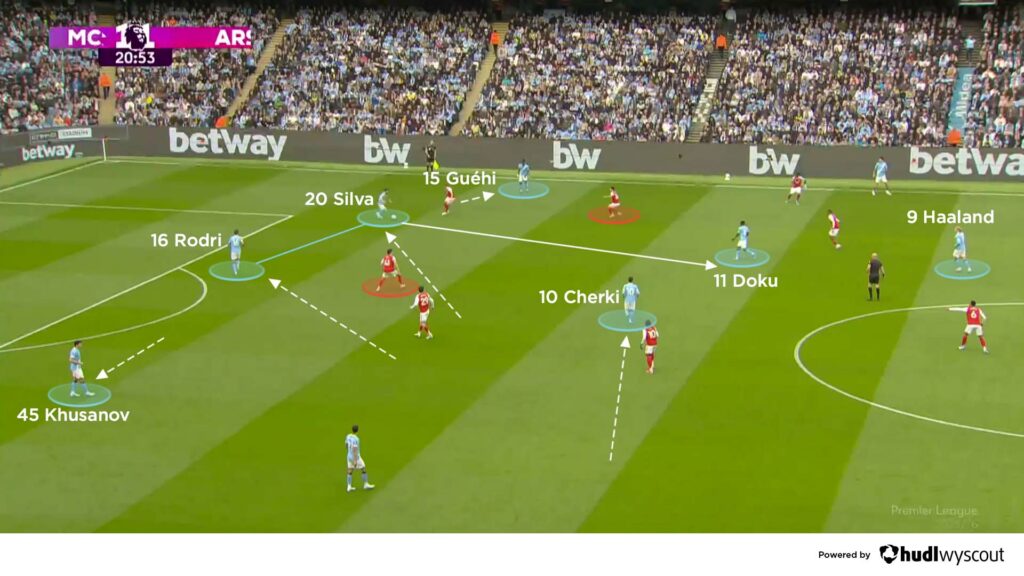
To restrict Manchester City’s build-up play, Arsenal pressed very high at the start of the game, going man-for-man via their initial 4-4-2 out-of-possession structure. If any Manchester City attacker dropped to the ball, Arsenal’s opposite number aggressively followed them. Where possible, Arsenal’s first line of Martin Ødegaard and Havertz pressed the ball outwards, forcing City’s centre-backs closer to the touchline, with Declan Rice and Martín Zubimendi working on City’s double pivot of Bernardo Silva and Rodri (below).
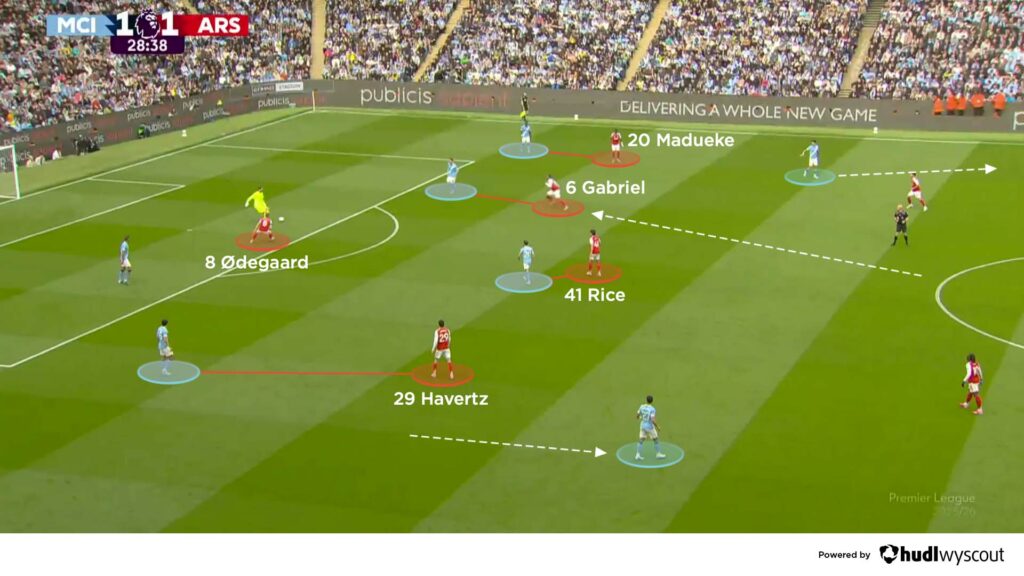
The visitor’s high press involved different Arsenal players applying their first line of pressure, depending on which City player dropped short towards the ball. Sometimes that meant players from Arsenal’s own back line were pressing on the edge of City’s box (see Gabriel, below), as Guardiola’s team attempted to push their full-backs higher up the pitch. Arteta’s team got a reward for their high-pressing endeavour when Havertz jumped an in-possession Donnarumma, and the ball ricocheted into the City net to swiftly restore parity.
City’s solutions
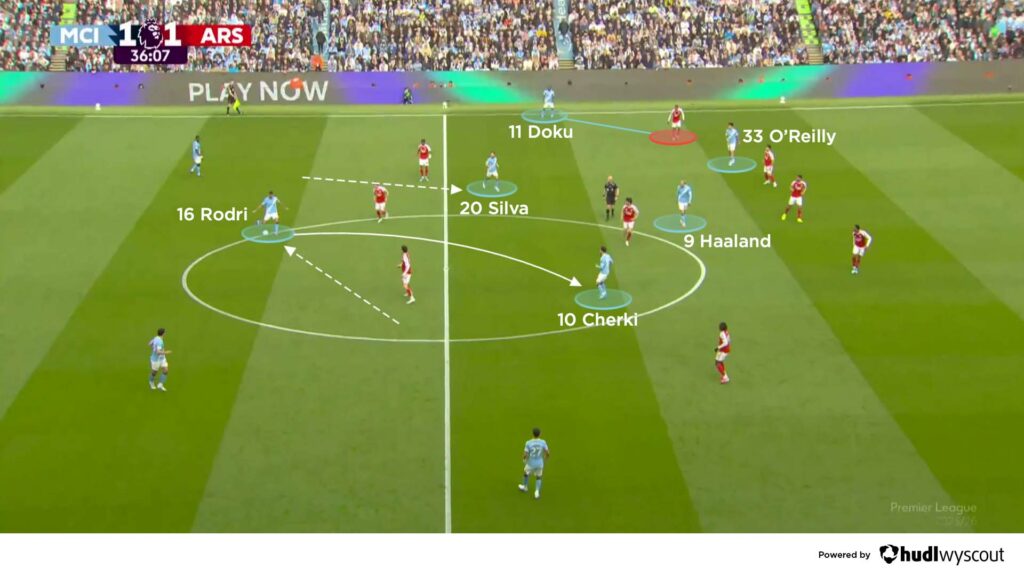
City soon found a productive solution to Arsenal’s press, with the home side’s centre-backs splitting and Silva and Rodri dropping between. Arsenal then had a problem – if Rice and Zubimendi followed this dropping movement, the centre would be vacant within Arsenal’s defensive structure. But whenever the Arsenal pair stayed, Rodri and Silva were both free to receive, face forward and find attacking teammates further ahead between the lines (below). Arsenal tried to maintain their high press on to Silva and Rodri, but City frequently found their spare player and began to take control with possession and territory.
Rodri and Silva began to dictate the play, while fatigue likely meant that as the game progressed Arsenal were unable to maintain the same levels of energetic pressing. With Rodri and Silva getting on the ball in front of Arsenal’s first-line pair, City had numbers to build and maintain possession, plus good cover for any potential transition the other way. Silva then joined in play further forward when City had broken the first line, with Cherki, Haaland and Nico O’Reilly (below) receiving between the lines more and more, to then turn and attack forward. And towards the end of the first half Doku provided more of a 1v1 threat on the left, once City had broken through the centre.
City’s left side
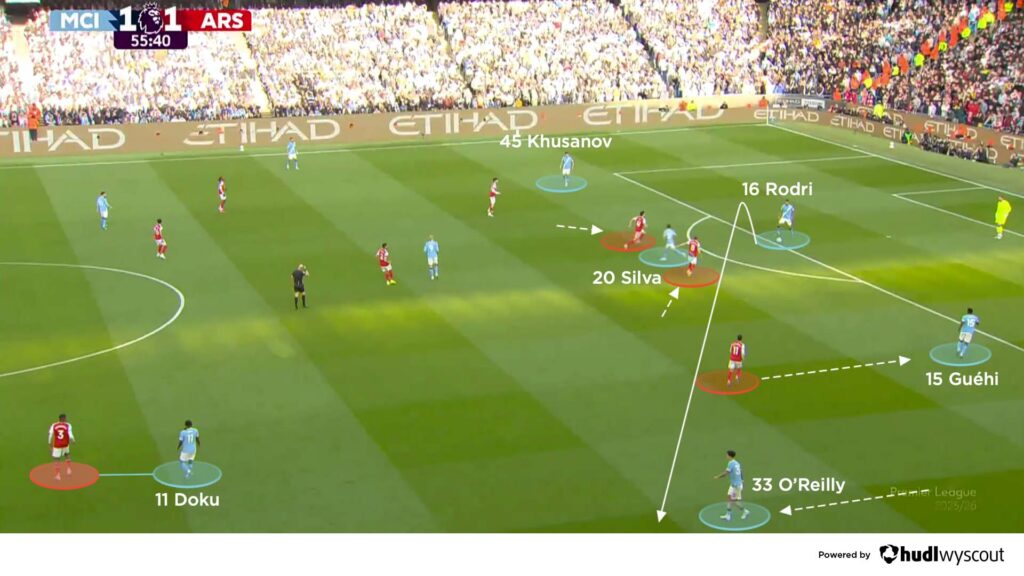
Silva and Rodri continued to dictate the play in the second half, again dropping central to support in between City’s centre-backs. As a result, Ødegaard and Havertz were occupied and pressed as a much narrower front two, with Gabriel Martinelli (on for Noni Madueke) ready to jump from the right wing, working towards wide centre-back Marc Guéhi. Doku pinnned Arsenal right-back Cristhian Mosquera, meaning that O’Reilly became free as Arsenal failed to readjust. Simple passes wide left helped City to progress, with Silva and Rodri controlling their build-up (below).
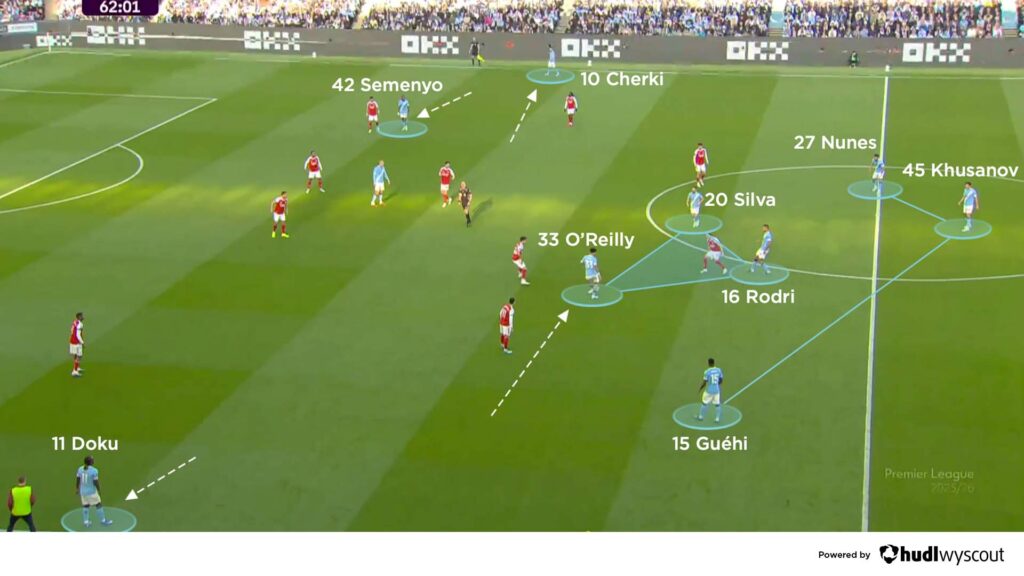
As City’s possession pinned Arsenal back, Silva and Rodri then connected in the centre, with O’Reilly also joining inside. Doku continued to hold the width on on the left as City’s best attacking outlet. Cherki was only really involved deep into the final third, moving very wide to the right for a lot of the second half, while Antoine Semenyo was slightly narrower on that side, but had little impact on City’s attacking. Abdukodir Khusanov, Guéhi and Matheus Nunes underneath the ball (below) were strong on defensive transition, with Arsenal having just the one counter-attacking chance, which was well saved by Donnarumma after a Guéhi error on the ball.
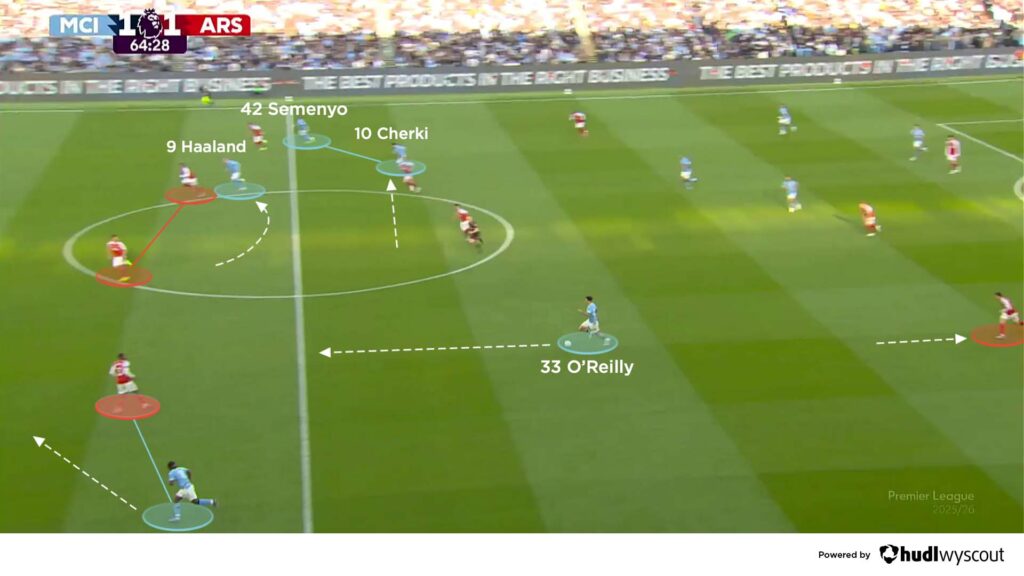
City’s left side created the match-winning attack. With Donnarumma taking possession after an Arsenal attack, Martinelli left O’Reilly free in preparation for a high press. However, Donnarumma’s quick decision-making punished Arsenal. He found O’Reilly in acres of space (below) with a throw that enabled the City player to take his first touch on the halfway line. Within 10 seconds City had gone from box to box and had Doku on the ball, who squeezed a return pass through to O’Reilly. He played a pass across the box as Rodri crashed the penalty area, occupying two Arsenal defenders, which helped the ball to fall for Haaland at the back post. City’s number nine used his strength to hold off Gabriel and apply the finish.
Arsenal came close to scoring themselves, but hit the post twice – via a set-piece and an Eberechi Eze shot from range – while Havertz headed over from a Leandro Trossard cross in added time. With the title race so close and potentially to be decided on goal difference, being clinical in front of goal will likely be vital. Fortunately for Arsenal, they still have five games left to find their shooting boots. City, however, are already showing their ruthlessness.
To learn more about football tactics and gain insights from coaches at the top of the game, visit Coaches’ Voice Academy
