

PREMIER League, JANUARY 4 2026
Reijnders (42)
Fernández (90+4)
Chelsea interim head coach Calum McFarlane oversaw a gutsy performance and result at Manchester City, in what was the London club’s first game following Enzo Maresca’s departure. Enzo Fernández poked home an equaliser in the 94th minute that was probably celebrated just as much by Arsenal fans, given that it left City six points behind the Premier League-leading Gunners.
Tijjani Reijnders had given the home side a first-half lead from which they looked set to narrow the gap at the top, but their inability to score a second left the door open for Chelsea to snatch a point. The visitors will hope it proves valuable in their pursuit of Champions League qualification, while City must pick themselves up for the visit of Brighton in three days’ time. Below, our UEFA-licensed coaches have picked out the tactical highlights from the game.
How the managers saw it
“We managed quite well in the first half,” said Pep Guardiola. “In the second half they had chances. We lost two balls in the beginning. We missed talented players at the end – two against one and three against two. They didn’t create much. We were extraordinary in all departments except we could not score a second or a third or a fourth. Of course in the second half they made a step up, first half they were a little more cautious and then had nothing to lose and at the end they found the reward.”
“We didn’t expect them to shape up the way they did in the first half, so they had a lot of control,” said McFarlane. “We were getting pinned back with Estêvão and Pedro [Neto] having to defend in a back five at times, which meant they had so much control and rhythm. That’s not how we wanted the game to look. We made a change at half-time to go more man for man against the ball, and to be able to get more pressure to disrupt their rhythm and hopefully force them to go a little bit longer. Andrey Santos was exceptional. He really controlled the middle of the pitch. In and out of possession, the shape change and the sub really helped us. Liam [Delap] gave us a really good outlet to go more direct and occupy the centre-half.”
 2522432716104472091234235272484110720
13/3
SHOTS / ON TARGET
8/4
58%
POSSESSION
42%
37
ATTACKS INTO AREA
14
1.06
EXPECTED GOALS (XG)
2.95
Breaking Chelsea’s defensive strategy
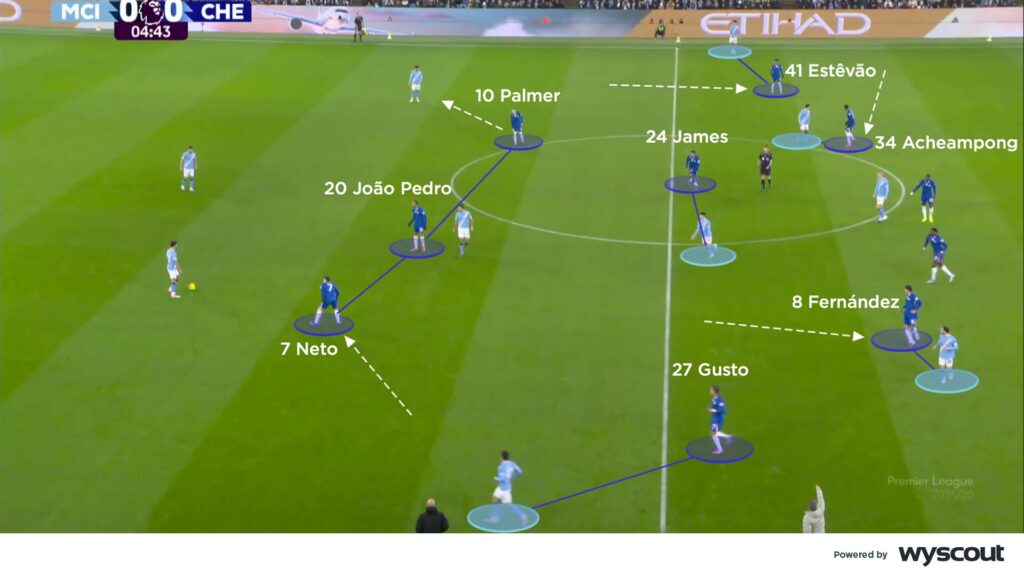
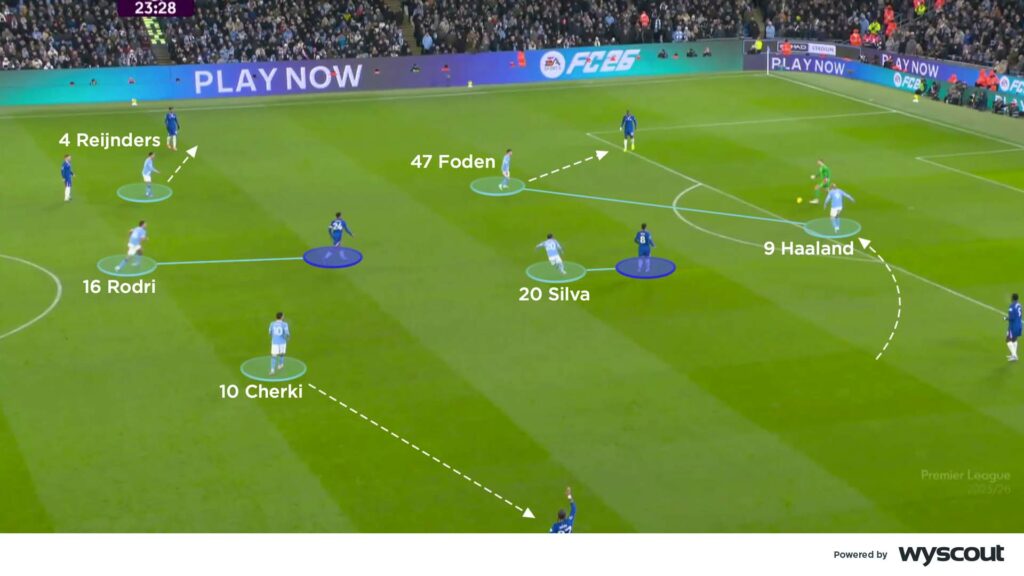
In the first half Chelsea attempted to nullify Manchester City’s central play, with Reece James and Fernández aggressively marking Bernardo Silva and Phil Foden, even following them into the back line if needed. Right-back Josh Acheampong defended narrow to cover Reijnders, with winger Estêvão then required to defend the outside spaces, tracking Nico O’Reilly’s advances. Cole Palmer then covered the space ahead on Chelsea’s right, with the visitors’ centre-backs overloading Erling Haaland. Malo Gusto filled in at left-back to cover City’s wide-right attacker, allowing Pedro Neto to jump higher as Chelsea’s first-line trio defended against City’s converted back three and Rodri (below).
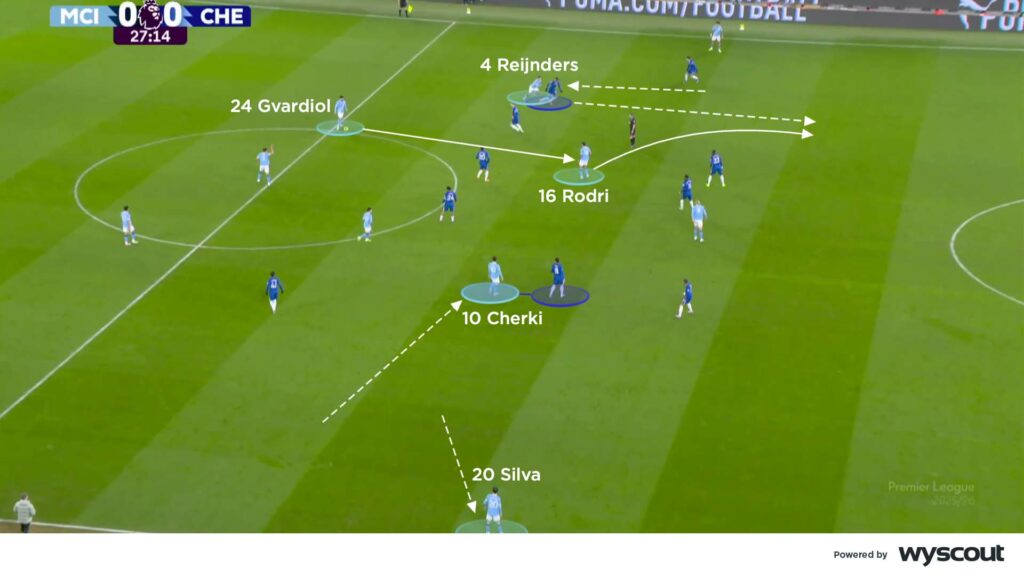
City were a stronger threat whenever they had runners in behind, especially when they targeted spaces between Chelsea’s full-backs and centre-backs. With Acheampong continuing to cover Reijnders, a gap was available to exploit, and City broke into the Chelsea penalty area whenever they worked the play through this gap (below). In an attempt to further disrupt Chelsea’s central defending, Silva and Rayan Cherki rotated. But after a while Fernández simply waited for this to happen, then picked up Cherki, with Gusto defending wide and picking up Silva.
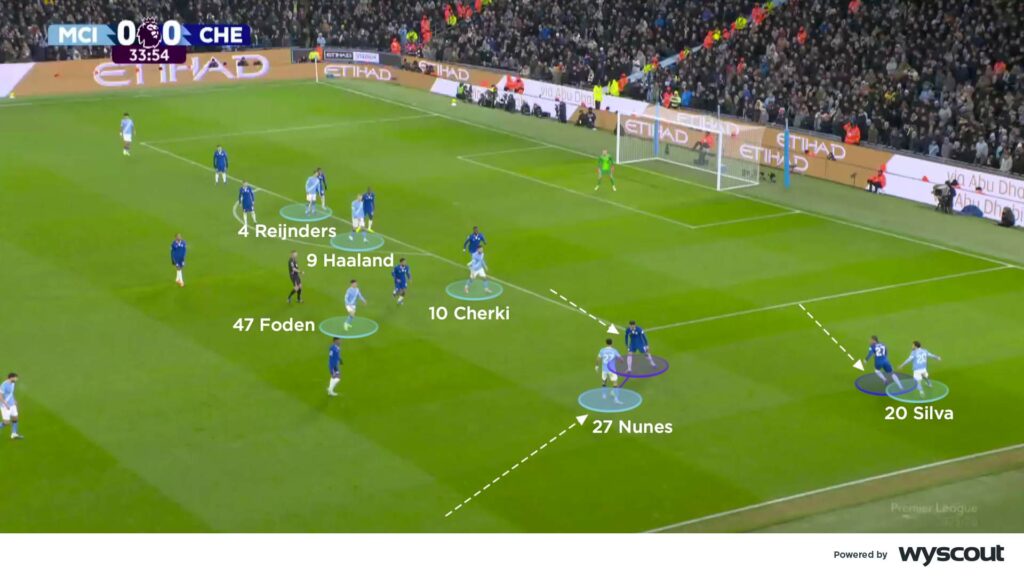
Despite City picking the odd moment to penetrate in behind, Chelsea’s defending of the central spaces remained fairly resolute. City were often forced to play from left to right, with Chelsea leaving Cherki or Silva free to receive. But when Matheus Nunes left City’s converted back three to join their attacks on this side, Guardiola’s team started to break into the box from wide right as well (below). This allowed City to place more attackers around Haaland, as Chelsea soon dropped into a very low block and were forced into more emergency defending.
City on transition
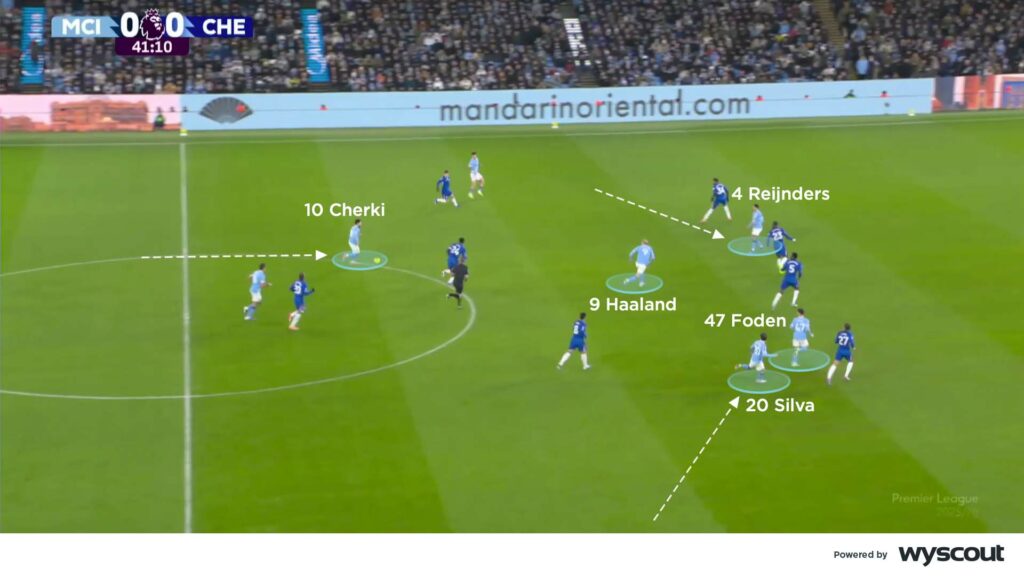
City limited most of Chelsea’s build-up in the first half, employing an impressive narrow press. Foden jumped with Haaland – one locking play one way, while the other jumped Chelsea’s receiving centre-back. From here, Silva pressed on to Chelsea’s deepest pivot, with Rodri ready to cover any long balls, but also able to work on to the next Chelsea pivot when needed. Wide players Cherki and Reijnders narrowed, ready to press out to a Chelsea full-back (below), especially on straight passes along the touchline or long aerial passes to a wide area.
City’s high press helped them to create chances, including when Haaland hit the post after a high regain. The home side were also most effective in the first half from regains around the halfway line, with their goal coming from a quick move forward. By defending and pressing so narrow around Haaland, it meant that Foden, Silva, Cherki and Reijnders were all in prime positions to attack against Chelsea’s back four (below).
Chelsea’s second-half changes
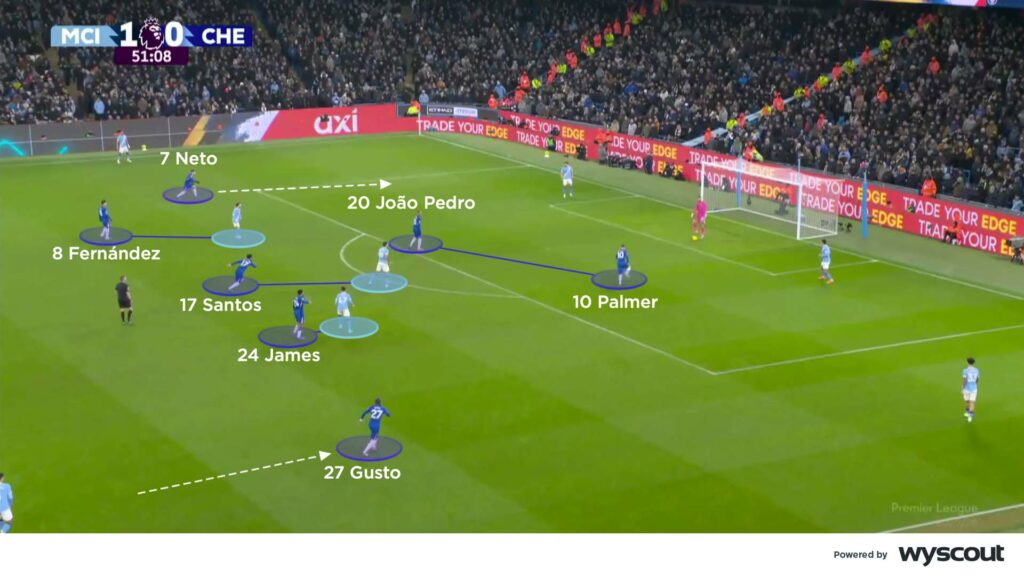
McFarlane changed Chelsea’s shape for the second half, converting into a back three. The visitors then committed significant numbers to a much higher press, with Palmer and João Pedro jumping as a central pair in the first line. Neto and Gusto – the latter now at right wing-back – moved high to defend into the wide areas, with Neto particularly aggressive with his defensive positioning. Andrey Santos – added to the midfield for Estêvão – helped James and Fernández defend City’s midfield three (below).
With Neto so high when pressing, Fernández moved wider to help cover City’s central midfield and be ready to press behind Neto when needed. As Cherki moved inwards from this side, Chelsea responded by sending a centre-back into midfield to help out James and Santos (below). From here, City sent a runner the other way to support Haaland and played more direct in the second half, creating some moments of real potential – not least when Haaland drove forward, centrally. But City’s failure to score a second kept Chelsea alive in the game.
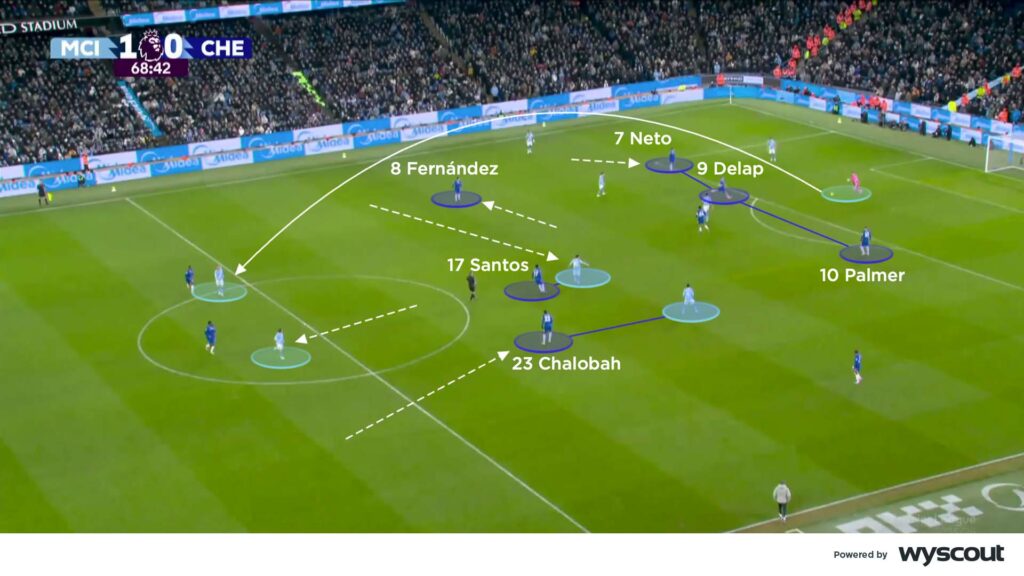
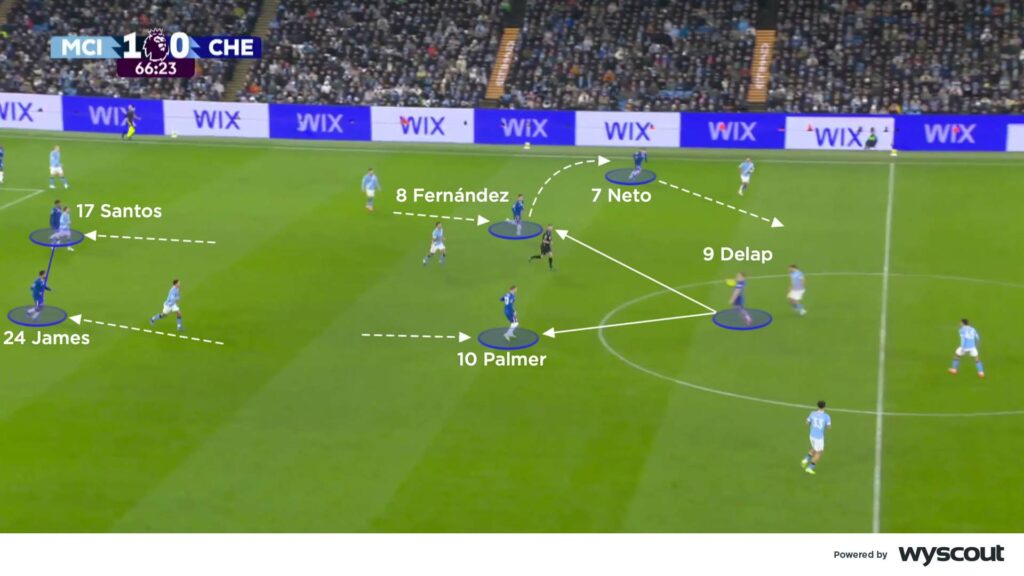
City had more space to attack in the second half, but on the flip side Chelsea were much more of an attacking threat after the break. Their play into Liam Delap – on for João Pedro after 62 minutes – went over City’s press. With Palmer and Fernández as two number 10s, Delap had options to lay the ball off either side, to then connect into advancing wing-backs. Chelsea’s double pivot dropped deep, drawing City’s midfield forward. This created more space in which Delap and the 10s could combine. Fernández sometimes moved wide left, rotating with Neto (below), which also caused City problems.
It was Fernández who supplied the back-post finish to secure a point for Chelsea, which stemmed from McFarlane’s brave change of shape at half-time. Whether the interim coach gets more opportunities to lead the first team remains to be seen, but he certainly stepped up when needed on this occasion.
To learn more about football tactics and gain insights from coaches at the top of the game, visit CV Academy