
PREMIER League, DECEMBER 14 2025
Woltemade OG (46)
Sunderland edged the first Premier League Tyne-Wear derby since 2016, thanks to a Nick Woltemade own goal. Newcastle’s German striker headed a Nordi Mukiele cross in off the crossbar shortly after the break to decide a game of few chances. Sunderland then saw the game out to move up to seventh in the table, five points clear of their northeast rivals, as their impressive return to the Premier League continues.
How the managers saw it
“We stayed focused on our game model and how we wanted to play,” said Sunderland head coach Régis Le Bris. “The intensity was really important because we knew that it was the key for this game. They are really intense, and we matched them. We weren’t too low or too high – we had the right balance. After that, we played our game with the ball. We were composed and really agile and flexible in managing the pressure. The last part was to score, and we need to be a bit more clinical in the final third.”
“We know our performance was not what it needed to be,” said Eddie Howe. “It was a game of very few chances settled by a freak goal and we couldn’t create the openings we wanted. The effort was there but the quality wasn’t. We were disappointed with our creative output. We haven’t delivered. It’s difficult to take.”
Below, our UEFA-licensed coaches have outlined the tactical ebb and flow of the game…
 221715520273472825932211233383967272010
6/1
SHOTS / ON TARGET
4/2
45%
POSSESSION
55%
23
ATTACKS INTO AREA
29
0.34
EXPECTED GOALS (XG)
0.2
Sunderland’s inside left channel
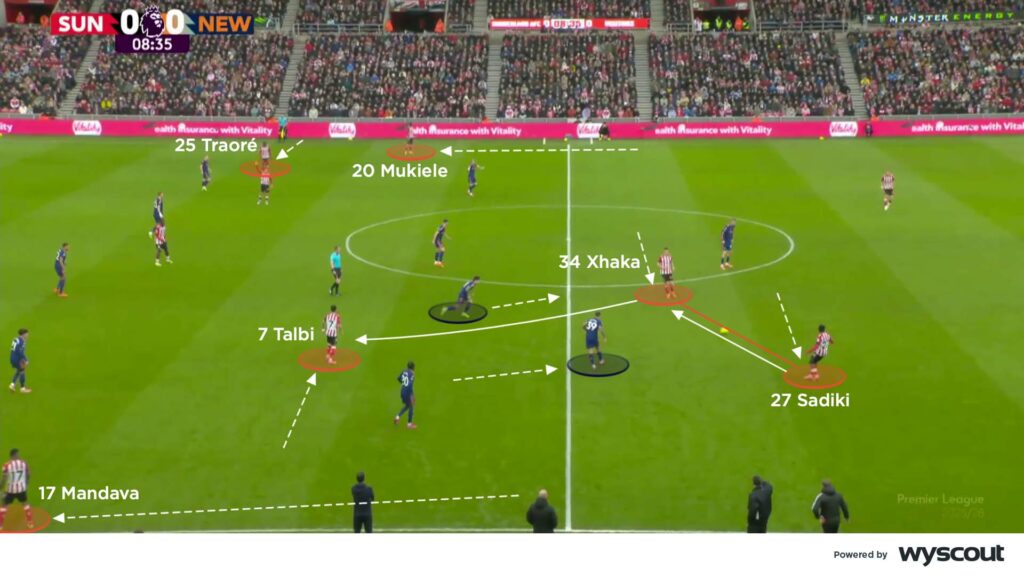
Sunderland started the game strongly, trying to break Newcastle’s 5-4-1 mid-block. Both sides of Sunderland’s 4-2-3-1 had similar rotations, with the full-backs moving higher and the wingers rolling inside. But the double pivot of Granit Xhaka and Noah Sadiki shifting to the left helped that side in particular to progress forward, especially when Newcastle’s midfielders jumped out to press. Here, Xhaka’s clever passing around corners helped penetrate through (below).
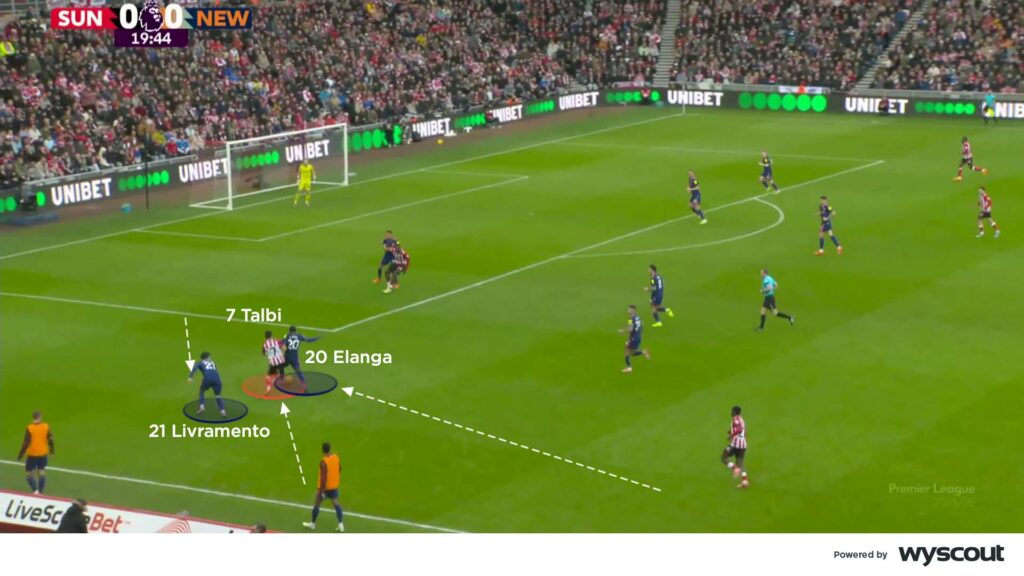
Although Xhaka and Sadiki continued to work the ball forward through Sunderland’s left inside channel, Newcastle limited the home side to minimal clear chances. This was largely thanks to the defensive depth and positioning of Newcastle’s wingers. If Sunderland’s wingers beat their full-back opponent or received in spaces coming inside, Newcastle’s wingers being so deep added extra cover (below). However, this nullified their counter-attacking the other way, resulting in minimal goal threat or chances for both teams.
Newcastle’s wide right
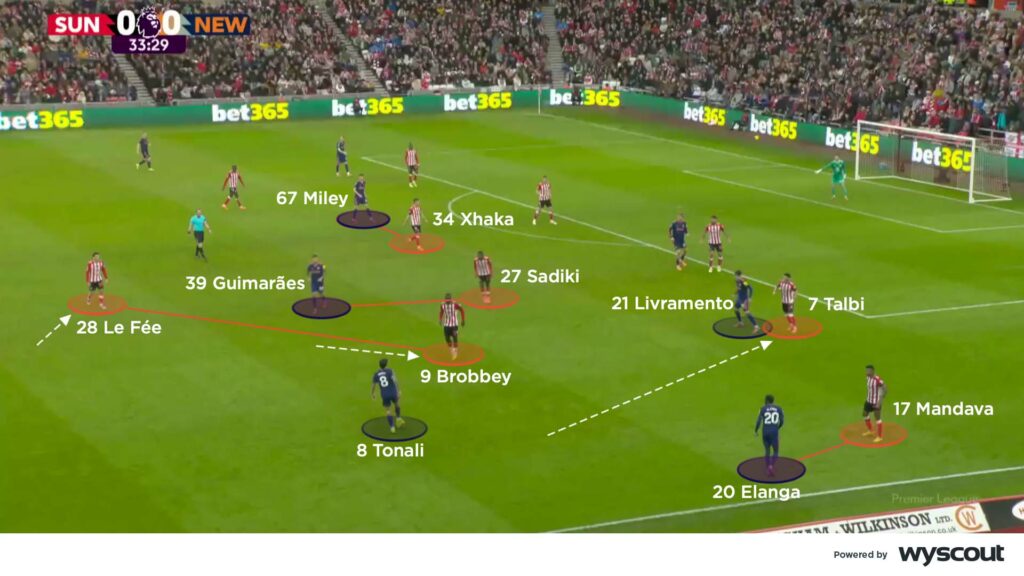
Newcastle eventually managed to flip the momentum, building around the home side’s 4-4-2 block with their 4-3-3 structure. Left-back Lewis Hall rarely ventured forward in the first half. He remained deeper, allowing right centre-back Malick Thiaw to widen during their build. Sunderland’s block shuffled across whenever Newcastle played left, with far-side winger Chemsdine Talbi narrowing to defend a Newcastle midfielder. That meant whenever Newcastle worked the ball from left to right, they could find Anthony Elanga or Tino Livramento in promising positions. Elanga’s dropping helped pull out his full-back opponent for Livramento to make narrowed runs behind, away from Talbi (below).
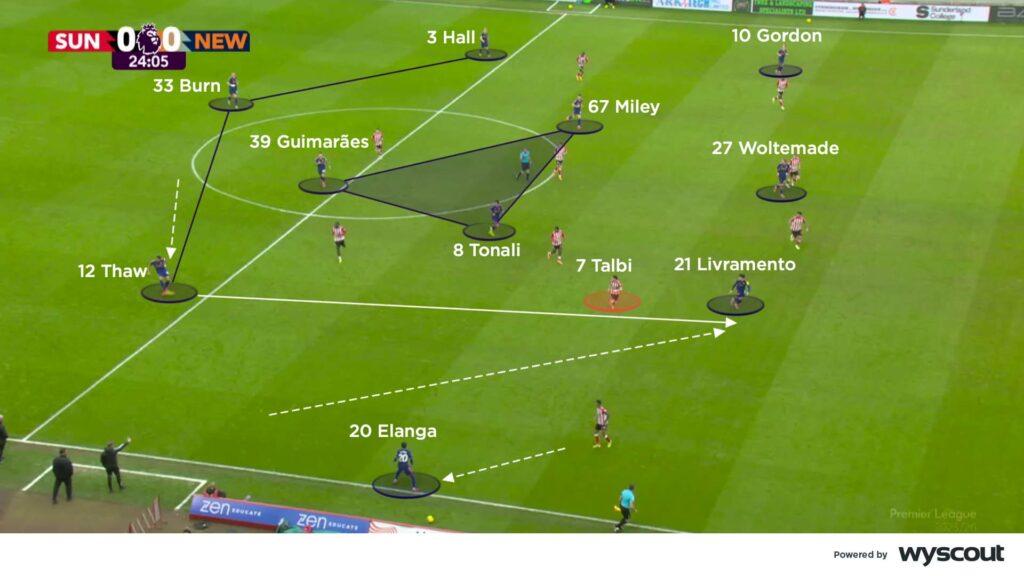
Just as Newcastle responded defensively with deeper wingers, so too did Sunderland. Talbi began following Livramento’s advances much closer, tracking all the way into his own back line if needed. Sunderland’s front pair also dropped deeper, keeping the ball in front of them as much as possible, almost encouraging one of Newcastle’s midfielders to drop out and receive deeper. This meant Xhaka and Sadiki spent less time overloaded, and could focus on the remaining two Newcastle midfielders (below). Although this involved much more low-block defending from the home side, it did limit Newcastle’s chance creation in a game already lacking opportunities.
Howe responding
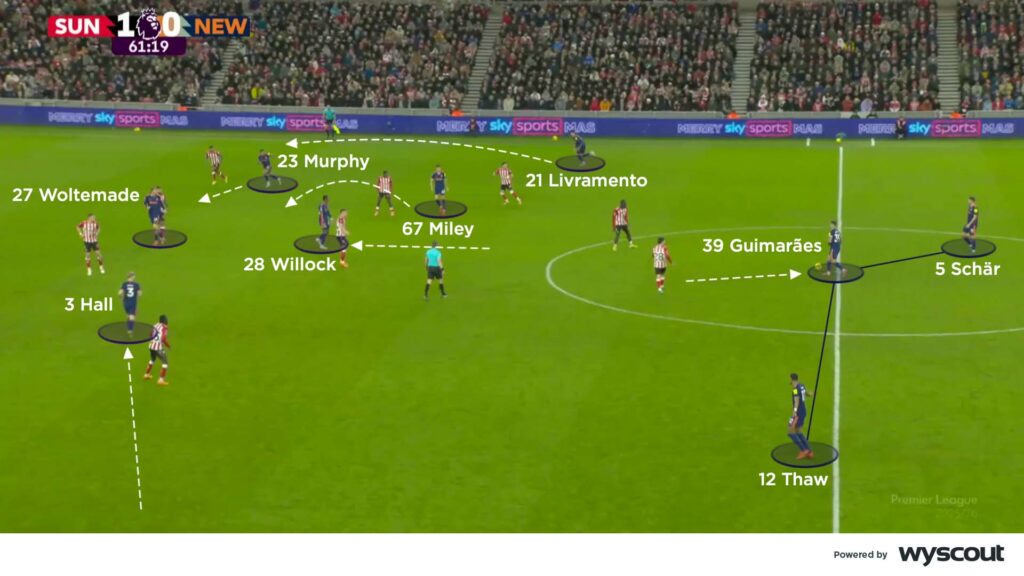
After going behind to Woltemade’s own goal, Howe responded with a triple change – Joe Willock for Sandro Tonali, Harvey Barnes for Anthony Gordon, and Jacob Murphy for Elanga. His side then looked for more narrow combinations, placing extra bodies between Sunderland’s lines within the central spaces. Left-back Hall moved inside, with Willock and Lewis Miley as number eights running forward from midfield. Right-winger Murphy ran inside and beyond, supporting a fixed Woltemade. Murphy’s runs also freed space for Livramento to overlap into and receive. Bruno Guimarães became the single pivot (below), working between and just ahead of the two centre-backs. He controlled the build-up superbly from deep with a varied range of passing.
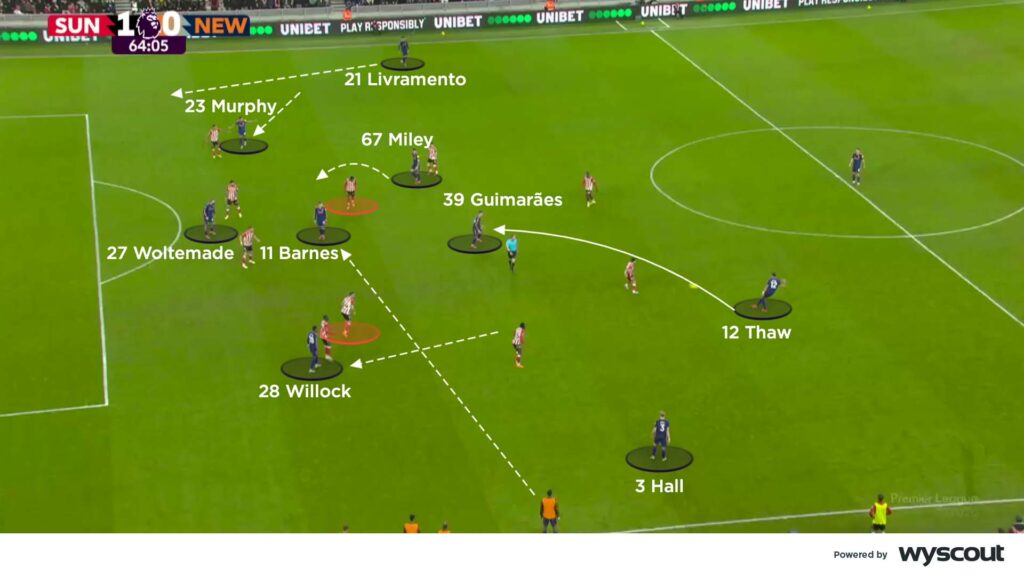
As Newcastle continued to probe the centre, Hall would sometimes hold the width, allowing Barnes to move inside. Willock took up quite high positions on this side, with Miley still joining from deep and Murphy also inside, continuing to create space for Livramento. Guimarães continued to link play between the back line and his narrow attacking teammates, with Sunderland’s double pivot working extra hard to nullify Newcastle’s increased central play.
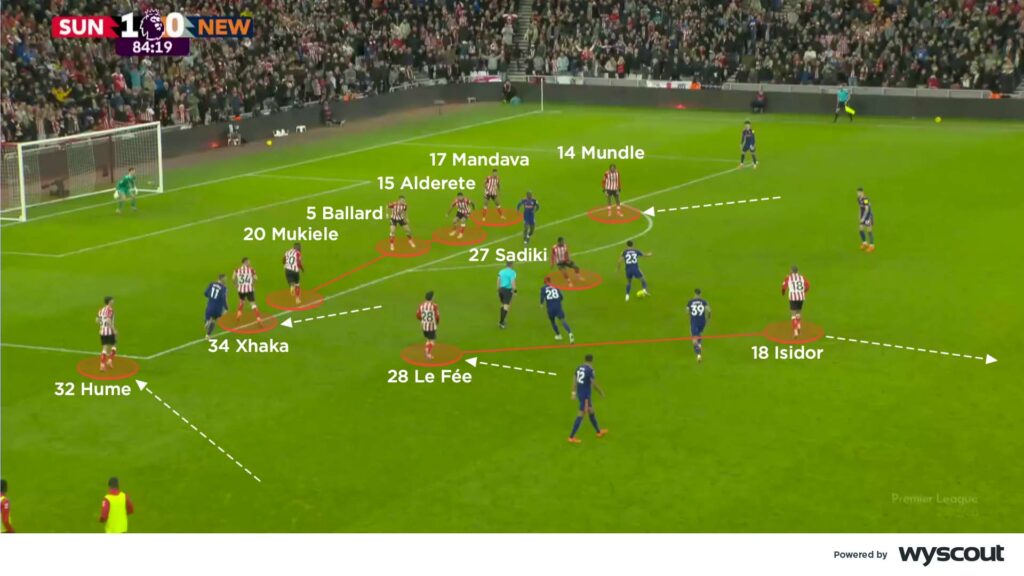
Sunderland responded to this central play by adding more bodies to their back line. The original back four narrowed, with the wingers and at least one of the double pivot often dropping to defend around or sometimes within the back line. This created a significant central barrier, blocking Newcastle shots and making it congested when Newcastle tried to combine through. Sometimes crosses came in from the wide areas, but Newcastle’s attacks were repelled by Sunderland’s extremely compact block (below).
Centre-forward Wilson Isidor managed to stretch the game on the counter for Sunderland, as Newcastle committed bodies forward only to have to recover all the way back. This became a bit demoralising for Newcastle as they toiled in search of an equaliser. The second half mirrored the first, with minimal chance creation against constant defensive adjustments. While it was far from a classic, the result was important for Sunderland, sparking joyous celebrations at the Stadium of Light.
To learn more about football tactics and gain insights from coaches at the top of the game, visit CV Academy