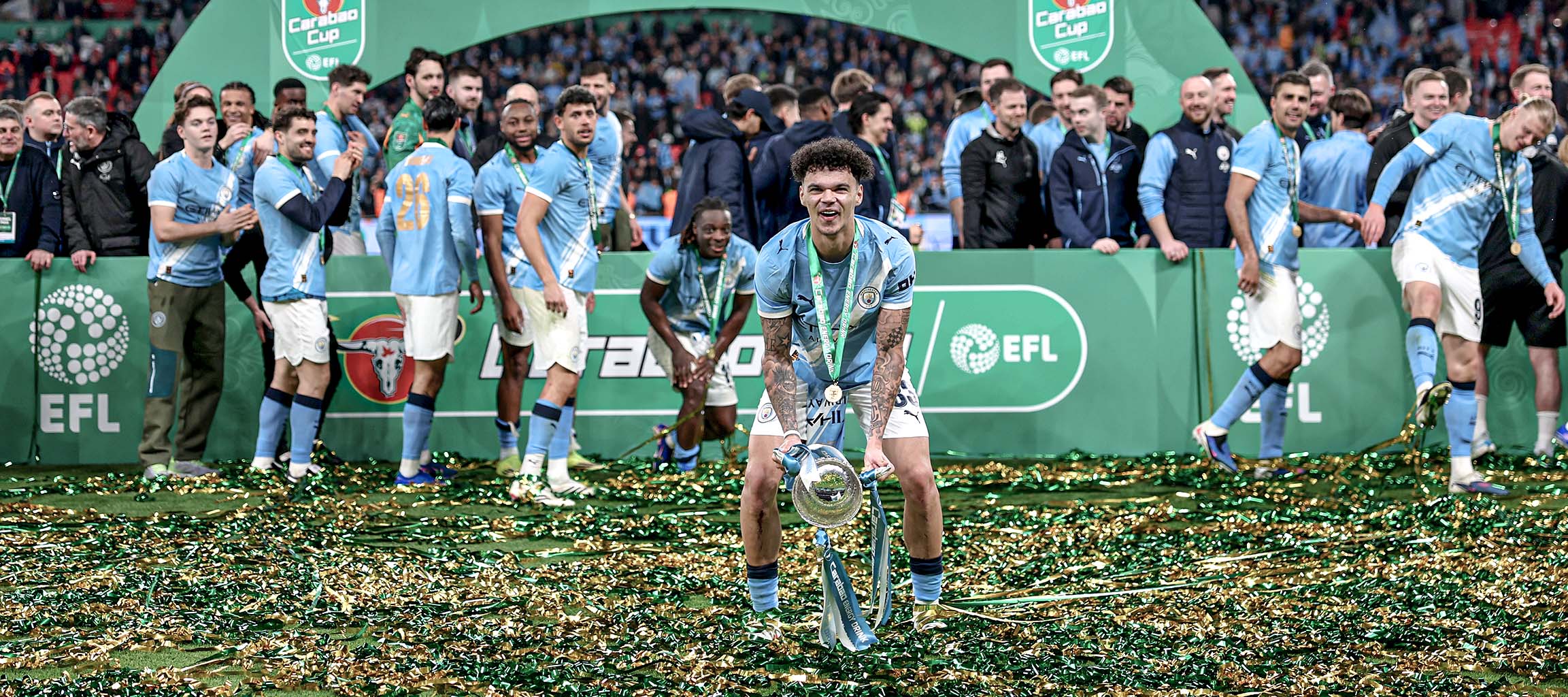

EFL CUP FINAL, MARCH 22 2026
O’Reilly (60, 64)
Manchester City returned to the winners’ rostrum with this EFL Cup triumph, ending Arsenal’s pursuit of four trophies in the process. Nico O’Reilly was City’s hero, netting a quickfire second-half double in a meeting of English football’s two best teams of the season so far. Arsenal had been aiming to end a trophy drought stretching back six years, while City endured a rare campaign without silverware last season. In the end it was Pep Guardiola who could celebrate becoming the first manager to win the EFL Cup five times. Mikel Arteta and Arsenal, meanwhile, will hope their nine-point lead in the Premier League – not to mention places in the Champions League and FA Cup quarter finals – yield at least one long-awaited honour this year.
Below, our UEFA-licensed coaches have picked out the tactical highlights from this Wembley showpiece.
How the managers saw it
“They suffocated us in the first 15 minutes but after that we started to win second balls,” said Guardiola. “Second half, I could not believe we could do that against Arsenal but we did it… without the ball and with the ball was unbelievably good.
“Today I made one substitution and it is never over at 2-0, but I felt the team was there. Jérémy [Doku] kept the ball, Antoine [Semenyo] as well and Bernardo [Silva] and Rodri. I think what I said in the previous days, the team has been something underneath [the best] but I can smell that they can flourish and winning helps to anticipate the process a little bit.”
“In the first half I think we had some really good moments and I think we were the better team,” said Arteta. “We had the biggest chance of the game by far that we should have been 1-0 up, and that would have changed the course of the game. In the second half we had, especially in the first 18-20 minutes, [we had] some issues to get out from that block, to press them better and especially to manage the ball much better than when we did when we regained it.
“Then we conceded the ball [for the first goal] in a really unexpected manner obviously, and three minutes later they scored another one in similar conditions to that. That’s something you have to give credit to the opposition [for] as well, when they are so good in these periods and they capitalise on that. We had our periods, we didn’t [capitalise] and then we have to accept that.”
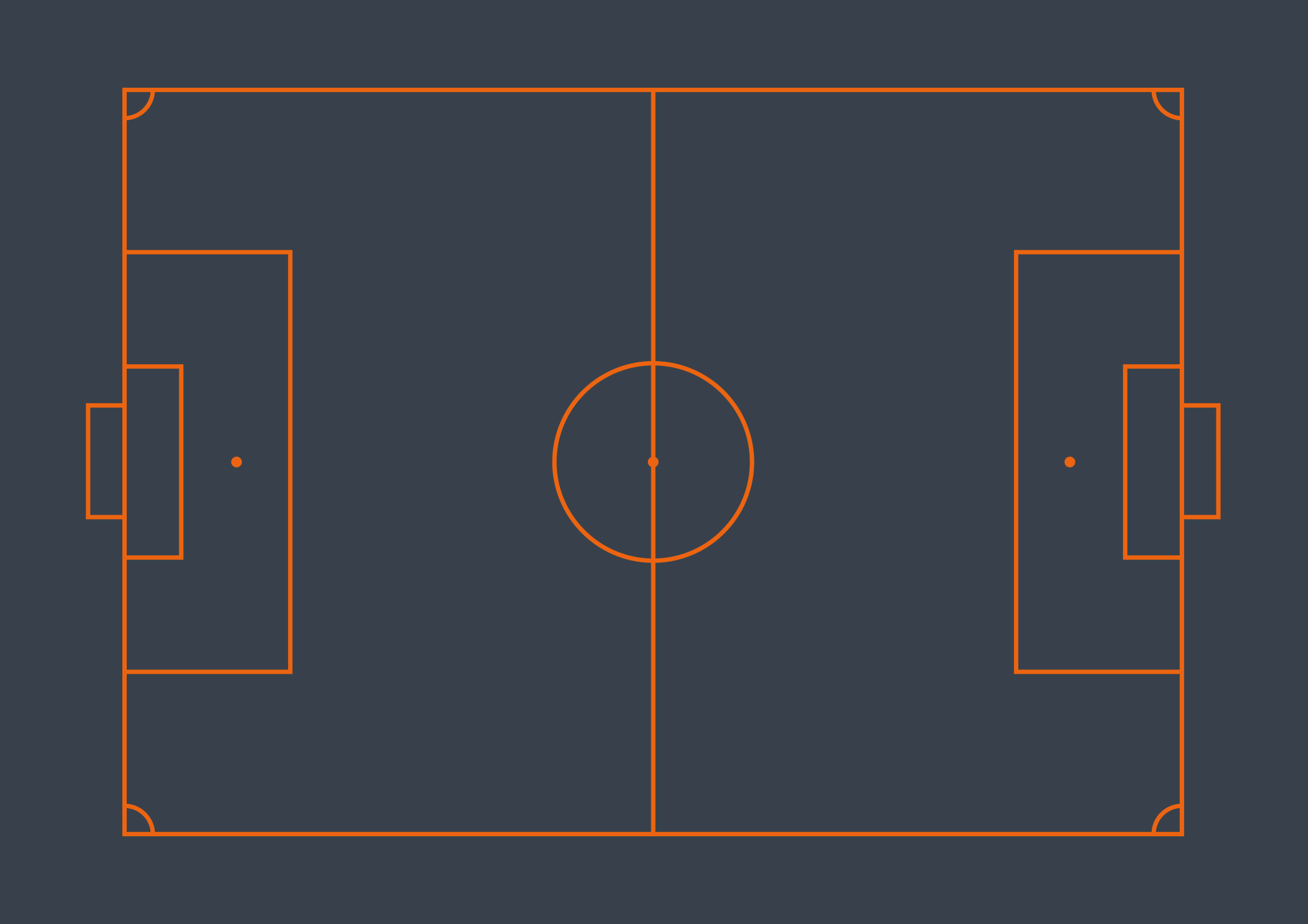 135624413619297141274563316204210119
9/4
SHOTS / ON TARGET
10/1
39%
POSSESSION
61%
15
ATTACKS INTO AREA
32
1.12
EXPECTED GOALS (XG)
2.29
High pressing numbers
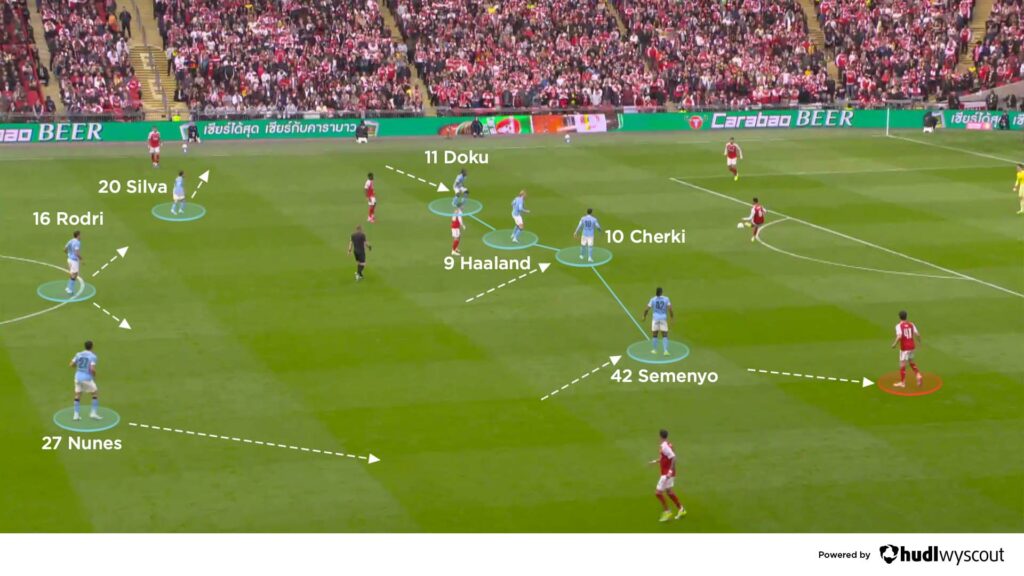
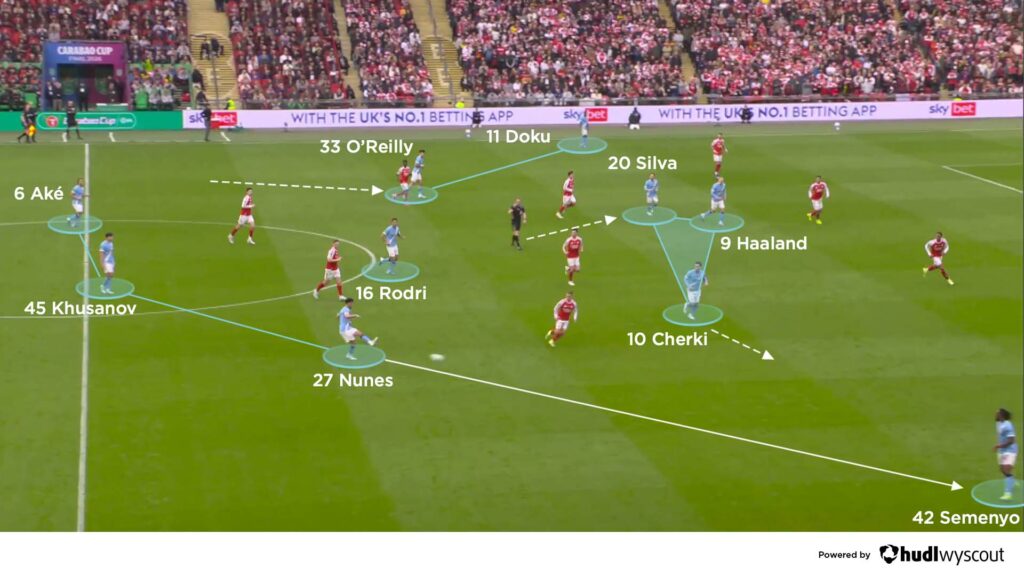
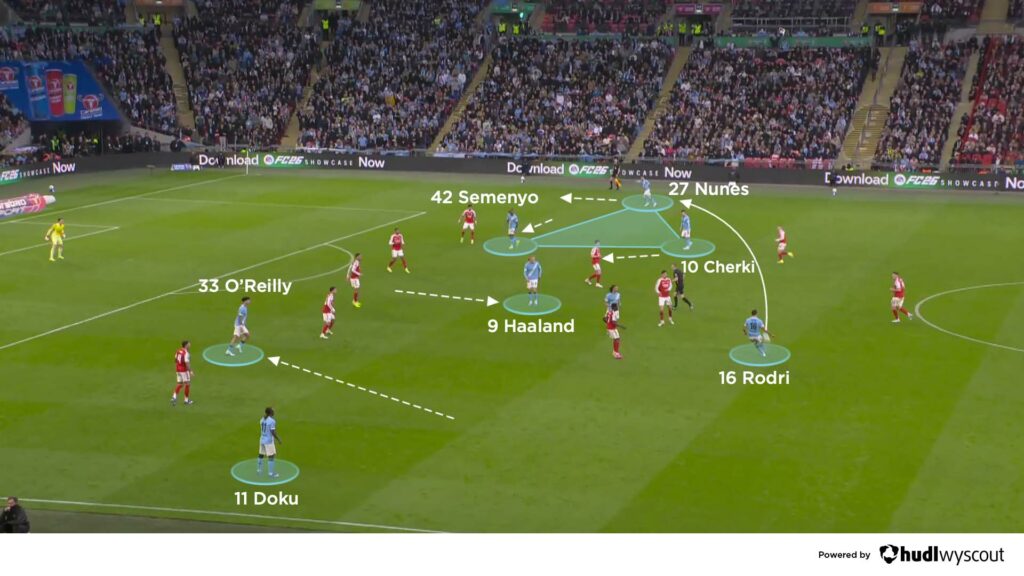
Manchester City limited Arsenal playing through midfield by having four players in their first line when they defended high. In City’s block, first Rayan Cherki joined Erling Haaland to cover the centre, with Jérémy Doku also very high on the left. Antoine Semenyo varied his positioning, but got higher as the first half progressed, especially when Declan Rice attempted to roll out wide to receive on that side. Rodri, Bernardo Silva and Matheus Nunes then supported across the pitch, and were able to move into wide areas to cover, due to the compactness and numbers in City’s first line (below). This resulted in Arsenal having ineffective possession, with their centre-backs and goalkeepers passing back and forth. Momentum ebbed away from them after a bright start.
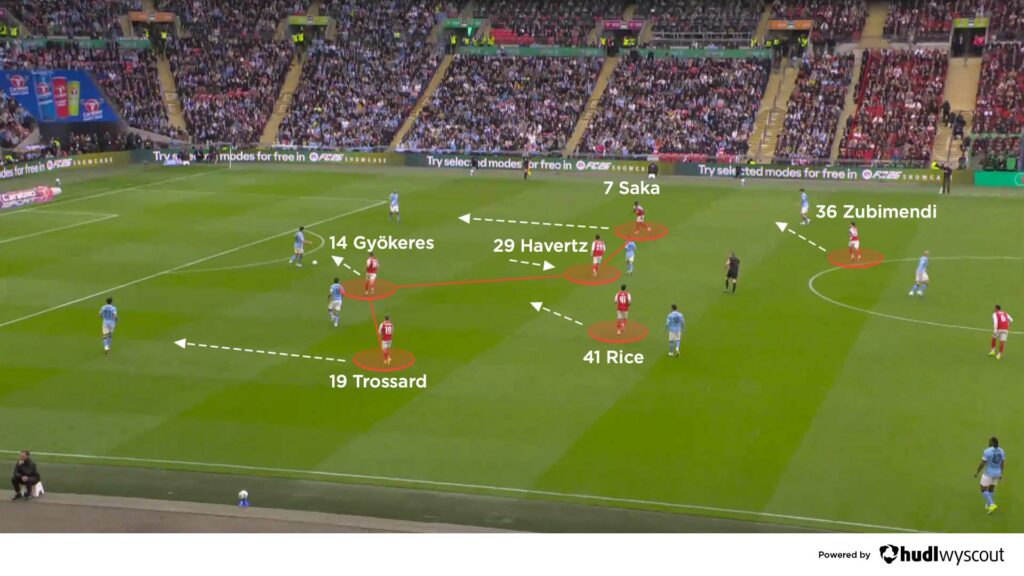
There were also moments when Arsenal committed similar numbers to their first line, with Kai Havertz and Viktor Gyökeres as the central pair. Havertz sometimes had more of a screening role, with Gyökeres setting the tempo for the press on to City’s back line. Leandro Trossard and Bukayo Saka were then ready to jump from the wide areas – Trossard often with his opponent in front of him, while Saka had to be more wary of O’Reilly’s advances. Rice and Martín Zubimendi covered behind (below), prioritising City’s central combinations, but ready to cover wide when needed.
First-half attacking threats
Arsenal’s strong start forced James Trafford into a triple save, but City found their passing rhythm once their high numbers nullified the opposition build. With the ball, City converted into a back three, with O’Reilly moving higher to support Doku on the left. Rodri and Silva linked between the lines, with the latter given licence to roam and push forward to support closer to Haaland. Cherki was mostly involved through the right inside channel, looking to receive in a pocket of space behind Arsenal’s midfield, as well as between the centre-back and full-back. Semenyo held the width on the right (below), and was City’s most promising threat in the first half – not least when Arsenal didn’t press, instead defending their own half in a 4-4-2 block.
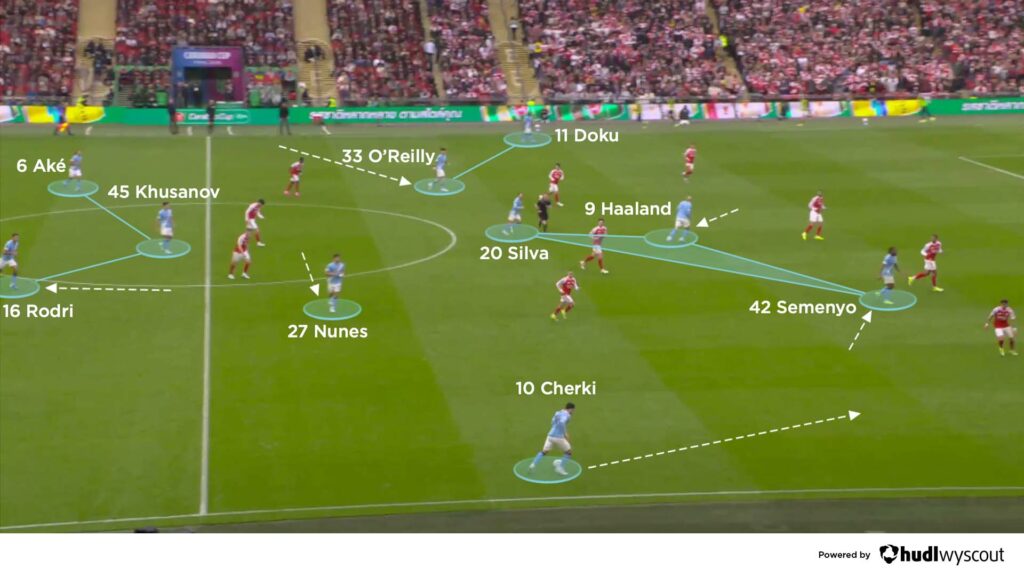
City began to dominate the ball. They continued with the same attacking shape, but added more rotations within the structure, especially on their right side. Cherki sometimes drifted wider, swapping with Semenyo, which allowed this pair to receive and attack Piero Hincapié. Rodri dropped into the back line at times, swapping with Nunes (below), as City’s movements allowed players to receive in different areas and progress play. Along with Semenyo’s dangerous 1v1 play, City’s rotations were their best method of attack as they ended the first half well.
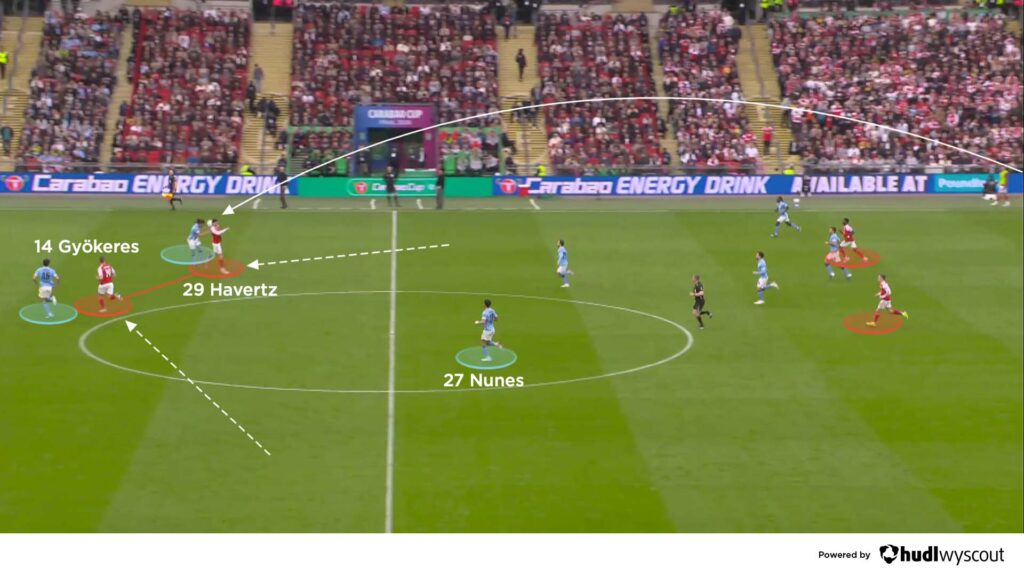
For their part, Arsenal posed a threat on the transition in the first half, especially when City built and attacked with just two centre-backs in their first line, as Nunes moved high to support the attack. In these moments, Gyökeres was able to run the channels easily, giving Arsenal a quick method to penetrate high up the pitch from their low block, often winning set-pieces well inside City’s half. Havertz also joined Gyökeres in competing for direct play when Nunes was higher and there was a 2v2 against City’s back line (below).
City lock Arsenal in
City dominated from the start of the second period, with Arsenal pinned back well inside their own half, often defending with all 11 players back. O’Reilly made more forward runs through the inside channels, working between Haaland and Doku, as Nathan Aké and Nunes from City’s back line squeezed the pitch with very aggressive positioning. Cherki moved wider, earlier, to combine with and support Semenyo, as City found good switches of play to combine and penetrate the Arsenal penalty area (below). Arsenal initially held out, but City locked them in and built pressure that eventually yielded goals.
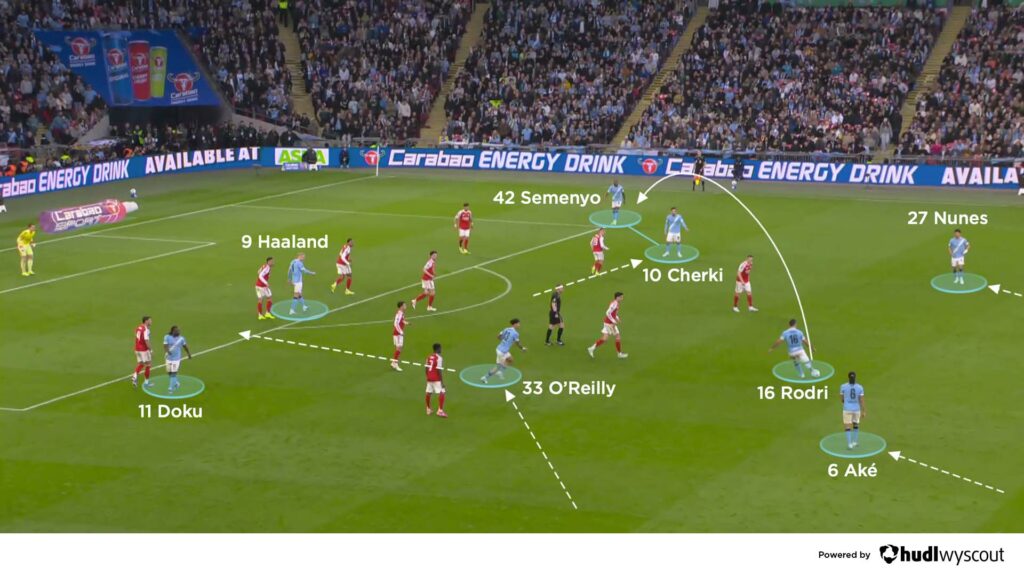
Silva sometimes rolled out wide to add a third attacker to City’s right-side play, with Nunes occasionally moving forward from the back line as Arsenal were so deep. Rodri maintained the attacking rhythm in the centre with his passing, recognising when and how to switch so that Doku had plenty of service to attack 1v1 on City’s left. Rodri also connected well with the numbers on City’s right (below), and the breakthrough came from that side. Kepa Arrizabalaga fumbled a Silva cross, with O’Reilly lurking behind to punish the goalkeeping error. He then headed a second from another cross from the right, putting City firmly in the driving seat.
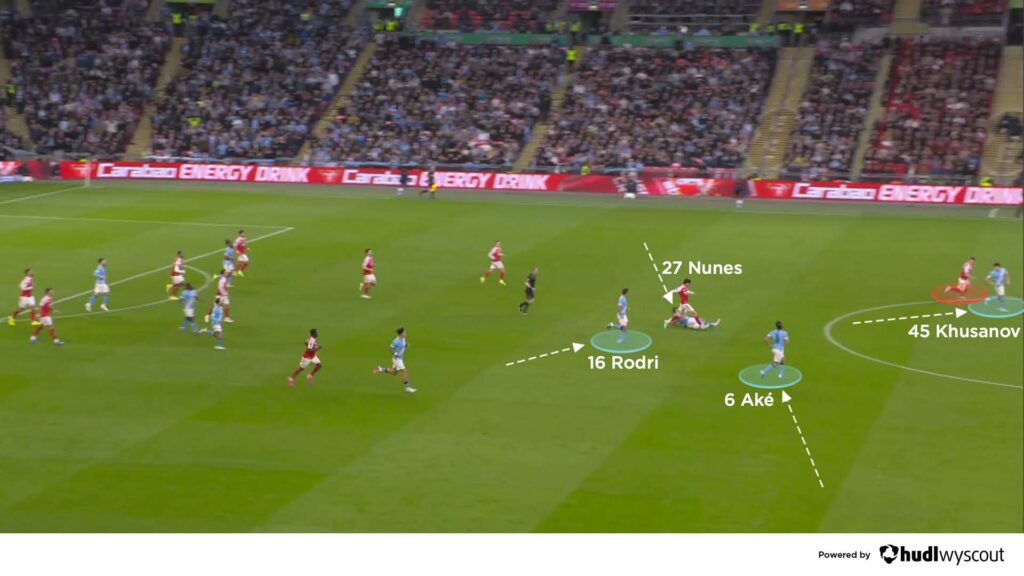
City’s second-half dominance was also marked by how well they defended potential counter-attacks, locking Arsenal in their own half for sustained spells. Rodri, Nunes and Aké were superb in stopping any breakout, especially in the central spaces (below). Their ability to delay, screen, track and successfully duel against Arsenal’s attempted counters helped City to keep the ball high up the pitch for long periods. As a result, Arsenal’s back line and attackers were left demoralised and frustrated, with the forwards spending more time defending than anything else. Abdukodir Khusanov’s pace as City’s last defender also helped cover spaces in behind against the direct running of Gyökeres.
Although Arsenal did hit the woodwork later on, it was too little too late, as their poor restart after half-time ultimately cost them. The fascination now will be how both teams respond to this result, with City being the only side capable of stopping Arsenal from winning a first league title since 2004. They meet at the Etihad Stadium on April 19, in a Premier League game that could yet have a bearing on the destiny of the title. Meanwhile, the prospect of an FA Cup semi final or even a cup final rematch remains on the cards. For now though, Guardiola and City can savour winning yet another piece of silverware – the 15th major honour of his nearly 10 years in charge.
To learn more about football tactics and gain insights from coaches at the top of the game, visit Coaches’ Voice Academy