Women’s champions League quarter final first leg, march 24 2026
Blackstenius (22)
Kelly (32)
Russo (76)
James (52)
Holders Arsenal take a two-goal lead into the second leg of this Women’s Champions League tie with Chelsea, thanks to a clinical performance. The Gunners withstood an early Chelsea storm before racing into a two-goal lead, then rode their luck when the visitors had a Veerle Buurman effort controversially disallowed. Lauren James did reduce Chelsea’s arrears seven minutes into the second half, but a brilliant finish from Alessia Russo put Arsenal in the driving seat ahead of the return fixture on April 1.
How the managers saw it
“It was a very tight game,” said Arsenal head coach Renée Slegers. “Chelsea created some opportunities early in the game. We stayed in the game, we were calm. It was constantly finding solutions to create spaces, to find ways out, to solve the press. So there were a lot of decisions being made and a lot of changes in what we wanted to do. In combination with very high intensity and a lot of duels and very tight spaces on the pitch, it was a very demanding game for the players. Of course, very happy how we were task-focused and were composed in all moments and stayed in control. The players felt in control the whole game and we were ruthless with our chances.”
“I’m frustrated for sure about the result,” said Chelsea head coach Sonia Bompastor. “We created enough to be in a better place in terms of results. We hit the post twice in the first 10 minutes. I’ve been in these [types of] games [before], and when we didn’t score it just changed the game, mentally.”
Below, our UEFA-licensed coaches explain the key tactical points from this first leg.
 281153281118239252451626176308221012
11/6
SHOTS / ON TARGET
12/5
40%
POSSESSION
60%
21
ATTACKS INTO AREA
30
1.65
EXPECTED GOALS (XG)
0.93
Chelsea’s early counters
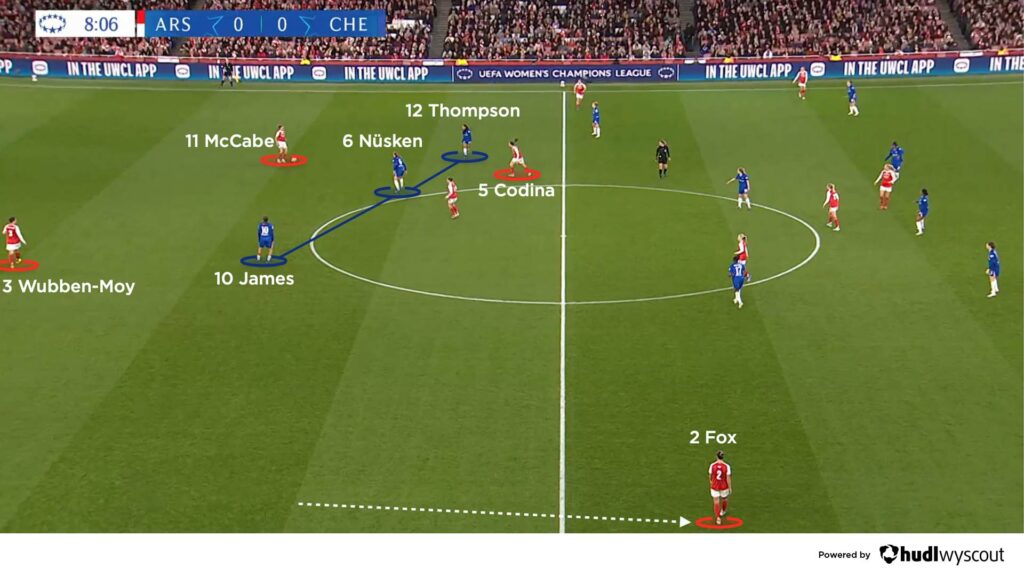
In Arsenal’s initial shape during their build-up, right-back Emily Fox moved quite high. Others in the back line (such as Laia Codina, below) occasionally moved forward, too. With Arsenal then having fewer players in their back line as they looked to play forward, Chelsea’s narrow forwards were in prime position to counter-attack after any regain. Alyssa Thompson and James were joined by Sjoeke Nüsken in Chelsea’s first line of pressure, with spaces on the outside particularly favourable for any counters – especially when they utilised Thompson’s pace from the right (below).
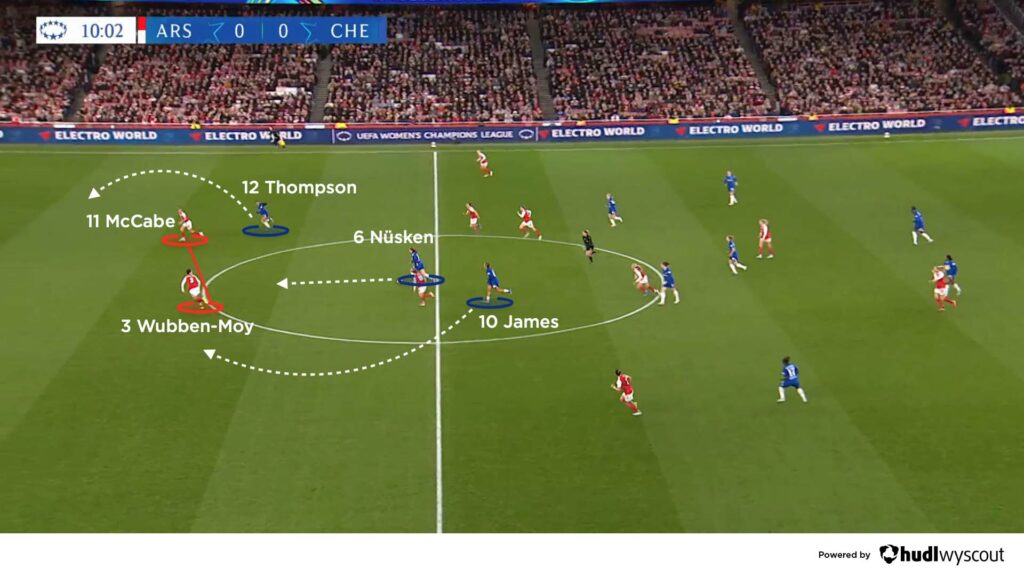
Thompson’s speed and direct running was a threat, with Nüsken supporting with good runs from midfield, as well as forward passing. James supported from the centre, but also drifted to the left as a secondary transitional threat against Arsenal’s exposed back line (below). Chelsea duly had two good chances to take an early lead, but hit the post on both occasions.
Arsenal’s central combinations
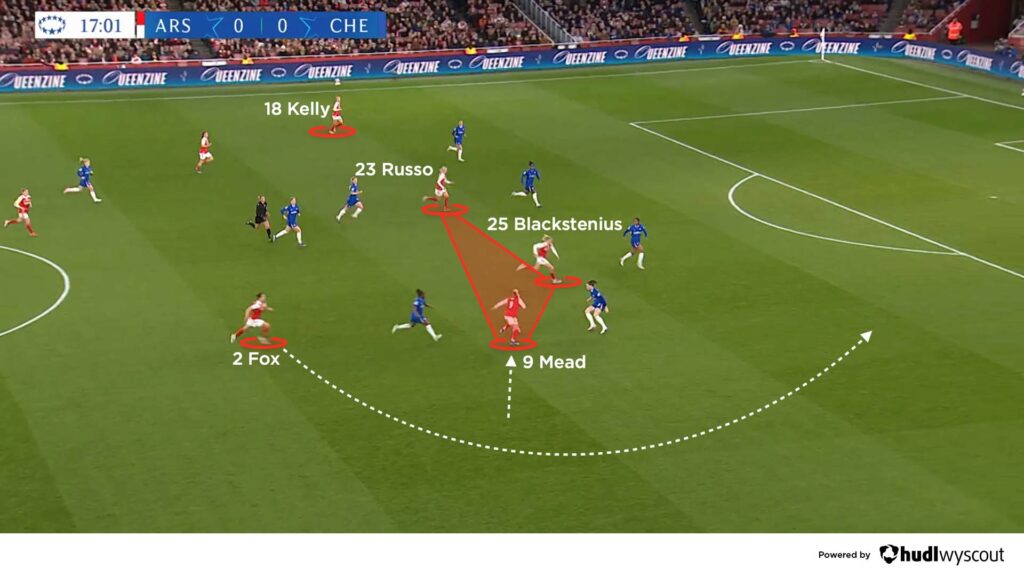
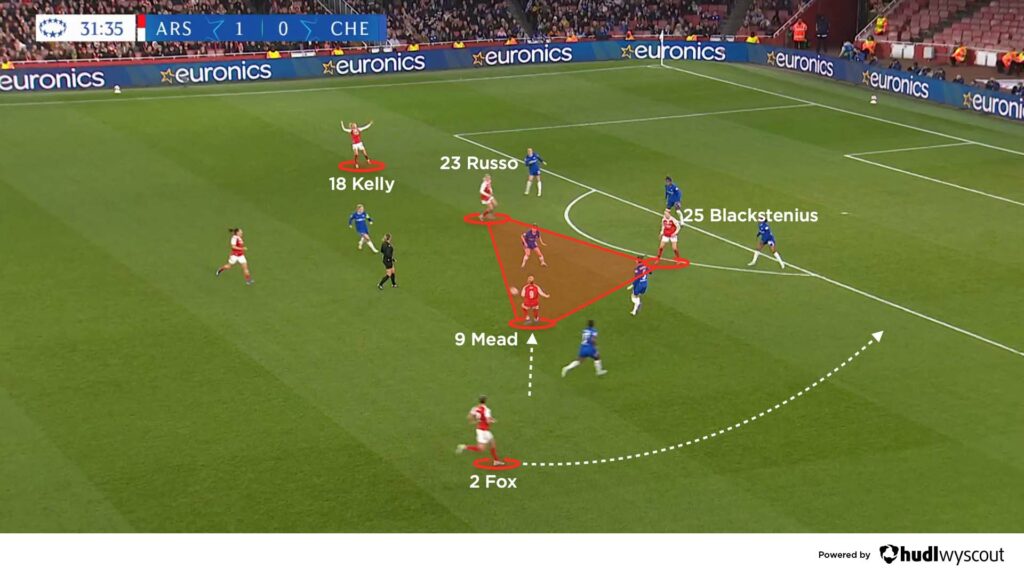
Arsenal then began to work attacks of their own, with right-back Fox continuing to get forward and overlapping around Beth Mead, who moved inside with and without the ball. Russo and Stina Blackstenius operated as a nine and 10 pairing, combining in central areas, where they were often fed by Mead when she came inside from the right. Meanwhile, Chloe Kelly initially held the width on the left (below), looking to receive and attack 1v1 against her direct opponent.
The home side grabbed the opener from a set-piece, but it was their central numbers and combinations that consistently caused Chelsea problems. Arsenal’s flowing movements on the right combined with Mead’s central passing to work the ball into Russo and Blackstenius on a number of occasions. But it was Kelly who scored the second, finding space after moving slightly inside from the left (below) and striking from range.
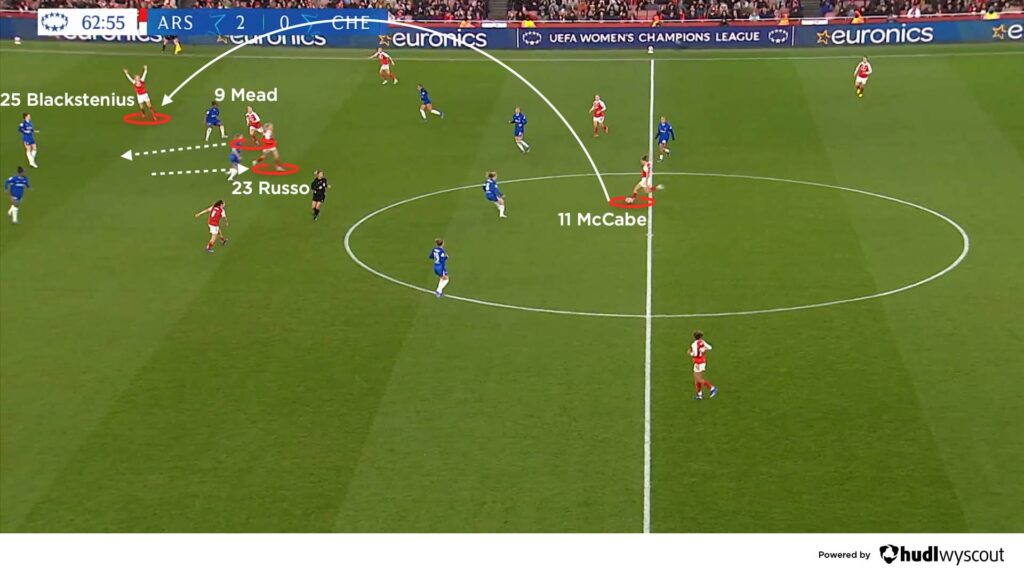
Katie McCabe moved to centre-back for Arsenal in the second half, and her forward passing gave Slegers’ team another method of finding their central attackers. Play into Blackstenius built attacks over Chelsea’s block, and was often paired with opposite movements from Russo, dropping short. Mead then worked the other way (below) so that Blackstenius had support to combine with, underneath, as Arsenal maintained central numbers in attack and continued to create dangerous combinations between Chelsea’s lines.
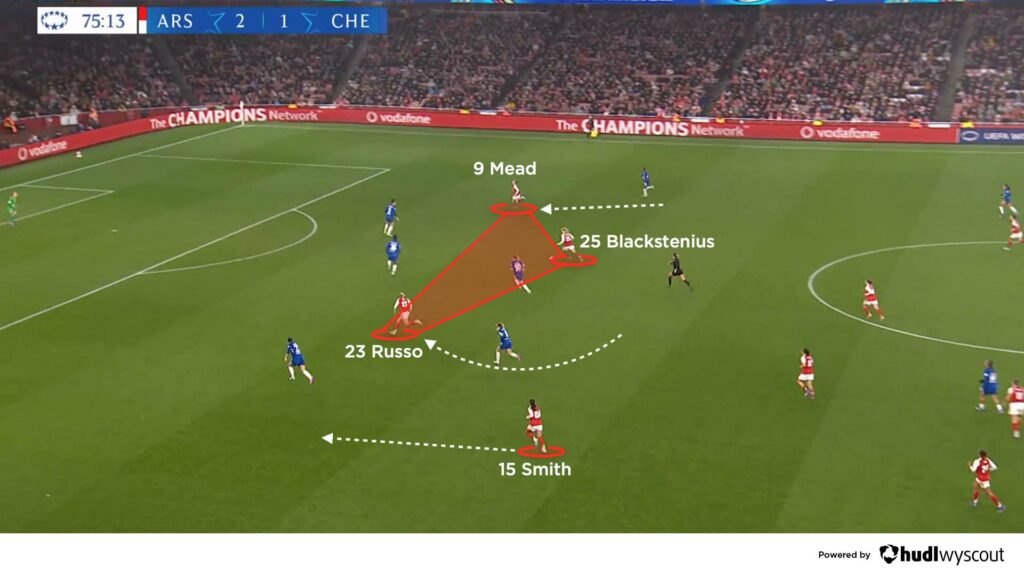
Although they attacked less frequently in the second half, Arsenal’s front line remained a threat. Blackstenius’ link-up play was important, with her teammates playing into her when possible. Mead’s forward runs from the right gave her an option, with Russo tending to shift across to the left. Olivia Smith came on for Kelly on the left with 60 minutes on the clock, providing another 1v1 threat from wide, but it was Russo who Blackstenius found for Arsenal’s third (below).
Chelsea’s attacking changes
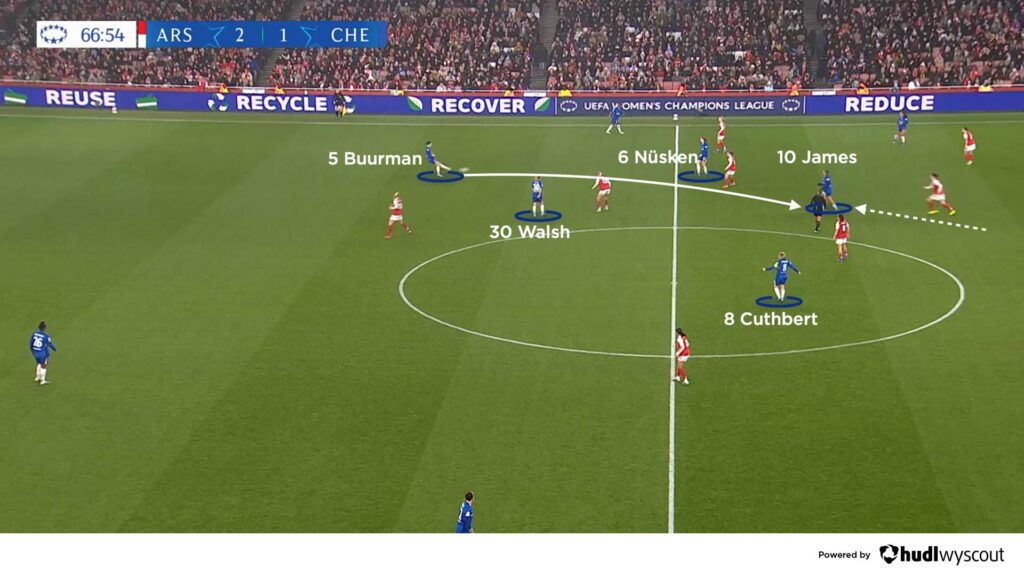
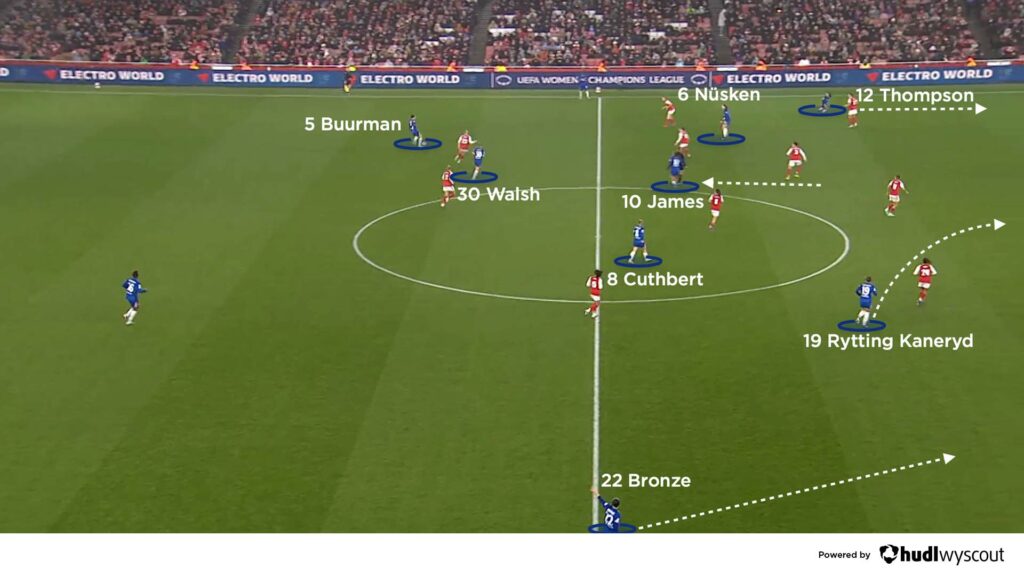
It was a blow for Chelsea, who had built momentum prior to Arsenal’s third goal. A dipping effort from James had halved the deficit after Bompastor had made attacking changes. Sandy Baltimore shifted to left-back, with Thompson also moved to the left to form a direct wide pair. James then occupied the central spaces, looking to drop into midfield to combine with the trio of Keira Walsh, Erin Cuthbert and Nüsken in that area, dragging out one of Arsenal’s centre-backs in the process (below). Johanna Rytting Kaneryd (on for Naomi Girma) was added wide right, as Chelsea’s central numbers helped them to have long spells of possession.
This continued even after Arsenal’s third goal, with James supporting between the lines and at times well into central midfield. The visitors’ wingers then made direct runs forward and in behind, with threats running beyond on both sides of the pitch, as James disrupted Arsenal’s centre-backs with her dropping. Lucy Bronze pushed forward from right-back as Rytting Kaneryd ran in behind, as well as inside to create wide space for Bronze. But despite getting numbers forward and having periods of attacking pressure, Chelsea were unable to score again.
The tie is not over if last season’s quarter finals are anything to go by, though. On that occasion Chelsea lost 2-0 away to another Women’s Super League rival, Manchester City, before advancing to the last four with a 3-0 win at Stamford Bridge. So while Arsenal have given themselves a good chance of taking another step towards successfully defending their European crown, it is all to play for in the second leg.
To learn more about football tactics and gain insights from coaches at the top of the game, visit Coaches’ Voice Academy