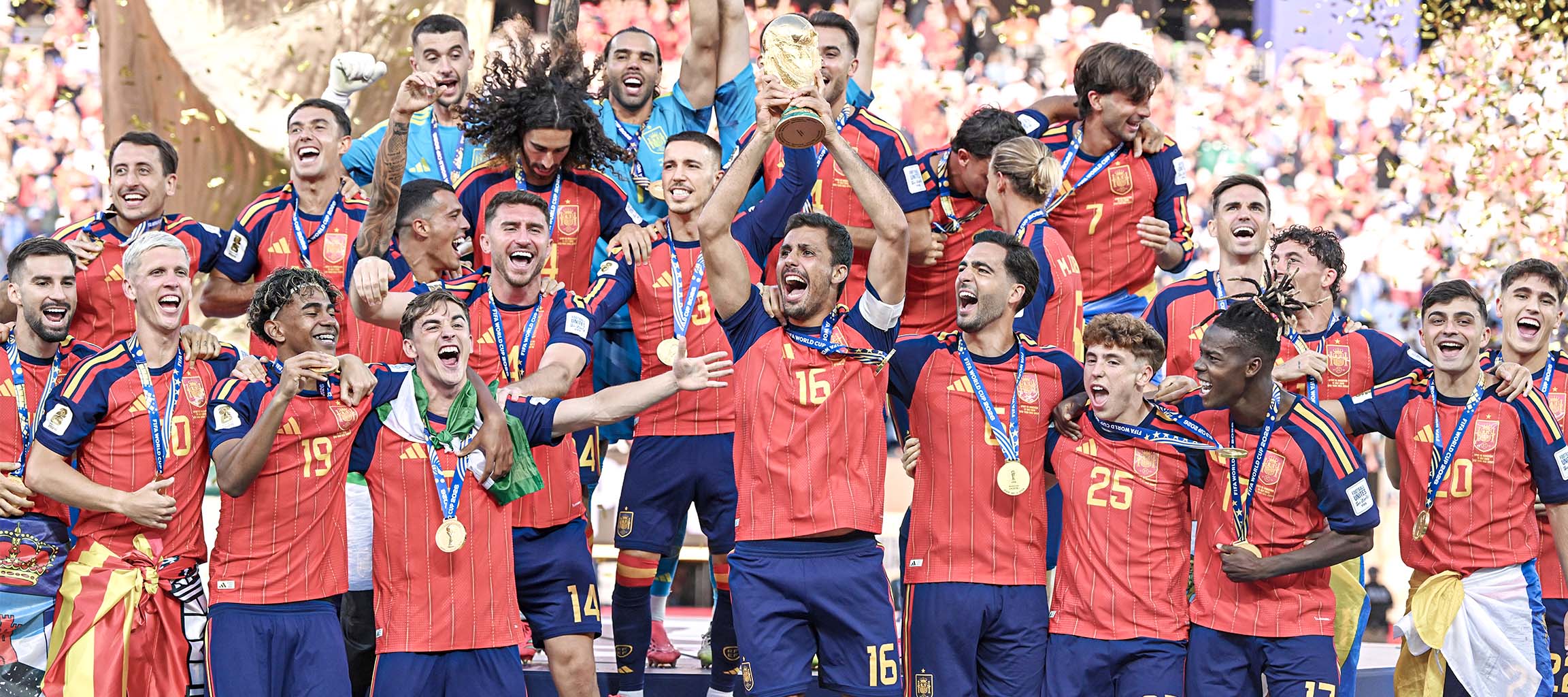
WORLD CUP FINAL, JULY 19 2026
Torres (106 ET)
Spain deservedly sealed the second World Cup triumph in their glittering history with this extra-time win against the holders, Argentina. In a meeting of the European and South American champions at New Jersey’s MetLife Stadium, the Spanish dominated the game and got their reward when Ferran Torres swept home the winning goal. With player of the tournament and captain Rodri pulling the strings in midfield for much of the final, in a team that conceded just one goal in the competition, Spain patiently probed as they do, until they finally breached Argentina’s defence.
Lionel Scaloni’s defending champions had ridden a rollercoaster to reach the final, winning games in every knockout round in which they had failed to take a lead into the 90th minute, in what is likely to be Lionel Messi’s last appearance at a World Cup. But in New Jersey they faced a team that plays a style of football built on control, and Spain duly controlled virtually the entire game, barely giving the outgoing world champions a sniff of a chance. A red card for Argentina’s Enzo Fernández in added time of the second half gave Argentina even less incentive and ability to attack, but even with 11 players they had failed to have a single attempt at Spain’s goal. Instead, the final turned out to be a game almost entirely of Spanish attack versus Argentinean defence, resulting in a cagey affair, but ultimately a fitting result.
How the managers saw it
“We are the most united team and that is thanks to having people with solidarity, [and] values,” said Spain’s head coach Luis de la Fuente, who has now won the 2023 Nations League, Euro 2024 and 2026 World Cup. “I’m so proud of this generation of footballers who have grown up with this philosophy, remained true to it, made it even better, and set an example as a team and a family – they’re excellent, world-class footballers with exceptional talent.”
“We tried up until the very last minute to give our utmost,” said Scaloni. “I want to thank these guys [Argentina’s players] eternally for giving us another World Cup final and for competing until the end. They [Spain] were better, that’s the truth.”
 23241422128161510192123413637242015109
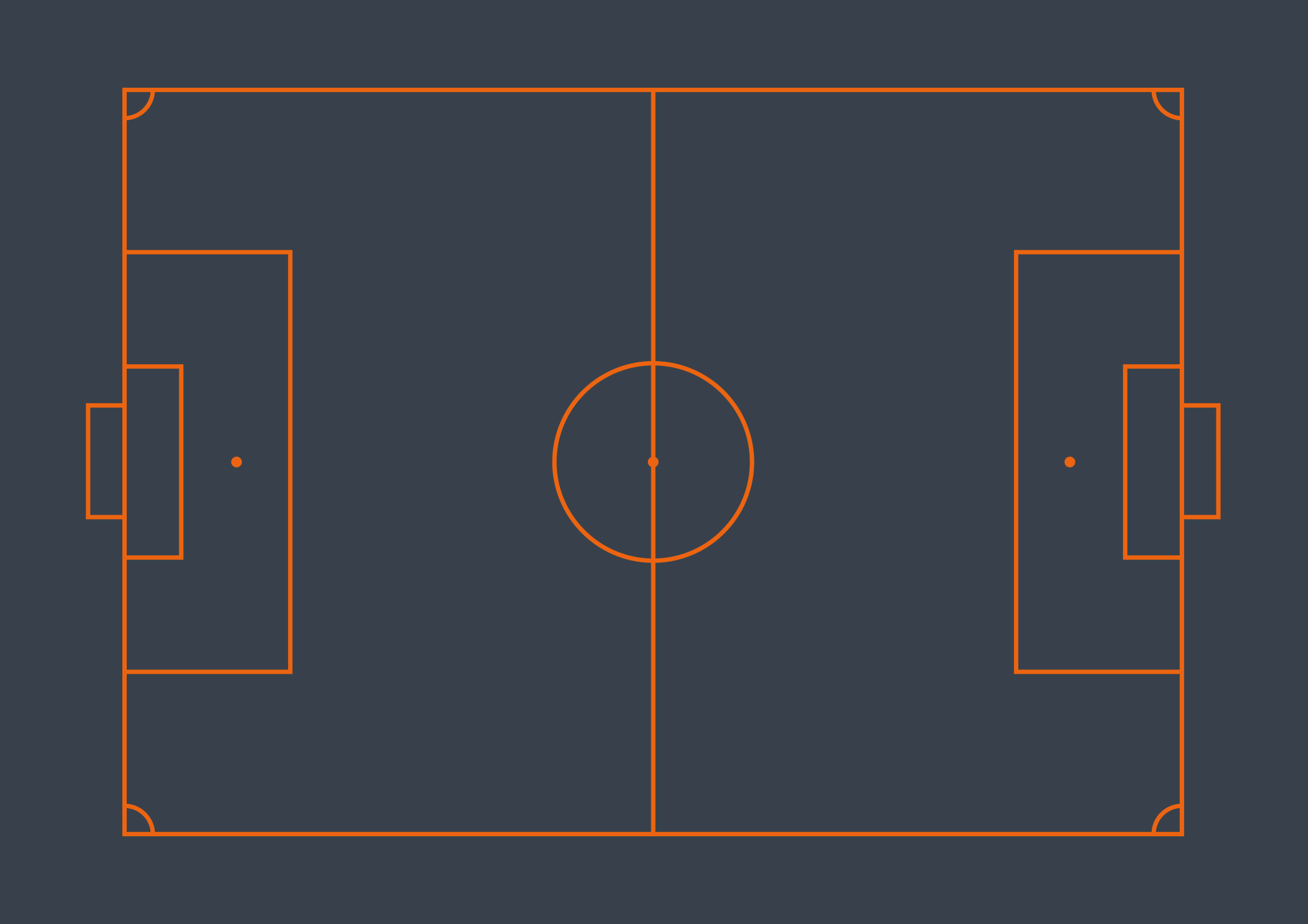
20/12
SHOTS / ON TARGET
2/0
65%
POSSESSION
35%
34
ATTACKS INTO AREA
7
2.34
EXPECTED GOALS (XG)
0.38
Spain’s attacking fluidity
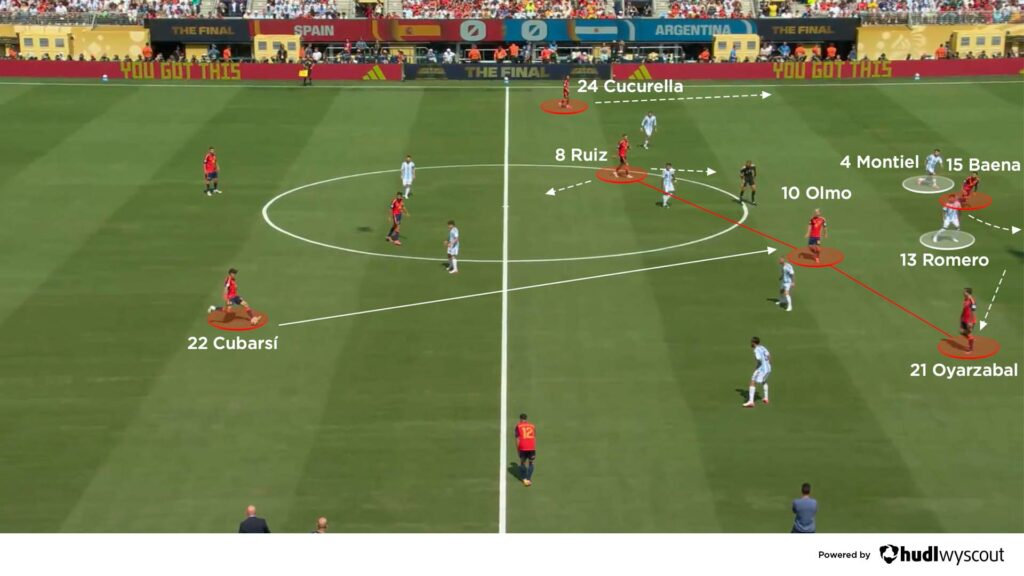
Spain began the game dominant in possession, utilising fluidity within their attacking structure to create opportunities to penetrate centrally. In build-up Mikel Oyarzabal often dropped from his central-striker position on the last line. At the same time, Fabián Ruiz pushed forward from his deeper position alongside Rodri to create a line of three attacking midfielders between Argentina’s defensive and midfield lines in their 4-4-2 block. Marc Cucurella advanced on the left to provide width, enabling Álex Baena to rotate inside, where he threatened in behind Argentina’s defensive line. On the right, Pedro Porro often stayed slightly deeper and provided balance, giving Lamine Yamal space to attack 1v1 against Argentina’s narrowed block.
Spain’s intention was for Baena’s run to attract Gonzalo Montiel and Cristian Romero, preventing these defenders from engaging Spain’s spare central player and giving Pau Cubarsí the opportunity to break lines using the central 3v2, playing into Dani Olmo (below). Alternatively, if Argentina’s back line were aggressive in engaging on the spare central player, Spain had the option to play directly in behind to Baena, depending on the timing and execution of his run across Montiel.
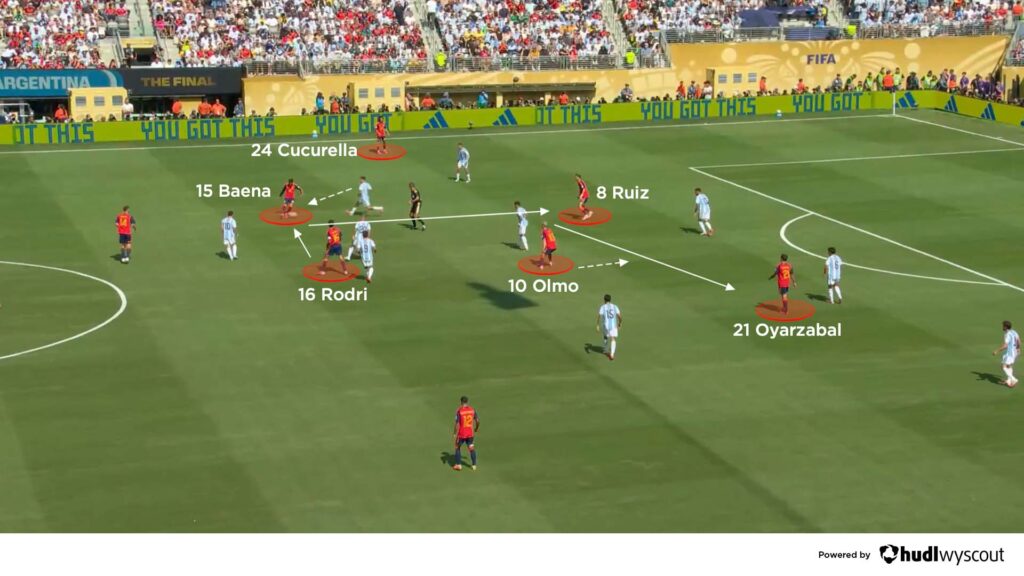
Spain’s best chances in the first half came via these types of fluid movements and close connections to combine. Provoking the press from Argentina’s front two of Messi and Julián Alvarez, Aymeric Laporte quickly played a pass into Rodri who started a quick combination, finding Baena. The latter timed his movement to drop down and rotate with Ruiz from a higher position behind Argentina’s midfield line, while Cucurella provided width. Baena could then combine around the corner into Ruiz (below), who quickly played across into the centrally positioned Olmo. The ball fell for Oyarzabal, who got his shot off from just outside the area, only for Emi Martínez to make a comfortable save.
Argentina’s resolute block
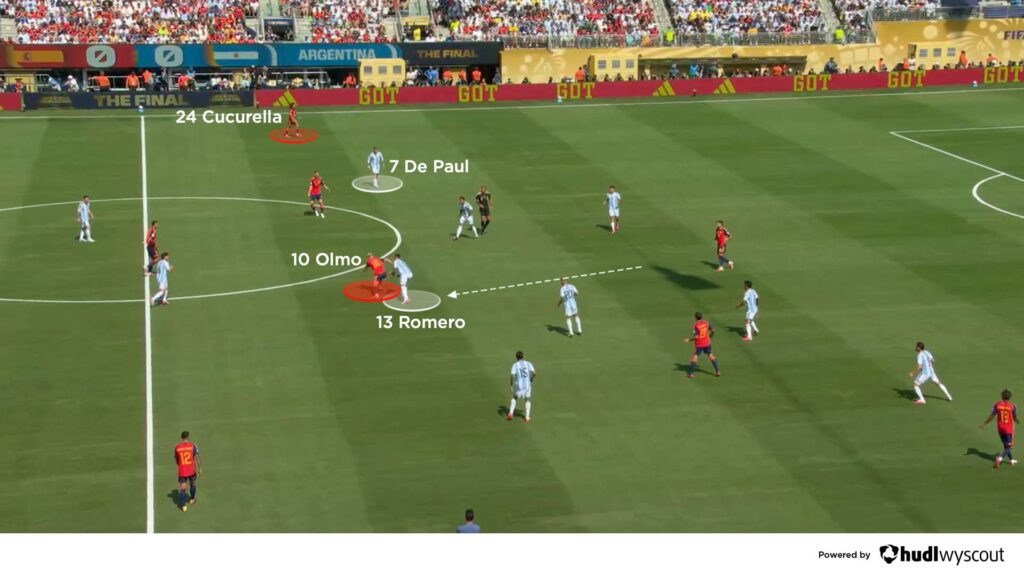
Despite Spain dominating possession, Argentina’s defensive structure was compact and organised, particularly in the first half. Central defenders Romero and Lisandro Martínez (until he was replaced by Nicolás Otamendi in the 44th minute) positioned themselves ready to drop, which dissuaded Spain’s deeper players from playing in behind when there was minimal pressure on the ball. At the same time, Argentina’s centre-backs managed the height of the defensive line to be close enough to engage Spain’s spare central player when necessary. When Spain did look to play centrally to try to exploit their central overload, Argentina’s centre-backs timed their release well, engaging Spain’s spare central player as they received, restricting their opportunities to combine with quality or turn to play forward – as with Romero engaging Olmo, below. That meant Spain had to continue circulating possession or try to play wide to progress, with Rodrigo De Paul matching the height of Cucurella and minimising the Spanish left-back’s attacking contribution.
Argentina’s defensive commitment was tested even more in the second half, with Romero (in the 70th minute) joining Martinez in going off injured. Indeed, Nicolás Tagliafico was the only starter in Argentina’s back line to remain on the pitch beyond 70 minutes, with Nahuel Molina replacing Montiel after 58 minutes. And as the game progressed, Spain became more aggressive in their movements to penetrate Argentina’s defensive line, with more intent to run in behind and disrupt the defensive structure.
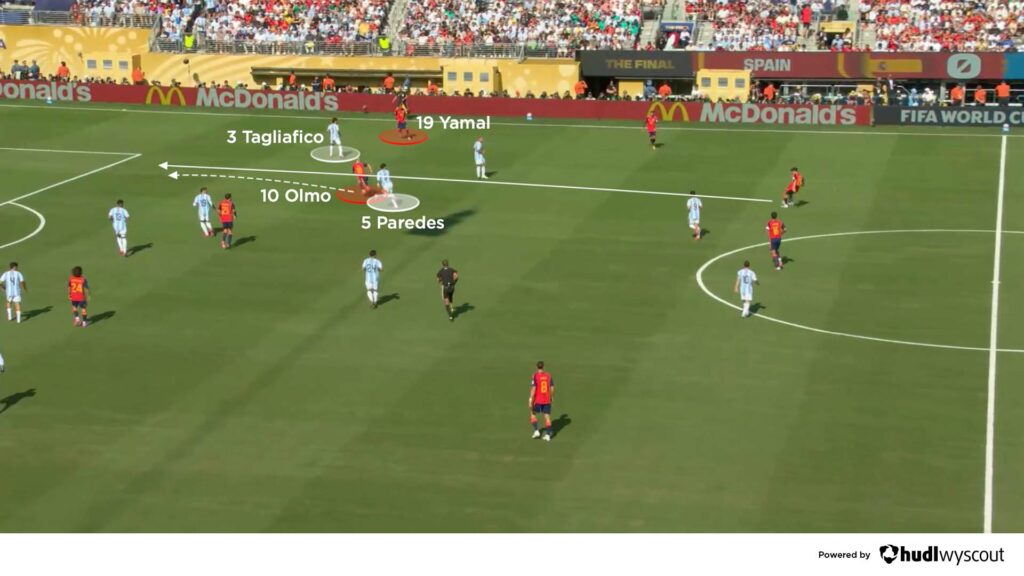
Olmo positioned himself in space between Argentina’s defensive and midfield lines (below). With Tagliafico attracted to Yamal on the touchline, Olmo momentarily overloaded the back line on that side with a run in behind, creating a cutback opportunity that was cleverly intercepted before Cucurella could arrive to finish, following a diagonal run to attack the box. To counteract this, Leandro Paredes (on for Nicolás González) began to drop deeper in moments when Argentina were required to defend the box. Argentina then had a temporary back five as they became contained in their low block, to have better coverage across the width of the pitch, protecting against Spain runs into the half-spaces. However, Spain’s aggressive rest-defence positioning, combined with Argentina’s lack of composure in finding solutions to escape in transition, ensured relentless waves of Spanish attacking.
Spain’s eventual breakthrough
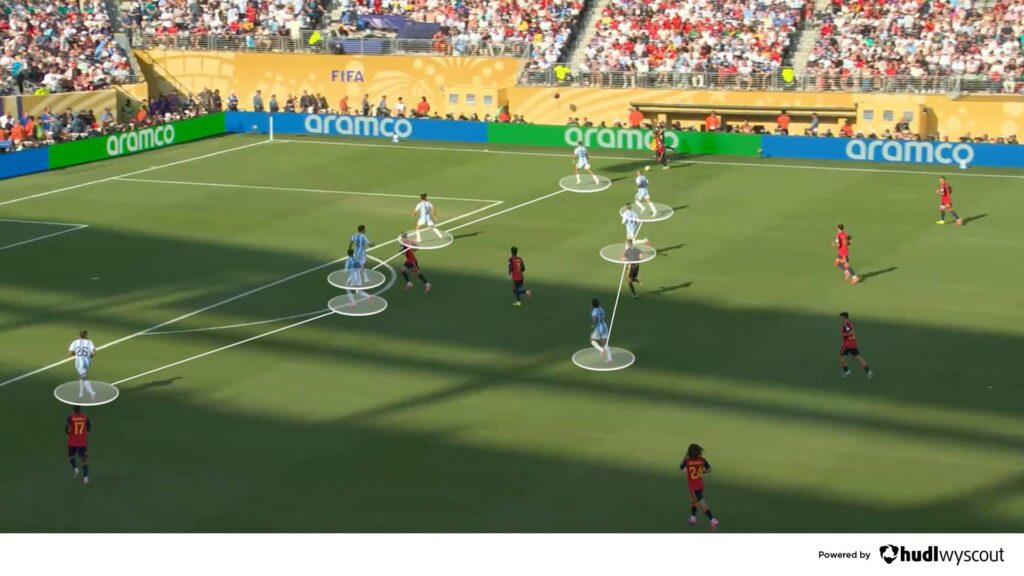
Following the red card for Fernández, Argentina operated a 4-4-1 formation in the first half of extra-time and somehow withstood sustained Spanish pressure in that opening period – including Spain having a goal controversially disallowed. Scaloni then changed Argentina to a 5-3-1 formation (below) for the second half, with Marcos Senesi replacing Alvarez to provide better coverage across the defensive line.
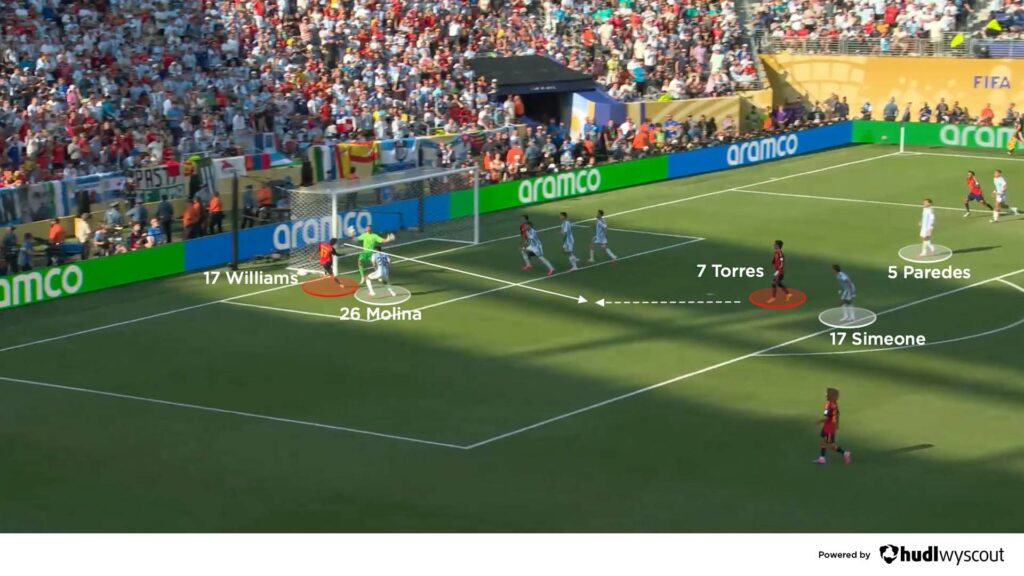
Despite the change, a lack of coverage from Argentina’s midfield line contributed to Spain’s winner. On an initial cross from Porro in the half-space, Nico Williams (on for Baena after 75 minutes) timed his run well to attack at the back post against Molina, who was caught under the height of the delivery. Molina was also distracted by Williams’ run, which restricted his ability to adjust his body position to attack the first contact. At the same time, Torres (on for Oyarzabal after 62 minutes) arrived ahead of Argentina’s midfield, anticipating the knockdown from Williams. Argentina’s ball-side midfielder Giuliano Simeone (on for De Paul after 70 minutes) failed to protect the space that Torres arrived in. Argentina’s switch to a 5-3-1 also reduced Paredes’ ability to cover what proved to be crucial space, having just provided support on the opposite side against Porro’s initial cross.
Torres duly landed on Williams’ knockdown and fired home the winner that Spain’s dominance deserved. In doing so he wrote his name into World Cup history, giving his nation a second World Cup triumph after the glory of 2010. Another history-maker is Luis de la Fuente, who has now guided the Spanish men’s national team to the status of world and European champions. A former coach of Spain’s Under-19, Under-21 and Under-23 teams, prior to taking the reins of the senior side he had already led the age-group teams to their respective European Championships and an Olympic silver medal. Now the phenomenal success of the senior team under his leadership has ensured that he will go down as one of the greatest international managers of all time, if not the greatest.
To learn more about football tactics and gain insights from coaches at the top of the game, visit Coaches’ Voice Academy