


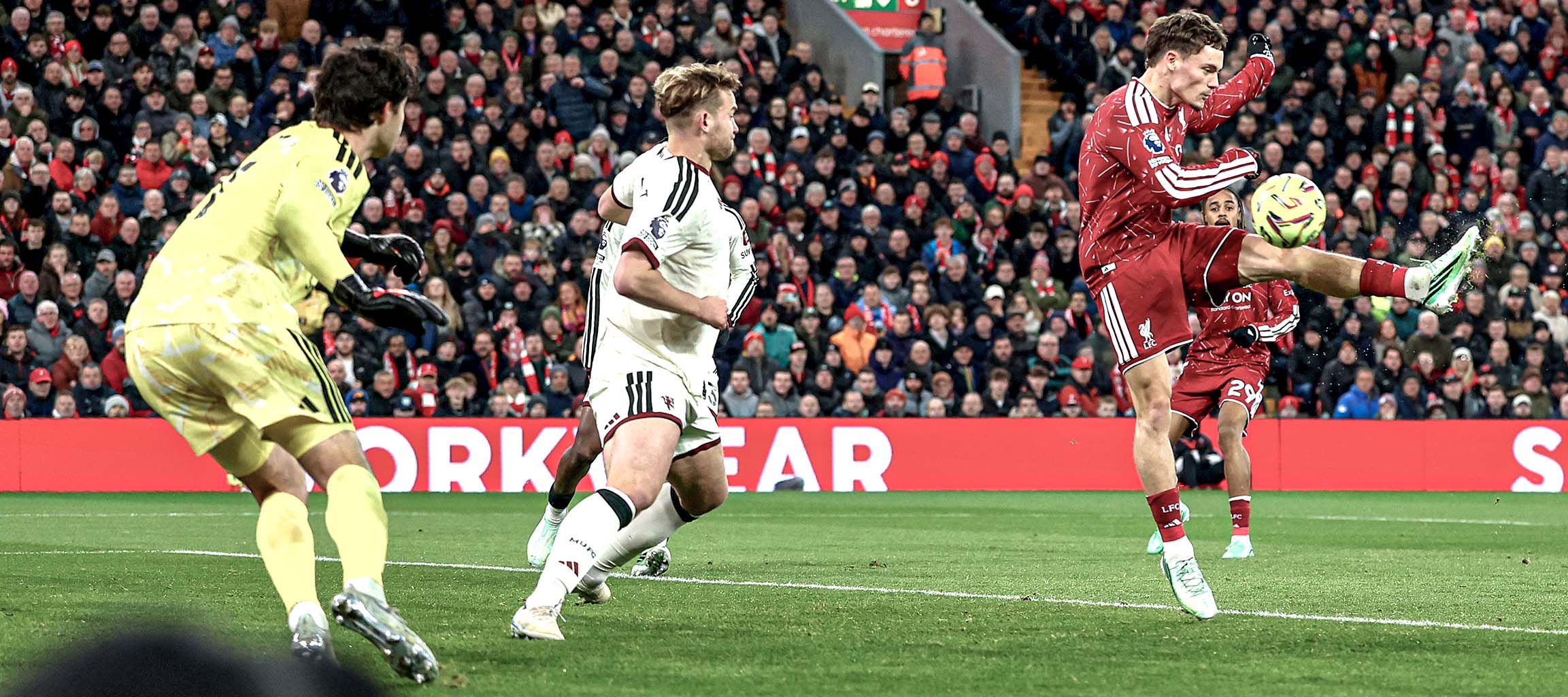

PREMIER League, NOVEMBER 22 2026
Szoboszlai (10)
Wirtz (13)
Ngumoha (66)
Muñoz (82)
Mauricio Pochettino experienced a nightmare first game as Manchester United head coach, with Liverpool systematically dismantling his new team in front of a baying Anfield. Liverpool started on the front foot and were helped when Leny Yoro was sent off in the eighth minute, after he fouled Alexander Isak just outside the box. Any relief United felt at not conceding a penalty disappeared when Dominik Szoboszlai slammed home the free-kick, before Florian Wirtz acrobatically doubled the lead with only 13 minutes on the clock.
United stemmed the tide of Liverpool attacks for a while, but goals from Rio Ngumoha and Víctor Muñoz did not flatter the home side. It means the Red Devils have now conceded a total of 34 goals across all competitions in the 2026/27 season – the most of any club in Europe’s top five leagues. The fact it is not the worst on a goals-per-game basis does little to disguise the reality that Pochettino has a major job on his hands, with United second bottom of the Premier League after 11 games.
For Liverpool’s Andoni Iraola, by contrast, it was a morale-boosting victory against his club’s traditional rivals. Going into this game with only one win from five at Anfield in the Premier League, any victory against United was important for the Spanish coach – especially with the top three of Arsenal, Brighton and Manchester City all failing to win in this round of fixtures. As a result, three points here lifted Liverpool into fourth, a point off second, as Iraola’s Reds doubled the number of Premier League goals they have scored at home in one fell swoop.
How the managers saw it
“[I am] happy [with Ngumoha],” said Iraola. “If you can give him the ball in a situation where he can go 1v1, it’s going to damage any full-back. Sometimes they were arriving to double cover him and then he has to decide when to release the ball quickly or when to go for the 1v1… [and] the way he also scored the goal, arriving second post, we are trying to encourage him so he can make some numbers, apart from his strengths. Try to arrive, be another threat inside the box. The same with Flo [Wirtz], try to arrive to the six-yard box. And I’m happy for them because they are receiving the reward.”
“After the 13th minute when we conceded [the second goal] and started to play with 10 men, the players were committed and they tried everything,” said Pochettino. “We made effort, we ran, we tried. [Liverpool are a] very difficult team, a team that found the goal when there was the red card.”
Below, our UEFA-licensed coaches have analysed the key tactical points from the game.
 16453310873729912154618371981310
27/12
SHOTS / ON TARGET
9/5
62%
POSSESSION
38%
62
ATTACKS INTO AREA
10
4.54
EXPECTED GOALS (XG)
0.19
A glimpse of Pochettino’s United?
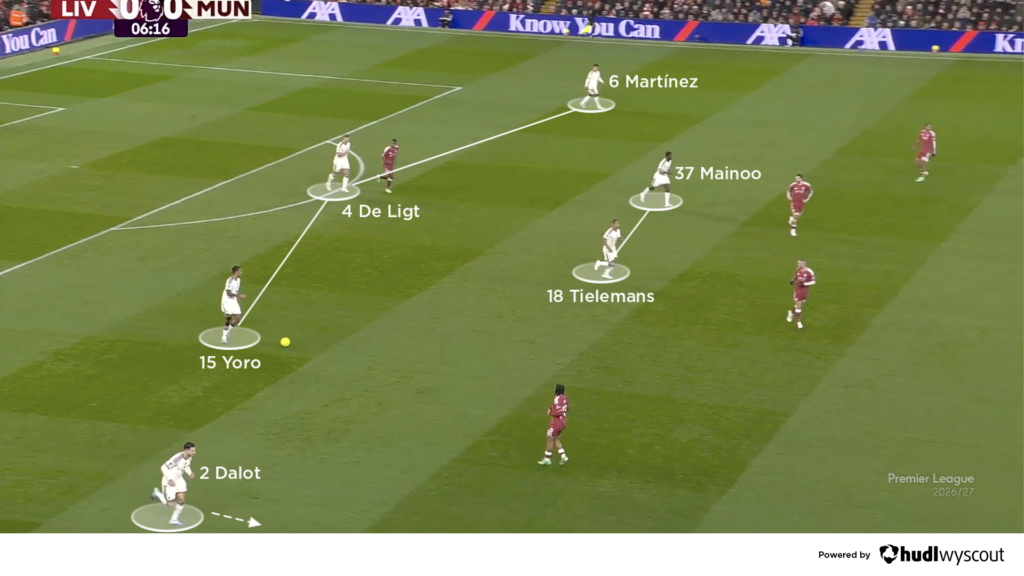
Pochettino’s selection of Matthijs de Ligt – only his second start for Manchester United in the last year – was a big talking point before kick off, and the opening minutes gave a glimpse of what the Argentinian’s United could look like. In possession, they looked to build with a 3-2 base structure of Lisandro Martínez, De Ligt and Yoro, with a double pivot of Youri Tielemans and Kobbie Mainoo in front. Diogo Dalot provided support and width on the right (below), as did Patrick Dorgu on the left, while Bryan Mbeumo narrowed from the right alongside Bruno Fernandes and Matheus Cunha to form a fluid front three in the opening stages. United looked to combine in tight areas and progress possession quickly, suggesting a more possession-based approach under Pochettino.
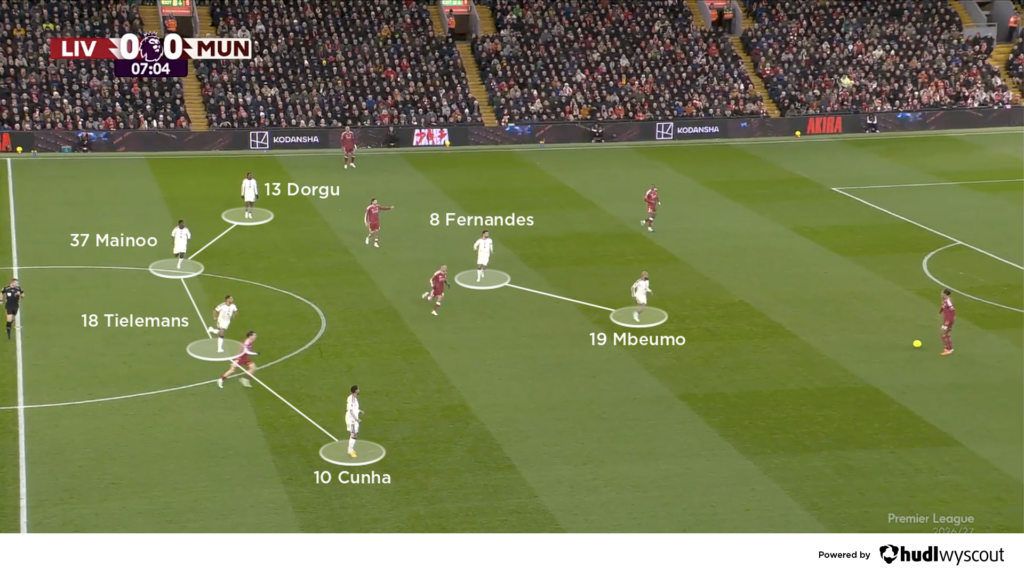
Out of possession, United settled into a compact 4-4-2, with Dalot dropping from his higher position in build-up to create a back four, as United looked to retain central compactness in the opening stages. In the example below, Mbeumo formed the front two alongside Fernandes following a transition, but this role would likely more often fall to Cunha, with Mbeumo taking up a position on the right of midfield so that United can more quickly regain their structure.
Liverpool threaten United’s back line
Liverpool fired an early warning shot to United, rapidly exploiting the space between and in behind United’s back line from a Liverpool goal-kick. United had a relatively aggressive pressing structure from goal-kicks, pressing with a player-oriented approach – Fernandes and Cunha as a front two, with Tielemans jumping onto deep pivot Alexis Mac Allister, while Mainoo released onto ball-side midfielder Szoboszlai as the ball was played across to Jérémy Jacquet. Opposite centre-back Yoro (just out of picture, below) was front-footed in his position, ready to step onto Wirtz when Jacquet was in possession, leaving equal numbers on United’s back line. Liverpool played longer in the scenario below and, following a contested ball, were able to break into the space behind United’s back line. The speed and athleticism of Bradley Barcola and Alexander Isak then threatened the vast space behind United’s back line, with the latter missing a chance that he should have put away.
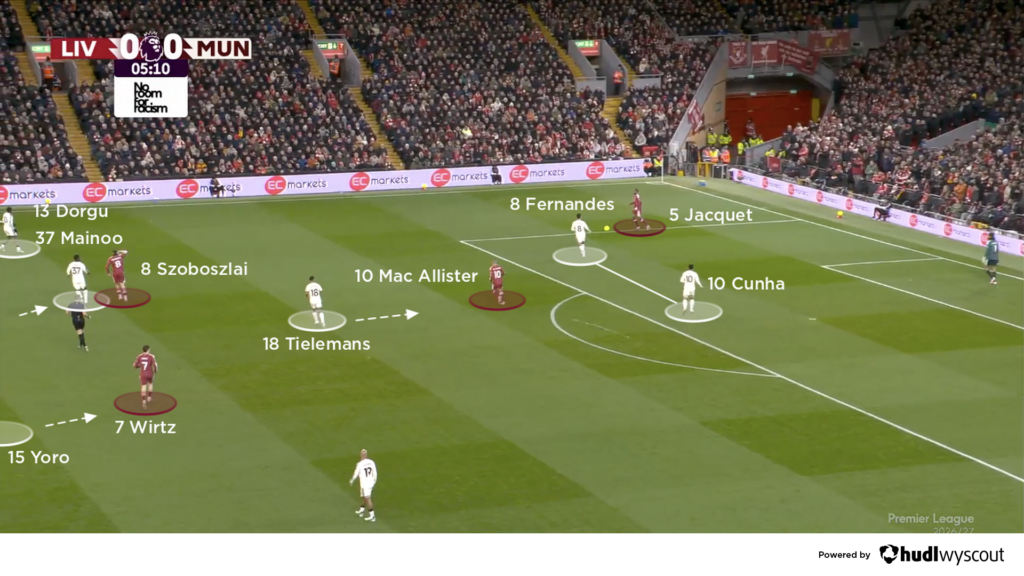
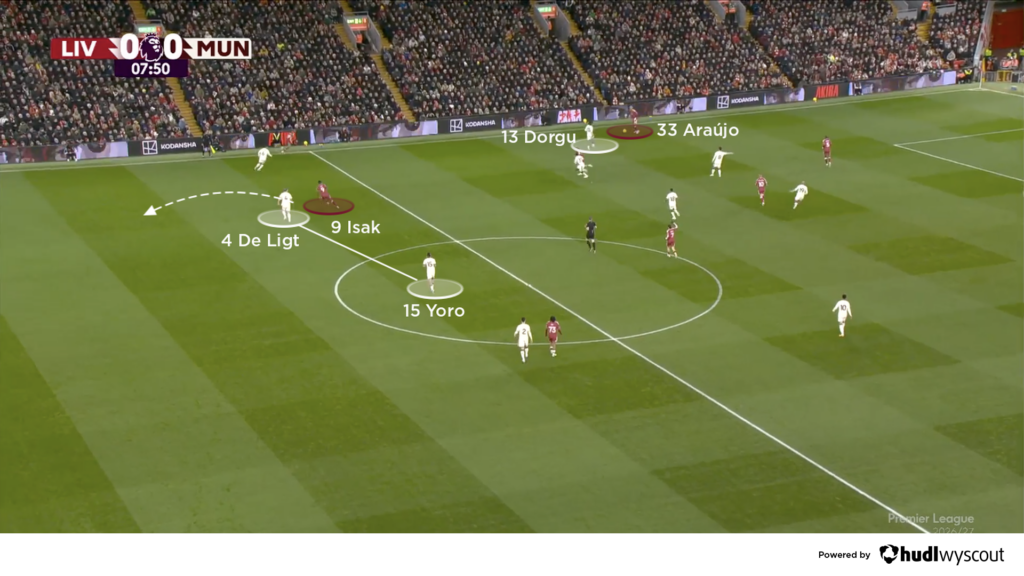
Only moments later, United’s back line was undone again, which in turn led to a game changing moment. With Dorgu releasing from the left side of United’s midfield unit to pressure Ronald Araújo, Isak briefly dropped towards the ball with the intention of luring De Ligt out with him, before making a second movement in behind United’s high back line to exploit the space, as Araújo played a shaped pass in behind. As a consequence – and due to United’s disjointed structure, with the distance between Yoro and De Ligt far too large, and no cover or balance provided by Yoro on the opposite side (below) – Isak was able to receive beyond De Ligt and Yoro. The recovering Yoro fouled Isak on the edge of the box and was shown a straight red card, before Szoboszlai further punished the foul with his free-kick.
Pochettino’s changes
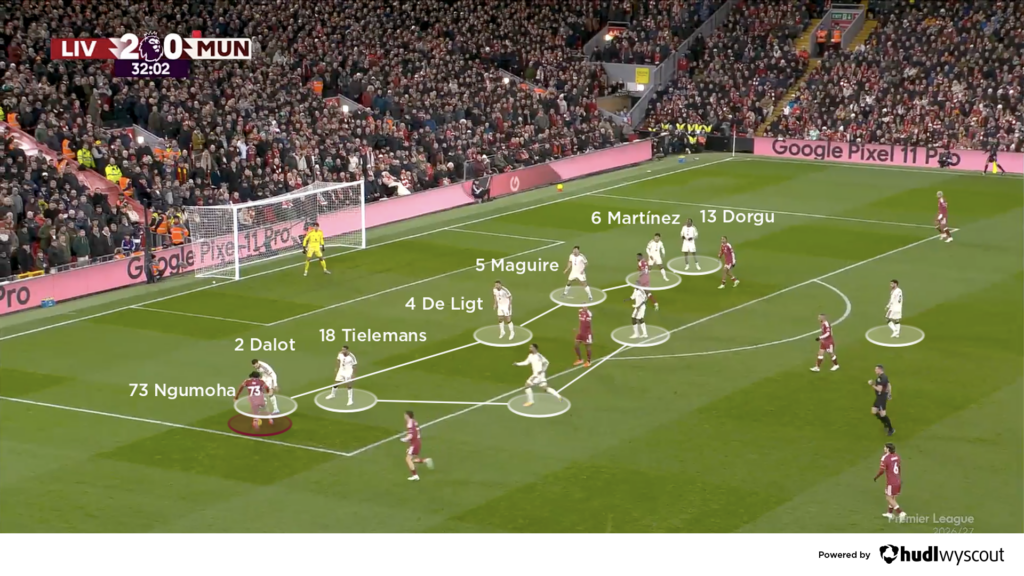
While Liverpool's front line all offered a threat in the opening 20 minutes, Ngumoha was probably the standout, often left free to isolate Dalot 1v1. Left-back Milos Kerkez opted on several occasions to stay deeper rather than overlap or underlap, giving Ngumoha space to use his directness against Dalot. As a result, Pochettino replaced Mbeumo on 22 minutes, bringing on centre-back Harry Maguire and changing from the 4-4-1 structure United had operated in following the red card. United moved to a more cautious 5-3-1 structure, which provided better horizontal coverage across the back-line by reducing the distances between defenders. As shown below, this ensured that when Dalot did engage Ngumoha 1v1, ball-side midfielder Tielemans was able to come across to support. There was also better coverage in the box, with ball-side centre-back De Ligt able to release and apply pressure if Dalot was beaten, while retaining security centrally with Maguire, Martínez and Dorgu positioned to defend the six-yard box (below).
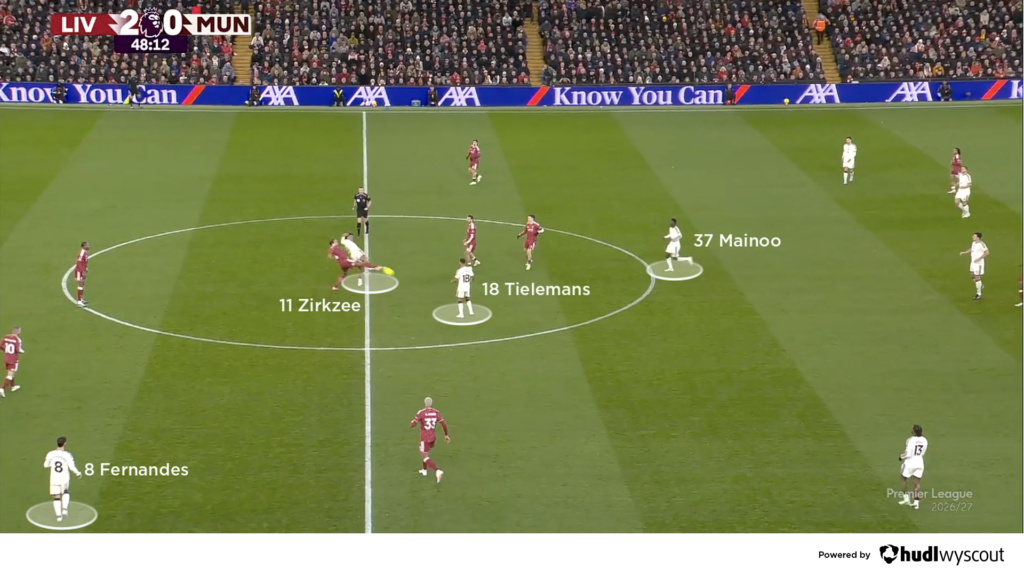
Although United gained some territory and a slight foothold in the game before the break, Pochettino introduced Joshua Zirkzee at half time (for Cunha) to lead the front line, with Fernandes dropping into the side of midfield. The intention with this change was to give United more of a focal point to play into, secure possession and gain ground up the pitch, before linking into United’s deeper midfielders to create opportunities and try to get the away side back into the game. However, United never truly threatened and as the game proceeded towards its conclusion, Liverpool struck twice more to seal a convincing victory.
It meant that since English football’s top division was rebranded in 1992, Liverpool have now won 700 Premier League games. Only United (776) and Arsenal (728) have won more, but incredibly the former have only won once in the competition so far this season. If Pochettino had any doubts about the scale of the challenge facing him at Old Trafford, his first game in charge was a stark demonstration of where United currently sit in the Premier League pecking order.
To learn more about football tactics and gain insights from coaches at the top of the game, visit Coaches’ Voice Academy
