

Víctor Muñoz
Liverpool, 2026-
Much like his ability to burst past opponents, Víctor Muñoz’s career accelerated rapidly in the 2025/26 season. A breakthrough campaign with Osasuna earned him a move to Liverpool and a place in Spain’s World Cup-winning squad, with the promise of more to come.
Born in Barcelona, he joined FC Barcelona’s famed La Masia academy at the age of 11, moving on to local youth side Damm three years later. By the age of 18 he had progressed enough to sign for Real Madrid, starting out on loan in Spain’s fifth tier. He then moved up to the reserves in 2023, before making his first-team debut towards the end of the 2024/25 campaign. On that occasion he replaced Vinícius Júnior in the 88th minute of a game against Barcelona, with Real Madrid trailing 4-3. It was quite an introduction, with Muñoz missing a one-on-one chance to level the score, sparking a backlash that prompted him to deactivate his social media accounts.
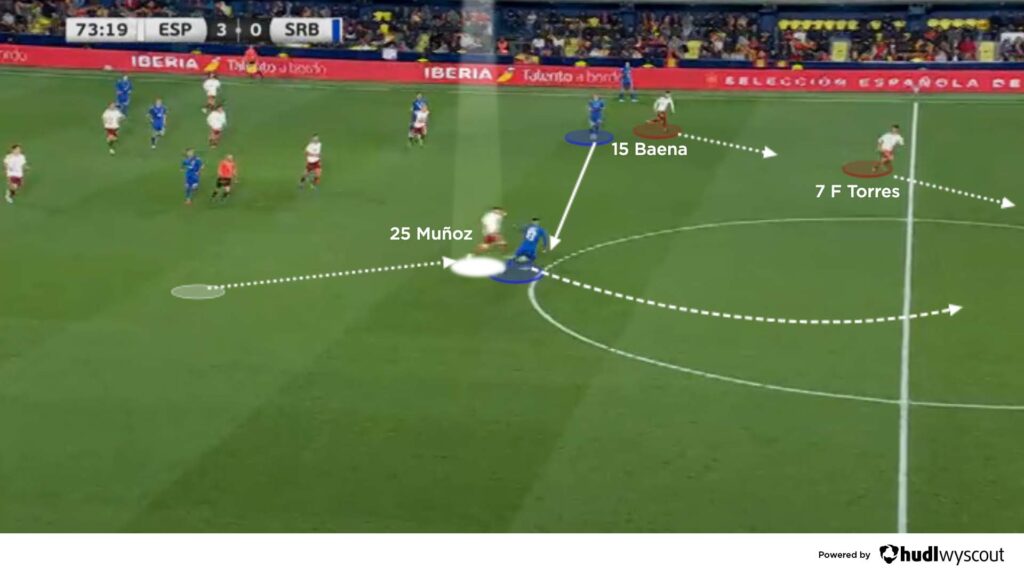
After one more substitute appearance at the Club World Cup, he signed for Osasuna in search of an environment that would provide regular playing time and maximise his strengths. The move could hardly have worked out better, as he made 34 appearances, scoring seven goals and providing five assists in 2025/26. A goalscoring debut for Spain duly followed in March of that season, as he notched the third in a 3–0 friendly victory against Serbia. “He’s slotted in perfectly,” was the verdict of Spain head coach Luis de la Fuente.
Injury ruled him out of selection for Spain’s opening games at the World Cup, and he didn’t manage to get on the pitch as the European champions won the tournament. But being in and around an elite group will have been no bad thing, ahead of his £34.5m move to Liverpool. Below, our UEFA-licensed coaches have analysed his game…
A traditional winger
In an era dominated by wingers who prioritise combinations in central areas, receiving between the lines or occupying number 10 spaces, Víctor Muñoz retains many of the characteristics of a traditional touchline winger. Operating mainly on the left flank (below) – both in Alessio Lisci’s 4-2-3-1 and 4-4-2 at Osasuna, and in Luis de la Fuente’s 4-3-3 with Spain – his first instinct has been to attack the space behind the opposition defence, rather than drop deep to receive the ball to feet. This consistent threat forces opposing full-backs and centre-backs to adjust their defensive distances, dropping their pressing line to protect the space behind them. Muñoz is not a player who needs to be heavily involved in possession to influence the game. His positioning alone alters the behaviour of the opposition block and creates advantages for his teammates.
Although right-footed, operating on the left flank means that he is equally capable of making aggressive diagonal runs inside, or through gaps between full-backs and centre-backs (below). This dual threat makes him difficult for defenders to manage. Unlike many inverted wingers who rely on driving inside, Muñoz has consistently alternated between inside and outside movements, complicating defensive cover and forcing opponents to defend multiple scenarios.
Acceleration
His speed is an asset, but what sets Muñoz apart is his acceleration. Modern football is increasingly played and decided in tight spaces and brief moments. In this context, his ability to gain half a second in the first few yards can be decisive. His initial explosiveness allows him to attack spaces before the defender, getting to 50-50 balls first and creating an advantage in a seemingly even situation. Many of his decisive breakaway runs (below) have stemmed from this ability to burst forward at exactly the right moment.
His acceleration is also useful in other phases of the game. For example, in attacking transitions, he can turn a recovery deep in his own half into a dangerous attacking situation within seconds, either through an individual action or a combination. During these transitional moments, he consistently identifies, occupies and exploits free spaces, attacking the gaps between defenders and taking advantage of any structural imbalance as the opposition reorganises (below). In defensive phases, meanwhile, his speed and acceleration allow him to cover large distances, recover positions and sustain high-intensity effort throughout a game.
In addition, he has excellent co-ordination, changing direction without losing balance or speed. This combination of speed, explosiveness and ball-carrying makes him very difficult to contain when he finds space to attack.
Dribbling to create overloads
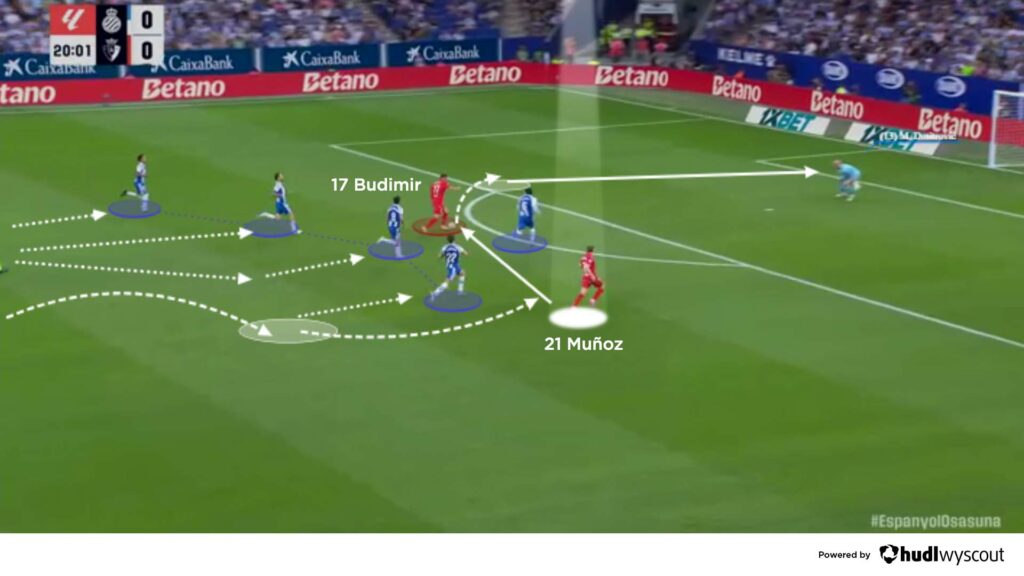
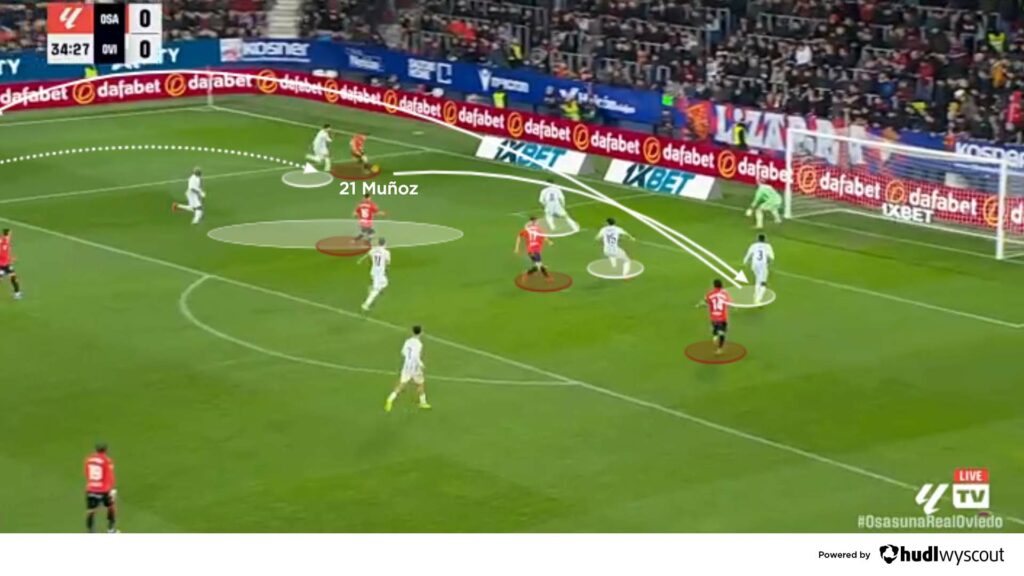
Muñoz has excelled in 1v1 situations, but his ability to unbalance opponents goes beyond simply beating a defender in an individual duel. His dribbling has also served a tactical purpose within the attacking structure of Osasuna and Spain, creating overloads in the final third. When he receives the ball in wide areas and drives directly at his marker, he can force the opposition to provide immediate support around the ball, adjusting their covering positions and modifying their defensive references (below) to do so. At that moment, spaces open in the final third for players around him. As such, his ability to beat defenders does not merely take a direct opponent out of the game; it can disrupt the opposition’s defensive structure too.
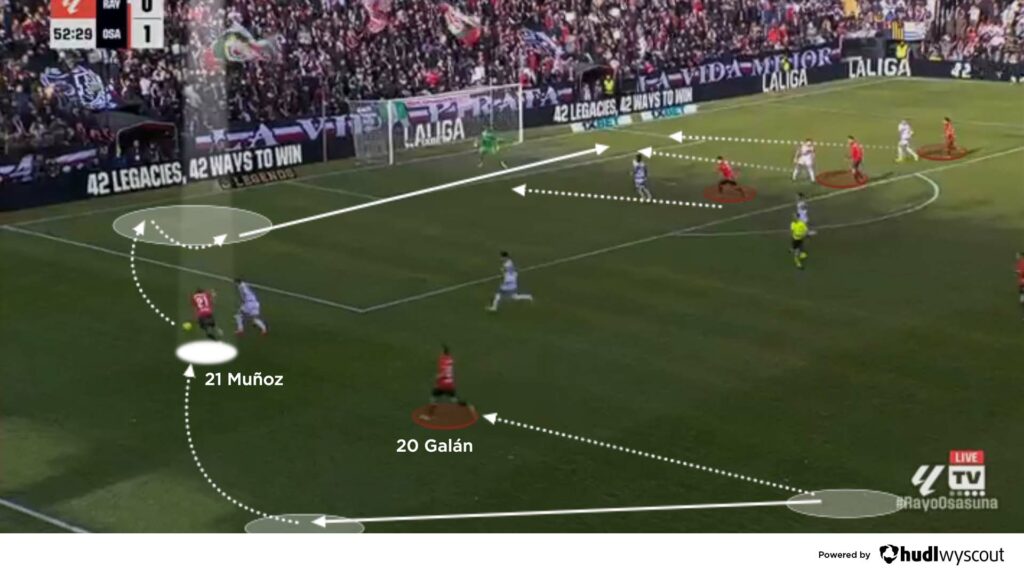
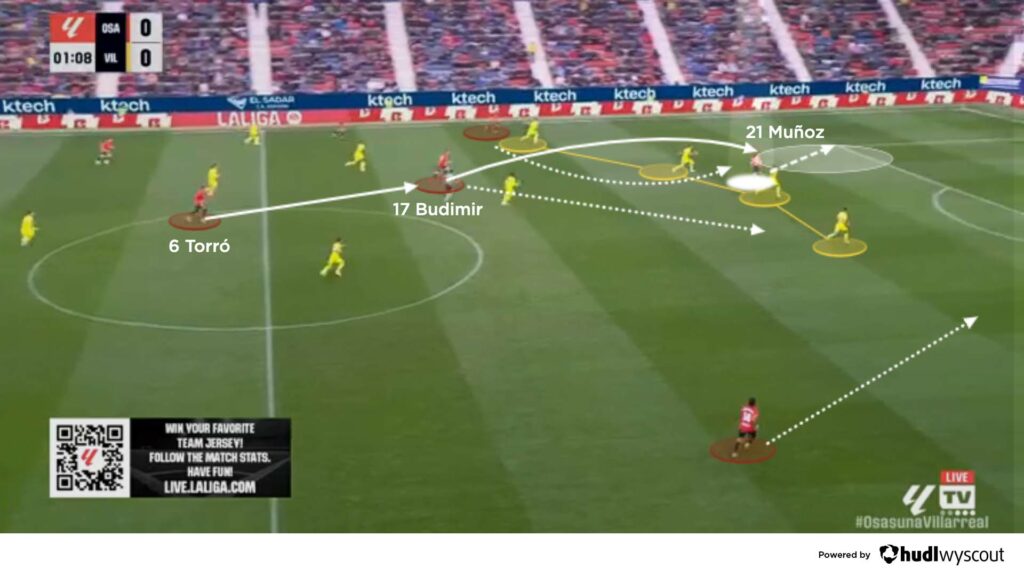
In many situations, the defensive cover required to stop him has involved several defenders. At Osasuna, this often created opportunities for teammates such as striker Ante Budimir (below), midfielder Aimar Oroz, or full-backs arriving from deeper positions. In addition, his ball-carrying tends to be direct. He doesn’t dribble to retain possession or accumulate eye-catching actions, rather to progress play, break lines, move the ball closer to the opposition penalty area and create opportunities for teammates in better positions. That attacking mindset helps to explain why he became one of La Liga’s most effective and influential dribblers.
Defensive intensity
Muñoz is not a winger who switches off out of possession. At Osasuna, this trait dovetailed well with the demands of Lisci – a coach whose game model asked for aggression, intensity and quick regains after turnovers in the opposition half. From advanced positions, Muñoz played an active role in his team’s high-pressing structure (below), steering opposition build-up toward the flanks, where opponents could be trapped with support from midfielders and a full-back. There, he used his pace to limit the ball-carrier’s time and space, forcing quick decisions and helping recover possession while keeping the attack alive.
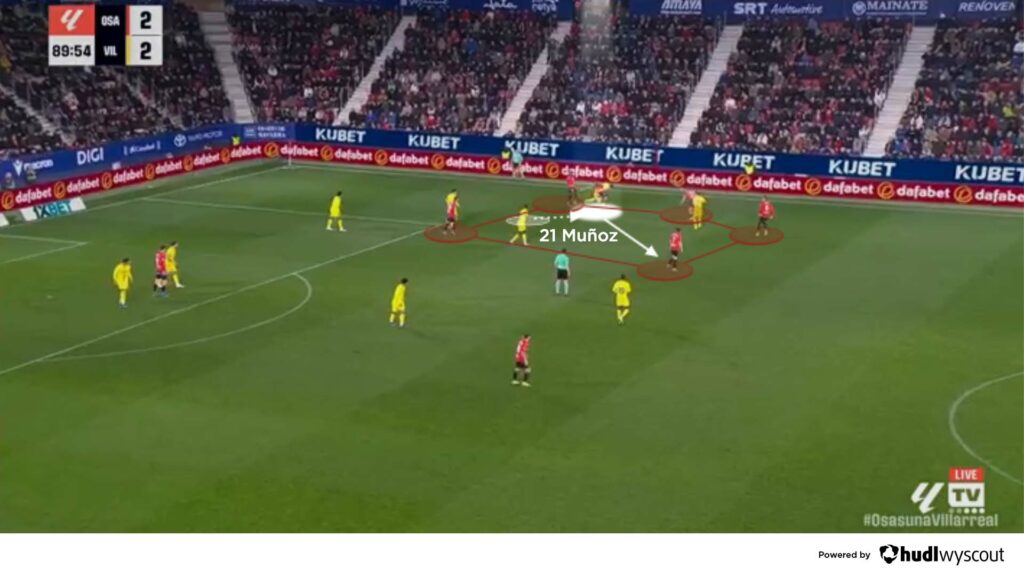
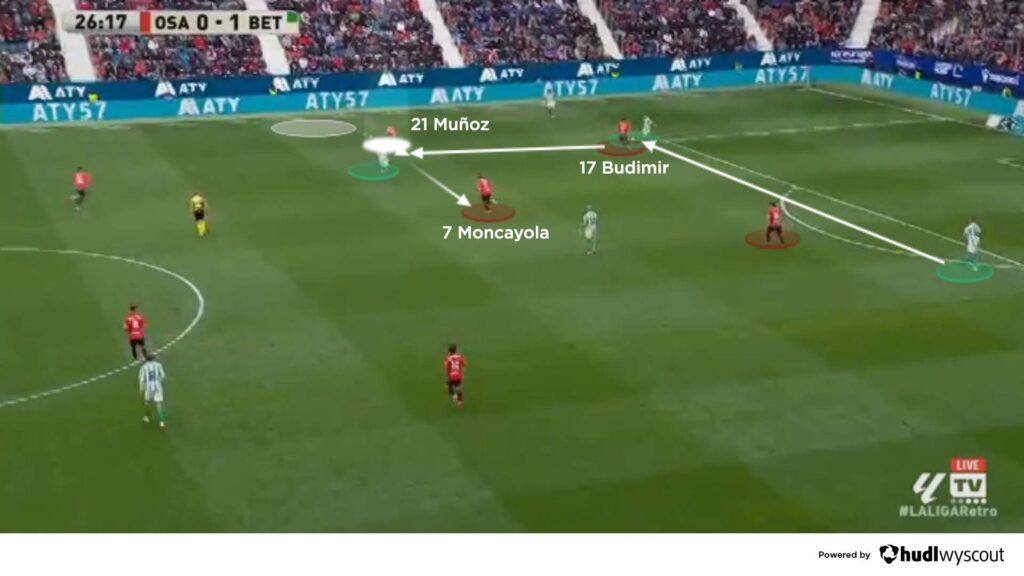
His behaviour in counter-pressing situations has been particularly noteworthy. After losing possession, he has typically reacted immediately, closing distances and looking to recover the ball before the opposition could organise their attacking transition. Again, his acceleration has been decisive, quickly reaching areas where possession was lost, recovering positions and providing support deep into his own half when required. Relentless and powerful in his attempts to win the ball back, he has consistently maintained a high level of defensive intensity. He has also stood out for his ability to intercept passes in central areas, thanks to his anticipation and reading of opposition passing lanes.
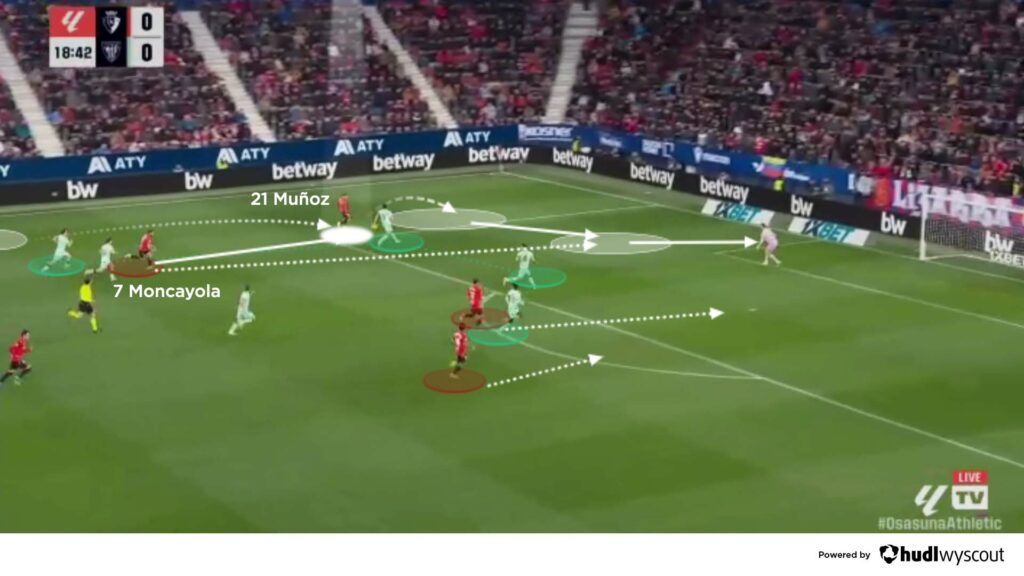
Muñoz has often deliberately separated from a potential receiver before closing the distance at the right moment – in the example below, anticipating the next opposition action to intercept before quickly linking up with Jon Moncayola. He also contributed long recovery runs, demonstrating a level of tactical maturity that is unusual for a player of his age. His defensive commitment has been further evident in the support he has provided his full-back whenever they have pushed forward and possession has been lost in advanced areas. This combination of attacking talent and collective sacrifice goes a long way to explaining why Luis de la Fuente decided to integrate him into the Spain squad.
Still developing
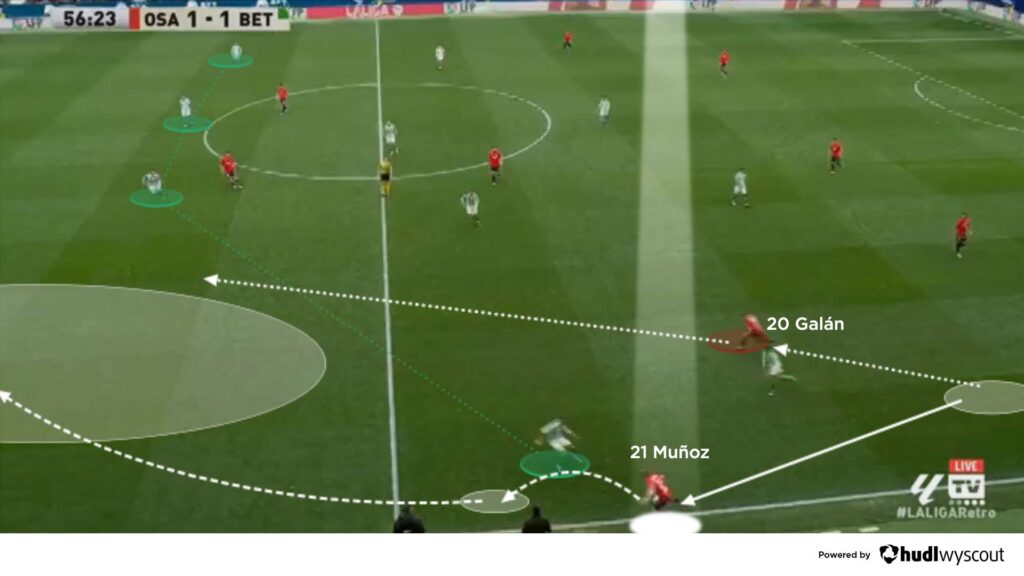
Perhaps the most exciting thing about Muñoz is that he is still a long way from reaching his competitive peak, with plenty of room for growth. He can operate on either flank, play as a second striker, provide width as an outside attacker, and even occupy more central positions (below), depending on the demands of the system. This tactical versatility allows him to adapt to different contexts and significantly increases his value to any group.
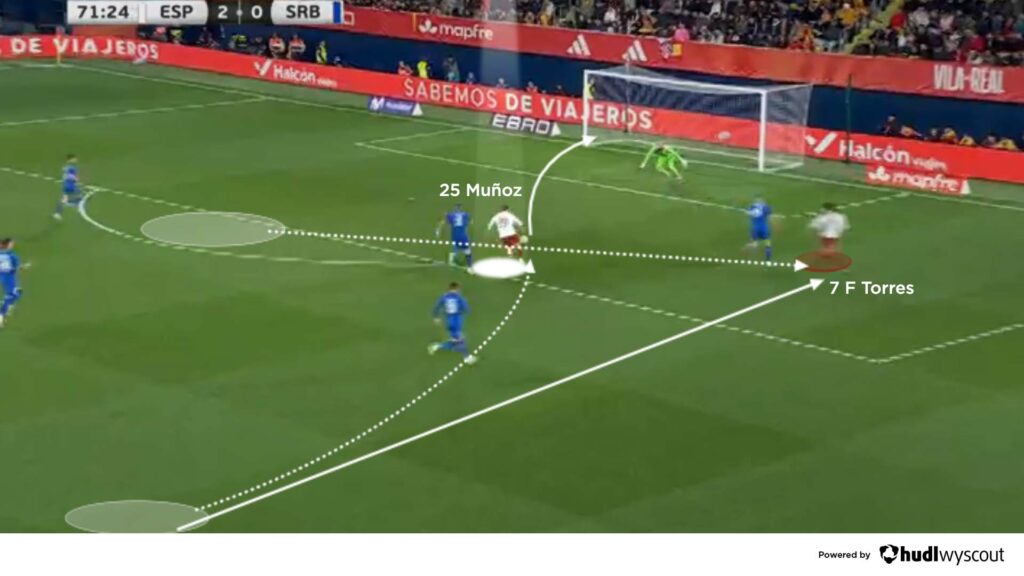
His future development will largely depend on refining certain technical and tactical details. The use of his weaker foot, the accuracy of his crosses after beating his marker (below), decision-making with the final pass and his shooting threat from medium range are all areas with room for improvement. He can also continue to develop his emotional management of specific competitive situations. However, these areas for growth are precisely what make it possible to envisage an even higher ceiling on his performance level. The foundations are there – elite speed, dribbling ability, defensive aggression, a strong competitive mentality and an increasingly mature understanding of space.
For all these reasons, Muñoz is not just a Spain international, but one of the brightest hopes for what is an all-conquering national team. And it will be fascinating to see how he fits in with Andoni Iraola’s Liverpool.
To learn more about football tactics and gain insights from coaches at the top of the game, visit Coaches’ Voice Academy