
PREMIER League, JANUARY 8 2026
Arsenal and Liverpool searched in vain for a goal in a game of contrasting halves between last season’s champions and the team looking most likely to win the title this year. With the chance to go eight points clear after 21 games, Arsenal penned Liverpool in for much of the first half, although the visitors did hit the bar through a Conor Bradley strike after a rare spell of possession. After the break it was Liverpool who dominated the ball, but with no recognised striker on the pitch they lacked a cutting edge. Arsenal knocked on the door with a couple of efforts in added time, but it was too little, too late for Mikel Arteta’s table-toppers. Nonetheless, they can still be satisfied at moving to a six-point lead over second and third-placed Manchester City and Aston Villa.
How the managers saw it
“We struggled to dominate the game more through two things,” said Arteta. “One, because we gave some very unnecessary balls away – very unlike us – and that didn’t allow us to travel together as a team. And when you don’t do that, you are not compact and they start to drop everybody behind the ball and through the midfield and back, without having any presence in the box… I don’t think they had a single shot on target tonight. But we [then] struggled more to dominate the game and to be a threat in the opposition box.”
“In the first half they had much more ball possession than us,” said Arne Slot. “Although in some spells of the game you could already see how well we can play the ball out from the back and how many times we could play through them. But they were more dominant, were a few times very dangerous over their right side with [Jurriën] Timber and [Bukayo] Saka, but that led to not much more than crosses…
“In the second half I think we defended a little bit better in their first build-up, so that made it more difficult for them to dominate as much as they did in the first half, and we were even better on the ball, or we did similar things like [in] parts in the first half, to dominate [the second half]. But from all that ball possession – and that’s not something new for someone who follows Liverpool – you’re hoping for more chance creation. We were a lot of times very close, [but] shots and decision-making in the end… Just not enough to score a goal.”
 15621236418141971125463810308187
9/5
SHOTS / ON TARGET
7/0
53%
POSSESSION
47%
31
ATTACKS INTO AREA
13
0.95
EXPECTED GOALS (XG)
0.08
Arsenal’s right side
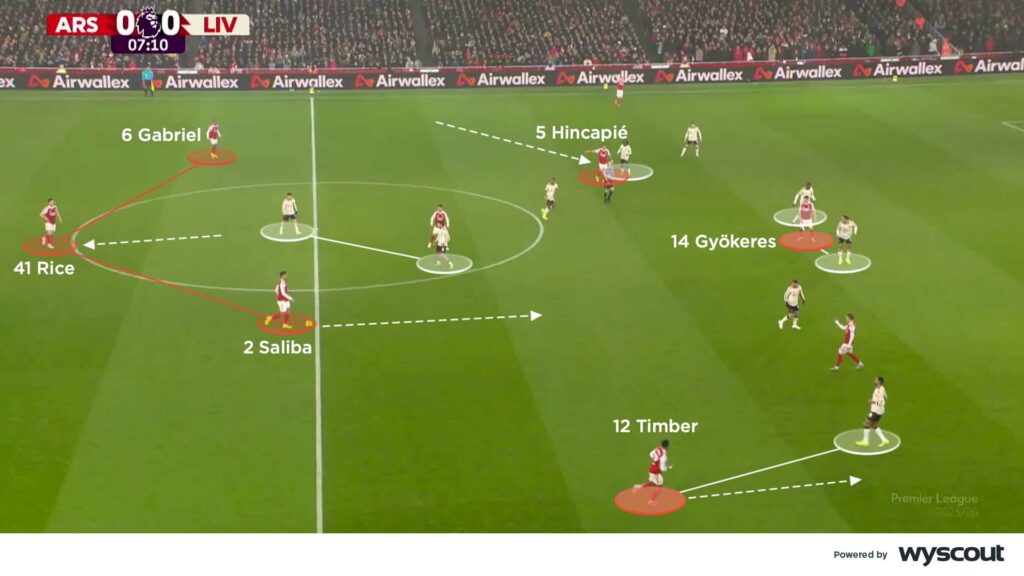
Arsenal quickly locked in Liverpool with rotations and overloads that helped them to progress up the pitch. In possession, Arsenal converted their back line to a three, with Declan Rice or Martín Zubimendi dropping between or alongside the two centre-backs. Their full-backs advanced higher and were closely tracked by their direct opponents, forcing Liverpool deep into their own half. These rotations allowed the widest of Arsenal’s back three to step forward with the ball, as Liverpool chose to defend with an underloaded front two in order to create their own 2v1 overload around Viktor Gyökeres at the other end. As a result, Arsenal repeatedly progressed around Florian Wirtz and Dominik Szoboszlai, gaining territory with ease (below).
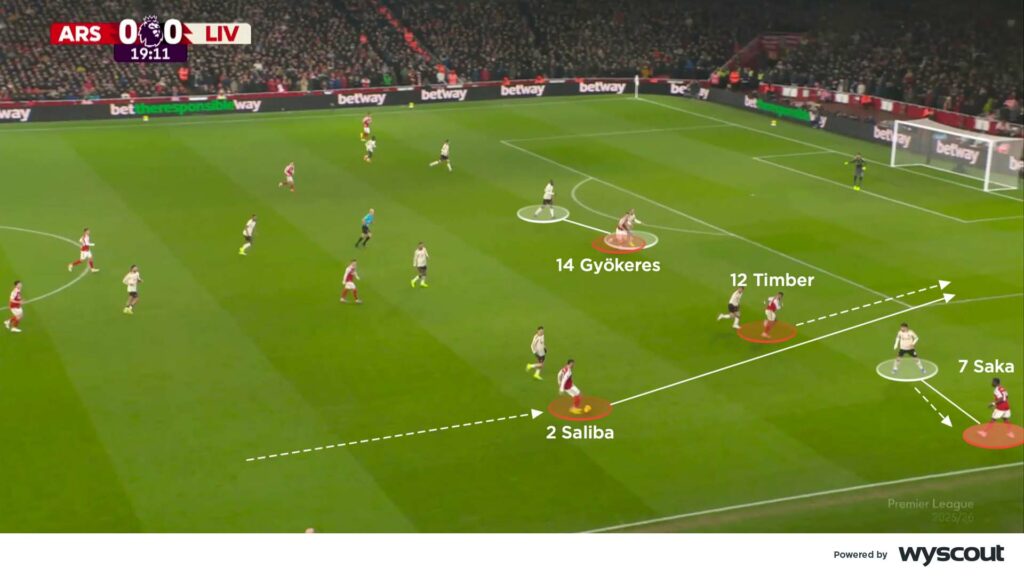
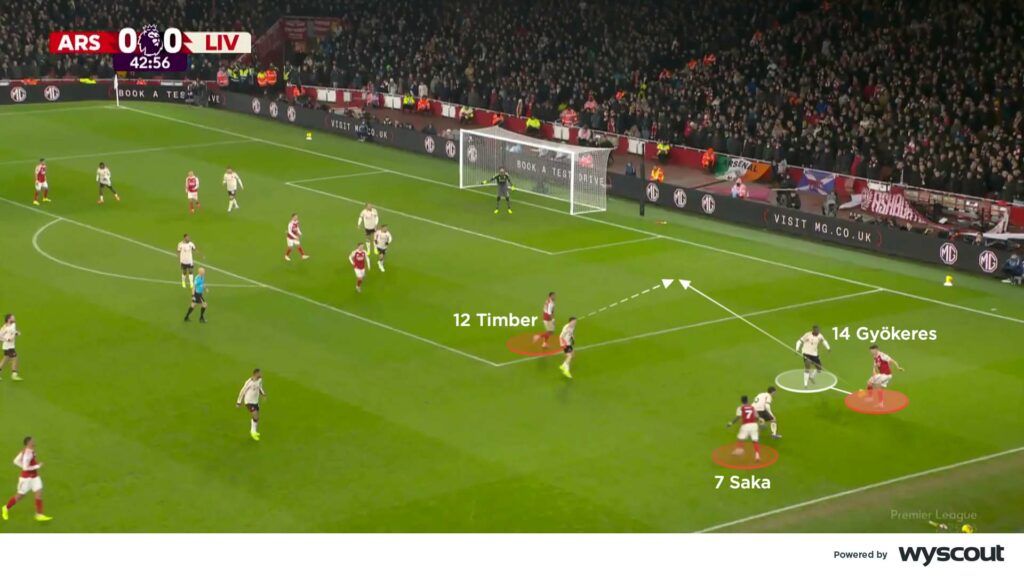
Despite being able to progress around either side of Liverpool’s front line, it was play on Arsenal’s right side, through simple and consistent access to Saka and Timber, that proved most challenging for Liverpool. Saka caused problems out wide by attacking around Milos Kerkez and others with deft dribbling. As Kerkez moved wide to put earlier pressure on Saka, Virgil van Dijk and Ibrahima Konaté maintained their 2v1 overload on Gyökeres. As a result, Arsenal had an inside channel gap in which Timber could receive and get into useful crossing positions (below).
There were also moments when others joined Arsenal’s wide-right attacks, such as Gyökeres dragging one of Liverpool’s centre-backs out with him. He kept the key space within the right inside channel free, though, with Timber still able to receive on the move and penetrate Liverpool’s penalty area (below). But despite some promising moments from play on their right in the first half, Arsenal lacked a connection between their crosses and the central players attacking them.
Liverpool’s central-midfield overload
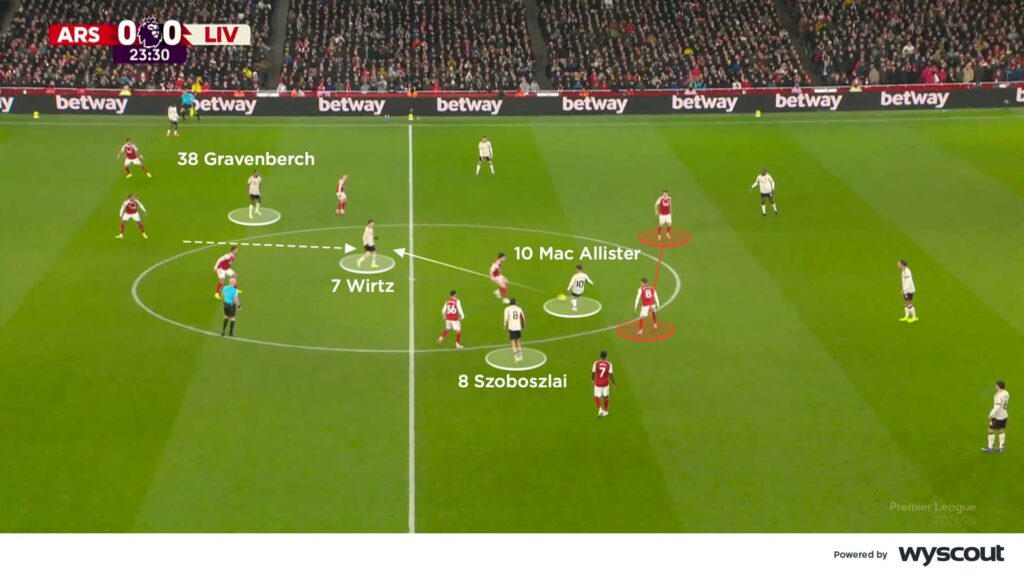
For a brief period in the first half, Liverpool found an overload in central midfield thanks to Wirtz – nominally playing as the main forward – dropping deep. Arsenal pressed with Martin Ødegaard frequently joining Gyökeres in their first line, which left two in central midfield who Liverpool were able to work the ball away from. Arsenal’s centre-backs were unsure whether to hold their position or follow Wirtz, ultimately leaving Liverpool’s number seven to help his team connect and combine for the first time in the game (below).
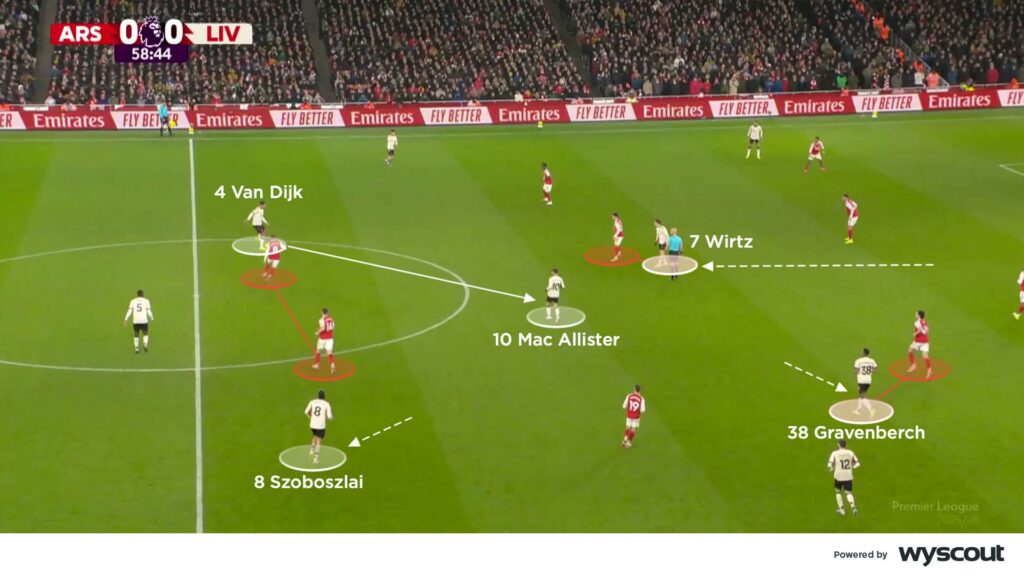
Liverpool then started strongly in the second half, taking control for lengthy periods with their passing rhythm. Arsenal continued to defend with Ødegaard and Gyökeres as the first line, leaving Rice and Zubimendi unable to cover Liverpool’s midfield three, while Wirtz added another option by continuing to drop away from Arsenal’s centre-backs. Liverpool’s numbers and rotation in midfield meant they often had at least one free player to receive (below), dominating possession. Arteta then made several personnel changes that had little impact on his team, with or without the ball.
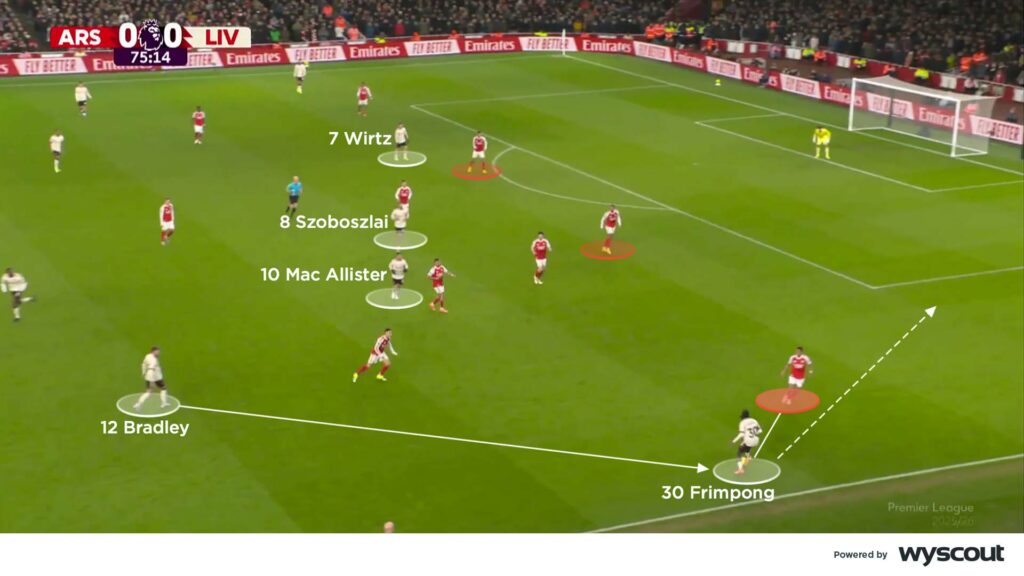
Liverpool controlled much of the second half, but their only consistent threat came when Jeremie Frimpong isolated and beat Arsenal’s substitute left-back, Myles Lewis-Skelly (below), who had replaced an injured Piero Hincapié after 57 minutes. Despite some promising situations, Liverpool’s combination of poor decision-making and lack of bodies in the box limited their threat. As such, their only consistent attempts at goal came from range from Szoboszlai.
Given Liverpool went into the game 14 points behind Arsenal and without a recognised centre-forward – as well as missing the third-highest goalscorer in their history, Mohamed Salah – their lack of a goal threat could be somewhat excused. But while Slot’s side were likely more content with a draw than Arsenal, Arteta’s team are in an excellent position in the Premier League and the cup competitions as they aim to end a trophy drought.
To learn more about football tactics and gain insights from coaches at the top of the game, visit CV Academy