
PREMIER League, NOVEMBER 30 2025
Chalobah (48)
Merino (59)
Premier League leaders Arsenal took a point from this heavyweight clash against a Chelsea side that was reduced to 10 players. The hosts were aiming to close the gap on Mikel Arteta’s men to three points, but faced an uphill task when Moisés Caicedo was sent off after 38 minutes. They responded admirably, however, taking the lead when Trevoh Chalobah headed a corner home shortly after half-time. Arsenal levelled 11 minutes later with a header of their own from Mikel Merino, converting a Bukayo Saka cross. The result left Arsenal five points clear of Manchester City, with Chelsea a point further back in third.
How the managers saw it
“11v11, I think we were better than them,” said Chelsea head coach Enzo Maresca. “We managed the game, controlled the game, didn’t concede chances. The red card changed the dynamic, but the way the players dealt with that was fantastic.”
“After the sending-off of Caicedo we wanted to settle the game,” said Arteta. “At half-time we said: ‘Let’s push it now, get what we have to do.’ And we were very clear on our intention and how we were going to dominate the game in the first action. Long ball, free-kick, corner, and we concede from a set-piece. So then, the momentum shifted, and ultimately the team have to react to that. We managed to get some good spells without having too much momentum and we score a great goal, and after that we had two or three big chances but lacked certain detail, especially in the manner we attacked.”
Below, our UEFA-licensed coaches have picked out the key tactical points from the game…
 132329272524784120112353336417101123
9/4
SHOTS / ON TARGET
7/4
40%
POSSESSION
60%
12
ATTACKS INTO AREA
29
0.84
EXPECTED GOALS (XG)
0.89
Significant central spaces
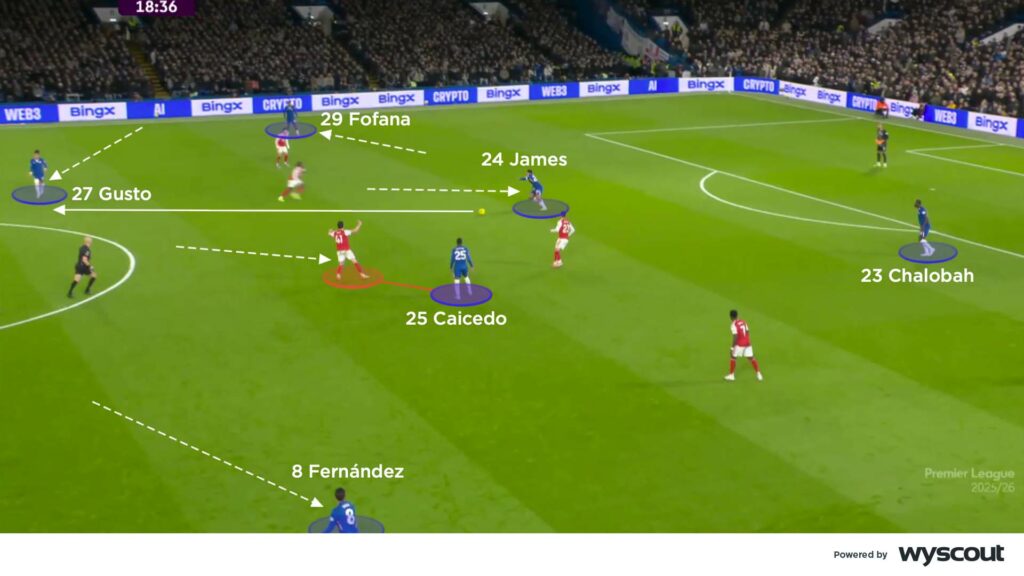
From Chelsea’s 4-2-3-1 structure, right-back Malo Gusto moved inside to receive in midfield – particularly when Arsenal’s Declan Rice committed to jumping on to Caicedo. Reece James formed a double pivot with Caicedo, but soon dropped into the back line, usually towards the right centre-back position. In turn, centre-back Wesley Fofana moved wider as Gusto advanced. Enzo Fernández also created room for Gusto by drifting over to Chelsea’s left, often drawing across his marker Martín Zubimendi. In doing so, Maresca’s team disconnected Arsenal’s two central midfielders, creating a significant central space in which they could progress (below).
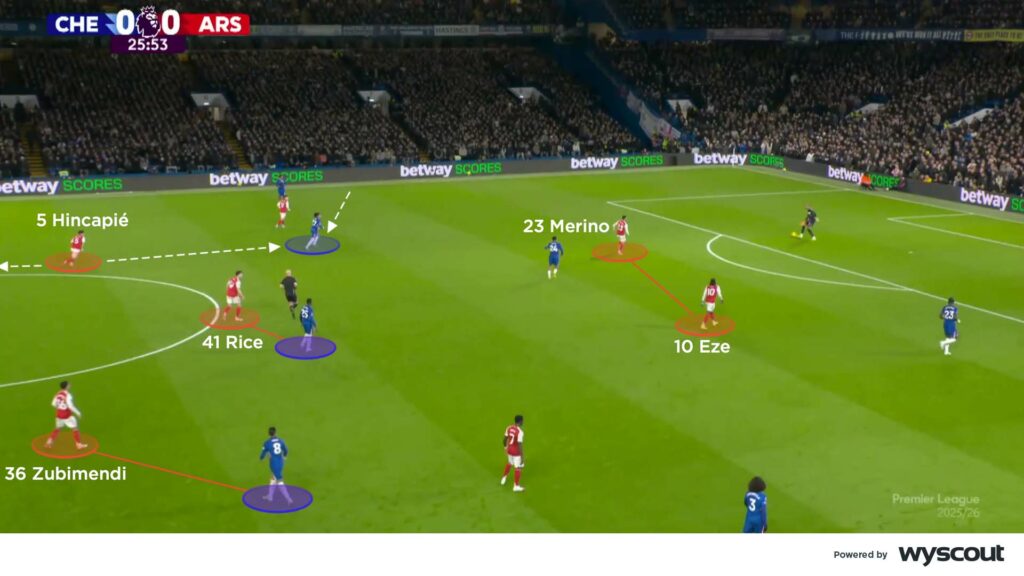
Arsenal responded to this by having left centre-back Piero Hincapié defend higher. The Ecuadorian moved into a half-and-half position, ready to recover back for any longer balls but high enough to jump on the narrowed Gusto. With this extra defensive support in midfield, Rice and Zubimendi could focus on their direct opponent without being exposed centrally (below). The remainder of Arsenal’s back line then dealt with any long balls. Caicedo in particular was strong on the second contact for Chelsea, helping his team attack from there before his dismissal.
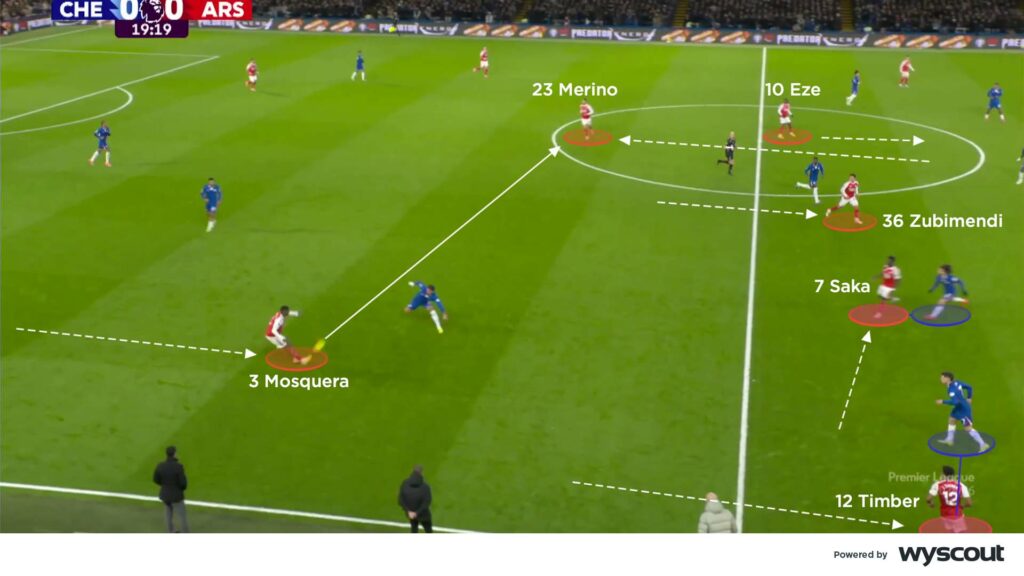
Arsenal also tried to create and exploit central spaces. As the initial centre-forward in the 4-2-3-1, Merino dropped into midfield, often becoming the main pivot, while Eze and Zubimendi cleared out the central spaces, taking their opponents away. On the right, Saka moved inside to allow Jurriën Timber to advance early. The Dutch right-back also created space for Arsenal’s extremely wide centre-backs to step forward into midfield through the wide areas, from where they could play passes to Merino in the vacant centre (below).
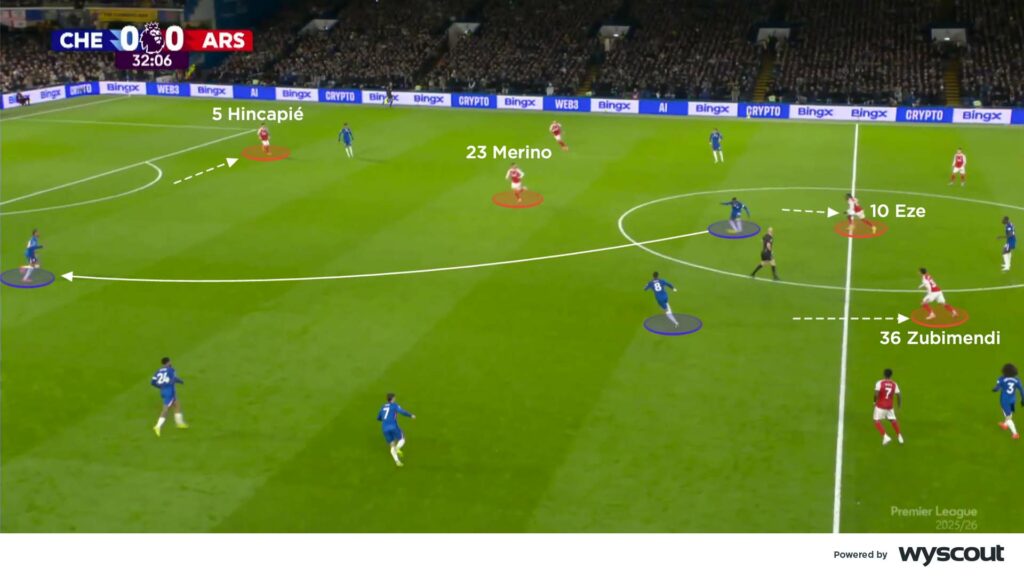
Despite having more first-half possession, Arsenal were sloppy at times, especially when linking with Merino. By clearing out so much space in the centre, they left big central spaces for Chelsea to attack when the home side regained in the middle third. Arsenal’s centre-backs were wide and the full-backs were quite high in these moments, while Eze and Zubimendi were unable to back-press and impact any loose balls or misplaced passes (below). As such, Chelsea’s best final-third entries came in these transitional moments, but they lacked a clean end product.
Breaking Chelsea’s block
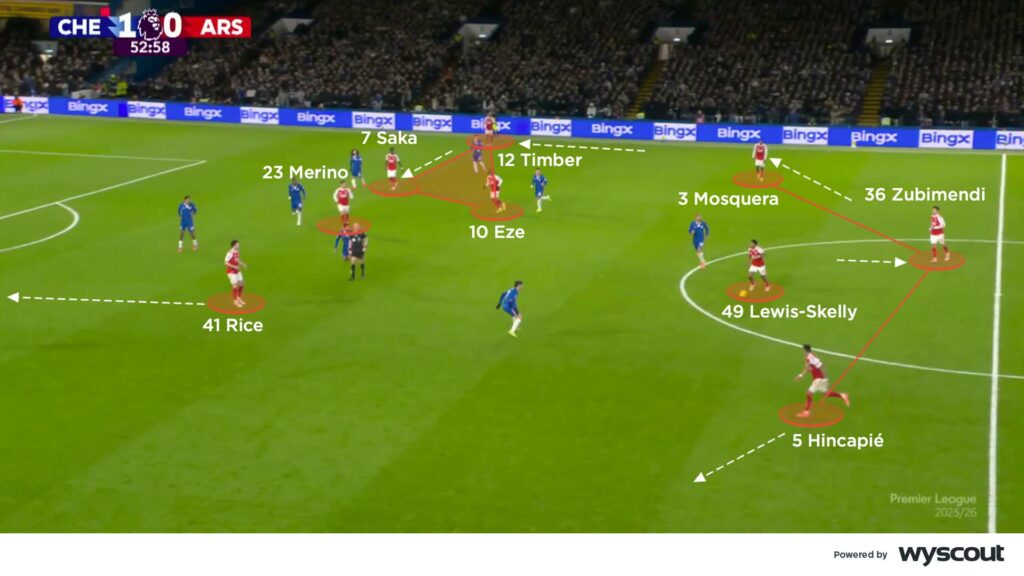
With Chelsea reduced to 10 players, Arteta added Myles Lewis-Skelly at half-time for Riccardo Calafiori. The substitute became Arsenal’s main pivot ahead of a converted back three, as they attempted to break down Chelsea’s low block. Zubimendi split his two centre-backs, while Eze joined Saka and Timber as a right-side three (below). Gabriel Martinelli was left to isolate Gusto, with Rice available for runs into the box, working inside whenever Gusto jumped out to Arsenal’s left-winger. Merino remained the centre-forward, but stayed higher, dropping nowhere near as deep as before the break. The result was that Arsenal’s right side was more threatening in the second half, with Saka crossing for Merino to head home an equaliser after Chelsea had stunned them early in the second period.
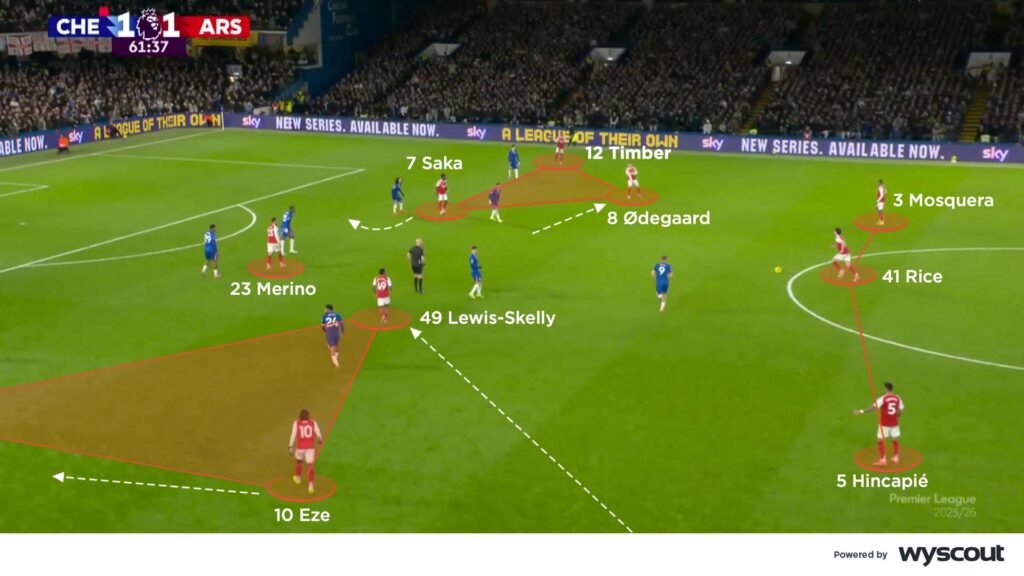
Noni Madueke replaced Martinelli on 57 minutes, with Martin Ødegaard introduced for Zubimendi. Arsenal created wide triangles, attacking with a combining and rotating trio on both sides of the pitch. Eze supported the left, while Lewis-Skelly joined higher as Rice split Arsenal’s two centre-backs in possession. Ødegaard added a second left-footer along with Saka on the right, supported by Timber’s overlaps (below). Arsenal’s right continued to have plenty of convincing and penetrative play, largely via Saka and Ødegaard combining back inside on to their left feet.
Arteta eventually added an out-and-out centre-forward, bringing on Viktor Gyökeres for Eze after 72 minutes as Arsenal searched for a breakthrough. Elsewhere, wingers Saka and Madueke briefly swapped sides, but the away side couldn’t grab a winner as Chelsea’s low block held out. In the end, a point apiece could be viewed as a point gained for both teams from a very competitive London derby.
To learn more about football tactics and gain insights from coaches at the top of the game, visit CV Academy