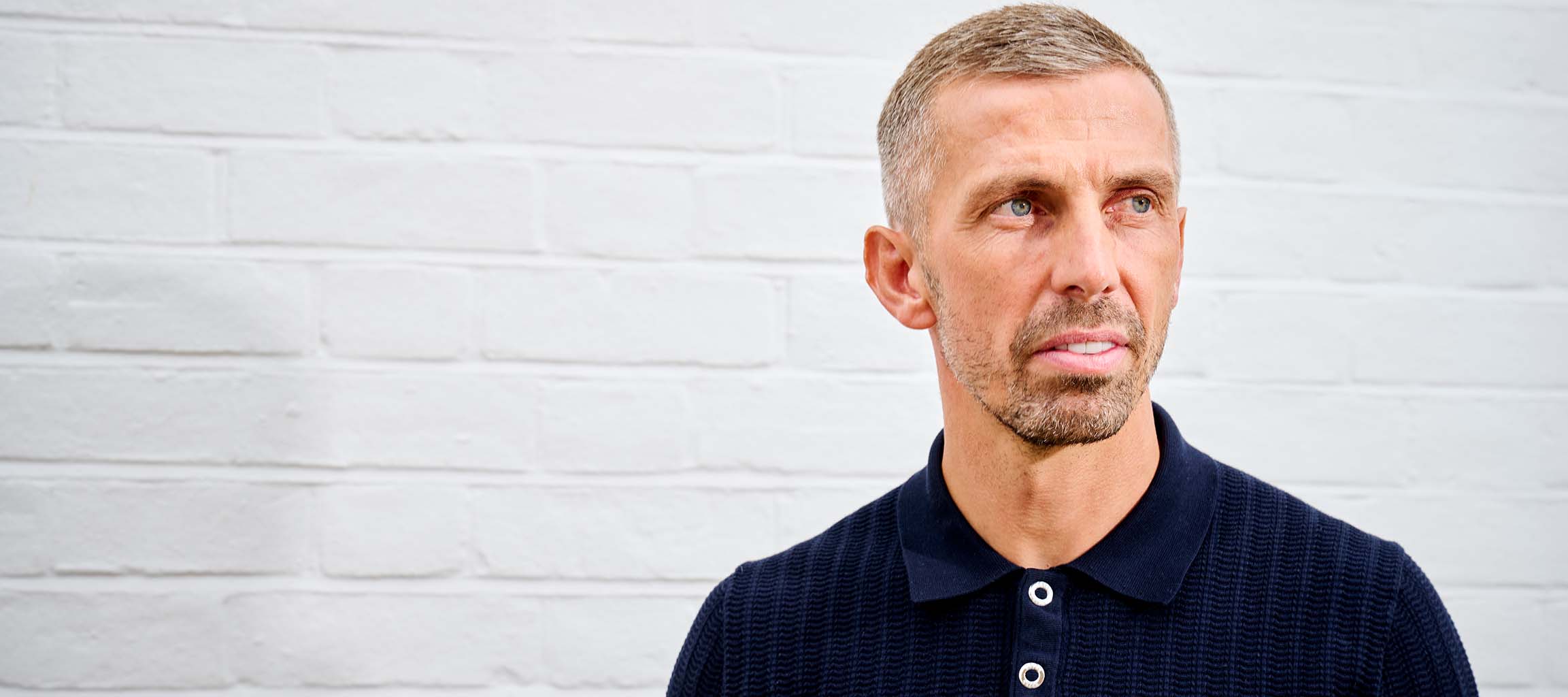
Gary O’Neil
Racing Club de Strasbourg, 2026-
I knew early in my playing career that I wanted to be a head coach.
I always enjoyed the tactical side of the game. As a player, I felt there was a ceiling on how high I could go, based on the limits of my physicality, speed and power. But I always felt I was technically good.
Although my physicality at the top level was maybe a limiting factor, what I did have was a really good tactical understanding. I figured that if I went into coaching and management, my physical limitations would no longer be relevant. Instead, I would be able to draw upon my strengths in understanding the game. So if you’d asked me when I was a young player if I would go on to coach, I would have said yes, definitely.
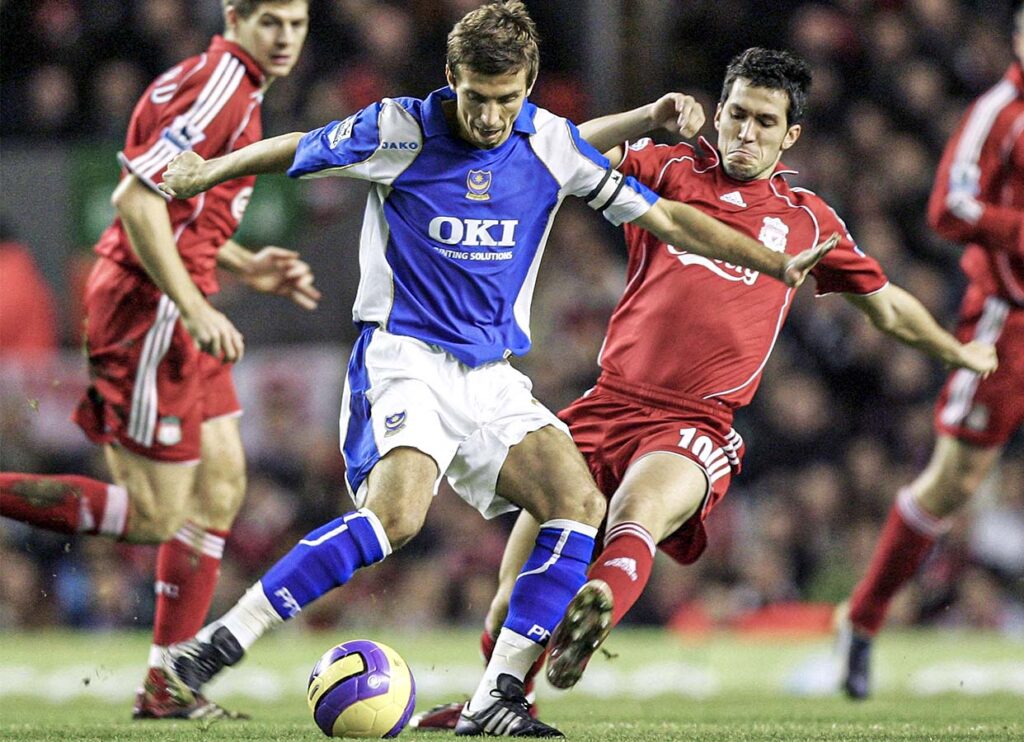
After playing with Portsmouth and Middlesbrough in the Premier League, at the age of 27 I was back in the top flight with West Ham. It was then that I suffered a fairly significant injury to my right ankle. The early diagnosis was that I might struggle to get back to playing at the same level.
When you’re a player, you feel like it will go on forever, until something like that happens and you realise how close the end can actually be. Fortunately, I was able to come back and play for another 10 years, but it accelerated the process of doing my coaching badges.
I started preparing for the transition to coaching, looking in more detail at my coaches and managers and what they were doing. I watched the top teams around the world, how they behaved and what they were up to. And I tried to get myself ready so that there wouldn’t be too big a gap between playing and coaching.
“I never envisaged my journey going from coaching Liverpool’s Under-23s to being a Premier League manager within two years”
In the latter years of my playing career, I made sure to appreciate how enjoyable it was, because I felt like it was coming to the end. My last season at Bolton, playing in the Championship at the age of 36, was a tough year for us as a team – but I had loved it. I was named player of the season, then I went away to do some work in the off-season. I had a bit of pain in my Achilles and ruptured it.
Shortly after I’d had surgery and was in the process of rehabbing, I visited Liverpool’s academy to spend a day with the academy director, Alex Inglethorpe. We had a few conversations, and I also spent a bit of time with Neil Critchley, who was then the Under-23s manager. A couple of weeks later, they called and asked if I’d be interested in taking up a coaching role.
It seemed like a better decision than nine to 12 months of rehab on an Achilles and trying to come back at 37 in the lower leagues. The time was right, especially with such an incredible opportunity to work at a big club, so I jumped at the chance. While continuing my rehab, I was able to join in with a few sessions with Liverpool’s Under-23s. I spent a good few months learning how to be on the grass, how to set up sessions, how to treat players, and what they need from you.

I also got some exposure to the first-team environment, being around Jürgen Klopp, Pep Lijnders and the guys on their staff who were doing so well there. It was a fantastic introduction to coaching for which I feel very fortunate. I had always worried about that spell between stopping playing and starting coaching, and what the middle would look like. Luckily, it wasn’t too long for me. I was able to go fairly quickly from one to the other, being appointed assistant coach with Liverpool’s Under-23s in August 2020.
However, I never envisaged my journey going from coaching Liverpool’s Under-23s to being a Premier League manager within two years.
In February 2021 I got an opportunity to go Bournemouth and work with Jonathan Woodgate in the Championship. I was torn. I didn’t want to leave Liverpool’s academy that early, as I was learning so much. But there was the draw of first-team football and of working with Jonathan, who I knew well. There was also the attraction of it being an ambitious club that had just fallen out of the Premier League and was trying to bounce straight back.
“It was a big test to take over a group that had just lost 9-0, working in the top league in the world”
It felt like it was too good an opportunity to turn down, and it accelerated what I thought the journey was going to look like. I had envisaged being in academy football for maybe two to three years, but it ended up being six months. Then I was into first-team football.
We had the Championship playoff experience that year and then Jonathan left, with Scott Parker and his team coming in. They were great with me, giving me real responsibility and opportunities to learn, so I had an excellent year under them.
We got promoted, and after that season I started to think about whether it would be time to move and maybe manage at a different level. I would have expected that to be a lower level than the Championship, and started to look loosely at opportunities. At the same time I was dedicated to helping Scott and his team, giving everything to try to help them be successful. Soon after the season started, Scott left. I got the call that morning saying they wanted me to take the team in the next game – against Wolves, funnily enough.
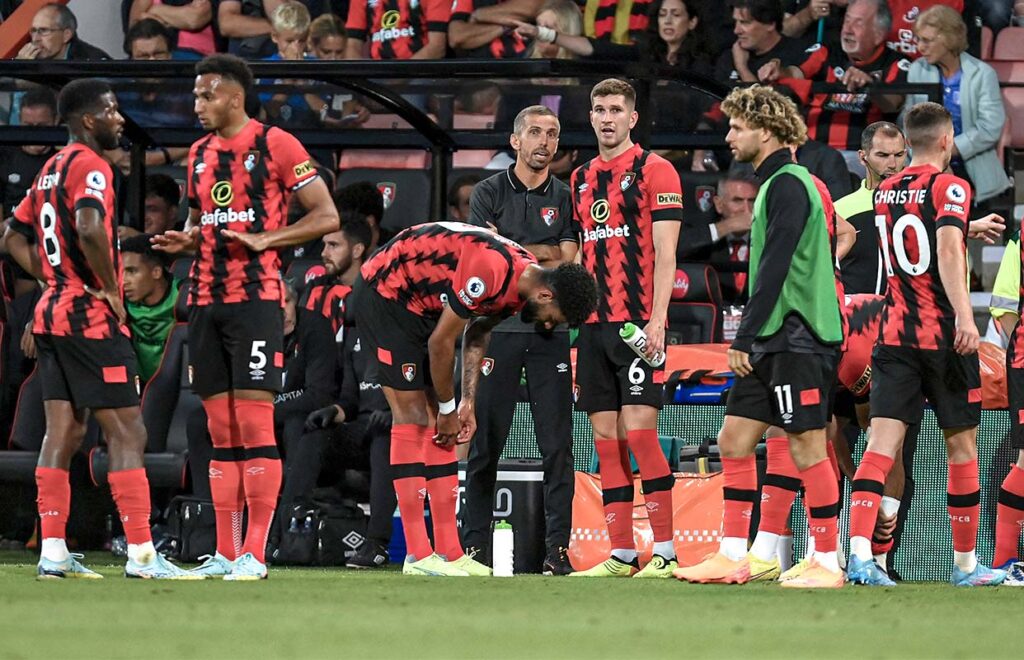
It had never entered my mind at any point until then that I would be in charge of a Premier League game any time soon. I had been assistant to Barry Lewtas with Liverpool’s 23s, assistant to Jonathan Woodgate at Bournemouth, then first-team coach under Scott Parker, so I had never even taken a team in a game. To have that thrust upon me in the Premier League, with a team that had struggled in its first three games, was an incredible opportunity. But it was also one that you would fail fairly miserably if you hadn’t put the work in and prepared yourself properly.
It was a big test to take over a group that had just lost 9-0, working in the top league in the world, at a newly promoted team. I am forever grateful to AFC Bournemouth and the guys there for giving me the opportunity. It was, however, one that most people probably thought I wouldn’t succeed in and would end badly.
The work I’d done as a player and how seriously I’d taken my roles at Liverpool and Bournemouth gave me an opportunity to be successful, though. I was obsessed with the game and understanding how to be the best head coach I could be. And I had to learn, fast.
“I am really proud of the job that we did there because it was a tough job”
With that Wolves game I only had 24 hours with the group, but we ended up being okay as a team and with our performance, drawing 0-0. What I liked about it was the resilience and togetherness we showed, rather than it being any kind of tactical masterclass. It gave us something to build on, and I was able to take a few days – which felt like a long time – to figure out tactically what I wanted us to be.
Next we went away to Nottingham Forest and were 2-0 down at half-time, having played fairly well. I made some radical changes to the shape of the team in the second half and we came back to win 3-2. At that moment, I started to get some attention and was asked the question: “Do you want the job?”
Managing Bournemouth as interim, I never dreamed about getting the job. Instead, I dreamed about helping the team, giving it a backbone and a stability that would show who I am as a person. First, in order to help stabilise the club. Second, to give me an opportunity to progress on to something else – a level that other people probably would have seen as more realistic for my first job.
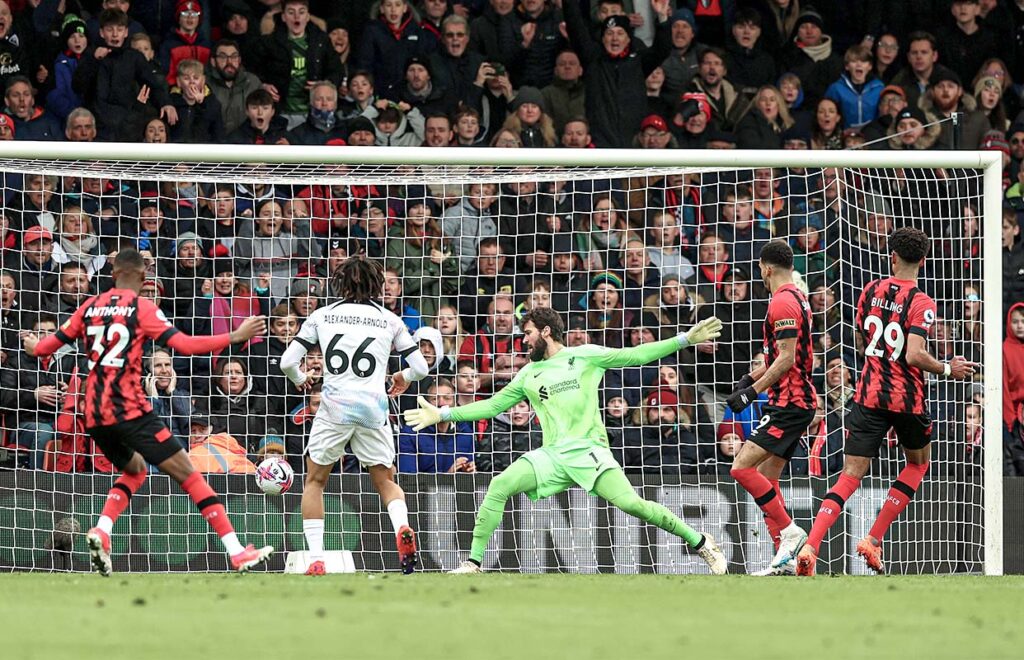
But the success snowballed from there. We went six unbeaten and looked like a team that had a good opportunity of doing something.
That year we faced challenges as a newly promoted side, and went through some tough spells. The Bournemouth team that I had was nowhere near what it has gone on to be. We were not able to sign freely, even though we had some fantastic owners at the football club. The takeover was still going through, so we were heavily reliant on players who have since left. That included Ben Pearson – who played a big part – Chris Mepham, Siriki Dembélé, Jack Stacey and Kieffer Moore. It was a group that had been together for a long time, but had spent a lot of their time in the divisions below. What we did was harness a togetherness and sprinkle it with some fantastic quality, including Marcus Tavernier, Dominic Solanke and Philip Billing.
I am really proud of the job we did there, because it was a tough job. Bournemouth have since pushed on to do some fantastic things, and I am proud of the part we played in their success. It was spelt out to me by the people above how important it was – for the takeover and the progression of the club – that we stayed in the Premier League that season. Since then, it’s been proven how difficult it is for newly promoted teams to stay up. The next six teams to have been promoted since Bournemouth were all relegated. To be the last team, as it stands, to have stayed up after being promoted – and to do it as a rookie head coach – was a huge achievement.
“The Manchester City game seemed to speed things up for us and brought everyone together”
It set me up to do the next job at Wolves – a part of the journey that was equally enjoyable. I walked into a situation where the head coach had left fairly close to the start of the season. The group had been unsettled by that and the summer they had. It was also a very different changing room to Bournemouth, in terms of having a lot of different cultures and players from all over the world.
I had to go in there with my staff and have an impact, making it quickly look like my team. We arrived on matchday minus four, with the first game being Manchester United away. With three to four days to prepare, it was difficult to know whether to give the lads all of my information on what I wanted us to be, or leave them with the pre-season they’d had and just try to give them some guidance. I decided to throw everything at them and see how much of it stuck.
Without the ball we were 4-4-2. In possession we were 3-2-5, with Nélson Semedo pushing on as a high right-back. We went to Old Trafford and performed unbelievably well. We should have won the game, but we built from there.
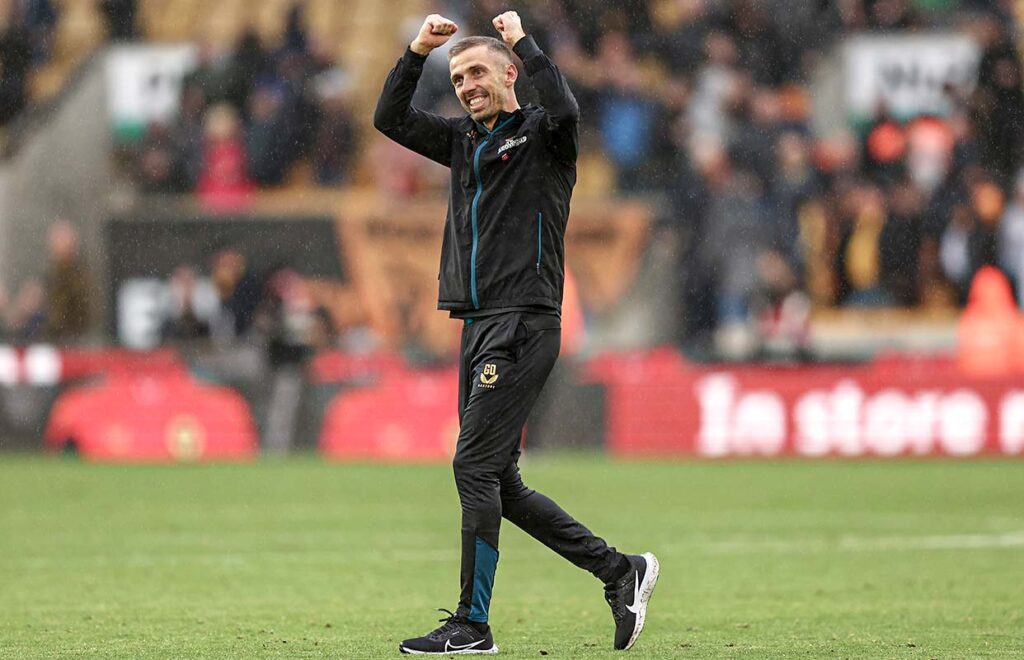
In the early phases we suffered some losses. I was still a new head coach who had only done it for nine months, so there were big question marks around whether I could do the job. We lost the next game at home to Brighton, then two of the next three. At the end of September I made 10 changes to the team for an EFL Cup game at Ipswich, who came back from 2-0 down to knock us out.
Next came Manchester City in the Premier League, fresh from winning the treble – they would go on to win an unprecedented fourth title in a row. We beat them 2-1 and the whole momentum of the place seemed to change from that moment. The coaching staff and the players were building a connection. We always got along really well. Now, there was a willingness and a desire from the players to give everything to what I was asking.
The Manchester City game seemed to speed things up for us and brought everyone together, including the fan base. We did not fear anybody. Next we drew against Aston Villa, then won away at Bournemouth. Newcastle came to Molineux and we played out an unbelievable 2-2 draw in teeming rain. It was free-flowing attacking football, end to end and working our socks off.
“The away section was packed full of Wolves fans, so to win 2-0 there and celebrate with them was fantastic”
Most pundits had predicted Wolves to be in the bottom three, but there we were, getting results and attacking teams. We weren’t just sitting there behaving like a team that was going to accept being down at the bottom of the league. Of course we conceded some goals and were never going to be perfect, but we were on the front foot and aggressive. We were involved in some fantastic games.
Wolves hadn’t scored goals freely for a very long time, but we were scoring more than 1.5 goals per game. Our xG was through the roof compared to what it had been in recent years. We were able to achieve this shift quickly because we got buy-in from big players and internationals, including Matheus Cunha and Pedro Neto.
I could see their career trajectories – how they were trying to get to the very top of world football – and managed to build a relationship and trust with them. As a young up-and-coming English manager, to build the culture and togetherness we had in the dressing room at Wolves was a big achievement.
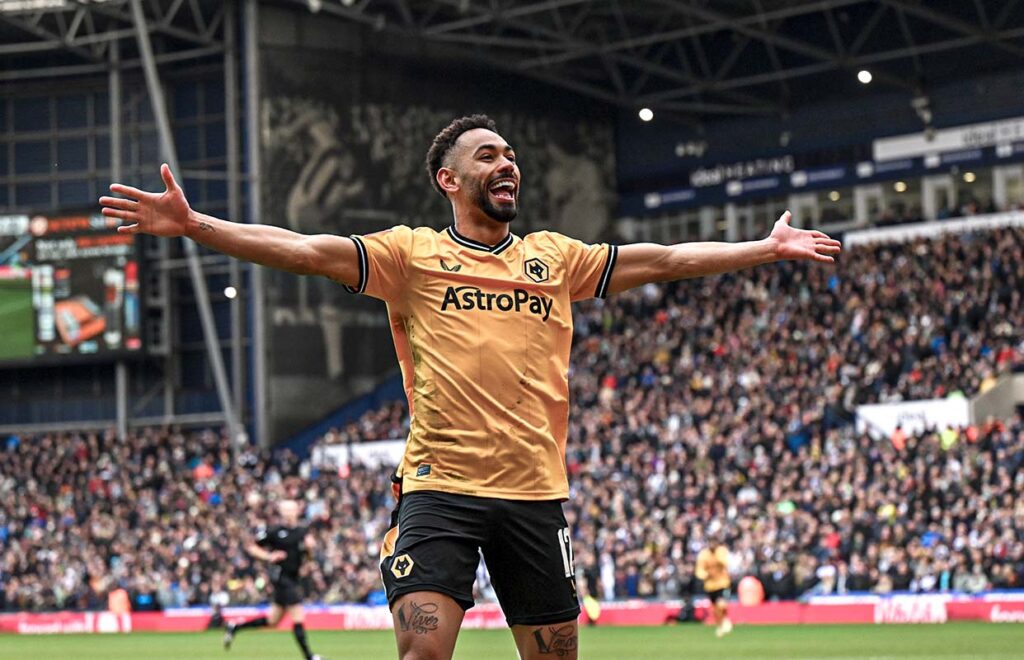
Of course, if you only concentrate on the end of the journey, it will always be seen as a negative spell. Unless you’re unbelievably successful and leave a club when you’re on a high, most managers end up being sacked – as happened to me at Wolves. If you concentrate purely on the end, it is always going to look like a negative experience.
Look at the whole tenure, however, and you can see that we achieved some magnificent performances and results. I think of the 3-0 at home to Everton, where we were excellent on the day and everything came together. Or going toe-to-toe with a Newcastle team that would go on to qualify for the Champions League. Then there was the win against Manchester City, and winning home and away against Chelsea and Tottenham.
In January 2024 we were drawn to play away at our local rivals West Brom in the FA Cup. Wolves hadn’t won at the Hawthorns since 1996, and hadn’t won there in the FA Cup since 1949. The away section was packed full of Wolves fans, so to win 2-0 there and celebrate with them was fantastic.
“The challenging moments really helped me”
For me, moments like that far outweigh how it ended. The end is the end, and it will usually always come to that at a football club. There were circumstances that made it difficult for us at Wolves – injuries and things that happened within the group. But in general, we knitted together a group who were in need of leadership at that moment. And we were able to produce some fantastic performances and results, and do it in a way that was really entertaining. I think Wolves fans would say that Molineux was an entertaining place to be at that point.
Following us on the road brought its entertainment, too. Wolves hadn’t scored four away from home in the top flight for more than a decade – then we did it twice in a few weeks, with wins at Brentford and Chelsea. They were incredible moments that will live with me forever, along with the backing of the fans, the staff and the players.
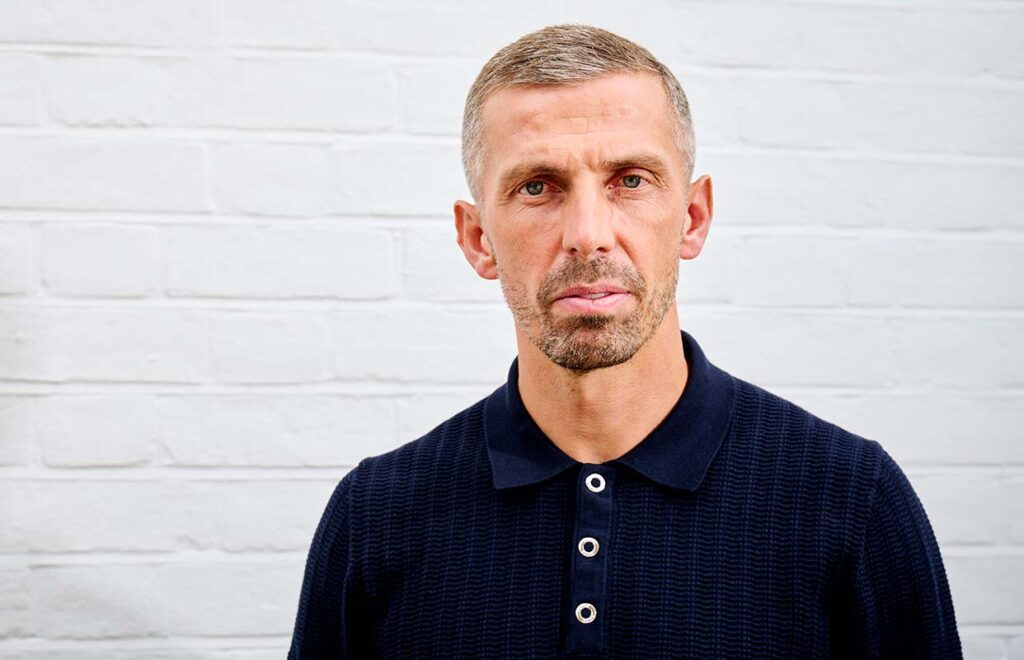
The challenging moments really helped me, too. The steep learning curve that I’ve had in such a short period of time, going from Liverpool’s Under-23s to Bournemouth manager, then the journey with Wolves, forced me to learn so much, so quickly.
Now that I’ve had a little break, I have been able to reflect and work on making sure that the next part of the journey, with Strasbourg, is even more successful.

Gary O’Neil