PREMIER League, FEBRUARY 8 2026
Szoboszlai (74)
Silva (84)
Haaland (90+3 pen)
Manchester City breathed life into their title challenge with this comeback win against Liverpool at Anfield. The result meant City cut the gap on Arsenal to six points with 13 games remaining, and was meaningful for a number of reasons. It was their first league double over Liverpool since the 1936/37 season, when they won their first league title. It was also the first time Pep Guardiola had led City to victory at Anfield in five years – his only previous success coming at an empty Anfield during the Covid season of 2020/21.
It didn’t look like City were going to leave with three points when Dominik Szoboszlai scored a superb free-kick to put Liverpool ahead on 74 minutes. With their title hopes hanging by a thread, Bernardo Silva pounced 10 minutes later to give City a lifeline, though. And when Alisson needlessly bundled over Matheus Nunes in added time, Erling Haaland made no mistake from the spot. There was still time for Gianluigi Donnarumma to save spectacularly from Alexis Mac Allister, and for a dramatic incident that saw a Rayan Cherki finish disallowed and Szoboszlai sent off.
Below, our UEFA-licensed coaches have picked out the tactical bones from an action-packed afternoon at Anfield…
How the managers saw it
“First half, City were the better team on the pitch without creating that many big chances,” said Arne Slot. “Second half, our standards went up. Standards in terms of intensity. We were pressing them all over the place and that is the biggest improvement we have made in the last three or four months. Fantastic second half, I was expecting more than being 1-0 up, but we weren’t and then two goals conceded.”
“The first half was exceptional but many times we are not composed enough in the final third,” said Guardiola. “In the second half, the ball came quick and it came back quicker. After that we allowed the crowd to be involved. After, hats off for the goal from Szoboszlai. At the end we were guided by our incredible player, one of the best ever to play or train – our captain Bernardo… he scored the first one from the Erling assist, and made the assist for Matheus for the penalty.”
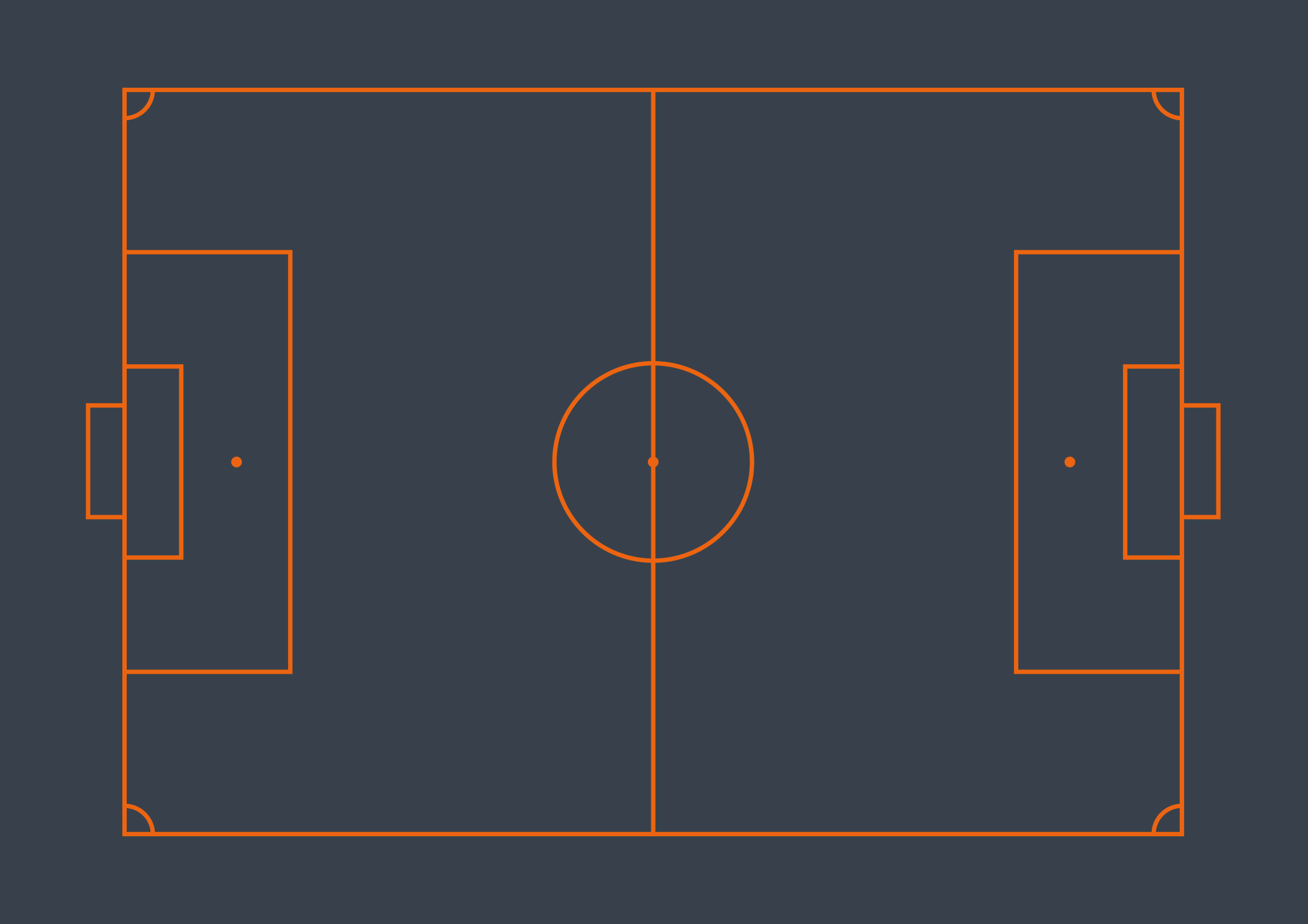 164581038187112225274515211620339427
13/3
SHOTS / ON TARGET
16/7
45%
POSSESSION
55%
34
ATTACKS INTO AREA
22
1.01
EXPECTED GOALS (XG)
2.32
Stretching Liverpool’s centre-backs
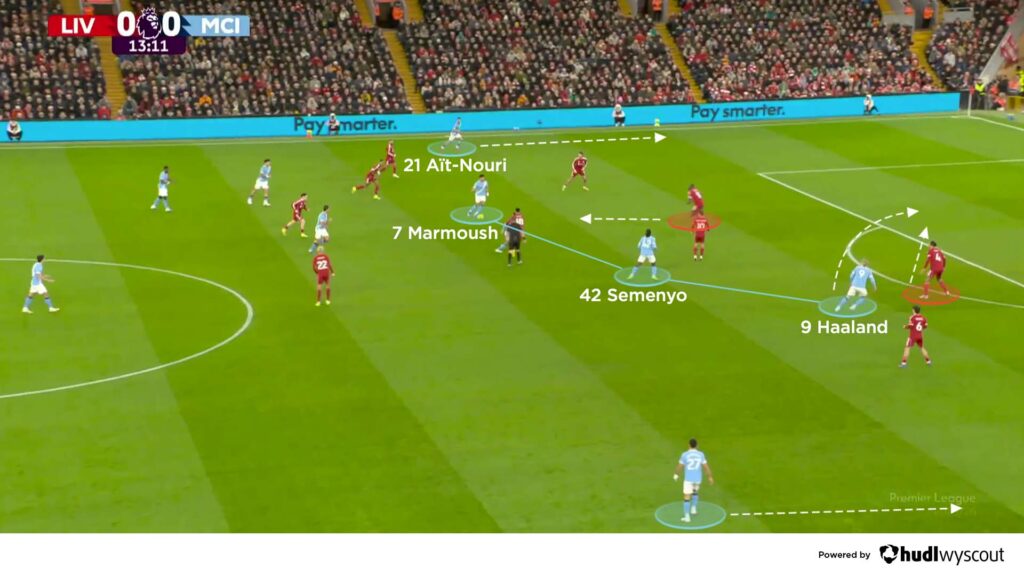
Manchester City started the game well, with their narrow front three working well together between Liverpool’s lines. The home side’s centre-backs were often pulled and stretched – one into midfield and the other tracking runs beyond – as City got in behind Liverpool’s back line numerous times in the first half, albeit without punishing the Reds. City’s full-backs, meanwhile, provided width with their late runs – Rayan Aït-Nouri in particular put in good crosses from the left (below).
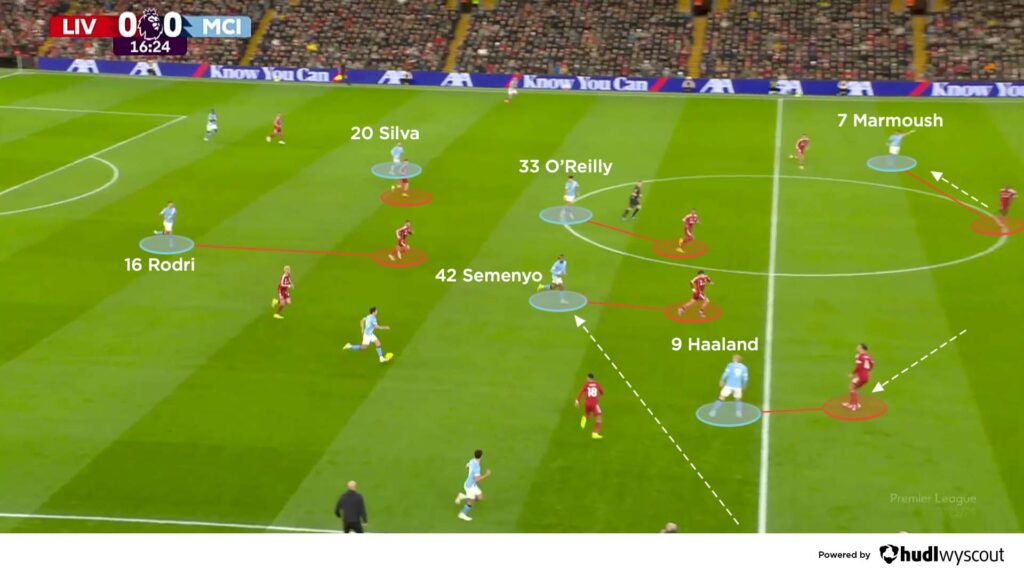
At times City’s deeper build lacked conviction, which Antoine Semenyo improved by dropping into midfield. As such, City’s 4-3-3 became a 4-2-2-2 to deal with Liverpool’s press, with Semenyo closely followed all the way into midfield by Milos Kerkez (below). Having a fourth central presence against Liverpool’s player-oriented press gave City more central passing options to bounce around Liverpool’s higher pressing players. They also found simpler access into Haaland and Omar Marmoush, who could attack Liverpool’s stretched centre-back pairing. Here, Haaland in particular did well to maintain forward momentum from these passes.
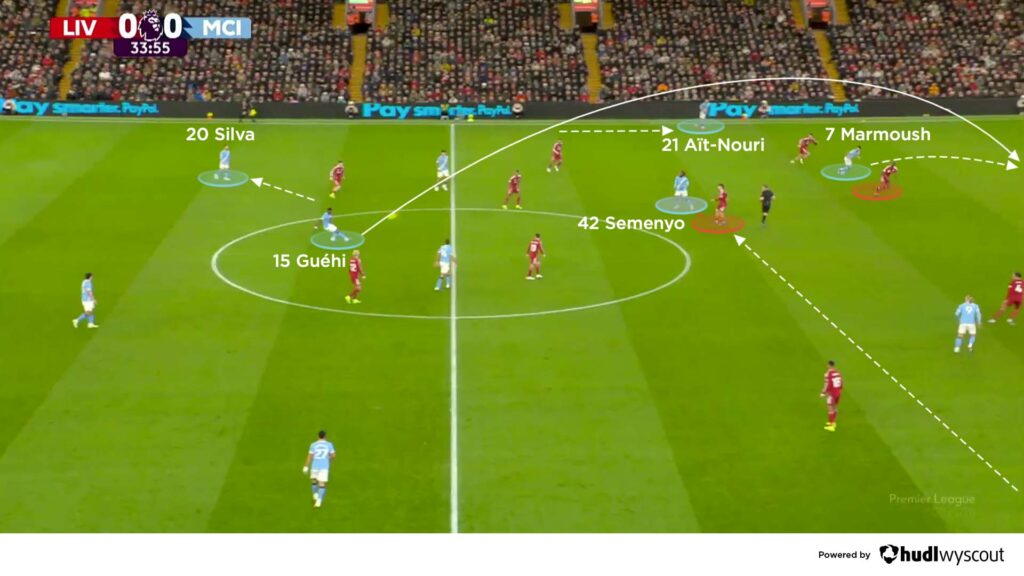
Semenyo continued to drop deep and central throughout the first half, with Kerkez likewise following him all the way. City’s midfield then adapted and moved away from the central congestion, with Silva often finding space to receive and maintain his team’s passing rhythm. Marc Guéhi also played some dangerous longer passes, mostly targeting the space beyond Ibrahima Konaté for Marmoush to run on to, with Aït-Nouri providing support from left-back (below).
City’s pressing trap
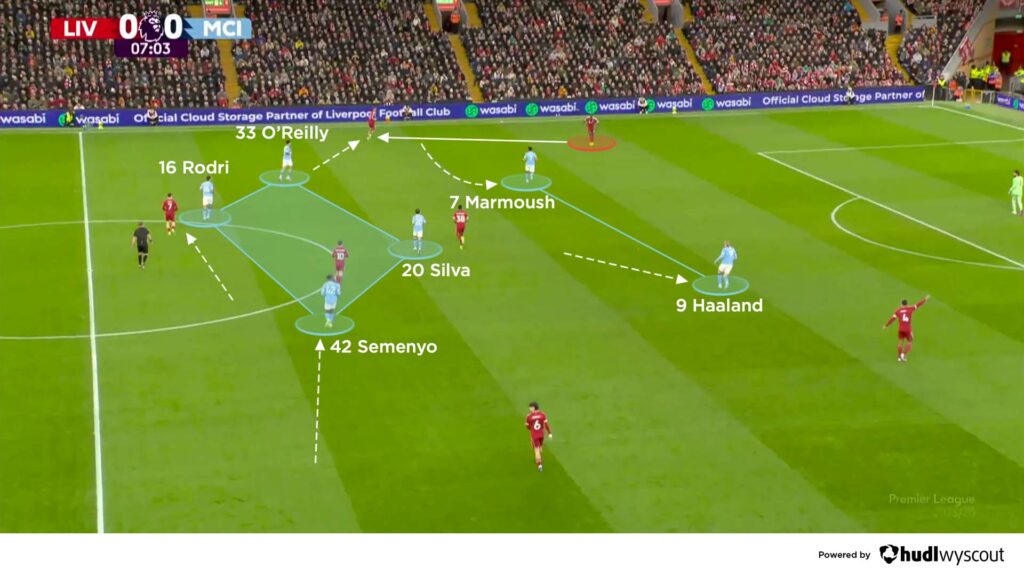
City’s effective use of a 4-4-2 diamond to press high against Liverpool’s deeper build involved Haaland positioned to his right, encouraging passes to Konaté. Marmoush then joined Haaland in the first line, stopping the ball from being played through the centre, allowing it to go wide if needed. From here, Nico O’Reilly would then jump out to press any wide passes, with the rest of the City unit shifting across to keep a 3v3. Semenyo supported this, leaving Kerkez free, but ensuring City still had three players defending in central midfield, as O’Reilly jumped wide (below).
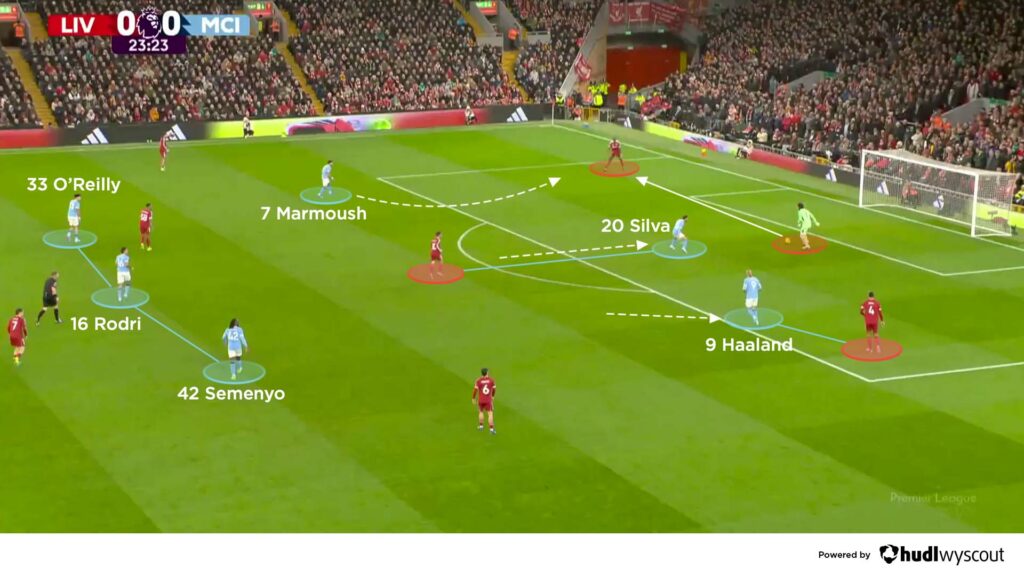
In some moments Silva left midfield and his direct opponent to initiate City’s press. Liverpool failed to find their spare player in these instances, with City still looking to funnel the ball to Konaté. Haaland stayed closer to Virgil van Dijk, while Marmoush started slightly deeper before jumping to press (below). As a result, not only did City limit most of Liverpool’s deeper build-up; they also got some high regains to then attack a spread back line.
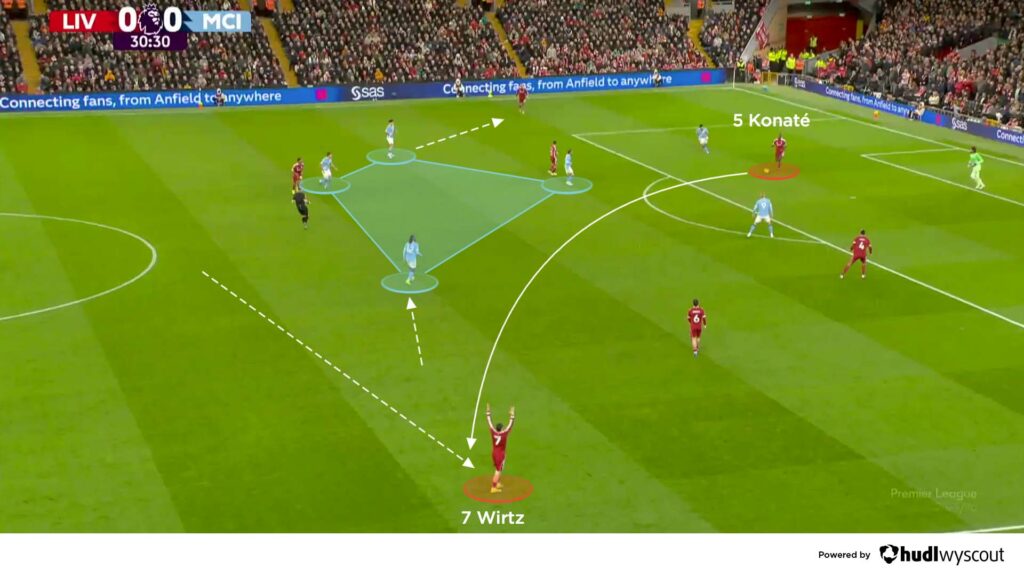
In response, Liverpool stretched their midfield unit as much as possible. This involved Florian Wirtz moving wide left for the home side, to take advantage of Semenyo’s narrow defensive position. Liverpool could then switch from right to left, away from City’s attempted pressing trap, to link with their high and wide front three, who had been relatively starved of service in the first half. This, however, often involved a challenging pass out to Wirtz (below), while up against constant City high pressure.
Liverpool’s solutions
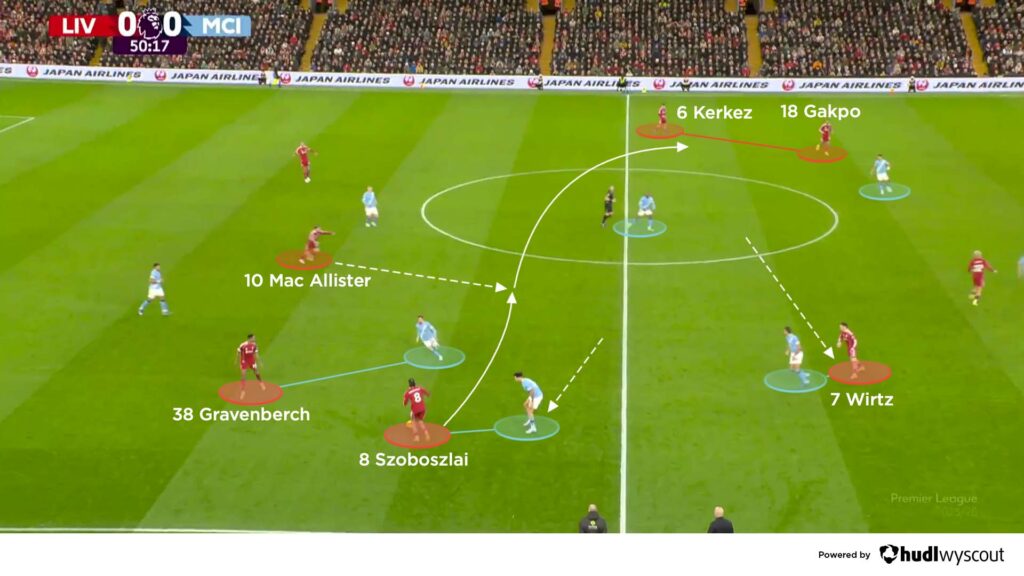
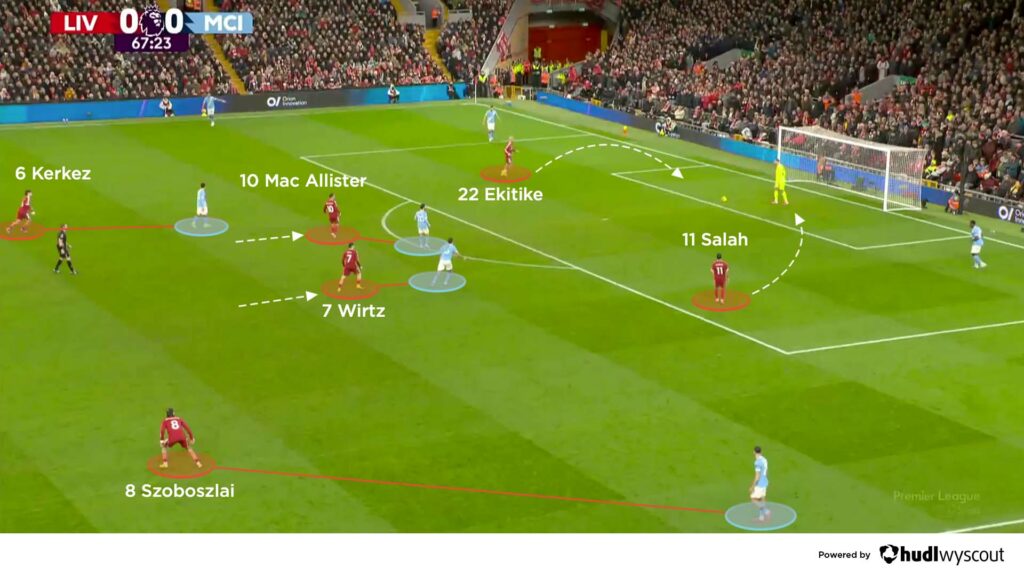
In the second half, Wirtz moved across to Liverpool’s right, adding support between Szoboszlai – still pressed by O’Reilly – and Mohamed Salah. Here, he drew Rodri’s attention, stopping him from working with Silva to cover Liverpool’s now much deeper midfielders, Ryan Gravenberch and Mac Allister. Semenyo’s defensive role became almost redundant due to Wirtz’s new positioning, with the City player unlikely to come all the way over to Liverpool’s right. Liverpool duly worked the ball to that side, to then switch to the free Kerkez on the other side to attack with Gakpo, often 2v1 against Nunes (below).
Aït-Nouri then began to jump on City’s left side to support O’Reilly and City’s increasingly disorganised midfield, leaving them with just three at the back. Liverpool played back inside to switch, continuing to find Kerkez, with Gakpo narrowing earlier to lock on to Nunes and free the raiding left-back. Liverpool’s left-sided players weren’t always on the same wavelength, though, with some mismatched final-third decision-making. The home team’s best play came in transition, with direct access into their front line.
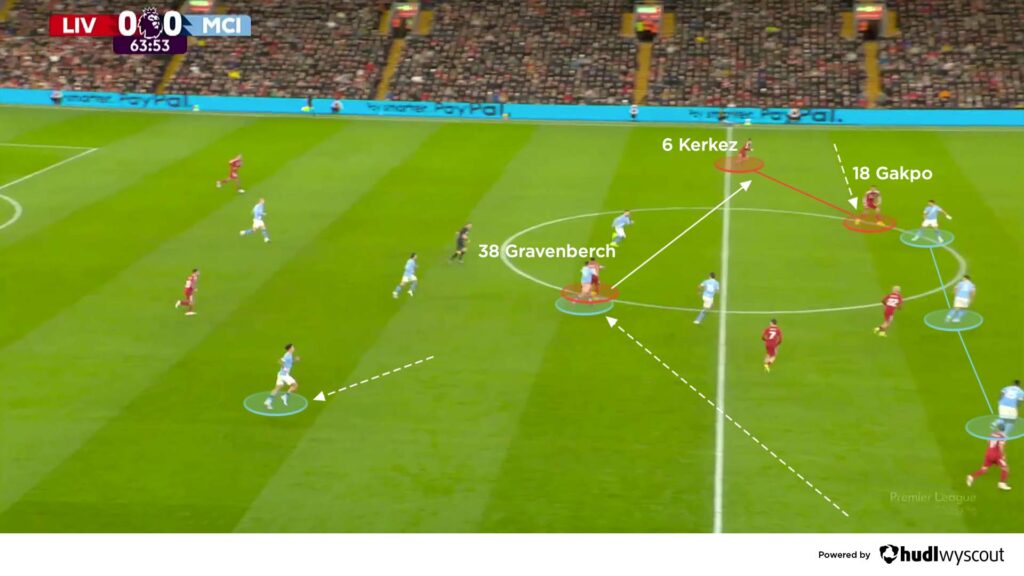
Liverpool also managed to disrupt City’s deeper build in the second half. Their forwards pressed much more aggressively, forcing Donnarumma to kick longer. Salah joined Hugo Ekitike pressing from out to in, curving to block access to City’s centre-backs. Liverpool’s midfield remained player-oriented, working tight on to City’s double pivot to limit bounce passes out wide, with Kerkez continuing to follow City’s narrowing right midfielder – now Cherki. Makeshift right-back Szoboszlai, in turn, readied to commit on to Aït-Nouri, with City’s resulting long passes posing no real threat.
And yet, despite taking the lead through Szoboszlai’s magnificent free-kick, Liverpool dropped points in added time for a sixth time this season. It was the fourth game in which they have conceded a winning goal from the 90th minute onwards in this campaign already – the joint-most in the Premier League era, along with Watford in 2017/18, West Ham in 2021/22, Watford again in 2021/22, and Southampton in 2024/25. For City, their hope will be that this victory acts as a turning point in another title charge, rather than simply another example of this Liverpool team’s tendency to collapse.
To learn more about football tactics and gain insights from coaches at the top of the game, visit CV Academy