PREMIER League, MAY 3 2026
Cunha (6)
Šeško (14)
Mainoo (77)
Szoboszlai (47)
Gakpo (56)
Kobbie Mainoo swept home the winning goal for Manchester United as they secured a return to the Champions League with victory over their greatest rivals. United had raced into a two-goal lead after only 14 minutes and looked set to romp to victory against a Liverpool side also chasing Champions League qualification. The game flipped on its head in the opening minutes of the second half, however, as the visitors – playing without a recognised striker due to injuries – levelled matters and pushed for a third. Instead, it was Mainoo who swung the game back in United’s favour, guaranteeing a return to the top tier of European competition next season.
How the managers saw it
“We thought, players available-wise, that they would try to overload the midfield and it would be a challenge for us to close the spaces in the middle of the pitch,” said Michael Carrick. “We have some really dangerous, dangerous forwards, but we’re asking them to do a lot of work without the ball as well and that’s part of being a good team. So the way we closed that space and made it difficult for them – they’ve got some fantastic players and they made it difficult for us – but I thought the way we stuck at that, especially, really pleased me a lot.”
“It wasn’t necessary to be 2-0 down and it wasn’t necessary to lose this game today,” said Arne Slot. “The first one we concede [from] a set-piece and the second one we played through the middle where their players are sharp in the duels and a quick counter-attack led to the 2-0. I did see us in the first half coming into good positions but that did not lead to anything. Well, a few shots but nothing serious, and I said if we can combine coming into these positions with a bit more intent in arriving in the box – that’s why I changed and put Cody [Gakpo] in a number nine position – then we are able to do more than only having ball possession, and that’s what happened in the second half.”
 3123265237181081930281754263038101887
18/6
SHOTS / ON TARGET
11/4
36%
POSSESSION
64%
24
ATTACKS INTO AREA
22
3.14
EXPECTED GOALS (XG)
1.1
United’s right side
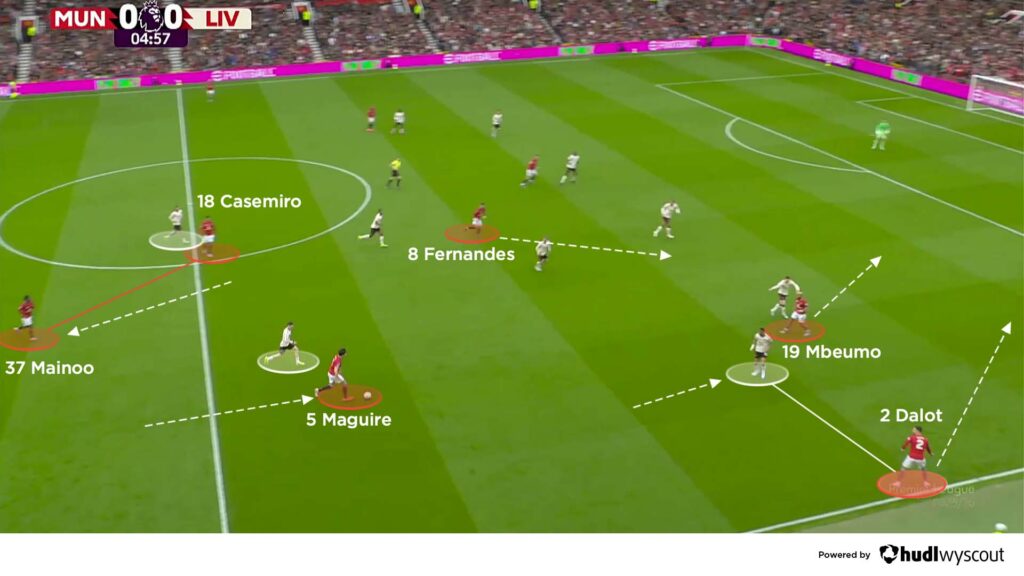
From Manchester United’s 4-2-3-1 shape, Mainoo or Casemiro dropped back to help their centre-backs widen and step into midfield with the ball. Harry Maguire, especially, worked around Liverpool’s first line of Florian Wirtz and Dominik Szoboszlai, allowing Diogo Dalot to move forward earlier from right-back. The Portuguese in turn dragged Gakpo back, nullifying much of the Dutch attacker’s counter-attacking potential on Liverpool’s left. United also had clever movements on their right that Bruno Fernandes occasionally supported (below), from which they worked good entries into the final third, as they started the game on the front foot.
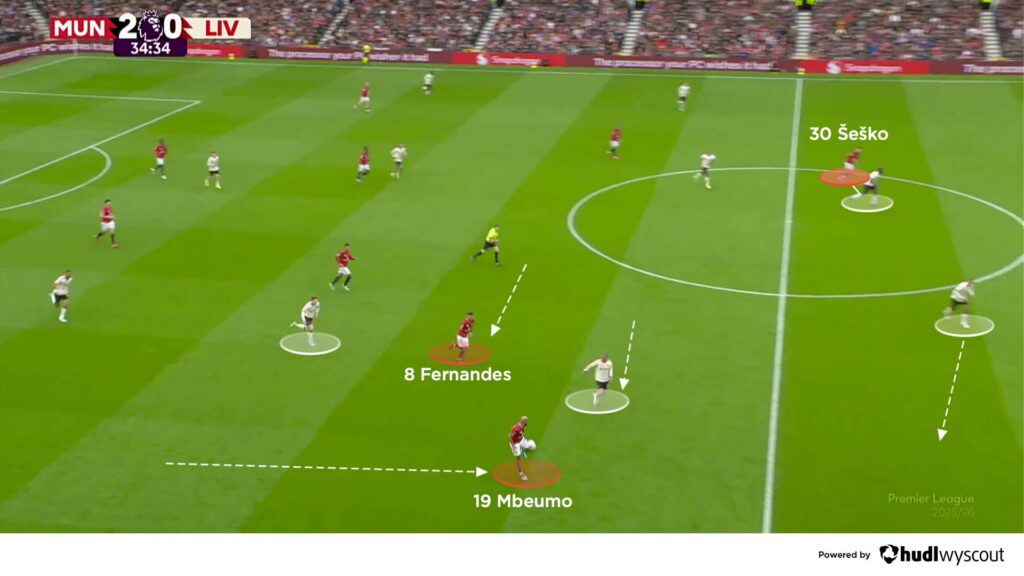
Matheus Cunha opened the scoring with a deflected effort past Liverpool’s third-choice goalkeeper, Freddie Woodman, before Benjamin Šeško scored a controversial second when the ball rebounded off him, including a suspicion of handball. United then sat deep to defend against a Liverpool team without a recognised striker, but with the players to control possession, while the home side were dangerous by counter-attacking mostly via their right side. Bruno Fernandes’ forward passing helped unlock spaces in behind, particularly when Liverpool left-back Andy Robertson was high up the pitch. Virgil van Dijk was then dragged across from his centre-back space, allowing Šeško to isolate Ibrahima Konaté 1v1 in much larger spaces (below). Alexis Mac Allister, meanwhile, attempted to cover across from midfield as Liverpool were forced to react and recover against United’s direct and purposeful counter-attacks.
Liverpool’s central numbers
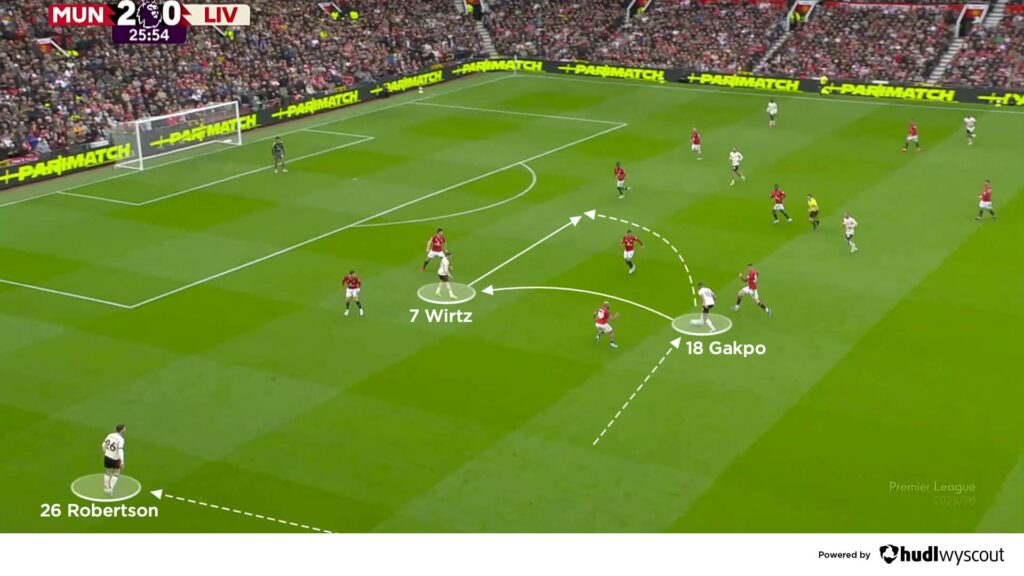
From an initial 4-4-2 when Liverpool were defending, Gakpo moved inside from the left when his team won the ball – especially during their sustained periods of possession just inside United’s half. Carrick’s team defended deep for lengthy periods, especially after their second goal, often with all 11 players well inside their own half. For Liverpool, Gakpo connected well with Wirtz between the lines, with Szoboszlai supporting mostly in Liverpool’s right inside channel. Ryan Gravenberch and Mac Allister acted as the main links between Liverpool’s high back line and their central teammates between United’s lines (below), looking to penetrate through United’s compact block. Robertson and Jeremie Frimpong provided attacking width when needed.
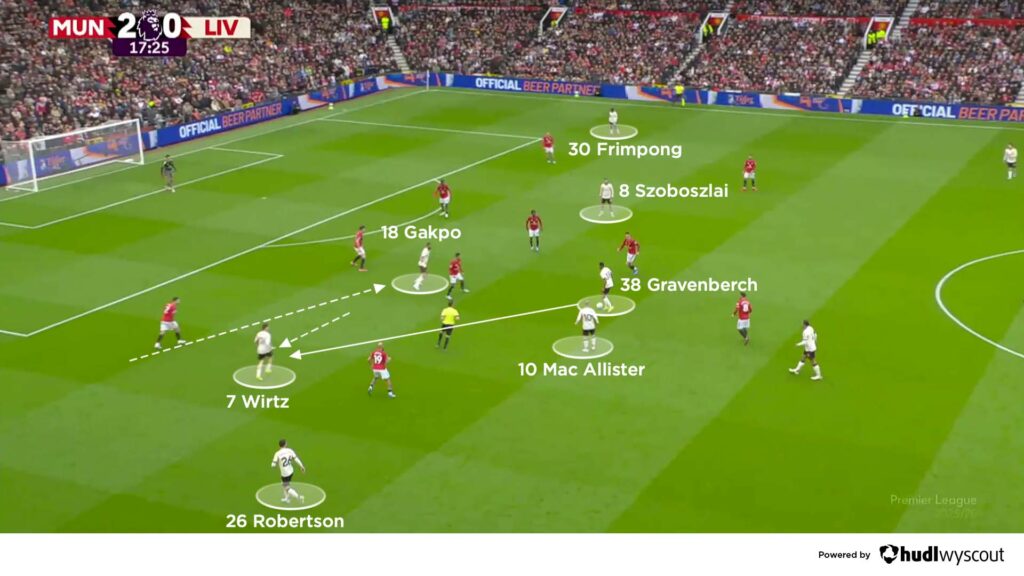
Although Gakpo and Wirtz continued to probe and act as Liverpool’s most influential attackers via their inside-channel combinations on the left, Slot’s team lacked the presence to threaten around United’s back line. Few runs beyond and too many bodies underneath the ball meant that Liverpool struggled to create, despite often working the ball into the final third. Indeed, aside from shots from the edge of the box from Gakpo and Wirtz, they carried little threat. And while Robertson getting high and wide on the left encouraged Gakpo to move centrally and combine with Wirtz (below), it also created that space for United to target on the counter.
Liverpool exploiting central spaces
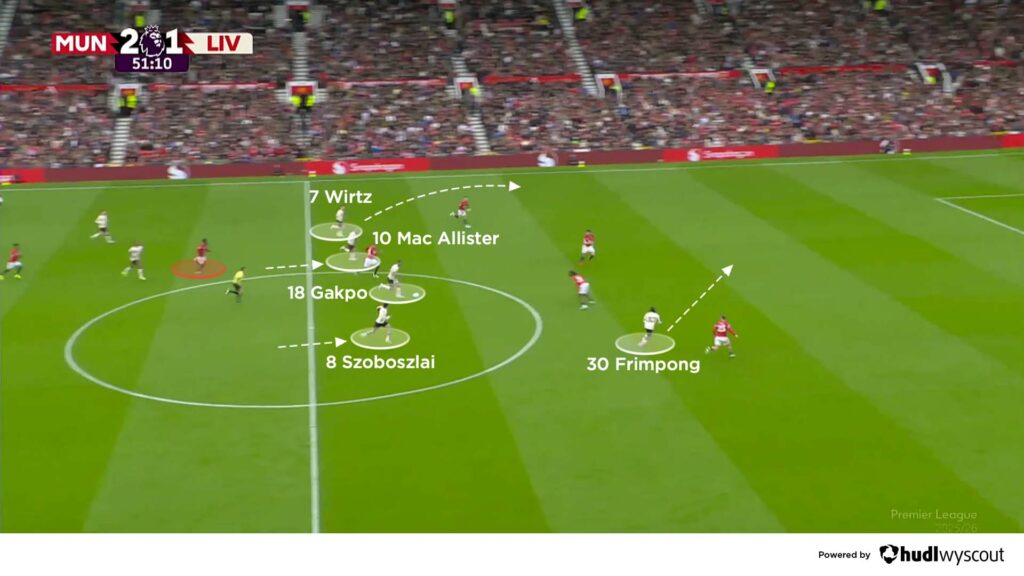
The game flipped almost immediately after the break, with Liverpool becoming a significant counter-attacking threat. Gakpo moved through the middle, while Wirtz attacked from the left – a change by Slot that helped his attack link with the midfield much more purposefully. Szoboszlai and Mac Allister as number eights provided inside channel runs, while Frimpong also made more runs beyond Luke Shaw to threaten in behind, pushing United’s back line deeper (below). Finding more space in midfield, Liverpool took control and levelled the score by punishing two poor United passes.
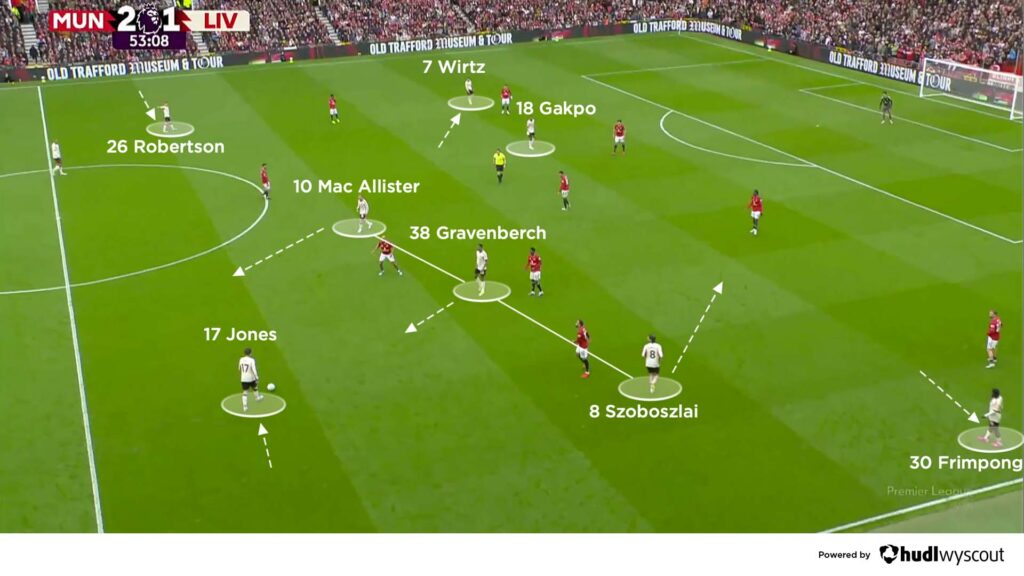
Liverpool also gained much better control via their midfield, who operated as a more traditional trio after the break, working much closer together. Opposite movements helped them to control possession and link with a front three that had width and threatened between the lines and in spaces beyond. The midfield’s movements also helped secure possession to limit most of the United counter-attacking that had caused so many problems in the first half. Full-backs Curtis Jones and Robertson were narrower (below), connecting more with the midfield and better positioned to limit United’s transitions when the home side regained the ball.
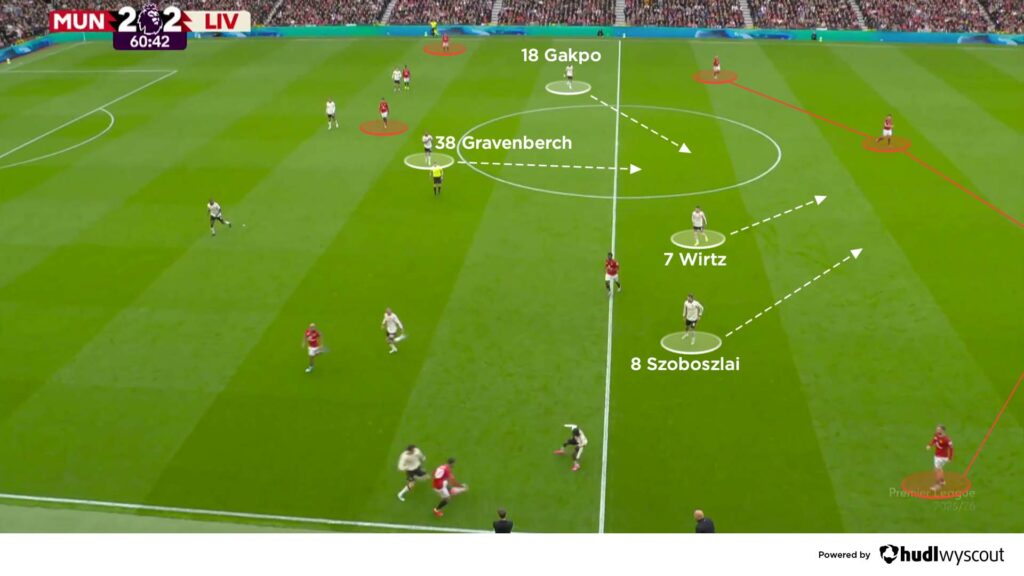
Carrick, meanwhile, had changed United’s attacking shape for the second half, with Amad Diallo on as a right winger for Šeško at the break – Cunha or Bryan Mbeumo filled Šeško’s central forward role. But United lost much of their attacking potency with this change, especially in the centre; Fernandes was sometimes pulled wide and had little impact on United’s attacking play. One of Casemiro and Mainoo got forward, sometimes becoming United’s highest central attacking player, rather than dropping deeper to support the back line build and be ready to defend the counter, as they had done in the first half. United had no rotations to complement these runs, meaning Liverpool had easy access to counter-attack into central spaces (below), leaving United’s retreating back line open and overwhelmed. Fortunately for United, Mainoo had his shooting boots on; after retaking the lead, the hosts regrouped to defend deep and see out an important win.
The victory gave United their first Premier League double over Liverpool in 10 years, and was the latest in a string of impressive results Carrick has achieved as head coach, including wins against Manchester City and Arsenal. When he took over as interim head coach in early January, United were sixth in the table, 11 points behind third-placed Aston Villa and three behind reigning champions Liverpool. With this result they cemented their grip on third, moving six clear of the visitors and confirming a return to Europe’s top table. The question now is whether Carrick will get the chance to lead them into the Champions League. For Liverpool, there is still work to do to ensure they join United there next season.
To learn more about football tactics and gain insights from coaches at the top of the game, visit Coaches’ Voice Academy