PREMIER League, AUGUST 24 2026
Elanga (5)
Willock (57)
Gakpo (52)
Szoboszlai (90+9 pen)
Nearly 53,000 people paid their respects to the late, great Kevin Keegan before kick-off at St James’ Park. Meanwhile, new managerial eras were beginning for two of the clubs he served so memorably. And given Keegan’s reputation for thrilling football, the game fittingly began and ended with goals, while having a burst of scoring in between.
Matthias Jaissle did not have to wait long to see Newcastle score the first goal of his tenure, as Anthony Elanga’s pace and cool finish punished Liverpool. The visitors hit back with their first goal under Andoni Iraola, but Cody Gakpo’s long-range strike levelled matters for just a few minutes; Joe Willock applied the finish as Newcastle hit Liverpool on the break again. With Jaissle’s team moments from a morale-boosting three points, Lewis Hall fouled Liverpool substitute Víctor Muñoz in the box. Dominik Szoboszlai duly stepped up to rescue a point for the visitors, deep into added time.
How the managers saw it
“There was a lot of what we want to see,” said Jaissle. “We’re really proud after a short amount of time, to see the lads as a unit on the pitch, really committed to what they are doing.”
“The first half we haven’t finished the things,” said Iraola. “We’ve had a lot of balls on the edge of the box, inside the box, where we haven’t finished the play, we haven’t shot. Actually, they punished us in the first goal because we don’t finish it and it’s a clear chance. Second half we’ve been more decisive – the goal from Cody, but also we put a lot more pressure [on], we create more set-plays, more crosses, more things inside the box.”
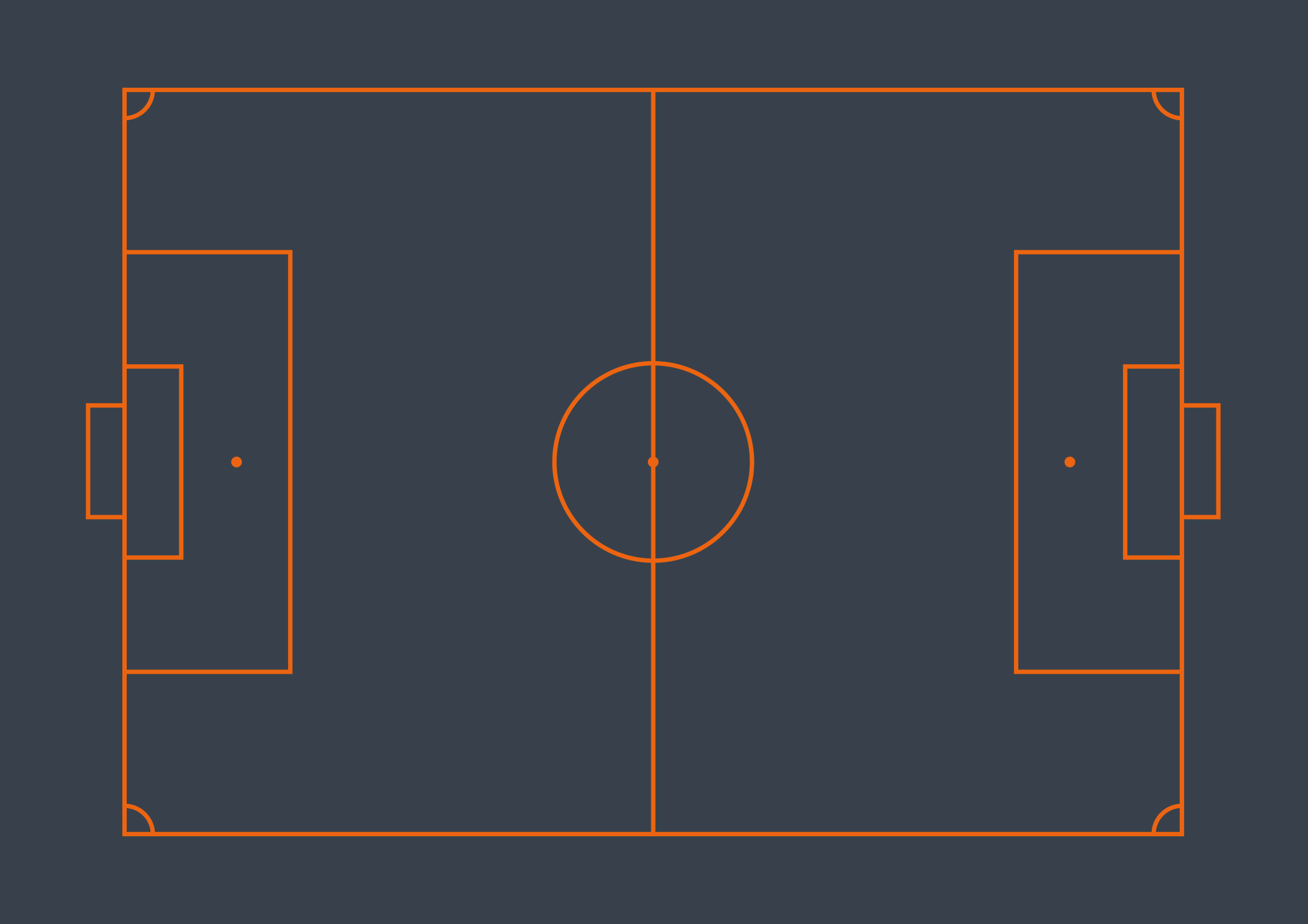 2134123767141191910130546838737189
12/4
SHOTS / ON TARGET
27/7
42%
POSSESSION
58%
13
ATTACKS INTO AREA
37
1.18
EXPECTED GOALS (XG)
3.69
Newcastle’s quick transitions
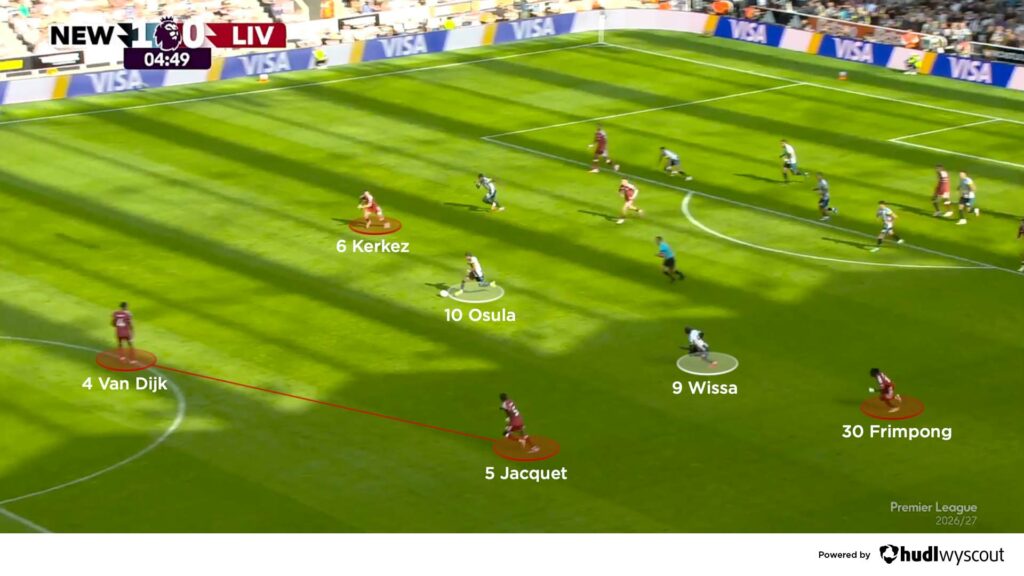
Newcastle started the game quickly, exploiting their speed in attacking transition to take advantage of Liverpool’s insecure rest defence structure. Liverpool’s Ryan Gravenberch vacated his central-midfield position to drive forwards and had a pass intercepted when he tried to combine inside. As a result, Will Osula and Yoane Wissa had been left inside Liverpool’s open and vulnerable rest defence structure (below). Virgil van Dijk and Jérémy Jacquet failed to step up and take aggressive central positions to restrict the available space. Meanwhile, Milos Kerkez and Jeremie Frimpong were in attacking positions that were too wide to impact either Newcastle player.
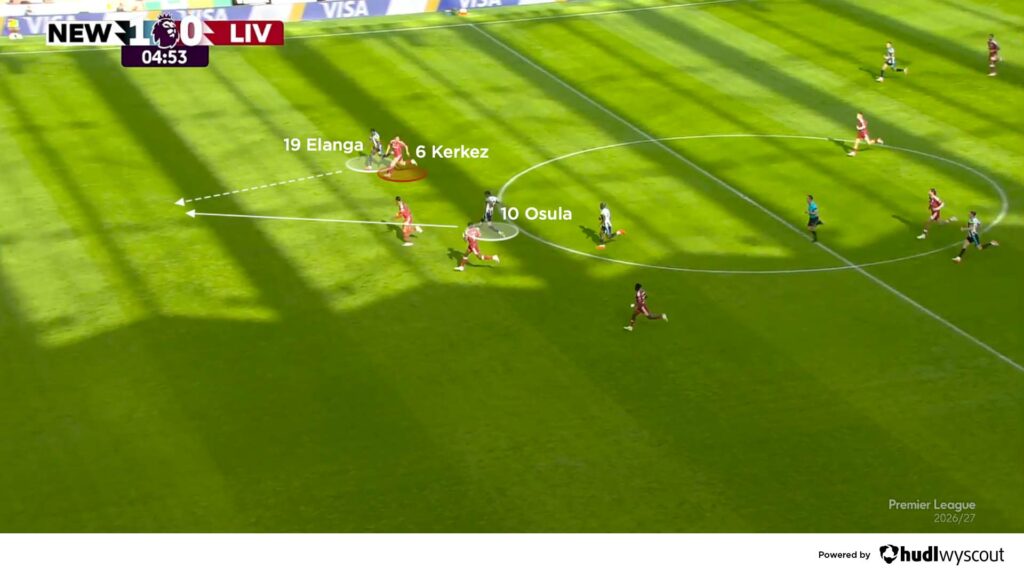
Osula had space to receive and face forwards, driving at Liverpool’s centre-back pairing. Van Dijk and Jacquet had no option but to drop and try to delay the counter-attack. Anthony Elanga then had space to exploit in behind Kerkez, and used his explosive acceleration to receive in behind Liverpool’s back line (below), before calmly slotting home. Newcastle’s threat in behind Liverpool’s defensive line continued throughout the first half, with more sustained possession as well as transitions. Osula regularly made intelligent runs off the back shoulder of the ball-side centre-back, while Wissa played numerous disguised passes through the lines, in a standout performance.
Liverpool’s build-up and progression
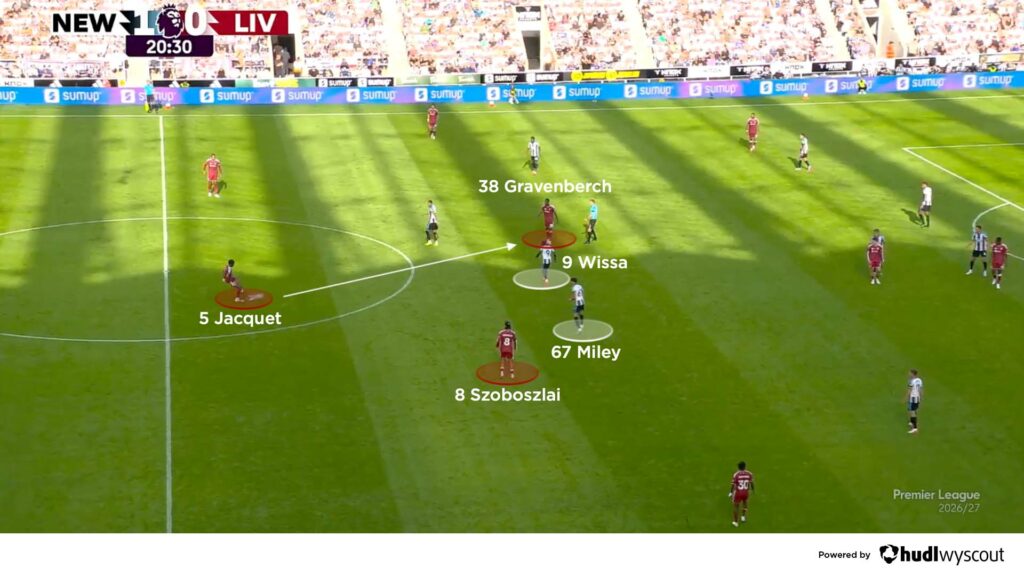
In possession, Liverpool found success in the early stages of the game by playing through Newcastle’s structure – particularly when Osula and Wissa were disconnected as Newcastle’s first pressing line. In these scenarios, while Wissa tried to front-screen Gravenberch in between pressing moments, the Dutch midfielder moved outside of Wissa’s cover shadow and had space to drift either side to receive and play forwards. Liverpool debutant Jacquet, meanwhile, broke lines with perfectly weighted and accurate passes. In Liverpool’s build-up phase, Szoboszlai mostly operated in a slightly more advanced role alongside Gravenberch in central midfield. At times Szoboszlai did drop deeper (below) to try to draw Lewis Miley out from a central position. In doing so, he either created space for a drifting Florian Wirtz to receive with lateral movements across Newcastle’s structure, or found and combined with dropping striker Alexander Isak.
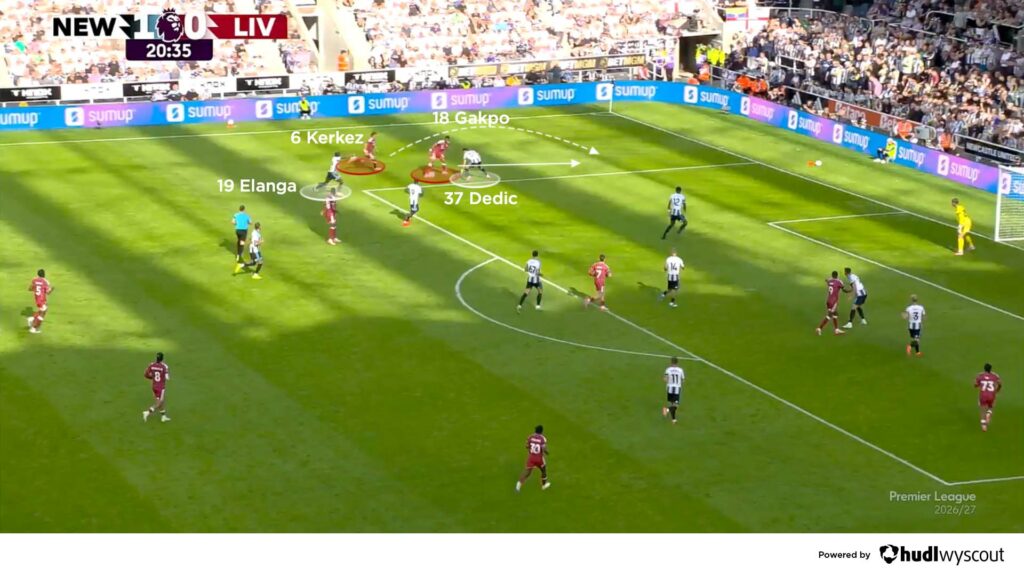
Liverpool often looked to create in wide areas when they had penetrated into the final third. Both full-backs took up attacking positions to support and create overloads against Newcastle’s full-backs. In the example below, Gravenberch had travelled to break the midfield line and found Gakpo. Kerkez overlapped ahead of the recovering Elanga to create a 2v1 against Amar Dedic. Gakpo then drove inside to create the space to release into Kerkez’s path to cross into the box.
Exploiting Newcastle’s midfield structure
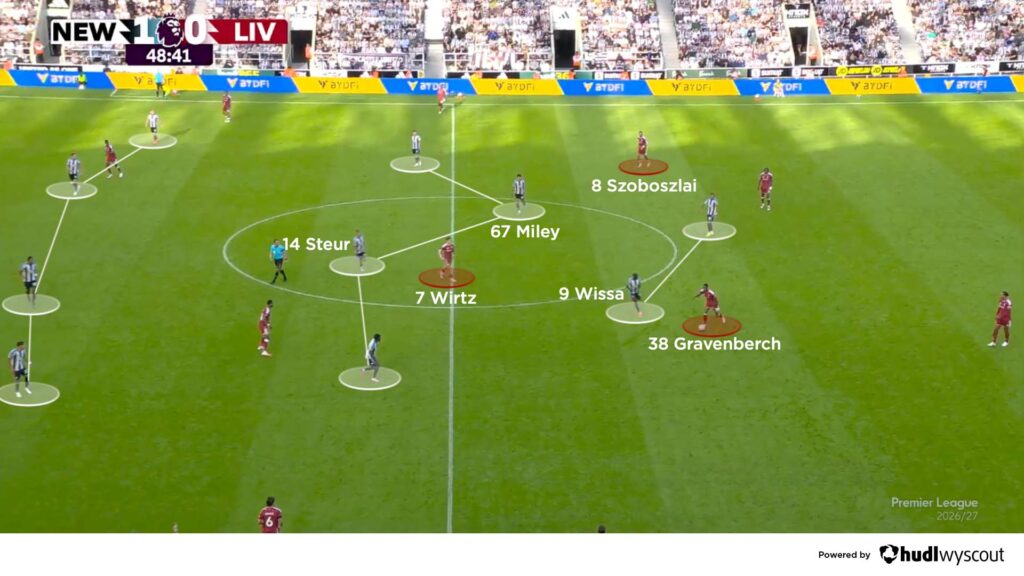
Out of possession, Newcastle operated in a 4-4-1-1 block. However, within this they operated with a significant amount of player-oriented marking. When Liverpool built their attacks, Wissa man-marked Gravenberch, Sean Steur marked Wirtz, and Miley took Szoboszlai. This was perhaps an early indication of how Jaissle will set Newcastle up to restrict the creativity of opposition players – especially against the stronger teams. Newcastle’s approach allowed them to maintain a secure defensive line and maintain an overload as much as possible. At the same time, they retained a compact structure (below) that Liverpool were challenged to break down.
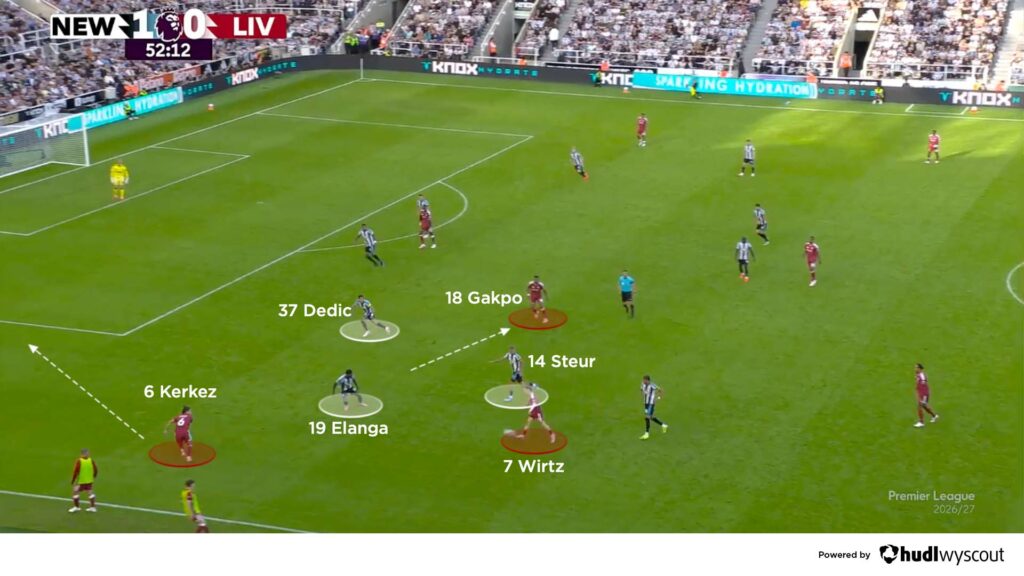
Liverpool became more intentional in their fluidity and rotations as the game progressed. They manipulated Newcastle’s player-oriented marking to create space to exploit inside the opposition structure. In the example below, Wirtz drifted wider to attract Steur on one side, while Szoboszlai (out of picture) drew Miley out on the opposite side. With vacated spaces inside the pitch, Gakpo moved inside from the left. Liverpool then had opportunities to exploit space through the advancing Kerkez on the outside when Elanga was attracted to the ball-player, but also on the inside when Dedic was reluctant to track Gakpo fully. These lateral movements increasingly disrupted Newcastle’s organised defensive structure. Indeed, they were integral to the separation between Steur, Miley and Wissa that allowed Gakpo space to receive and shoot for the equaliser.
In the end, both teams and head coaches were left with positives to take away from the game, while having plenty to ponder on how they can improve as the season progresses. But if either Jaissle or Iraola can achieve half of what Kevin Keegan did at Newcastle and Liverpool, they will have done an outstanding job.
To learn more about football tactics and gain insights from coaches at the top of the game, visit Coaches’ Voice Academy