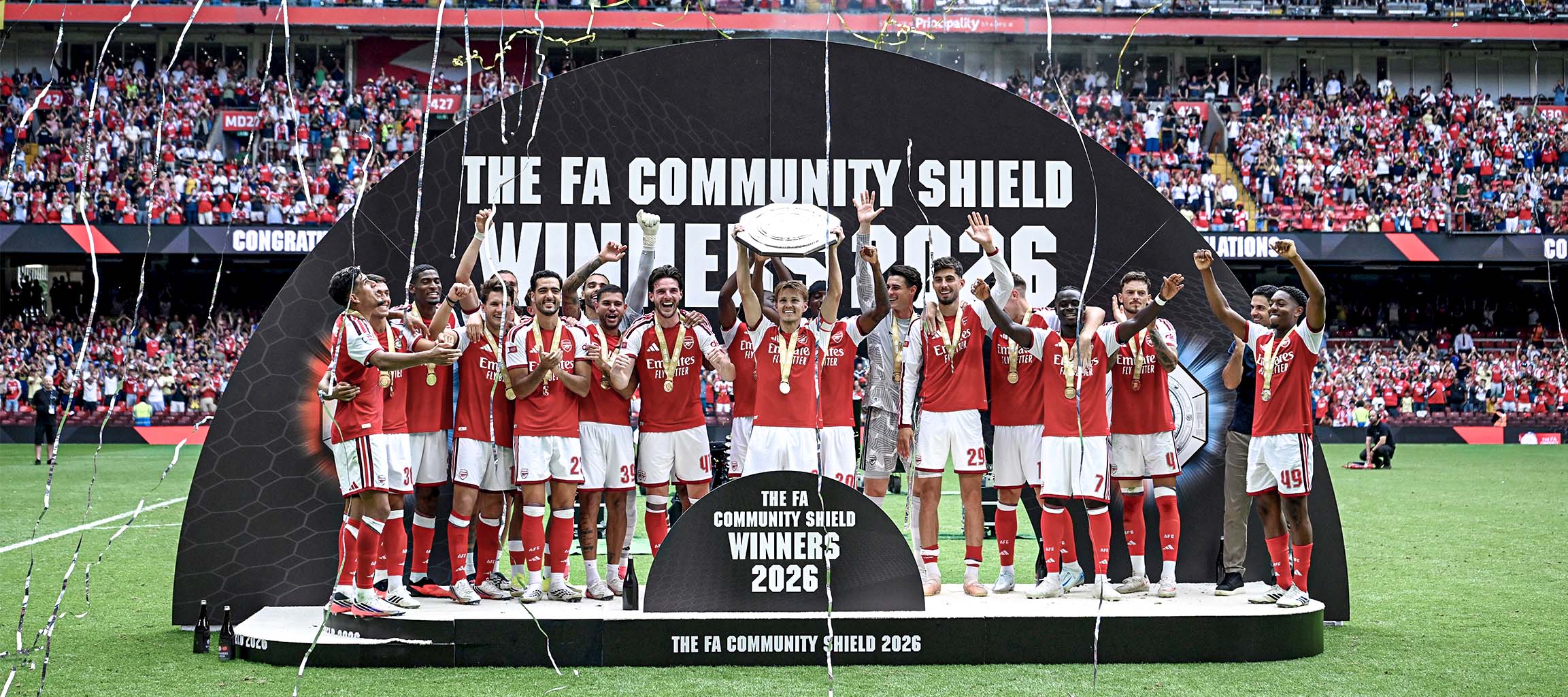

COMMUNITY SHIELD, AUGUST 16 2026
Calafiori (1)
Havertz (28)
Ødegaard (48)
Premier League champions Arsenal sauntered to victory against FA Cup holders Manchester City in this traditional curtain-raiser for English football’s new season. The Gunners took the lead through Riccardo Calafiori with barely 20 seconds on the clock, and were two to the good before the half-hour mark, thanks to Kai Havertz. Mikel Arteta’s side then effectively killed the game when captain Martin Ødegaard broke into the box just after half-time to calmly stroke home the third.
It was a less than ideal start to life as Pep Guardiola’s successor for new City head coach Enzo Maresca, while Mikel Arteta was delighted – if not lulled into a false sense of security – by the result in Cardiff.
How the managers saw it
“I'm obviously extremely happy with the performance, the result and winning the first trophy,” said Arteta. “The way the team tracks back is just unbelievable, especially when fitness-wise you are not there, so you have to get there in a different way. When you put your soul and your heart into a reaction, that's what happens.”
“A big part of the game was in the first goal we conceded,” said Maresca. “The reaction was good, before they scored the second goal we had three or four chances to score and to draw the game. Unfortunately we missed the chances and then after the second goal it became more difficult.”
Below, see the line-ups, initial formations and match statistics from the game, plus analysis from our UEFA-licensed coaches…
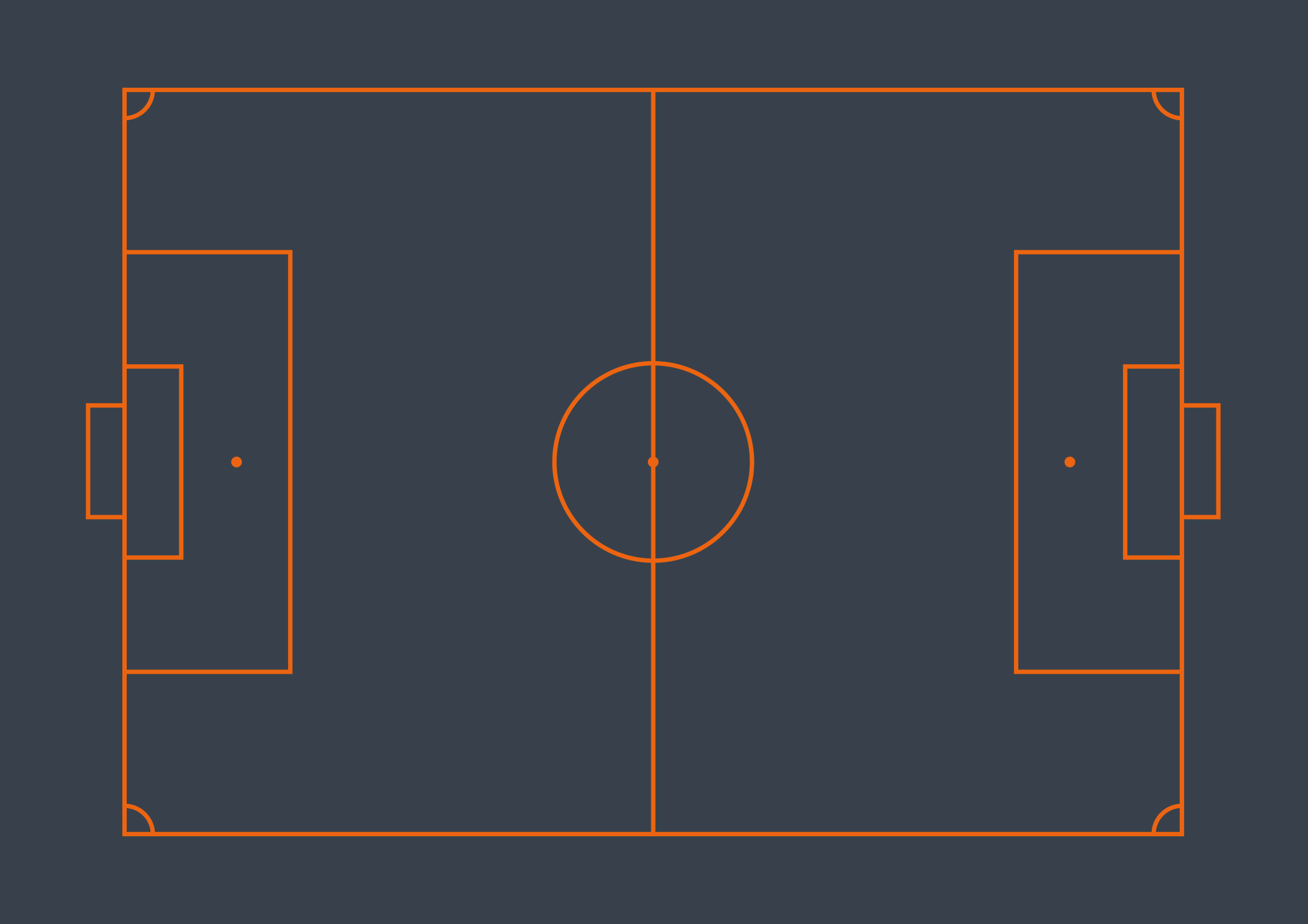 1336344939178202914532433584247119
9/5
SHOTS / ON TARGET
11/6
37%
POSSESSION
63%
22
ATTACKS INTO AREA
29
1.93
EXPECTED GOALS (XG)
1.21
Arsenal’s quick start
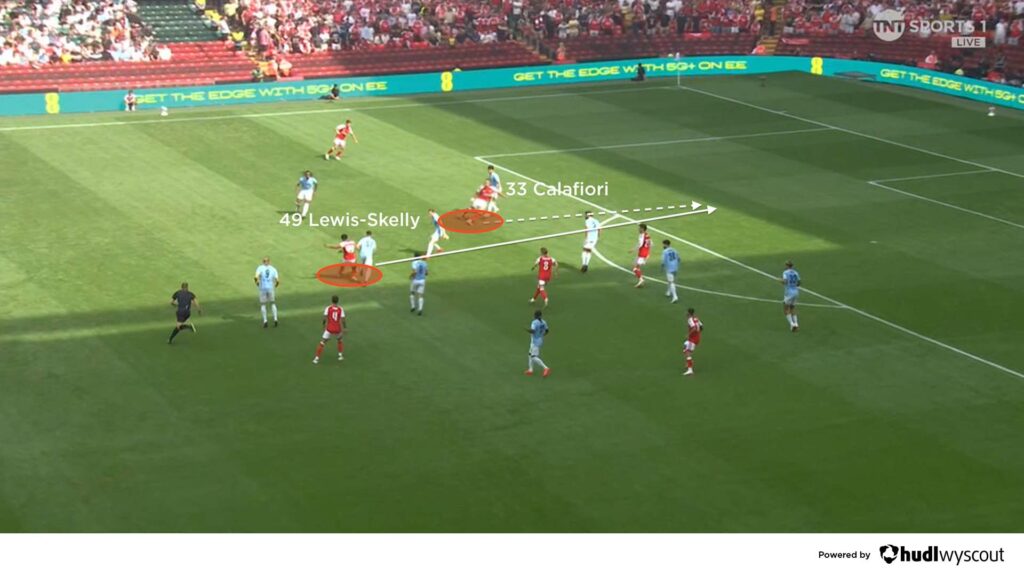
Both of Arsenal’s first-half goals highlighted some of Manchester City’s defensive frailties, with Abdukodir Khusanov a culprit on both occasions. For the opener, City’s defensive line tried to step up following the recirculation of an attack in which Riccardo Calafiori had made a run into the left half-space. Myles Lewis-Skelly (below) then slid an intelligent pass between Khusanov and Rúben Dias after receiving a pass from the right-hand side, with Calafiori making an out-to-in run across Khusanov. The City defender neither mirrored the Italian’s run nor made contact to block and disrupt the Arsenal man’s progress, allowing him to slot home past Gianluigi Donnarumma.
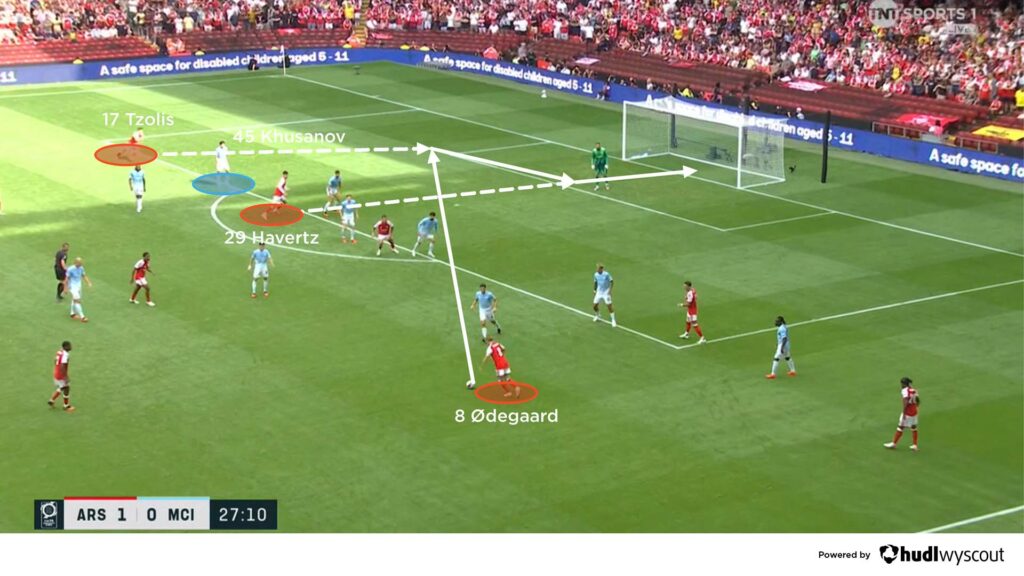
Similarly for Arsenal’s second goal, with Ødegaard in possession in the right half-space and City’s midfield line unable to apply any meaningful pressure to impact the quality of his cross, Khusanov was caught out. As the ball was delivered he was unaware of Christos Tzolis making a run in behind off his back shoulder, failing to adjust his body and anticipate the delivery to mirror Tzolis’ run (below). He was thus unable to defend the cross or make contact to disrupt Tzolis from heading back across goal. As a consequence, Arsenal’s new signing was afforded the time to head back across goal, where Havertz was behind Dias to head in.
Glimpses of Maresca’s City
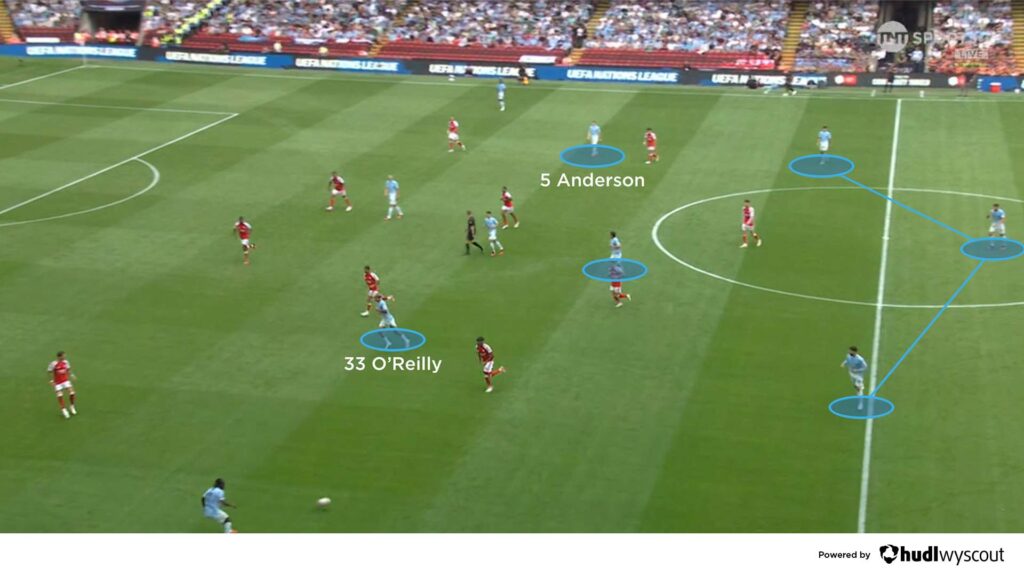
Despite the early setbacks, Maresca’s team did show glimpses of an in-possession structure that allowed them to control some passages of play in the first half, against Arsenal’s rigid and compact 4-4-2 block. As City progressed possession into the opposition half, Khusanov narrowed inside to create a base 3-1 structure alongside Dias and Josko Gvardiol, with Mateo Kovacic as a single pivot, while Nico O’Reilly advanced higher into a left attacking-midfield position. This enabled City to maintain full width with Antoine Semenyo and Jérémy Doku’s explosive pace in wide areas, while Phil Foden and Elliot Anderson (below) joined O’Reilly behind Erling Haaland.
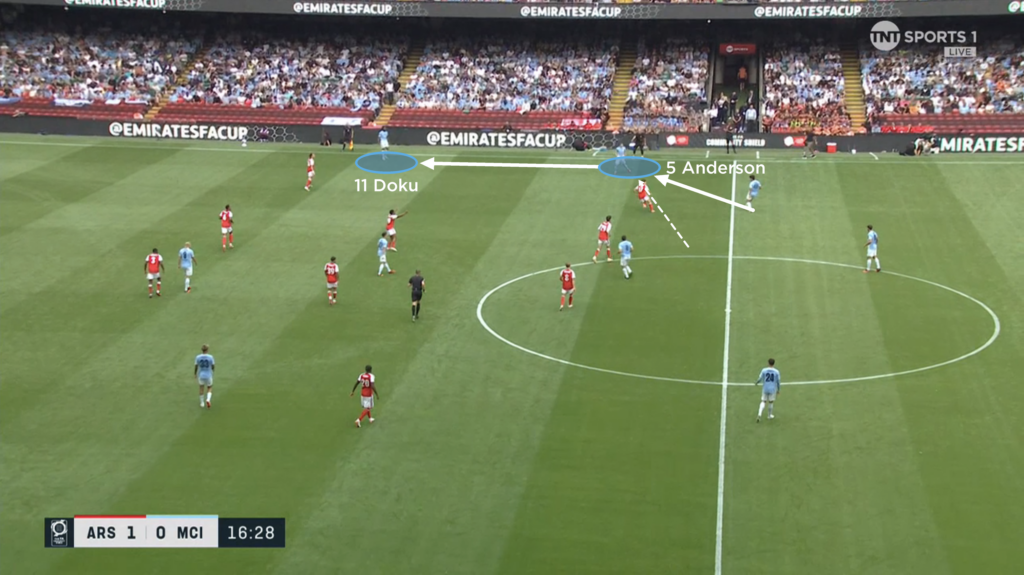
As City initially found it difficult to progress past Arsenal’s compact structure, they started to display variations in their own movements to disrupt and exploit space, to move possession into the final third. Centrally, Foden dropped down from his higher starting position behind Arsenal’s midfield line, creating the opportunity to receive when untracked and travel forwards to break lines and progress possession. In wider areas, upon City playing to the widest centre-back within their 3-1 base, one of the wide attacking midfielders, Anderson (in the example below) or O’Reilly rolled outside of Arsenal’s defensive structure to receive and progress possession outside, through combinations with Semenyo or Doku in wide areas. Doku occasionally rotated inside following this movement on the left-hand side to take up a position in the half-space, while O’Reilly maintained the width. However, despite these adaptations, City failed to penetrate beyond Arsenal’s back line, with a lack of creativity evident in these areas.
Arsenal’s ruthless attacks
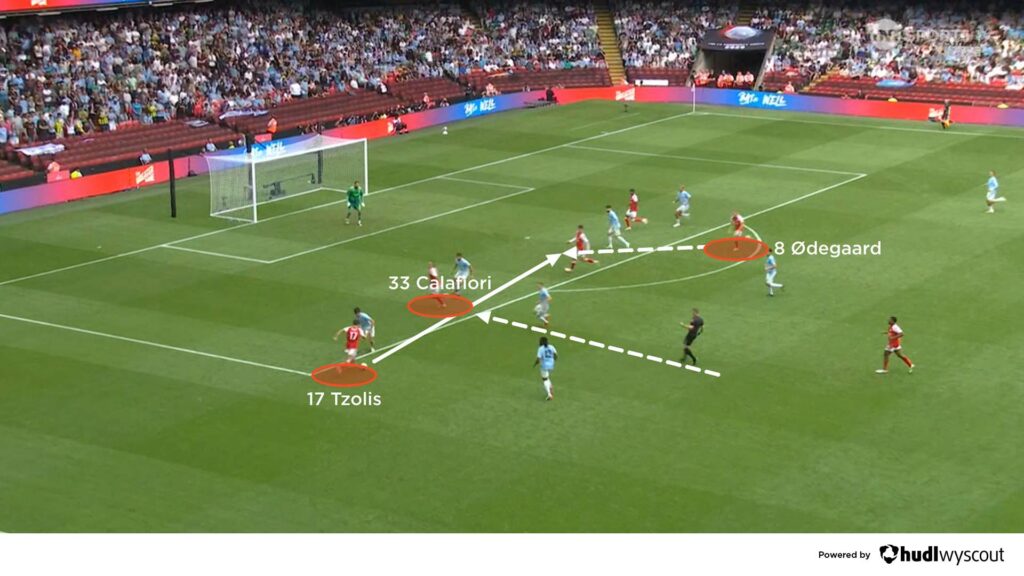
In attacking areas, Arsenal were ruthless in their exploitation of City’s back line and effectively finished the game in the early stages of the second half. The 2v1 created against Khusanov was an area that was continually exploited, while throughout the game they were consistently able to create temporary overloads through half-space runs and overloading Man City’s back line. For the third goal, Tzolis received in the widest lane and travelled inside the pitch, fixing Khusanov in the process, as Calafiori made a run from deep. With this run, Dias was attracted to the near side while Anderson as the near-side midfielder was unable to cover this run into the half-space. City’s back line was overloaded on the far side, with Havertz splitting the central defenders, Ødegaard arriving late (below) and Noni Madueke narrowing inside.
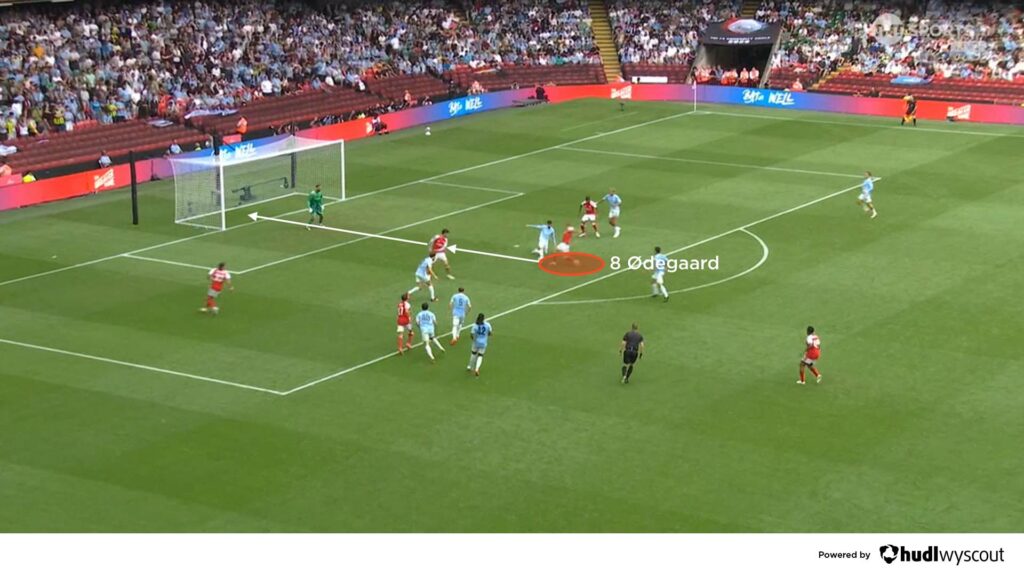
This allowed Tzolis to play a square pass inside and across City’s defensive line as Ødegaard arrived, timing his run perfectly to pinch the ball away from Gvardiol, who made a last-ditch attempt to intercept the pass. Following this, Ødegaard executed a moment of brilliance, dummying a shot to send Donnarumma to the ground and carefully slot the ball into the bottom corner (below).
At 3-0 and facing Arsenal’s formidable defensive organisation and workrate, there was no way back for City. Now we must wait to see whether the FA Cup holders will bounce back when the more meaningful fixtures begin in the 2026/27 season, and whether any side is capable of stopping Arsenal retaining the league title for the first time since 1935.
To learn more about football tactics and gain insights from coaches at the top of the game, visit Coaches’ Voice Academy