
PREMIER League, JANUARY 25 2026
Martínez (29 OG)
Merino (84)
Mbeumo (37)
Dorgu (50)
Cunha (87)
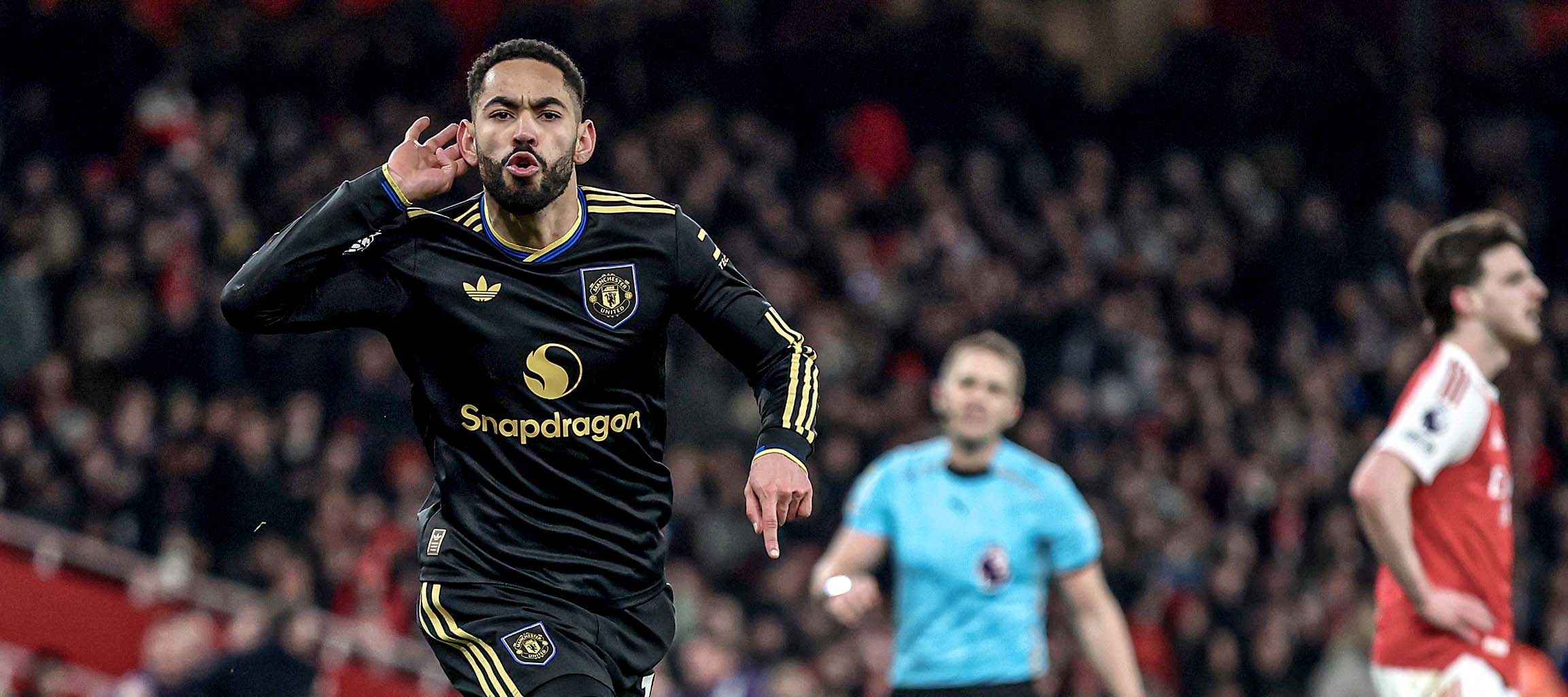
Manchester United achieved a notable win in Michael Carrick’s second game as head coach by becoming the first team to inflict a home defeat on Arsenal this season. Fresh from beating second-placed Manchester City last weekend under Carrick’s leadership, United passed what looked to be a tougher test against the Premier League and Champions League-leading Gunners. And they did so by shifting the momentum at key moments when Arsenal looked to have assumed the driving seat.
Mikel Arteta’s team took the lead just before the half-hour mark, with United’s Lisandro Martínez adjudged to have got the final touch as Jurriën Timber pounced in the six-yard box. The usually defensively sound Gunners soon gifted United an equaliser – a sloppy pass from Martín Zubimendi playing in Bryan Mbeumo to round David Raya. United then took the lead five minutes into the second half thanks to a brilliant strike from Patrick Dorgu.
Arteta responded by bringing on attacking talent in the shape of Viktor Gyökeres, Eberechi Eze and Mikel Merino – the latter turning the ball home from a corner with time running out. The question at that point appeared to be whether Arsenal had time to find a winner, but the home support were stunned into silence when Matheus Cunha struck a magnificent long-range winner for the visitors.
How the managers saw it
“We know that we were below par,” admitted Arteta. “Especially in certain individual standards, and when that happens the margin becomes very, very close. Today they made those margins bigger because the individual quality that they have made the difference in the game.”
“We understood the flow of the game,” said Carrick. “You knew at times we would be up against it, and we needed to dig in. We wanted to try and take control as well. Away from home in these big games you have to take an element of control, and calm things down a little bit. I thought we did enough of that to then grow into the match.”
 156212364189197312562318371681319
14/4
SHOTS / ON TARGET
10/3
59%
POSSESSION
41%
29
ATTACKS INTO AREA
12
1.25
EXPECTED GOALS (XG)
0.87
Arsenal lock United in
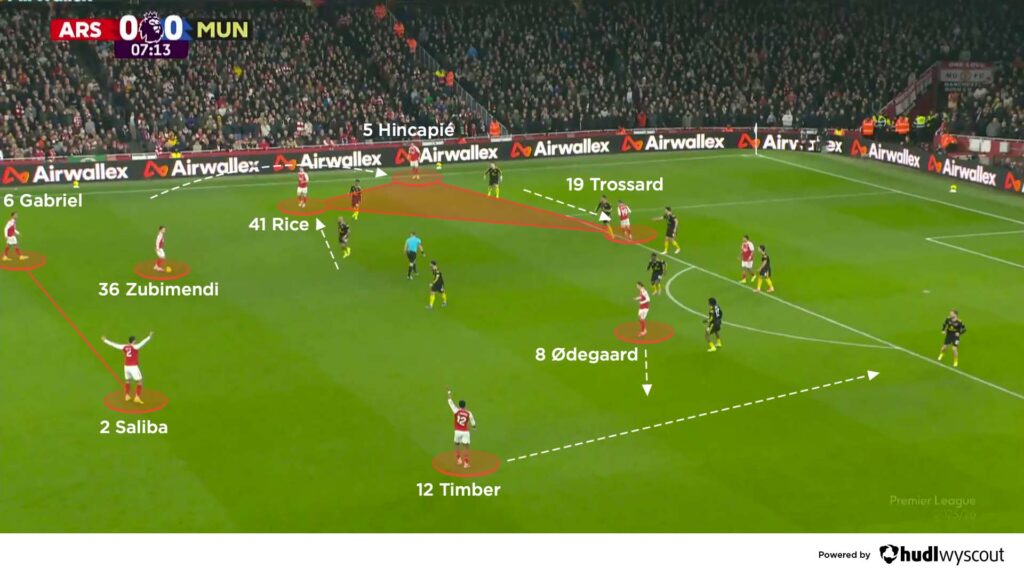
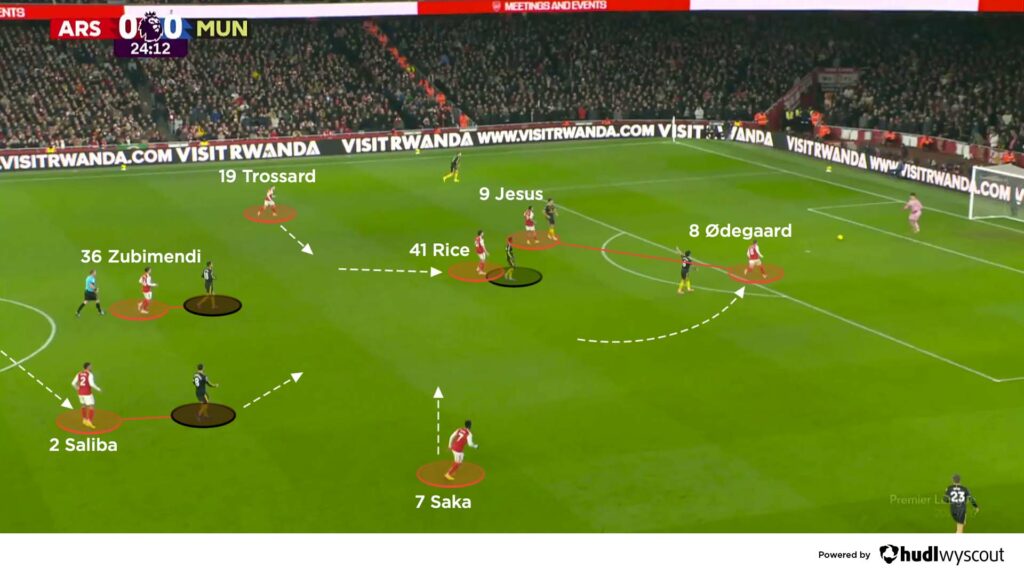
Arsenal were the dominant team for much of the opening 30 minutes, during which Declan Rice, Leandro Trossard and Piero Hincapié all rotated on their left, dragging Amad Diallo back to defend. Zubimendi supported ahead of Arsenal’s very high centre-backs, which helped to lock Manchester United into their own half.
Martin Ødegaard operated subtly between the lines, alternating between being central and in the inside right channel. Further right, Timber crashed the box with runs from deep (below), usually running inside Saka, who held the width to attack Luke Shaw 1v1. And it was Saka, Ødegaard and Timber who combined to create the opening goal.
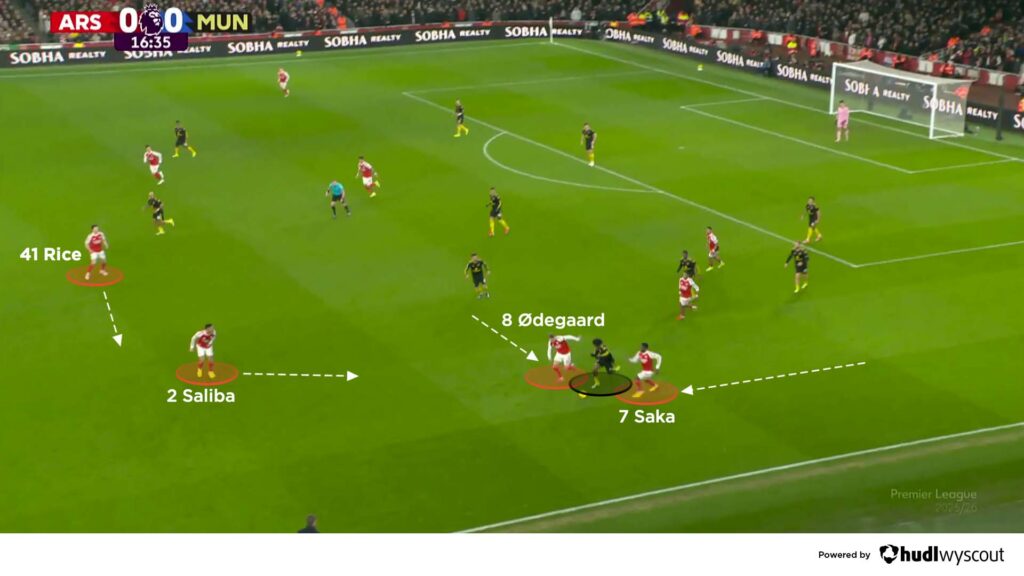
Arsenal’s reaction when they lost possession also contributed to locking United into their own half. On defensive transitions they pushed United into risky dribbles and combinations in wide areas, locking them to one side. Saliba and Gabriel’s high positioning also helped apply pressure and delay any United counter-attacking, while Arsenal’s central midfield was well placed in cover (below). With Dorgu and Diallo picking up the ball deep and underloaded, United found it very difficult to break out.
When pressing, Arsenal initially converted into a 4-4-2, with Ødegaard jumping to support alongside Gabriel Jesus as a first-line pair. Rice and Zubimendi then locked on to United’s double pivot, with one of Arsenal’s centre-backs aggressively following Bruno Fernandes – even when he began to drop very deep. Arsenal’s wingers being ready to narrow helped to choke the middle of the pitch (below), limiting United’s build and locking them into their own half in the opening 30 minutes.
United’s central numbers
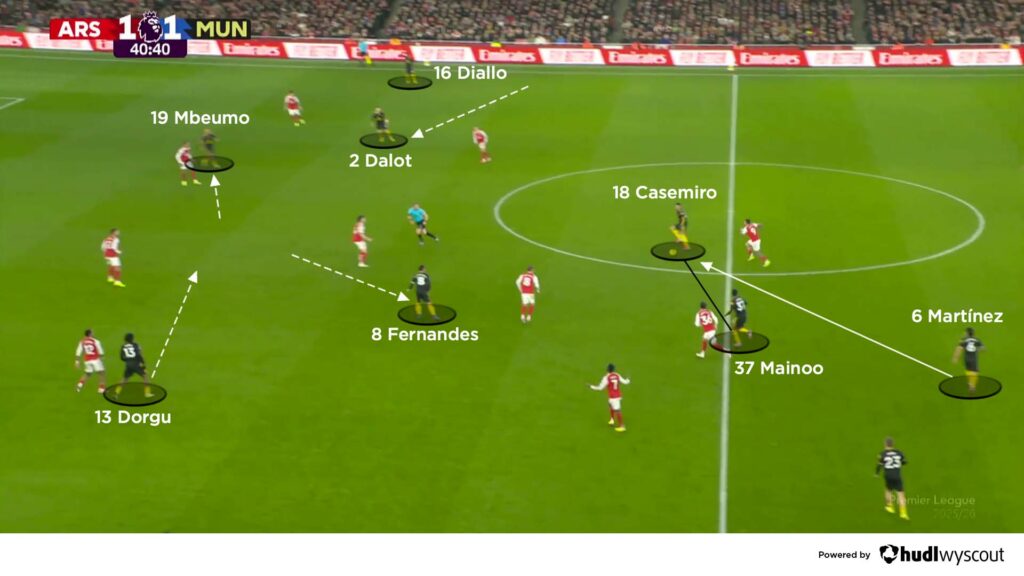
With Arsenal 1-0 up and seemingly in control, United achieved parity thanks to Mbeumo punishing Zubimendi’s error. Carrick’s team then looked to place central numbers between the lines where possible, with right-back Diogo Dalot moving inside as Diallo held the width. Fernandes roamed from his number 10 space, allowing Patrick Dorgu to make runs inside from his left-wing role. Mbeumo tended to drift away from the ball, creating more room centrally, while clever forward passing from Martínez in particular found United’s pivots (below). They linked nicely into teammates who rotated in the central spaces ahead, helping United to have sustained periods of possession.
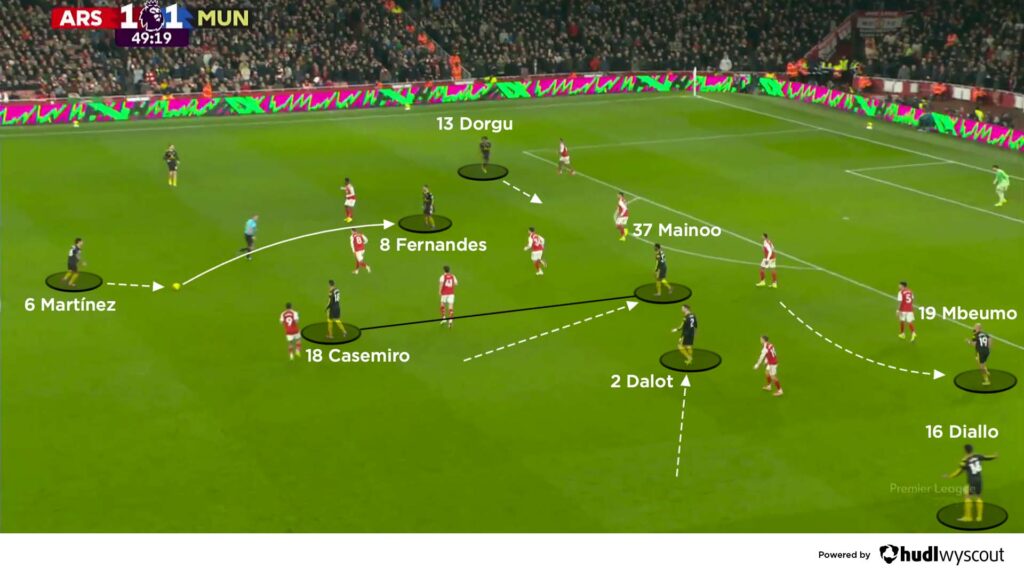
United started the second half as they ended the first, with lots of central numbers looking to receive between Arsenal’s lines. The home side were sloppy in possession, too, giving the ball away cheaply at times in their own half. For United, Dalot and Dorgu continued to move inside, with Martínez expertly feeding teammates between the lines. Mbeumo operated on the far shoulder of Arsenal’s centre-backs and linked with Diallo where possible, which allowed Fernandes and one of Casemiro or Kobbie Mainoo to move higher (below). Short, central combinations were crucial to United’s attacking approach, and preceded the long-range strikes for their second and third goals.
United’s block
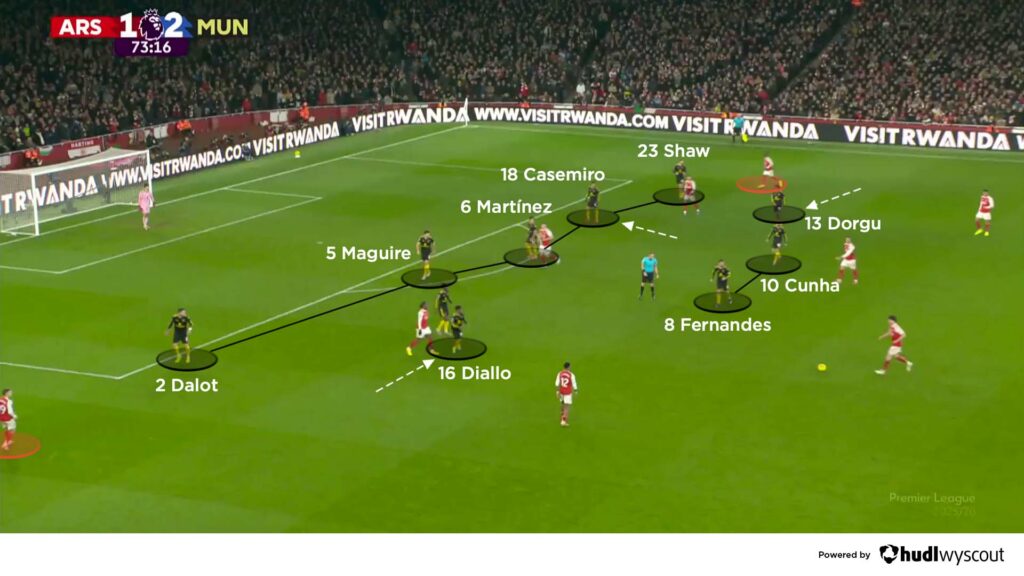
Arteta made four changes just before the hour mark in an attempt to revive Arsenal’s attack, with Eze, Merino, Gyökeres and Ben White on for Zubimendi, Ødegaard, Jesus and Hincapié after 58 minutes. Eze and Merino worked around Gyökeres, with Rice dropping deeper in his midfield role. Right-back White fed Saka in his continued 1v1 battle with Shaw, as Timber shifted to left-back (below) – a move that effectively nullified his attacking output. United then elected to defend in a low block, with the midfield unit extremely compact. This forced Arsenal around, from which the visitors had to defend crosses and corners.
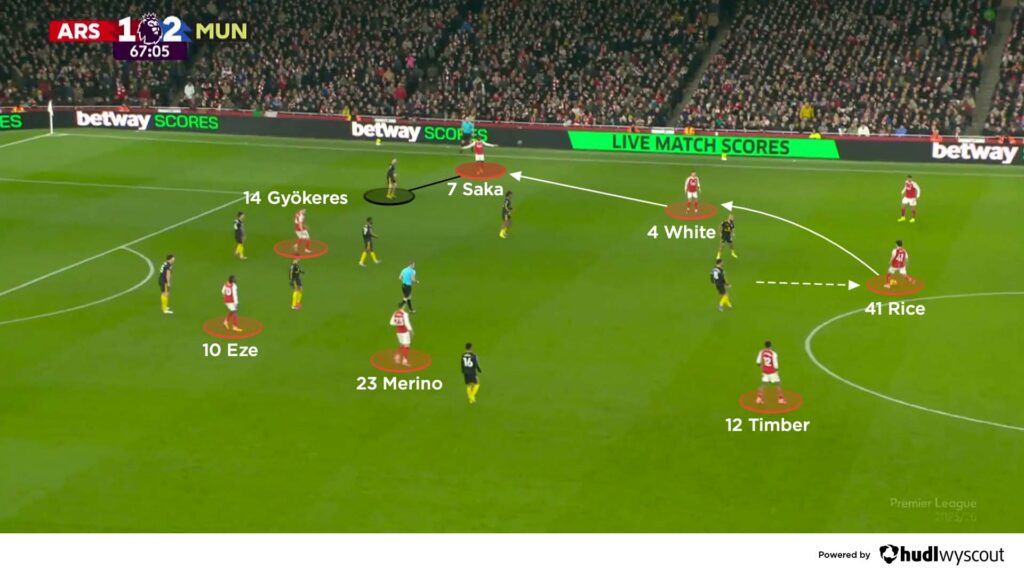
Arsenal’s wingers held the width and continued to look for crosses, even with United sometimes forming a back line of five. One of United’s pivots dropped in to help the centre-backs deal with the inside channels, while United’s wingers worked back and narrowed. That further encouraged Arsenal to play around, with United covering runs from Arsenal players either side of Gyökeres. Cunha and Fernandes were very deep as the first line of pressure, staying under the ball for as long as possible, as United formed a very compact low block, with all 10 outfielders often inside their own defensive third (below). This made it difficult for Arsenal to combine and work attempts on goal via open play.
Arsenal were briefly level thanks to their 13th Premier League goal this season from a set-piece, but United’s clinical edge – three goals from three shots on target – won the day. It was the first time that Arsenal had conceded three goals in a game since winning 4-3 at Luton Town in December 2023, while it was the second time Carrick had led United to a 3-2 win against Arteta’s Gunners – the first coming during a brief spell as interim boss in December 2021. Victory this time lifted United into the Premier League’s top four after 23 games, while Arsenal sit four points clear at the top and are still going strong in all competitions.
To learn more about football tactics and gain insights from coaches at the top of the game, visit CV Academy