
PREMIER League, OCTOBER 11 2026
Haaland (65)
Doku (68)
Cherki (78)
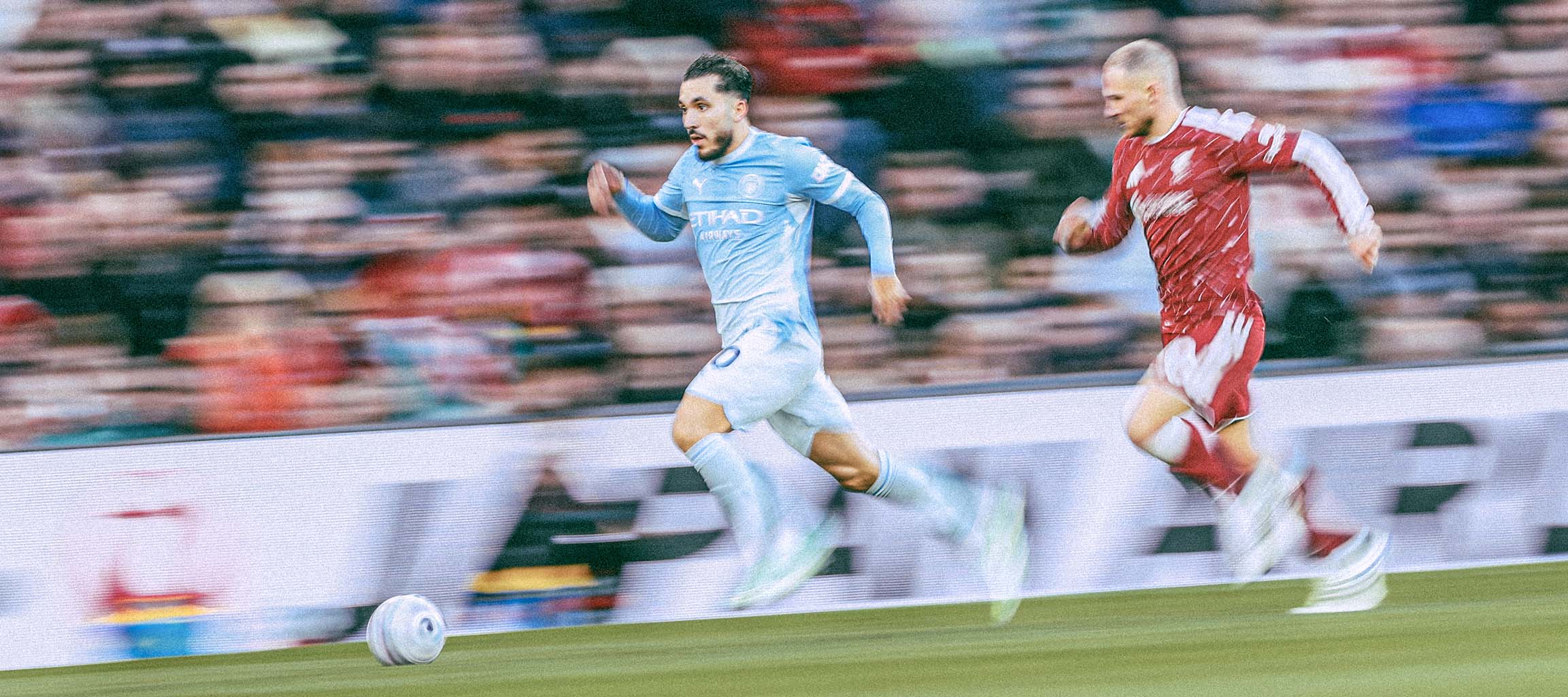
Manchester City emerged as comfortable victors at Anfield in the club’s first game since being found guilty of breaching Premier League financial regulations. With uncertainty about what the result of that guilty verdict will be for City, Enzo Maresca’s players got a result in the here and now against Liverpool to stay top of the Premier League table, as it stands.
In a febrile atmosphere fuelled in part by that guilty verdict, Liverpool began the game on the front foot but failed to trouble City goalkeeper Gianluigi Donnarumma, while the visitors gradually worked themselves into contention. With just over an hour on the clock the contest was finely poised until Liverpool’s influential Ryan Gravenberch – already on a yellow card – was swiftly punished for a challenge on substitute Jérémy Doku. Within six minutes of his dismissal City had decisively seized the momentum, picking apart the opposition with goals from Erling Haaland and Doku.
Rayan Cherki then danced through a crumbling Liverpool to have Maresca and the travelling City fans dancing with joy themselves. Andoni Iraola, meanwhile, was left searching for his first Premier League home win as Liverpool manager, while the whole of football was left wondering whether the result of this fixture would have any bearing on the season’s final standings.
How the managers saw it
“The analysis is quite clear,” said Iraola. “We played two different games – one until the red card and one from the red card until the end. I think we were the better team until the red card in the first 62 minutes. And they were better than us, obviously, after the red card and they scored the goals.”
“First half we struggled a bit because it was not easy for different reasons,” said Maresca. “Then second half we start working… It was just the right time [for Doku to come on] with the red card. Then the first goal from Erling came from Jeremy coming inside. He helped with many, many things.”
Below, our UEFA-licensed coaches have analysed how the game played out, tactically.
 164533103829723671273633517710429
13/6
SHOTS / ON TARGET
15/4
34%
POSSESSION
66%
15
ATTACKS INTO AREA
30
1.73
EXPECTED GOALS (XG)
1.68
Liverpool’s player-oriented high press
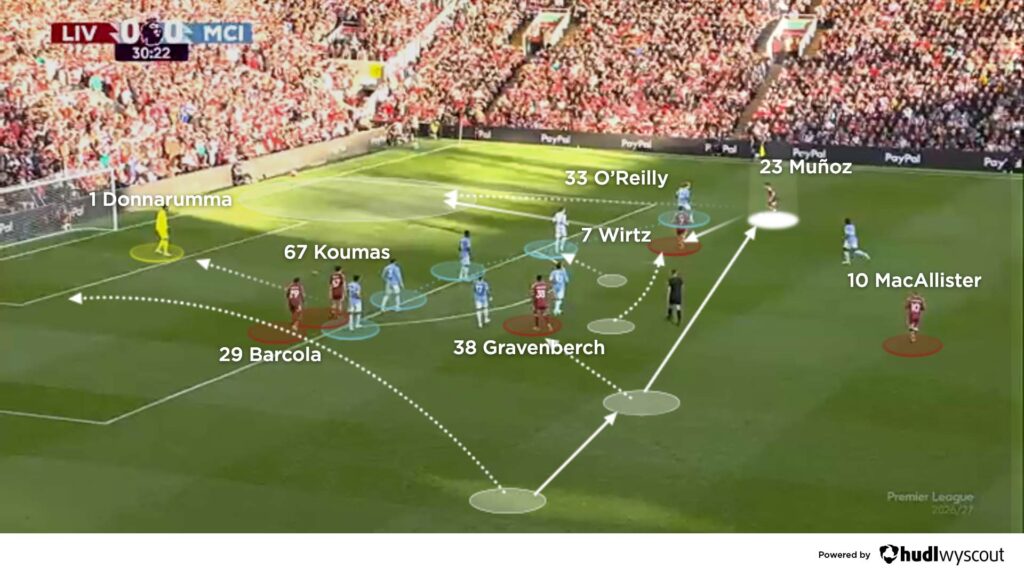
Liverpool’s 4-2-3-1 shifted to a 4-4-2 out of possession when Florian Wirtz moved up alongside Lewis Koumas, but the key to their early front-footed approach was player-oriented marking. Koumas led the press, as Bradley Barcola and Víctor Muñoz tracked City’s full-backs, while Wirtz often adopted a half-and-half position, keeping an eye on one of City’s splitting centre-backs – typically Rúben Dias on City’s right – as well as play through the centre, for example to Elliot Anderson. Ryan Gravenberch in turn regularly pushed high to track Enzo Fernández (below), while a deeper Alexis Mac Allister marked Cherki.
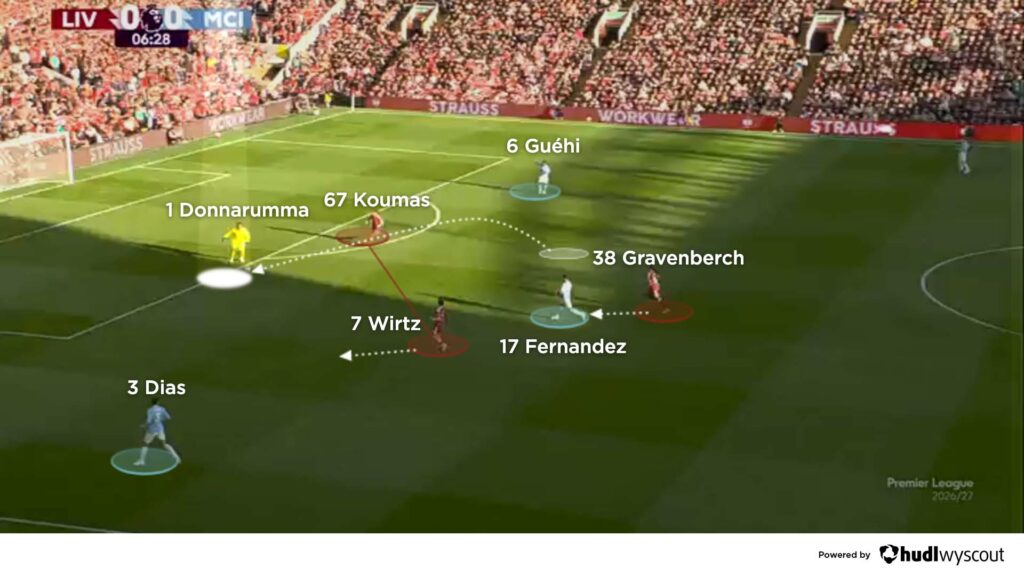
On occasion one of City’s double pivots pulled wide and was tracked by Gravenberch, with Mac Allister pushing higher to take the other pivot, prompting Cherki to drop deep as he looked to become a spare man. Virgil van Dijk was then brave in tracking City’s number 10 high up the pitch, far from Alisson, to keep Liverpool’s pressure on.
City’s 2-2-1-5
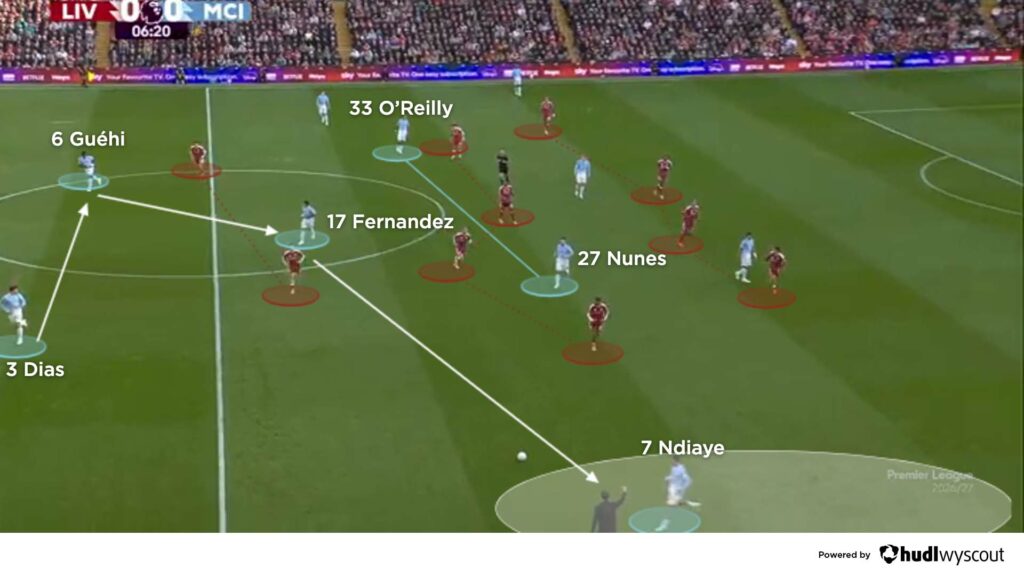
Manchester City also started in a 4-2-3-1, although their attacking structure altered several players’ roles. In settled possession, the full-backs O’Reilly and Matheus Nunes occupied the inside channels, while wingers Antoine Semenyo and Iliman Ndiaye provided width. In this way City’s shape sometimes resembled a 2-3-5, or a 2-2-1-5 with Cherki ahead of the Anderson and Fernández double pivot. Their inverted full-backs provided extra passing options between the wingers and Haaland, but Liverpool were able to maintain their man-marking assignments when City’s passing was too slow.
At times Fernández or Anderson dropped towards the base of the build to provide an initial passing option (Fernández in the example below), while City’s attacking midfielders tried to lose their markers, but in the opening stages they struggled to link their movements with a follow-up action in behind Liverpool’s pressing player. Although they found occasional outlets, including a Semenyo cross that flashed across the box without a finishing touch, they could not sustain their attacks.
Beating City’s press
To bypass City’s press, Liverpool passed out wide to their wingers, as well as finding central combinations. Jérémy Jacquet in particular was a useful option for beating Haaland’s press, moving out of the City striker’s cover shadow to give Van Dijk a passing option beyond the forward, to then link directly with Mac Allister.
Gravenberch gave Liverpool a different way to progress, receiving on the half-turn, reading his opponent’s approach and carrying the ball into space – a run from his own half in the opening period demonstrating his ability to break lines without passing. Further forward, Wirtz looked to drift towards the flanks and link up with Muñoz or Barcola, and his one-two with the Spanish winger after 30 minutes (below) forced O’Reilly to intervene before a shot could trouble Donnarumma.
Handing over Wirtz
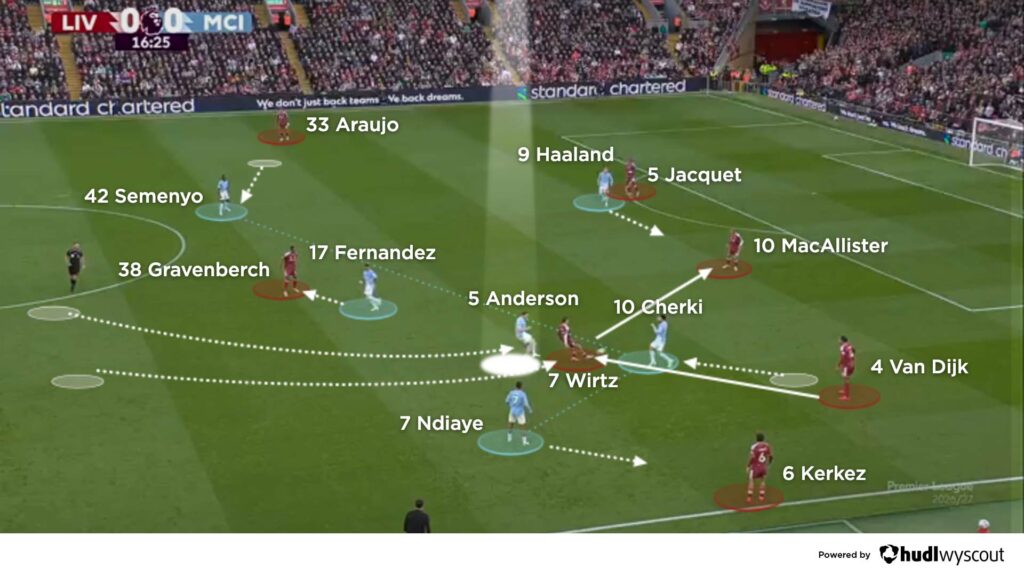
Out of possession for City, Anderson tracked Wirtz when the German dropped deep into midfield, but handed him over to Dias when the Liverpool attacker advanced. In doing so, Anderson stopped himself from being dragged out of position and made it harder for Wirtz to receive unmarked between the lines (below). Out wide, Matheus Nunes stopped several of Barcola’s bursts on the counter, while O’Reilly managed to hold his own against a threatening Muñoz, as City weathered the Anfield storm.
Liverpool’s struggles to create
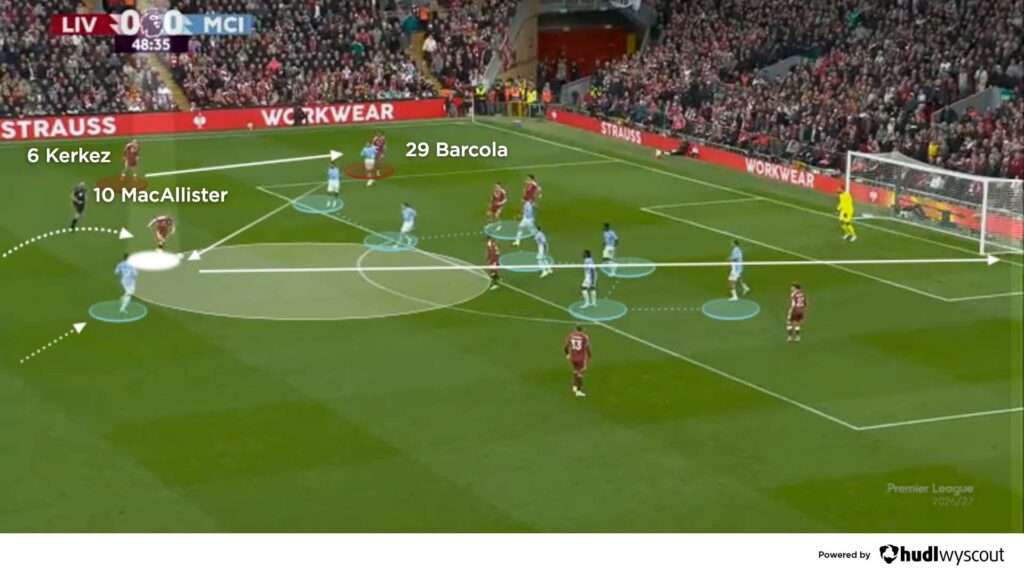
Liverpool increased their intensity again after the break, as Barcola linked up with Koumas to force a Donnarumma save. Gravenberch then tried his luck from distance, before Mac Allister went for goal from a similar range (below). This spell involved Liverpool launching repeated attacks without allowing City to fully reorganise, but also demonstrated their struggle to create chances closer to goal. Wirtz, meanwhile, supplied crosses from wide areas and set pieces, with Mac Allister getting on the end of one delivery, but they were otherwise unable to create chances inside the box.
City themselves began to pose a threat when they bypassed Liverpool’s initial press and found their forwards before the home team could reorganise their cover. The inverted positioning of Maresca’s full-backs meant that his team had additional passing options, while their wingers could receive out wide before driving inside. Semenyo was key to linking these attacks, on one occasion playing the ball towards Ndiaye, which forced Kerkez to intercept near the byline. He then threaded a pass through to put Haaland 1v1 with Alisson, only for the Norwegian to miss the target.
Doku on, Gravenberch off
In the 56th minute Doku came on for Ndiaye, with Maresca placing the Belgian on City’s left. His introduction added a threat that did not depend on passing through the lines, as he received out wide, engaged his defender and accelerated, forcing a second Liverpool defender to provide cover.
Gravenberch’s dismissal then disrupted Liverpool’s defensive structure, which had relied on coordinating pressing with cover. It also deprived Iraola’s team of a ball carrier who could escape the press, a late runner to the edge of the box, and cover in transition. As a result, Mac Allister had to protect a larger area, while Muñoz had to choose between tucking inside and helping Araújo deal with Doku – Liverpool’s Uruguayan, having been booked in the eighth minute, had no margin for error when challenging in a 1v1. Down to 10 men, Iraola opted to replace Wirtz with Trey Nyoni, switching to a 4-4-1 (below), but by then City had already scored.
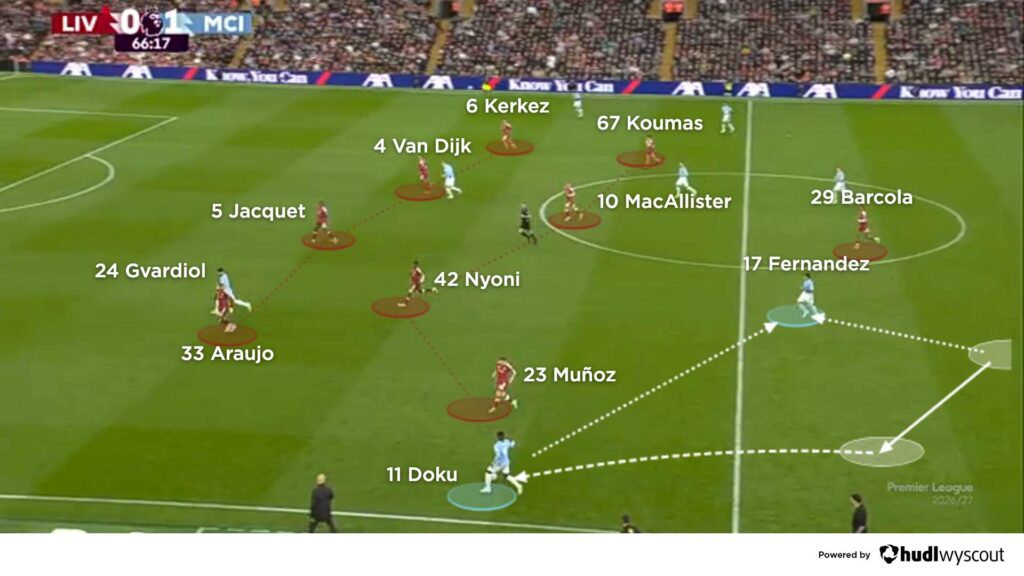
Liverpool dropped deeper and were exposed out wide and in the inside channels, as their defensive challenge shifted from tracking receivers to containing successive City advances. Doku exploited this difficulty by alternating between holding the width and driving diagonally inside. When positioned wide on the left, he forced Araújo to guard against the dribble; when he carried the ball inside, he drew in a midfielder and opened up other options around the box.
In the 64th minute, a direct, driving run took Doku past his man and pulled the Liverpool defence out of shape before he found Haaland. The striker finished first time, taking advantage of a defence focused on the initial move and unable to deal with the second phase as well. Three minutes later, the Belgian again found space inside and curled an excellent shot into the far top corner (below).
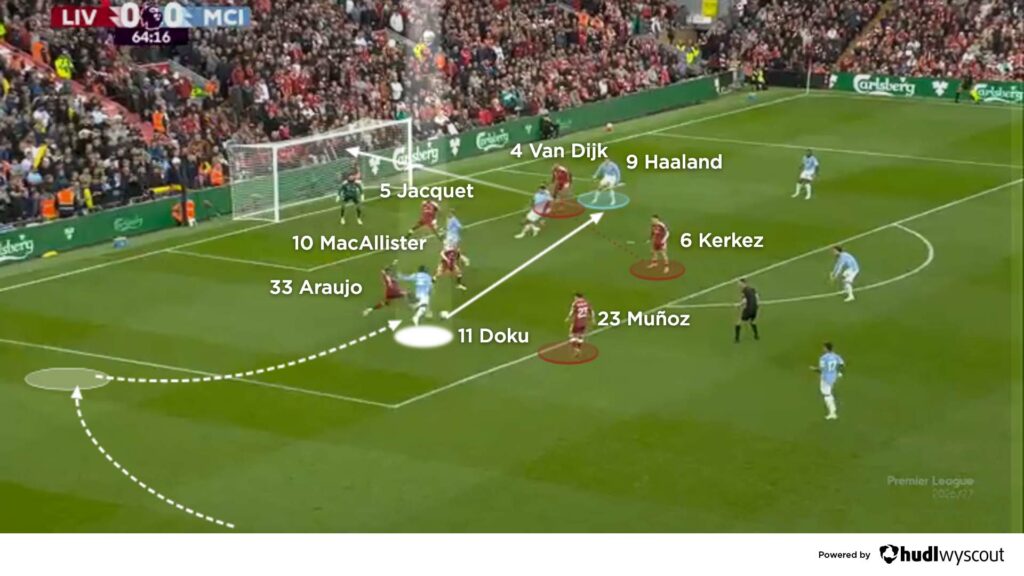
The tactical significance of Maresca bringing on Doku lay in introducing a threat that forced Liverpool to defend several options at once: driving down the outside, cutting inside, combining with teammates and shooting. Anderson and Fernández maintained possession behind these attacks, allowing City to recycle the ball or switch play when a direct route forward was blocked.
City move Liverpool’s block to penetrate
Liverpool needed to restore their attacking threat without leaving themselves exposed again. However, although Nyoni provided support for Mac Allister, they no longer had the high regains that had fuelled their best attacks. Koumas was left isolated (below), while Barcola had fewer opportunities to receive the ball on the run.
Jeremie Frimpong and Rio Ngumoha came on for Araújo and Koumas to add pace, presumably with the aim of helping Liverpool break out of their own half. But on regains the home side too often gave the ball straight back to City. Defending deeper reduced the space in behind but increased Liverpool’s need to shift across and cover ground laterally, protecting the width, before attempting to close down gaps through the middle.
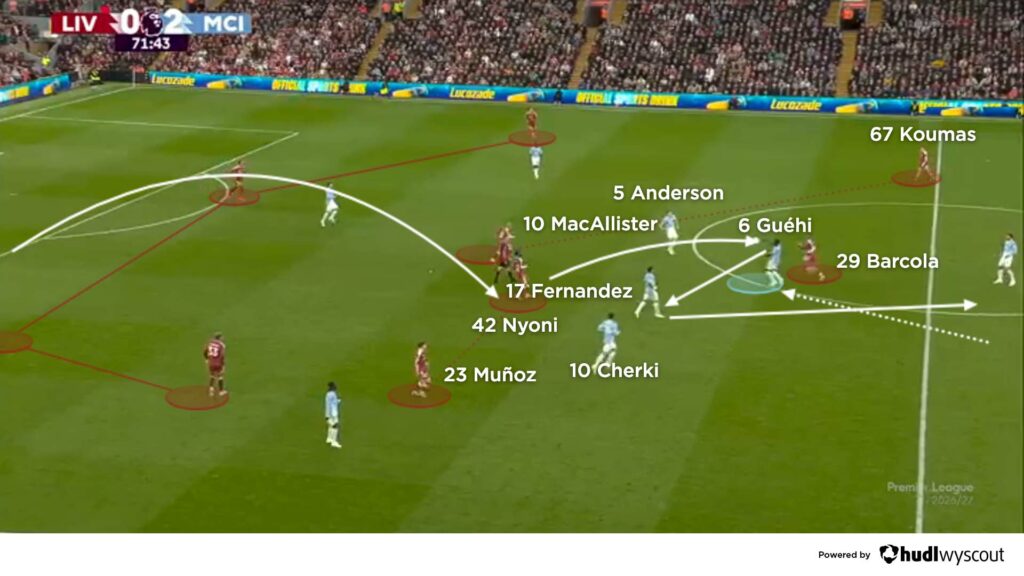
Utilising their overload, City moved Liverpool’s defensive block before attempting to break through it. Anderson was a fulcrum in possession, while Cherki adjusted his positioning to link up with teammates on the last line. And Josko Gvardiol – on for O’Reilly in the 66th minute – added a useful connection with Doku.
City’s third goal came in the 78th minute after 41 passes that took them back towards their own half before they moved the ball across both flanks and advanced towards the box again. Their patient circulation forced Liverpool to repeatedly adjust their defensive shape, until Gvardiol laid the ball off to Cherki, who beat Frimpong with a sharp change of direction before finishing past Alisson – the payoff for pulling Liverpool’s block out of position.
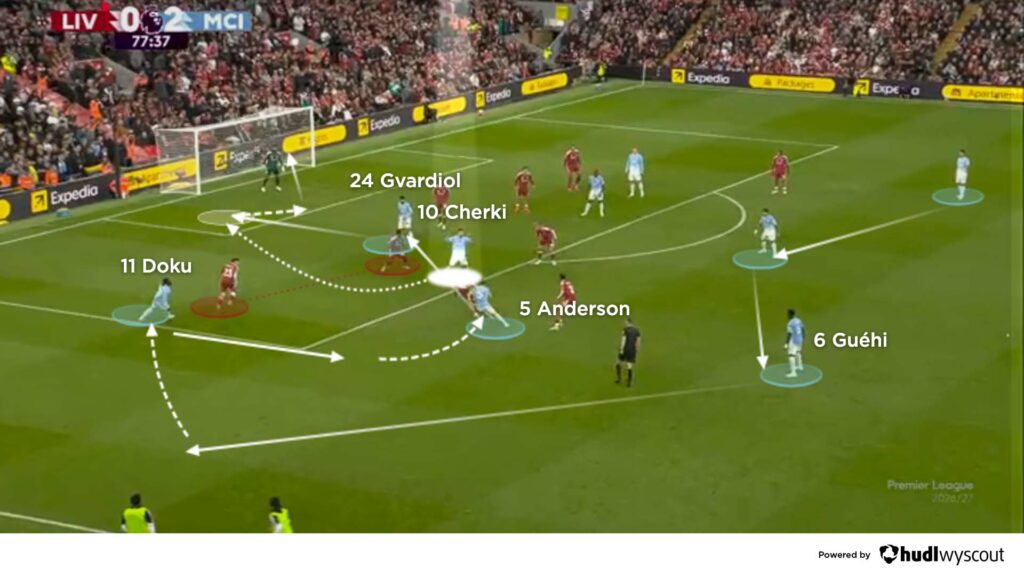
And so, with this impressive use of possession and a player advantage, City restored their three-point lead at the top of the Premier League over champions Arsenal. Whether they will be in that position at the end of the season is in serious doubt, however, regardless of how Maresca and his players perform.
To learn more about football tactics and gain insights from coaches at the top of the game, visit Coaches’ Voice Academy