

Pep Guardiola
Manchester City 2016-2026
When Pep Guardiola arrived in the Premier League there were question marks over whether his famed possession-dominant style of football would succeed in England. Yes, he had won a bucketload of trophies with Barcelona and Bayern Munich. But in Spain he had the great Lionel Messi, while Bayern had made a habit of regularly winning the Bundesliga no matter who was in charge. So when his first season at City ended with no trophies and a third-place finish in the Premier League, any critics perhaps thought they’d been proved right. They, emphatically, were not.
His numbers at City are incredible. Twenty trophies: six Premier League titles, one Champions League, five EFL Cups, three FA Cups, one Club World Cup, one Super Cup and three Community Shields. A record 100-point Premier League season (2017/18), a unique four English top flight titles in a row. Four League Cups in a row. The first club to reach four consecutive FA Cup finals. The first club to win a domestic treble in England. A continental treble in 2022/23. And, to finish, a domestic cup double of FA Cup and EFL Cup.
But perhaps even more important than the silverware was the style in which Guardiola’s City achieved their success. He came to a country famed for physical football, where taking risks at the back had been anathema to the game for so long. And yet his influence was such that ‘playing out from the back’ became commonplace at all levels of the game in England, as just one obvious example of his coaching influence.
Here, our UEFA-licensed coaches have analysed his time at City, including the various tactical approaches and changes he made in that remarkable decade, as well as the aspects of play that remained consistent under one of the all-time greats.
Inverting the full-backs
One of Pep Guardiola’s first priorities when joining Manchester City was maintaining his preferred style of play: controlled possession, short passes and build-up from the back. In his first few transfer windows, City spent heavily on full-backs, recruiting Kyle Walker, Danilo, Benjamin Mendy and Oleksandr Zinchenko. Other good passers of the ball, including John Stones and Aymeric Laporte, were added to the back line, as were goalkeepers Claudio Bravo and Ederson.
From here, Guardiola quickly established how he wanted his side to build from deep, which often meant a full-back inverting into central midfield from an initial 4-3-3 shape. This full-back operated alongside the initial single pivot – Fernandinho in Guardiola’s earlier seasons, then Rodri – creating a key overload in central midfield, where many opponents operated with three players (see the blue rectangular area highlighted in the diagram below). As a result, City went from having the joint-fourth most possession in the Premier League in the season before Guardiola arrived, to ranking first in each of his 10 seasons in charge.
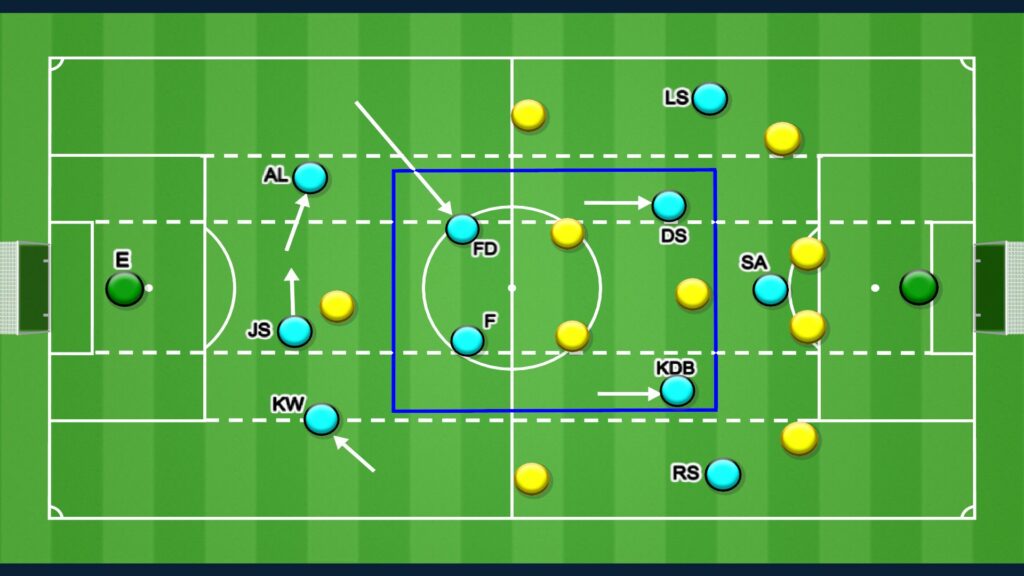
In the 2017/18 campaign, for example, City averaged 70 per cent possession, with Fabian Delph (above) and Zinchenko particularly influential when inverting from left-back. Laporte as a left-footed centre-back also complimented this side – he often found winger Leroy Sané with passes around the opposing block, or reversed passes into midfield, opening access into David Silva between the lines. City dominated in central midfield – just as Guardiola himself liked to operate as a player – ensuring his style was quickly implemented, while possessing strong, athletic defenders such as Walker, Stones and Laporte underneath who could limit the impact of opposing counter-attacks. Having Mikel Arteta as one of his assistants was also important in helping Guardiola adapt his preferred style to the Premier League. This ensured his side could still maintain possession by placing lots of numbers within 10 to 20 yards of the player on the ball, especially in midfield areas.
Freeing the number eights
Another positive consequence of inverting the full-backs came via City’s two number eights within the 4-3-3 shape. By moving the full-backs into midfield, the likes of Kevin De Bruyne, David Silva and lkay Gündogan could push higher between the lines. From this more advanced position, they could impact the back line much more directly with their respective qualities on the ball, while also dragging opponents back, allowing City to totally dominate territory. Silva’s delicate forward passing, through balls and ability to penetrate the penalty area created numerous chances. Gündogan was similar, but also crashed the box as an extra runner to provide a steady, often important goal return. De Bruyne could also provide deadly through balls as well as a goal threat – usually with strikes from range. However, Guardiola helped transform De Bruyne into one of the best attacking midfielders in the world via his crossing ability.
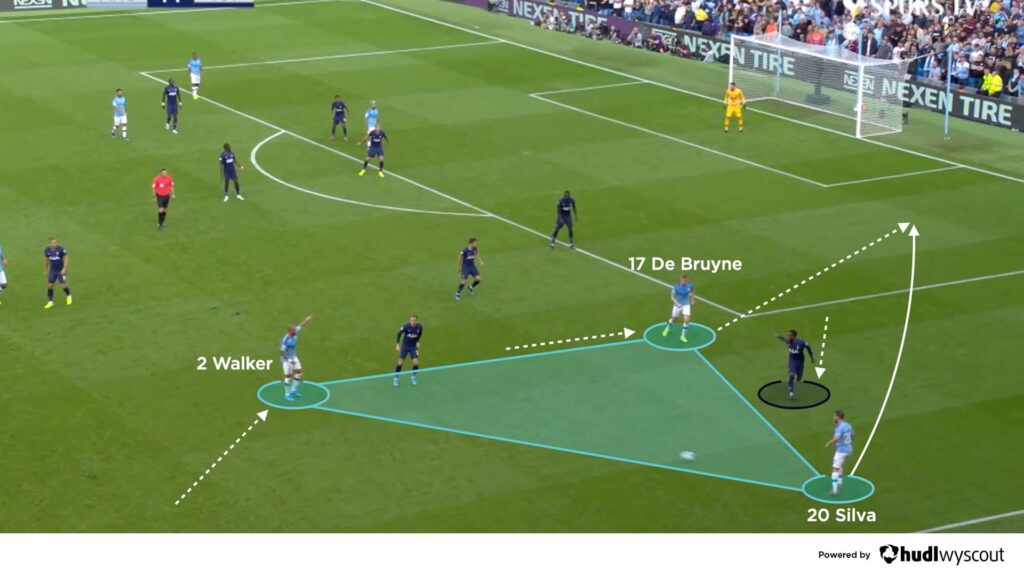
Maximum width from wingers Leroy Sané, Raheem Sterling or Riyad Mahrez – or players including Phil Foden and Bernardo Silva used in this role – created further room for Guardiola’s number eights to flourish within the inside channels while the wingers’ kept opposition full-backs busy. Coupled with City’s numerical advantage in the middle of the pitch, the eights were often free, with De Bruyne then able to cross from the right. The Belgian also made numerous runs beyond, taking advantage of the space left in behind as the opposing full-back jumped to City’s receiving winger.
De Bruyne was often encouraged to run beyond – City’s full-back narrowed on his side, allowing the Belgian to penetrate the box with narrowed runs, then deliver early crosses (below). With City’s wingers so effective at dribbling and ball-carrying, they regularly pushed their opposite number back as they progressed forward with the ball. De Bruyne would then drop underneath, crossing first-time from the inside channel from a slightly deeper position. In addition to his pinpoint accuracy, City’s numbers on the far side ensured they were ready and able to attack these crosses, with centre-forwards Sergio Agüero and Gabriel Jesus often there to finish, as well as the opposite winger and eight. The backwards pass into De Bruyne was often a trigger for the opposition’s back line to step out, which created the perfect space to target and find well-timed runs to the middle or back-post spaces.
The false nine
Post Agüero, and pre-Erling Haaland, Guardiola operated without a traditional centre-forward for a period. Instead, City played with Foden, Mahrez, Silva, Gündogan or De Bruyne in the central striker role. However, they all looked to drop back towards the ball from a high starting position, moving well away from the opposition’s back line. This false-nine approach gave City an alternative way to dominate the centre of the pitch, maintaining the numerical overload Guardiola craved – the principle of finding and dominating possession via the ‘free man’.
As a consequence of this, the full-backs inverted much less, with Guardiola’s back line operating as a more traditional back four in terms of their positioning. But with the false nine dropping, City still needed threats going the other way. This usually came via winger runs in behind, coming in off the line more to receive, to feet and also when moving beyond (see Foden, below). These opposite movements were well timed, and ideal for when City attracted opposing centre-backs to step out thanks to the dropping of their false nine.
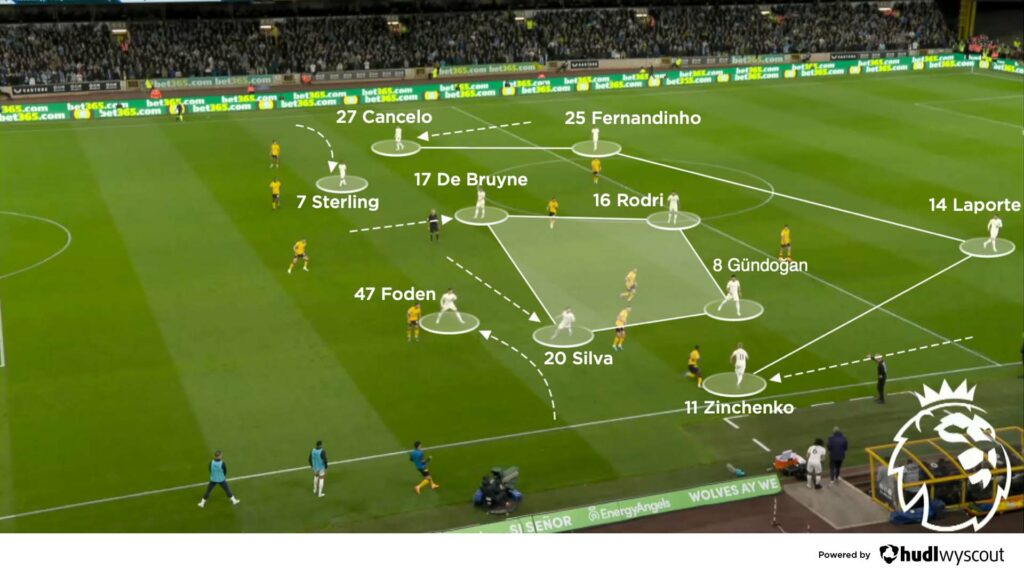
But in order to free and dominate the centre, City still needed width. With both wingers looking to attack inside more, Guardiola’s full-backs pushed forward, overlapping to create the attacking width once possession was well established within the opposition’s half. Walker and Mendy were ideal for these roles, with the flexible João Cancelo and Zinchenko also providing good support from the wide areas. Once City’s initial forward had dropped, further central rotations took place, to work different players into central attacking positions. As such, City made it extremely difficult for the opposition to simply stick man-to-man, or cover certain players. Guardiola’s side continued to score plenty of goals, without necessarily relying on an Agüero or Haaland type of goalscorer. Instead, they spread the goals across the squad, especially those in the false-nine role.
Revitalising the double pivot
Guardiola returned to the double pivot in a 3-4-2-1 attacking shape that he used at the start of his tenure, especially when some opposing teams improved their counter-attacking returns against City. The arrival of Enzo Maresca as his assistant contributed to this. Against more physical opposition, Guardiola’s City once again adapted to be able to dominate possession and remain secure underneath. Instead of moving a full-back into midfield though, Guardiola’s centre-backs repositioned during build-up, supporting the now single pivot of Rodri. Fernandinho briefly performed this role when he was used as a centre-back, but it was exemplified by Stones (below), with Manuel Akanji also used when needed.
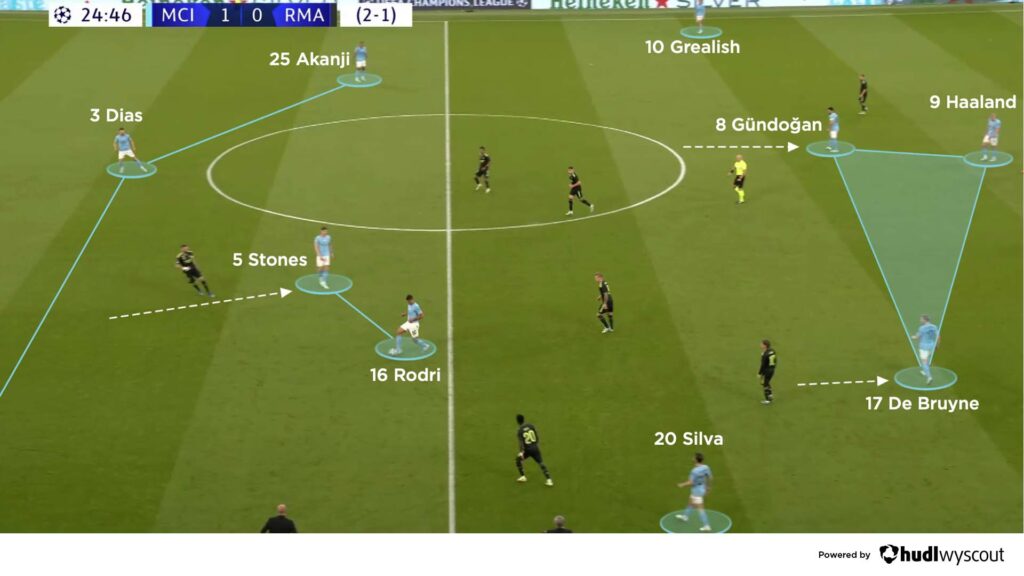
The back line then readjusted to a three underneath, with the double pivot again helping to push City’s numbers eights forward to support the front line. De Bruyne especially was then able to link with Haaland, forming City’s key attacking pair. The main return, however, came in defensive transition, with City very solid defensively. The height and aerial abilities of Stones (or Akanji) worked well around Rodri, with the back line underneath also more than capable of dealing with direct play, as well as fast and purposeful counter-attacks.
Guardiola’s change here to include additional centre-backs in his line-ups helped, with Akanji and Nathan Aké used at left-back, tucking inside to support the centre-back – usually Rúben Dias – when the other centre-back had fully committed into midfield. Walker also tucked inside to give City a superb coverage against any pacy winger on his side, using his experience of playing in a back three with England. From this base, Guardiola maintained his side’s dominance of possession and ability to create chances, but with an upgraded defensive structure underneath the ball. It was then no coincidence that this adaptation led to major success in Europe against some of the best transitional sides.
Narrow attacks
Guardiola then looked back to a more traditional and fixed double pivot, with Rodri and Bernardo Silva operating so well together, while injury issues hampered other players repositioning from centre-back or full-back. City now attacked as a solid 4-2-3-1, with De Bruyne feeding Haaland and the wide attackers looking to come inside and support from here. This paved the way for what would be Guardiola’s last adaptations with City.
Jérémy Doku and Antoine Semenyo – who prefer to receive wide and carry the ball – were added to City’s front line, while De Bruyne departed. Guardiola then looked to overload the spaces between the lines with numbers coming from elsewhere. City utilised their number 10, with Phil Foden, Omar Marmoush or Rayan Cherki all operating as the link under Haaland, joined by runs from deep from players such as Bernardo Silva and Tijjani Reijnders. Or the 10 would come inside from a wide space, with fluid movements off the ball that helped get the number eights into good positions between the lines, as in years gone by.
This latter version of Guardiola’s City also featured runs from very deep, with members of the back line joining the attack (below). Matheus Nunes was converted to right-back under Guardiola and would join from deep, while also giving his midfielders licence to push ahead as he moved into midfield. Academy product Nico O’Reilly got forward from left-back into spaces between the lines. With experience of playing as an attacker in his youth career, O’Reilly often became a third number 10, working inside a wide Doku. He also played narrow crosses from the left inside channel, just like De Bruyne did from the other side, as well as ending up in goalscoring positions.
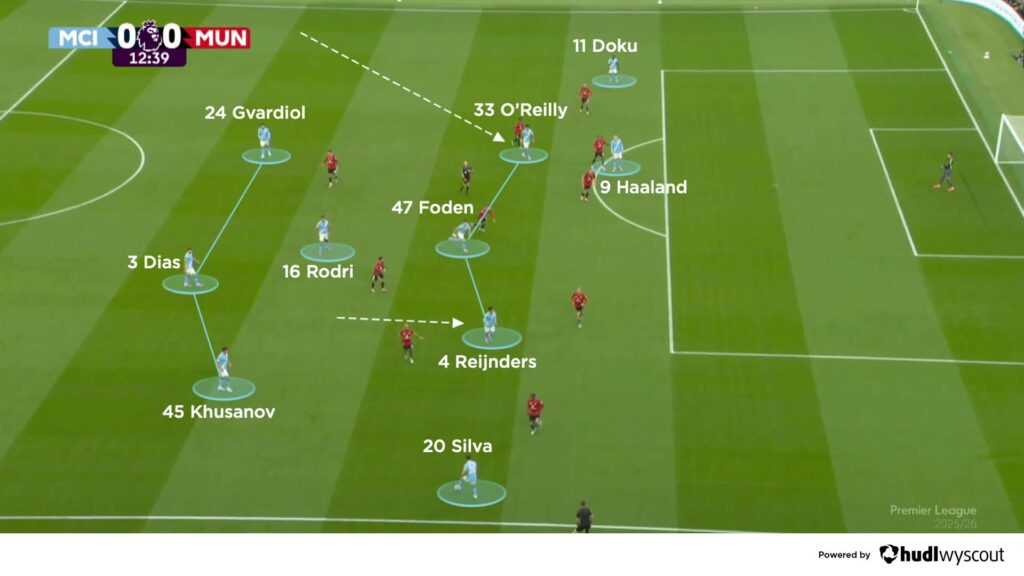
This change placed lots of central numbers in position for instant and aggressive counter-pressing whenever City lost possession in their attacking phase. Instead of relying on an aggressive and physically dominant back line, Guardiola relied more on central numbers to stop counters at source, likely influenced by Pep Lijnders’ arrival as one of his assistants. There were significant changes to their out-of-possession structure, as they defended much narrower in a 4-4-2 diamond or a 4-2-3-1 shape.
A constant feature of Guardiola’s City was their ability to build from deep and create a constant stream of short passes through excellent movement and support around the ball. And, of course, the ability to hoover up silverware year after year. His replacement will have quite the challenge to replicate that.
To learn more about football tactics and gain insights from coaches at the top of the game, visit Coaches’ Voice Academy