


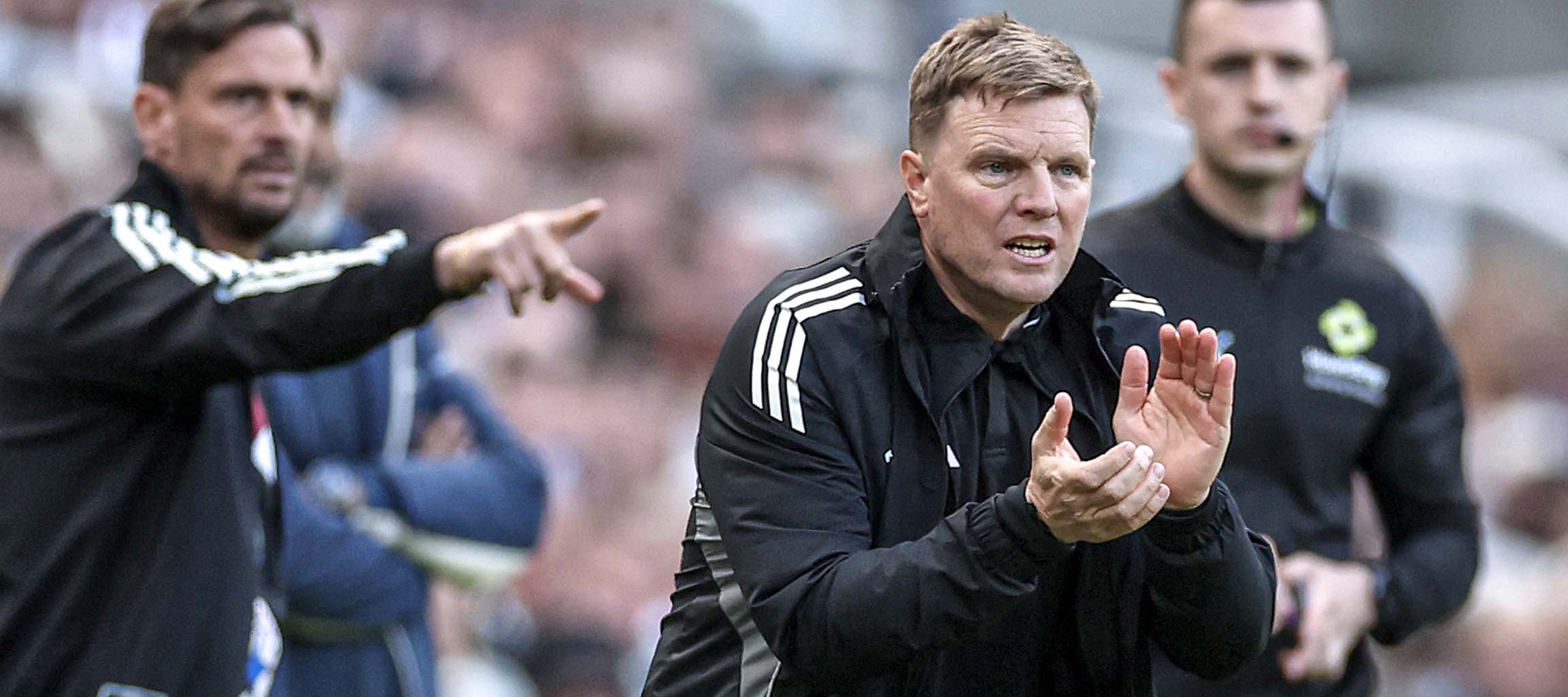

Eddie Howe’s time as Newcastle United head coach came to an end in summer 2026, after almost five years at St James’ Park. Appointed in November 2021, having established Bournemouth as a Premier League club (see his Coaches’ Voice Masterclass video below), Howe twice led the Magpies to Champions League qualification. He also wrote his name into the club’s history books by delivering Newcastle’s first major trophy in 56 years, with victory over Liverpool in the 2025 Carabao Cup final.
Tactically, his Newcastle side became known for their intensity without the ball and their directness with it. Below, our UEFA-licensed coaches have analysed the tactics and style of play that defined Howe’s Magpies, focusing on his final two seasons in charge.
Pressing
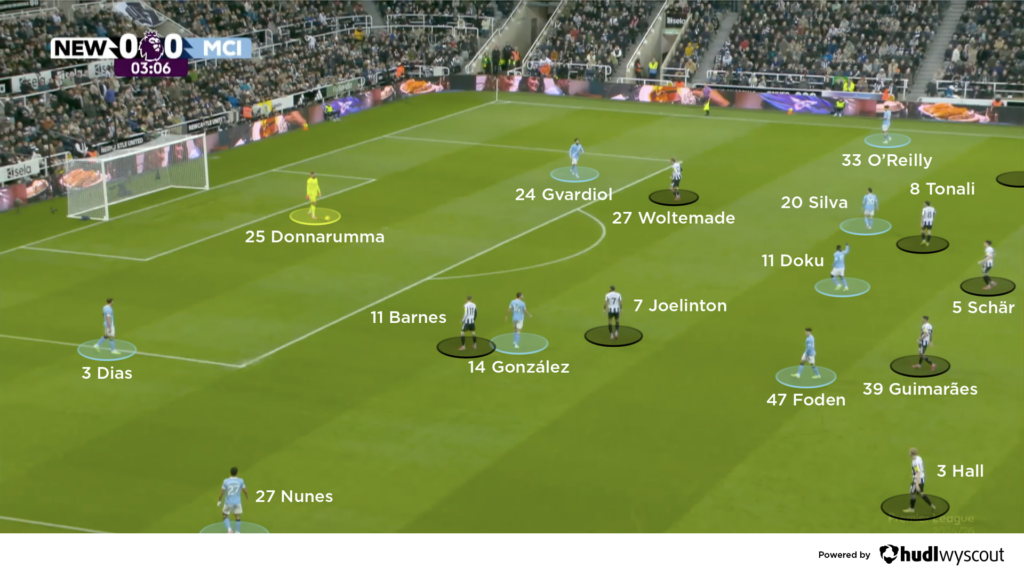
Under Howe, Newcastle were renowned for their aggressive pressing. They allowed the fifth-lowest Passes Per Defensive Action (PPDA) in the Premier League in both the 2024/25 and 2025/26 seasons. Towards the end of his tenure, Howe’s side pressed from an aggressive man-to-man structure, with the aim of regaining possession high up the pitch.
As shown below, at home to Pep Guardiola’s Manchester City, Newcastle lined up man-to-man. Nick Woltemade and Harvey Barnes were ready to press City’s central defenders, Rúben Dias and Joško Gvardiol, while Joelinton, Bruno Guimarães and Sandro Tonali locked on to City’s Phil Foden, Bernardo Silva and Nico González in midfield. The aggression of the approach is clear from the positioning of Newcastle centre-back Fabian Schär, who had followed Jérémy Doku all the way inside as the winger tried to disrupt Newcastle’s structure. The man-to-man approach was retained throughout the pressing phase.
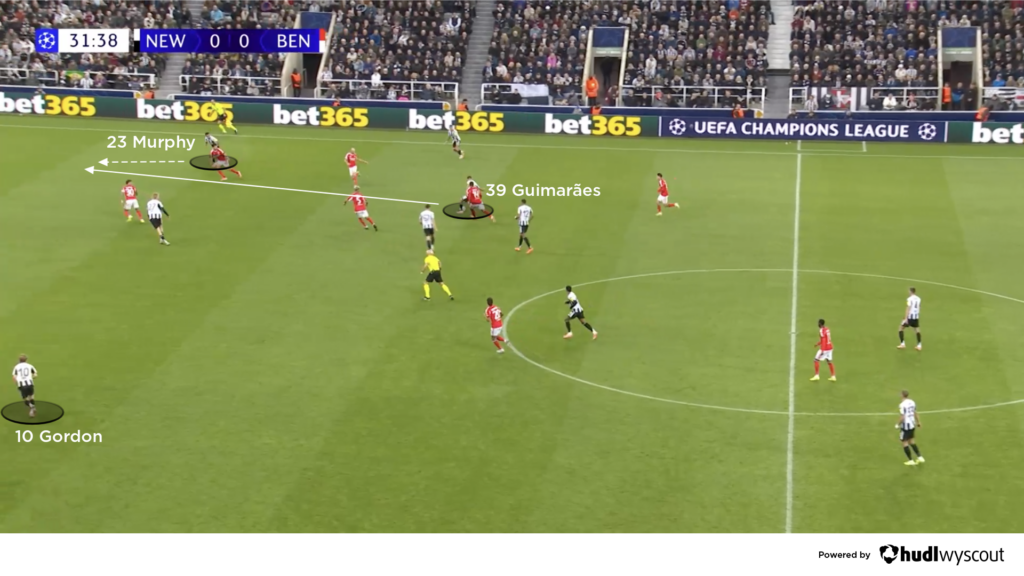
Consistently utilising this pressing structure meant that Howe’s side created many of their chances from attacking transitions after high regains. In the example below in the Champions League, after Guimarães won the ball centrally, Newcastle looked to play directly through Benfica’s structure, using the pace of Anthony Gordon and Jacob Murphy to exploit the space in behind the last line. Moments later, Murphy slid a pass across goal for Gordon to tap in and put Newcastle ahead.
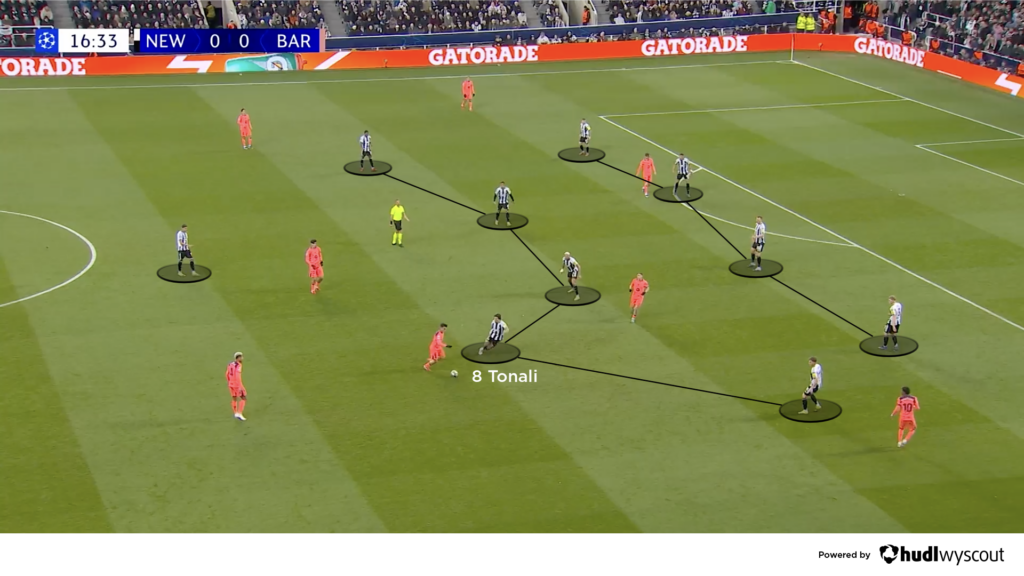
In deeper areas, Howe’s side generally dropped into a 4-5-1 to stay compact in a mid-to-low block. They would still look to pressure the ball by releasing players from the structure – as shown below with Tonali – but the priority was to prevent central penetration and force the opposition wide, then lock them into those areas. In his final season, Howe’s Newcastle also showed flexibility out of possession, shifting into a 4-4-2 block when required by his game plan.
Build-up
In possession, Howe’s side generally built up in a 4-3-3 with a single pivot, a role filled by either Guimarães or Tonali (below). They looked to connect through the pivot and play through the number eights, who positioned themselves on the outside shoulder of the opposition’s central midfielders. When the central defenders were under pressure, the eights would often drop to support, setting the ball back to the full-backs or into the pivot so Newcastle could play forward.
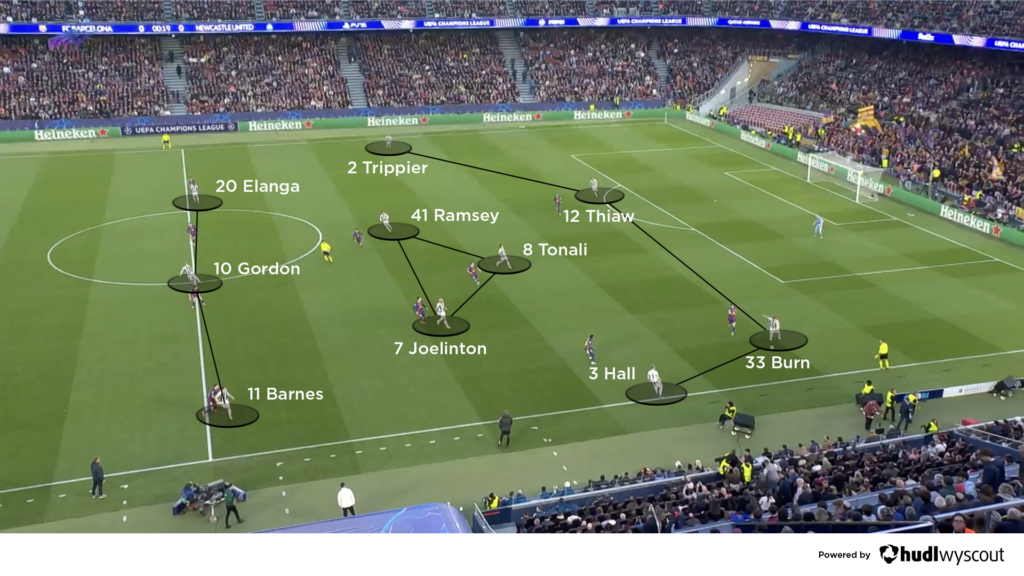
From there, Howe’s side looked to accelerate attacks into wide areas. Barnes, Gordon, Murphy and Anthony Elanga were all capable of going 1v1 during his tenure, but could also receive in behind when Newcastle chose to play more directly against an aggressive press. There was fluidity within the structure, too. The eights could roll outside into wide areas to receive and accelerate play, with the wide midfielders rolling inside on to different vertical lines when they did. Above all, Howe’s side looked to play forward and move the ball quickly wherever possible.
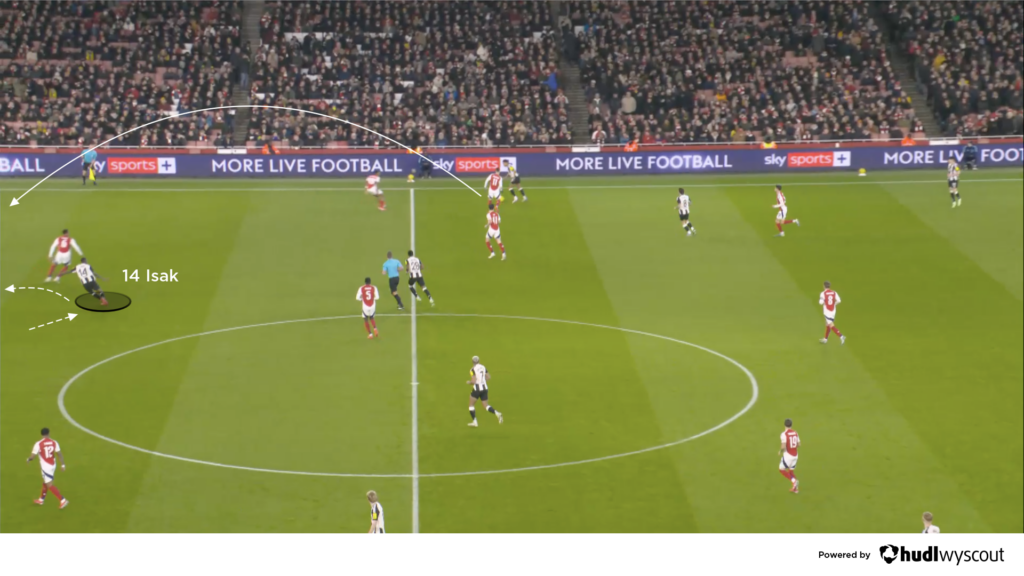
The structure also varied depending on the personnel available. Before his move to Liverpool, Alexander Isak gave Newcastle a greater threat in behind the opposition’s back line. As shown below against Arsenal, Isak would make intelligent double movements – dropping towards the ball to draw a central defender out, before making an opposite movement in behind and using his pace and acceleration to receive beyond the back line. In Howe’s final season, Woltemade tended to drop towards the ball and link with the midfielders, while the wide players maintained a constant threat in behind.
Chance creation
Howe’s side typically funnelled their attacks into wide areas to create goalscoring opportunities. Newcastle recorded the fifth-highest number of crosses in the Premier League in 2024/25 (635), and the most in the league in 2025/26 (713).
Howe’s side often formed wide triangles, consisting of a wide midfielder, a full-back and a number eight – as shown below with Barnes, Tino Livramento and Tonali in the 2025 Carabao Cup final. At times, the wide player was left to attack 1v1 and create crossing opportunities, while overlaps could be used when the wide midfielder drove inside, creating space to release a player on the outside.
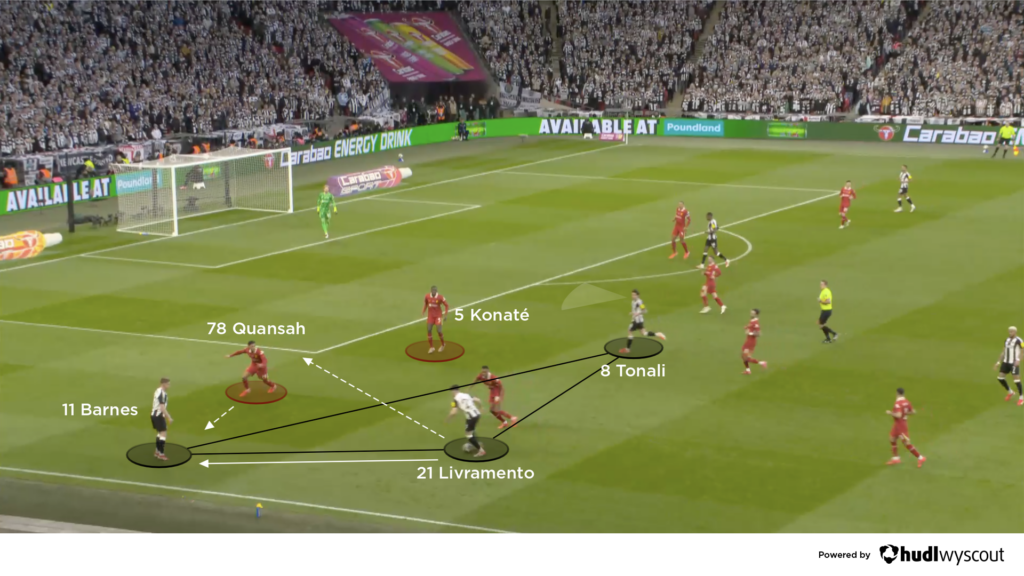
Alternatively, the wide player could hold possession to draw out the opposition full-back – in the above example, Liverpool’s Jarell Quansah – opening up space for an underlap from Newcastle’s full-back (Livramento). These triangles were fluid, with the number eight also making runs into the half-space to receive a ball in behind.
Key coaching points for attacking crosses
• Choose the right type of cross Depending on the pass into the wide player and the situation in the box, decide whether the cross should be low and driven behind the defensive line, cut back to the penalty spot or edge of the area, or lofted towards the back post for a late arrival.
• Time movements into the box Arrive late with the ball ahead, starting on the blind side of an opposition marker before moving across or in behind them to arrive unmarked.
• Attack the key areas As a unit, make sure the front post, back post, cutback space (between the six-yard box and the penalty spot) and the edge of the box are attacked, so every cross has the potential to create a chance.
• Keep a strong rest defence While committing enough players to attack the cross, deeper units must hold aggressive positions to win second balls, sustain attacks and prevent opposition counter-attacks.
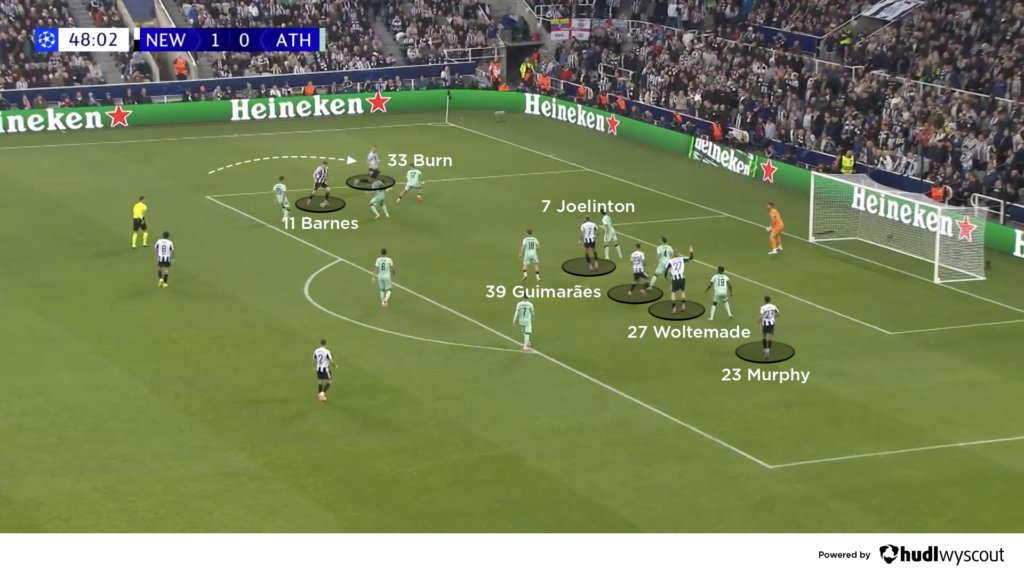
Once the ball reached wide areas, Howe's Newcastle would look to attack the box in numbers. In the example below against Athletic Bilbao in the Champions League, Barnes received ball-side support from an overlapping Dan Burn. Meanwhile, Newcastle filled the box with striker Woltemade, opposite winger Murphy and both eights, Guimarães and Joelinton. That created a 4v3 against Athletic’s back line and a high-quality chance to score.
Howe’s Newcastle were defined by intensity and directness, with an aggressive press designed to win the ball high up the pitch, and a quick, vertical attack that targeted wide areas and the space in behind. That identity underpinned one of the most successful periods in the club’s modern history – and it is one his successor, Matthias Jaissle, has so far chosen to build on.
To learn more from professional coaches at Coaches’ Voice, visit Coaches’ Voice Academy
