


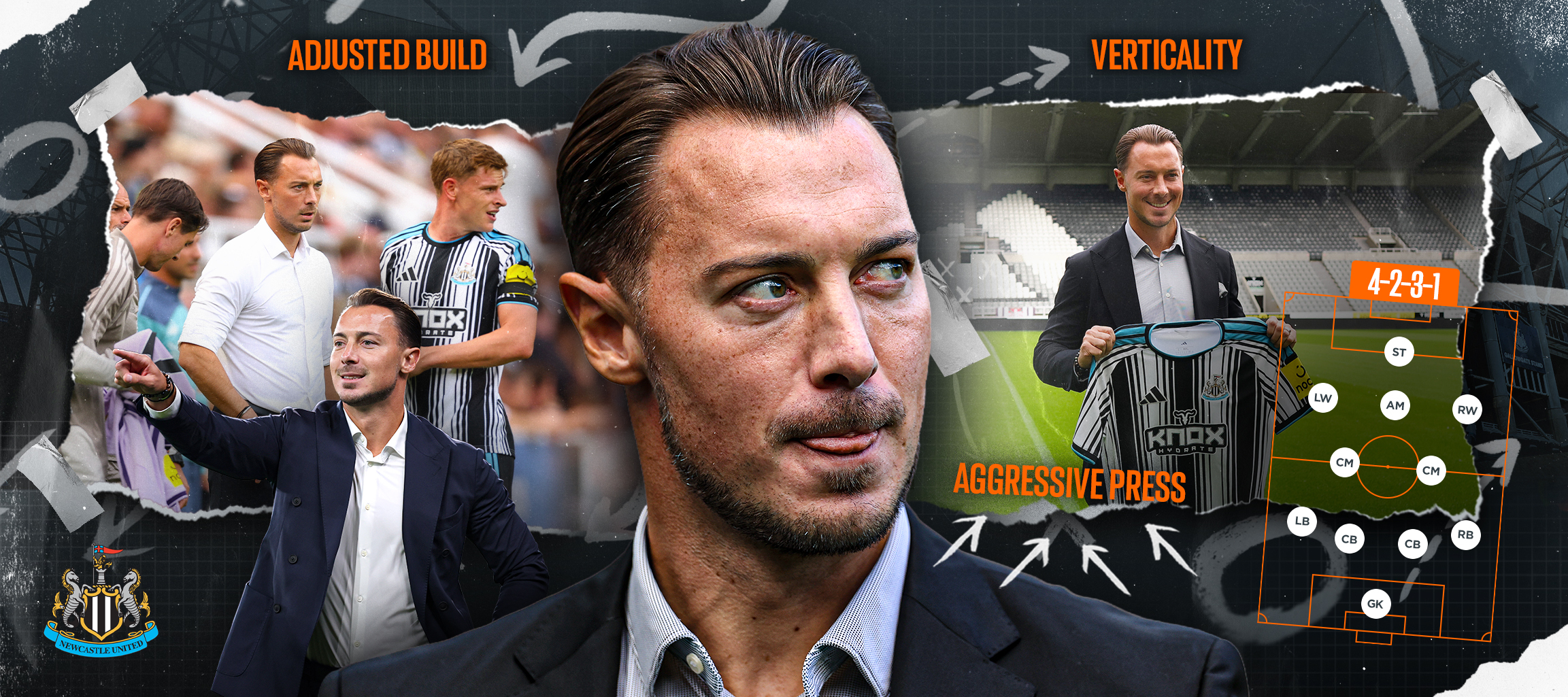

Matthias Jaissle
Newcastle United, 2026-
Matthias Jaissle was appointed Newcastle United head coach just two weeks before the 2026/27 Premier League season kicked off. The 38-year-old German was chosen as the man to succeed Eddie Howe, whose five years in charge of the Magpies had twice brought them Champions League qualification, as well as a first major trophy in 56 years.
Jaissle joined from Saudi Arabian club Al-Ahli, where he won back-to-back AFC Champions League titles. He had previously been in charge at RB Salzburg for two seasons, winning the Austrian Bundesliga twice and the Austrian Cup once. Below, our UEFA-licensed coaches have analysed his tactical approach during the early stages of his time in charge at St James’ Park.
Aggressive pressing approach
Since taking over at Newcastle in August 2026, Jaissle has continued the high and aggressive pressing approach often seen under his predecessor. Going into the first international break of the new season, Jaissle’s team were the fourth-most aggressive pressing side in the Premier League, according to Passes Per Defensive Action.
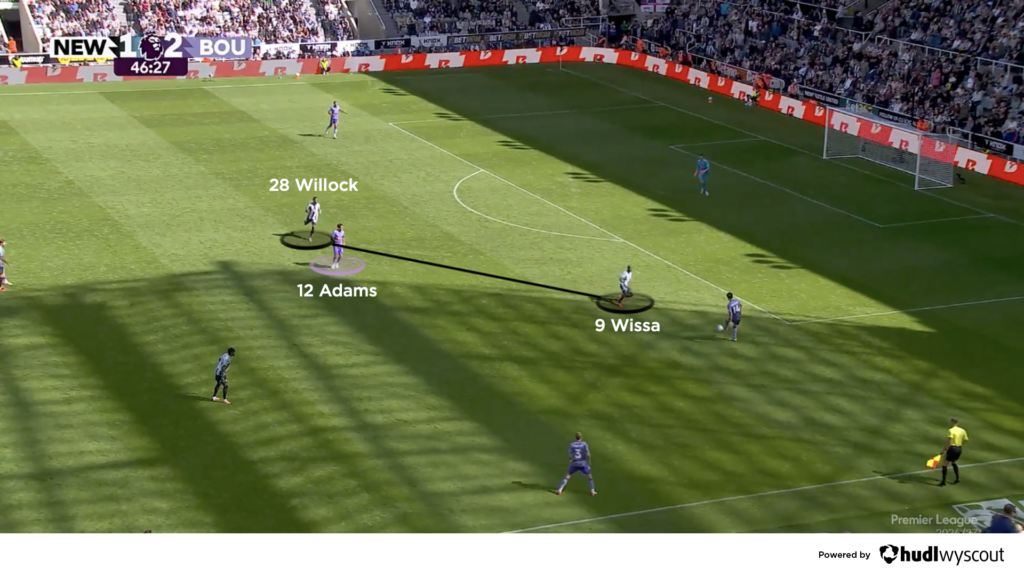
Out of possession, the team has operated from a 4-4-2 base. As shown below with Yoane Wissa and Joe Willock, Jaissle’s front two work in tandem; one releases to the ball-side central defender, while the other drops into a position off the back of the opposition’s central midfielder (Tyler Adams for Bournemouth, in the example below). If the opposition look to play into their full-backs, Newcastle’s wide players are on the front foot, anticipating the pass into wide areas as the trigger to release aggressively and regain. The ball-side central midfielder steps higher to apply pressure, should the opposition look to play centrally to progress. Where possible, Jaissle prefers to keep security in his back line and maintain an extra player – whether in the defensive line itself or through a central midfielder screening in front of it.
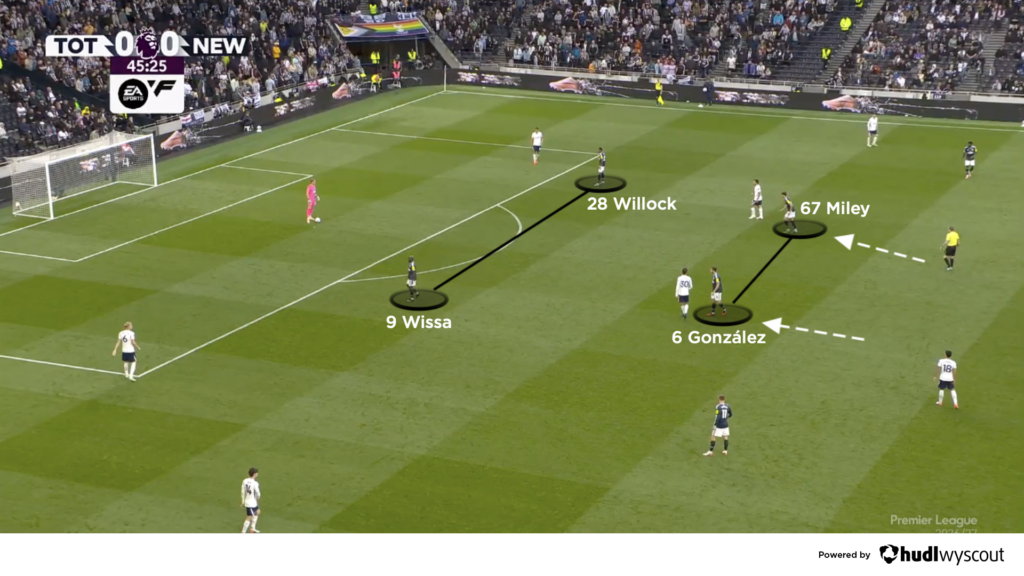
Jaissle has also shown flexibility with his out-of-possession approach, reacting with in-game tactical solutions. Away to Tottenham Hotspur, Newcastle began by pressing in a slightly adjusted 4-diamond-2 structure in the first half, pushing Lewis Miley higher into an attacking-midfield position to manage Spurs’ deep double pivot alongside the front two of Wissa and Willock.
This proved unsuccessful, however, with former Newcastle midfielder Sandro Tonali often rolling out into wide areas to disrupt and escape Jaissle’s pressing strategy. To react to this, Newcastle’s coach changed approach in the second half, switching to aggressive player-oriented pressing where both central midfielders (Nico González and Miley, below) and the central defenders (Sven Botman and Malick Thiaw) stepped higher to engage Roberto De Zerbi’s trademark 4-box-2 build structure. The game was 0-0 at half-time; Newcastle went on to win 2-0.
Key coaching points for high pressing
• Stay compact in your structure. Keep short vertical and horizontal distances between units and the team, to restrict the space in which the opposition can play.
• Press with purpose, release aggressively and make contact with the player on the ball, thinking about the detail on pressing runs – curved pressing runs to dictate play in a specific direction, or straight pressing runs to intercept or regain.
• Ensure there is sufficient cover and balance behind the first pressing line: near the ball, restrict passing options by marking tightly or being ready to release; away from the ball, maintain balance by staying connected between units.
• Be ready to adjust and react if the press is broken. Who is the next player to release and continue the press? Or does the team reset and drop into a lower block to regain a compact structure?
• Play forward quickly upon successful regains, exploiting the opposition’s open structure to create opportunities by playing into the highest line possible.
In deeper areas, Jaissle’s side have operated in a 4-4-2 block. They only adjust this structure when the opposition have pushed five or six players on to Newcastle’s back line in the defensive third, at which point a wide player drops to create a temporary back five. In these areas, while Newcastle are comfortable shifting and sliding to prevent play through them, they have still been aggressive to release on lateral or negative opposition passes.
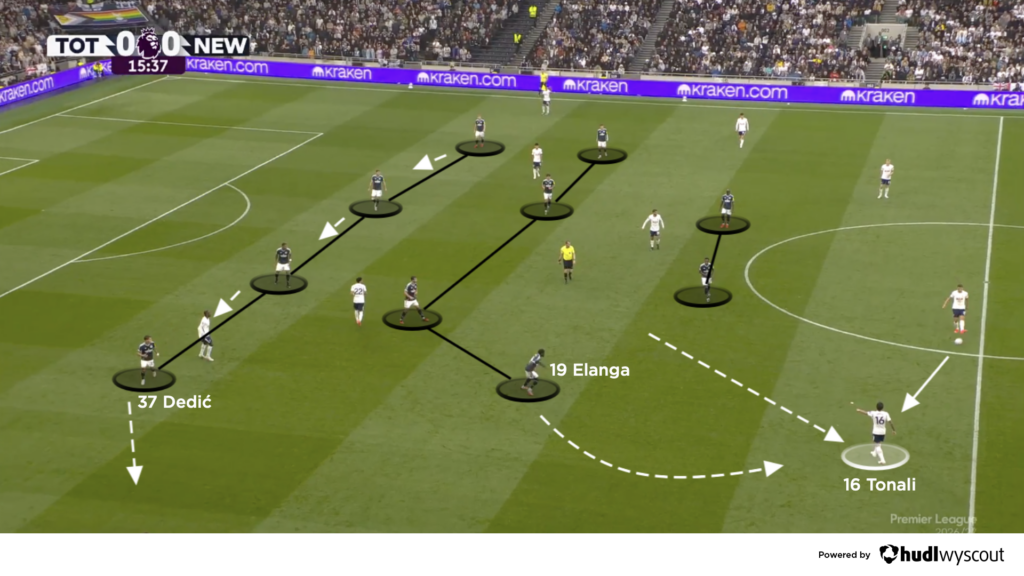
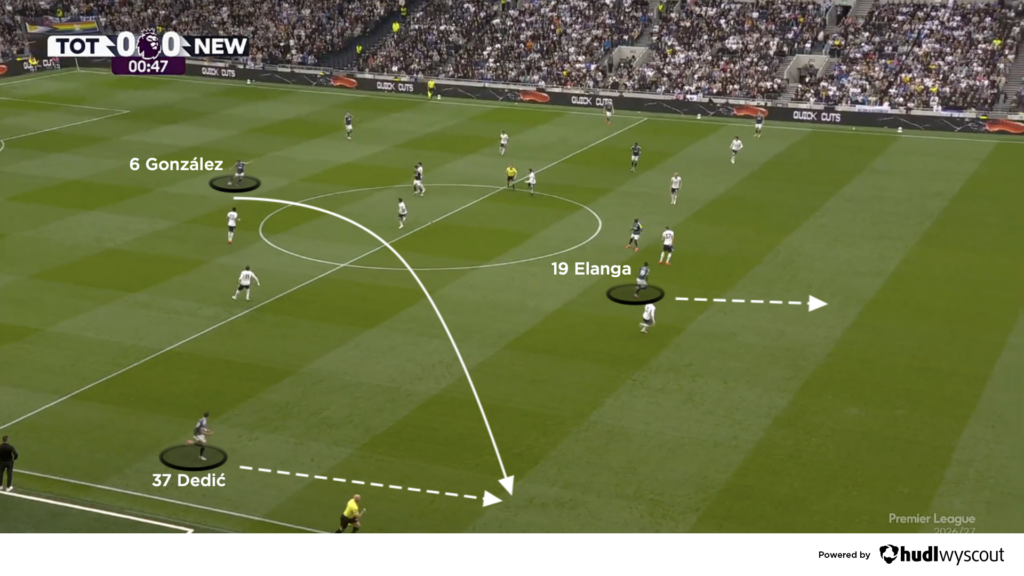
In the example below, Spurs were building with a back-three structure, with Tonali rolling out from a central position into a wide area. Anthony Elanga was on the front foot, ready to release, while deeper right-back Amar Dedic was anticipating sliding across to take Spurs’ wide player, as the remainder of the back line slid across to retain compactness. However, Jaissle’s central midfielders can stay quite player-oriented at times, leaving a large space centrally for the opposition to play through. Liverpool exploited this on the opening weekend of the season, with Cody Gakpo rolling inside from wide areas.
Build-up adjustments to progress possession
In possession, Jaissle’s Newcastle demonstrated some clear trends in their build-up phase in the first few weeks of his tenure. His team frequently dropped a pivot in between widened central defenders, creating a 3-1 base to build from. As shown below, early in the season Nico González was the pivot who dropped into this role. In doing so, Newcastle’s full-backs could stay wider and higher, with wide attackers rolling inside on to different lines when the full-backs advanced. There were also moments when the full-backs rotated inside into the half-spaces and the wide players held maximum width. The more advanced central midfielder – often Joe Willock – has also dropped down with the pivot to maintain shorter connections for combinations between midfield players.
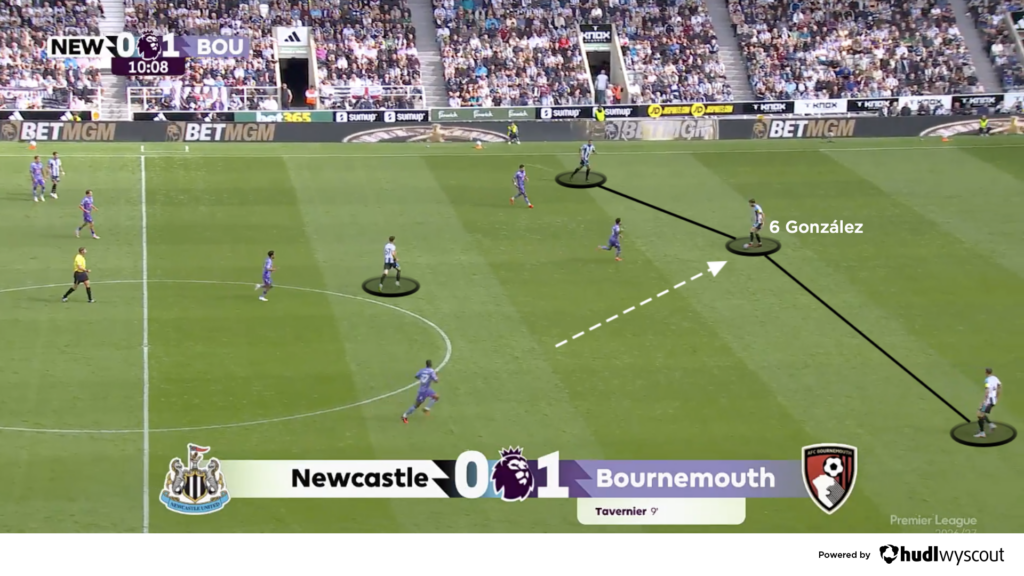
The primary aim of this adjustment is to get a better-quality ball-player to receive possession to progress play. As shown below, a regular follow-up action – and a more general adjustment as Newcastle look to play forwards – is for Dedic to advance on to the last line, while Elanga makes an aggressive run inside between the opposition’s centre-back and full-back. These two players create a 2v1 and the opportunity to switch possession quickly to create a dangerous attack. While Newcastle have mostly done this on the right-hand side, there have also been times when Lewis Hall has advanced on the left, with Harvey Barnes taking up an adjusted position in the left half-space.
Verticality in attacking play
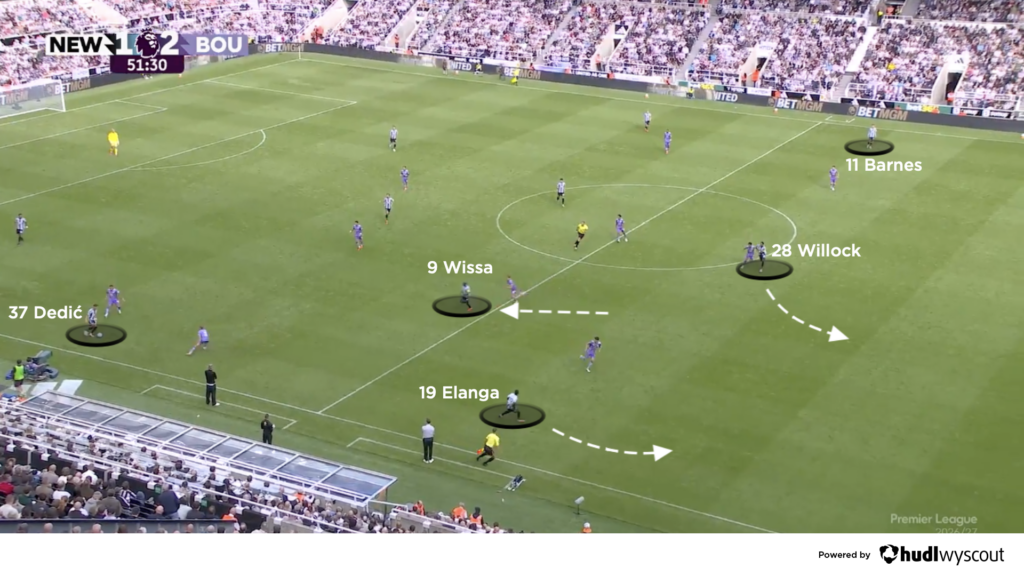
The standout feature of Jaissle’s Newcastle has been the verticality and directness of their attacking play. In deeper build-up situations, they have often looked to attract the opposition before playing in behind or into attacking positions by breaking multiple lines at a time. Their effectiveness in these situations is heightened by the dynamic capabilities of their front line, with Wissa, Elanga, Barnes and Willock all playing their part in a fluid attack that consistently looks to threaten in behind. In the example below, with Dedic under pressure, Wissa dropped and attracted Bournemouth’s António Silva, while Willock and Elanga made opposite movements to run in behind into the space.
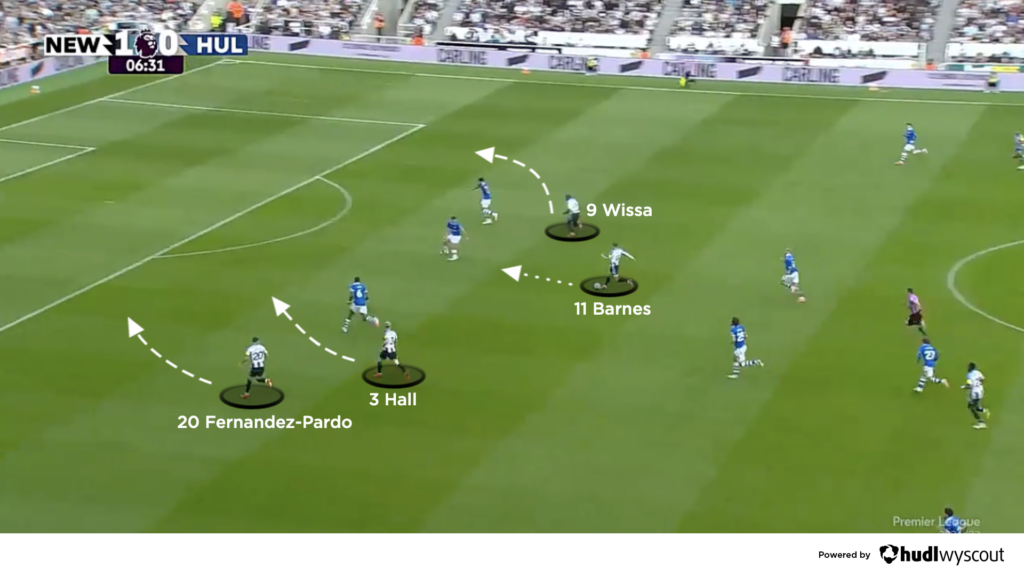
This directness has extended to attacking transition moments, with Jaissle’s side threatening when space opens up to travel into and exploit. The Magpies had the third-highest number of attacking 1v1 situations in the 2026/27 Premier League after the opening seven games, highlighting their willingness to drive at and attack opposition defences. Wide players Barnes and Elanga have been important in counter-attacking moments, with their pace and acceleration to either travel with the ball or run in behind the opposition. But Jaissle’s side have been effective at providing support in these moments, too, with full-backs and central midfielders often arriving quickly to create attacking overloads – as shown below in the early stages of the win against Hull City.
Subsequent defeats to Coventry City and Aston Villa after the Hull City victory heaped pressure on Jaissle, such is the ever-demanding world of the Premier League and football management – although an impressive win at Crystal Palace saw the team sit eighth after eight games of the new season. Regardless of the tactics a head coach employs, one thing remains constant: to have the chance to implement a tactical vision in the longer term, a manager must achieve positive results along the way. Despite his relative youth as a Premier League manager, Jaissle is experienced enough to know he needs results to get buy in for his tactical approach.
To learn more from professional coaches at Coaches’ Voice, visit Coaches’ Voice Academy
